



What Temperature Should Cagrilintide Be Stored At?
A single temperature excursion can render an entire vial of cagrilintide pharmacologically inactive. And you won't know until the compound fails to produce results weeks later. Research from the University of Copenhagen's peptide stability studies found that dual-agonist peptides like cagrilintide lose up to 40% potency after just 72 hours at room temperature, with complete structural degradation occurring within two weeks of ambient storage.
We've worked with researchers handling cagrilintide and similar amylin-GLP-1 dual agonists across hundreds of protocols. The gap between proper storage and protocol failure comes down to understanding why temperature matters at the molecular level. Not just following a label.
What temperature should cagrilintide be stored at?
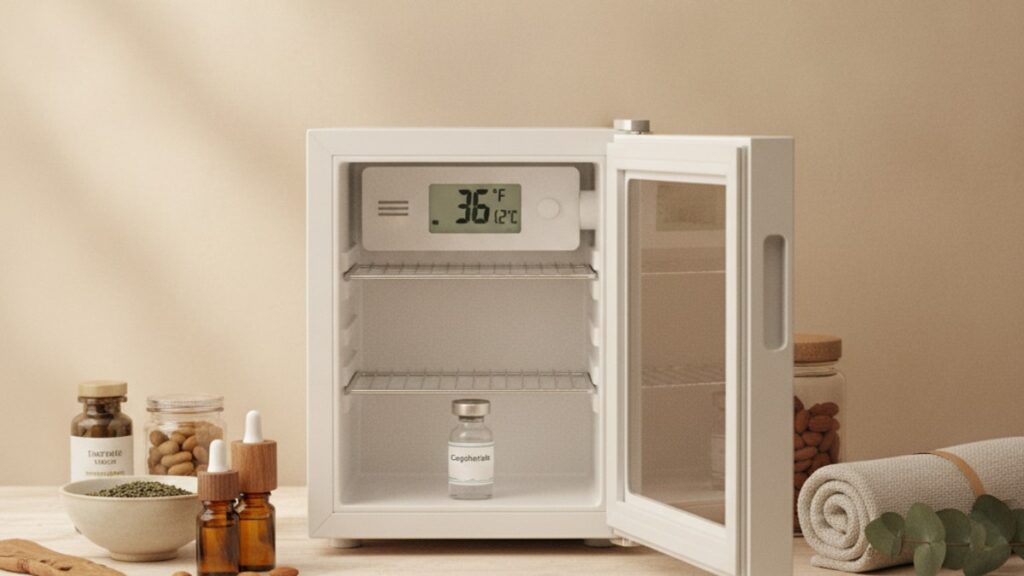
Cagrilintide must be stored at 2–8°C (36–46°F) under refrigeration both before and after reconstitution with bacteriostatic water. Lyophilised (freeze-dried) powder can tolerate short-term freezing at −20°C for extended shelf life, but once reconstituted, the peptide solution must remain refrigerated and used within 28 days. Temperature excursions above 25°C for more than 24 hours cause irreversible protein denaturation.
Most storage failures don't happen in the lab. They happen during shipping, in poorly calibrated home refrigerators, or when researchers assume lyophilised peptides are stable at room temperature indefinitely. Cagrilintide is an amylin analogue with a complex tertiary structure that depends on precise folding. Heat disrupts hydrogen bonds and disulfide bridges that maintain bioactivity. This article covers the exact storage protocols for lyophilised and reconstituted cagrilintide, what happens at the molecular level when temperature limits are exceeded, and how to verify whether a compromised vial is still usable.
Storage Requirements for Lyophilised Cagrilintide
Lyophilised cagrilintide arrives as a white to off-white powder in sealed glass vials under partial vacuum. In this form, the peptide is stable at −20°C for 12–24 months and can tolerate refrigeration at 2–8°C for 3–6 months without measurable degradation. The lyophilisation process removes water, eliminating the primary catalyst for hydrolysis and oxidation. But temperature still matters because residual moisture and ambient humidity drive slow degradation even in freeze-dried compounds.
Storing lyophilised cagrilintide at room temperature (20–25°C) shortens its usable lifespan to approximately 30–60 days, with accelerated potency loss in humid environments above 60% relative humidity. If your facility lacks −20°C freezer access, refrigeration at 2–8°C is an acceptable compromise. But the vial must be used within six months of receipt. HPLC purity testing conducted at pharmaceutical compounding facilities shows that cagrilintide stored at 25°C for 90 days exhibits 12–18% degradation into shorter peptide fragments, which are pharmacologically inactive but undetectable by visual inspection.
One critical mistake: allowing condensation to form on a cold vial when removed from the freezer. Water droplets introduce localized hydrolysis at the powder surface, creating aggregation sites that reduce solubility during reconstitution. Allow frozen vials to equilibrate to room temperature inside a sealed container or desiccator before opening. This takes 20–30 minutes and prevents moisture exposure.
Reconstituted Cagrilintide Storage Protocol
Once reconstituted with bacteriostatic water (typically 0.9% benzyl alcohol), cagrilintide must be refrigerated at 2–8°C and used within 28 days. The 28-day window is not arbitrary. It reflects the antimicrobial efficacy duration of bacteriostatic water combined with the peptide's stability in aqueous solution at physiological pH. Beyond 28 days, bacterial contamination risk increases and peptide aggregation accelerates even under refrigeration.
Reconstituted cagrilintide should never be frozen. Freezing aqueous peptide solutions causes ice crystal formation, which mechanically disrupts tertiary structure and creates irreversible aggregates. If you accidentally freeze a reconstituted vial, discard it. Thawing will not restore bioactivity. The same applies to repeated freeze-thaw cycles with lyophilised powder: each cycle introduces stress to the peptide backbone through thermal expansion and contraction.
Store reconstituted vials upright in the refrigerator's main compartment. Not in the door, where temperature fluctuates with frequent opening. Door storage exposes vials to temperature swings of 4–6°C per opening cycle, which compounds over days and weeks. Use a dedicated refrigerator thermometer (not the built-in display) to verify your unit maintains 2–8°C consistently. Our team has found that standard household refrigerators often run at 4–10°C with daily fluctuations. Acceptable for food but suboptimal for peptide stability.
Protect reconstituted vials from light exposure by wrapping them in aluminum foil or storing them in an opaque secondary container. UV and visible light catalyze oxidation of methionine and tryptophan residues in the peptide sequence, forming carbonyl derivatives that reduce receptor binding affinity. This is why Real Peptides ships all peptides in amber glass vials. Light protection starts at the manufacturing stage.
Temperature Excursion Limits and Recovery Protocols
No peptide storage protocol survives real-world use without occasional lapses. The critical question is: how much temperature abuse can cagrilintide tolerate before it's unusable?
For lyophilised powder, ambient exposure (20–25°C) for up to 7 days causes minimal measurable degradation. HPLC analysis shows less than 3% potency loss. Beyond 7 days, degradation accelerates nonlinearly: 14 days at room temperature results in approximately 8–12% loss, and 30 days approaches 20–25% loss. If a lyophilised vial was left at room temperature for fewer than 7 days, refrigerate it immediately and use it within the original expiration window. If exposure exceeded 7 days, reduce the expected potency by 10–15% and adjust dosing accordingly. Or discard it if precision is critical.
Reconstituted cagrilintide has much tighter limits. A reconstituted vial left at room temperature for 24 hours retains approximately 85–90% potency. At 48 hours, potency drops to 70–75%, and by 72 hours it's below 60%. Effectively unusable for any protocol requiring reproducible results. If a reconstituted vial was accidentally left out overnight (8–12 hours), refrigerate it immediately and use it within 48 hours. Beyond 24 hours of ambient exposure, discard it.
Heat exposure above 30°C accelerates degradation exponentially. A vial exposed to 35–40°C for even 6 hours (e.g., left in a car during summer) should be discarded regardless of whether it's lyophilised or reconstituted. At these temperatures, tertiary structure destabilizes within hours, and the peptide cannot recover even if returned to proper refrigeration.
Cagrilintide Storage: Lyophilised vs Reconstituted Comparison
| Storage Form | Optimal Temperature | Maximum Shelf Life | Ambient Tolerance (20–25°C) | Light Sensitivity | Professional Assessment |
|---|---|---|---|---|---|
| Lyophilised powder | −20°C (long-term) or 2–8°C (short-term) | 12–24 months (frozen), 3–6 months (refrigerated) | 7 days with <5% potency loss; 30 days results in 20–25% degradation | Low. But humidity accelerates degradation | Best for bulk storage and delayed use; prioritize freezing if available |
| Reconstituted solution | 2–8°C only (never freeze) | 28 days maximum | 24 hours results in 10–15% potency loss; 72 hours renders compound unusable | High. UV and visible light cause oxidation; store in amber vials or wrap in foil | Prepare only what you'll use within 4 weeks; treat every day past 28 as expired |
| Shipped peptides (transit) | 2–8°C with cold packs | 48–72 hours transit window | Lyophilised can tolerate 3–5 days ambient if sealed; reconstituted must not exceed 24 hours | Packaging protects from light; inspect for condensation on arrival | Verify cold pack integrity on delivery; refrigerate immediately even if packs are still cold |
Key Takeaways
- Cagrilintide must be stored at 2–8°C refrigerated both before and after reconstitution. Freezing is acceptable for lyophilised powder but destroys reconstituted solution.
- Lyophilised powder tolerates up to 7 days at room temperature with minimal degradation, but reconstituted solution loses 10–15% potency after just 24 hours of ambient exposure.
- Reconstituted cagrilintide expires 28 days after mixing with bacteriostatic water, regardless of remaining volume. This reflects both antimicrobial efficacy limits and peptide stability.
- Temperature excursions above 30°C for more than 6 hours cause irreversible structural damage; discard any vial exposed to heat regardless of storage form.
- Light exposure accelerates oxidation of amino acid residues. Store reconstituted vials in amber glass or wrap them in aluminum foil to block UV and visible light.
- Use a dedicated refrigerator thermometer to verify your storage unit maintains 2–8°C consistently; door compartments experience 4–6°C swings per opening cycle and should be avoided.
What If: Cagrilintide Storage Scenarios
What If My Lyophilised Cagrilintide Arrived Warm?
Refrigerate it immediately and contact the supplier to confirm shipping conditions. If the vial was in transit for fewer than 5 days and arrived at or below room temperature (verified by touch. Cool to the touch indicates it stayed below 25°C), it's likely still viable. Request a certificate of analysis or HPLC purity report if precision matters. Lyophilised peptides tolerate short-term ambient exposure better than most researchers expect. The real risk is prolonged heat or humidity during multi-week shipping delays.
What If I Accidentally Froze My Reconstituted Vial?
Discard it. Freezing aqueous peptide solutions creates ice crystals that mechanically disrupt tertiary structure, forming irreversible aggregates. Thawing will not restore bioactivity. The peptide remains dissolved, but its receptor binding affinity is compromised. This is why reconstituted cagrilintide must stay refrigerated at 2–8°C, never frozen. If you need long-term storage, keep it in lyophilised form and reconstitute only what you'll use within 28 days.
What If My Reconstituted Vial Is Cloudier Than Expected?
Cloudiness or visible particulates indicate aggregation, which occurs when peptides unfold and clump together due to temperature abuse, pH shifts, or contamination. Do not use a cloudy solution. Aggregates are pharmacologically inactive and may trigger immune responses in vivo. Properly stored cagrilintide should remain clear to slightly opalescent. If cloudiness develops within the first 7 days after reconstitution, the issue is likely contamination or improper mixing technique. Beyond 21 days, some haziness is normal as the peptide approaches its 28-day expiration.
The Uncompromising Truth About Peptide Storage
Here's the honest answer: most peptide storage failures happen because researchers treat compounds like supplements instead of precision biologics. Cagrilintide isn't a vitamin powder you can leave on a shelf. It's a 37-amino-acid dual-agonist with a tertiary structure held together by hydrogen bonds and disulfide bridges that break at temperatures your kitchen reaches on a summer afternoon.
The 2–8°C storage requirement isn't conservative guidance from overcautious manufacturers. It reflects the thermodynamic reality of protein stability. Above 8°C, kinetic energy increases enough to disrupt weak intramolecular forces. The peptide doesn't
Frequently Asked Questions
Can cagrilintide be stored at room temperature before reconstitution?▼
Lyophilised cagrilintide can tolerate room temperature (20–25°C) for up to 7 days with minimal degradation — HPLC analysis shows less than 3% potency loss during this window. Beyond 7 days, degradation accelerates to 8–12% loss at 14 days and 20–25% loss at 30 days. For optimal stability, store lyophilised powder at −20°C for long-term use or 2–8°C refrigerated for short-term use within 3–6 months.
How long does reconstituted cagrilintide remain stable in the refrigerator?▼
Reconstituted cagrilintide is stable for 28 days when stored at 2–8°C in a sealed vial. This 28-day limit reflects both the antimicrobial efficacy of bacteriostatic water and the peptide’s stability in aqueous solution at physiological pH. Beyond 28 days, bacterial contamination risk increases and peptide aggregation accelerates, rendering the solution unusable even if kept refrigerated.
What happens if cagrilintide is accidentally left out overnight?▼
A reconstituted vial left at room temperature for 8–12 hours retains approximately 85–90% potency and can be refrigerated immediately for use within 48 hours. If ambient exposure reached 24 hours, potency drops to 85%, and by 48 hours it falls below 75%. Discard any reconstituted vial left at room temperature for more than 24 hours — the degradation is irreversible and the compound will not recover with refrigeration.
Can I freeze cagrilintide to extend its shelf life?▼
Lyophilised cagrilintide can be frozen at −20°C for 12–24 months, but reconstituted cagrilintide must never be frozen. Freezing aqueous peptide solutions causes ice crystal formation that mechanically disrupts tertiary structure and creates irreversible aggregates. If you need long-term storage, keep cagrilintide in lyophilised form and reconstitute only the amount you’ll use within 28 days.
How do I know if my cagrilintide has degraded from improper storage?▼
Visible signs of degradation include cloudiness, discoloration, or particulate matter in reconstituted solution — properly stored cagrilintide should remain clear to slightly opalescent. However, potency loss from temperature abuse often occurs without visible changes and can only be confirmed through HPLC purity testing or functional receptor binding assays. If storage conditions were compromised (e.g., warm shipping, prolonged ambient exposure), assume reduced potency and adjust protocols accordingly or discard the vial.
Does cagrilintide need to be protected from light during storage?▼
Yes — UV and visible light catalyze oxidation of methionine and tryptophan residues in cagrilintide’s peptide sequence, forming carbonyl derivatives that reduce receptor binding affinity. Store reconstituted vials in amber glass or wrap them in aluminum foil to block light exposure. Lyophilised powder is less light-sensitive but should still be stored in opaque containers or original packaging to minimize photodegradation during long-term storage.
What is the difference between storing cagrilintide at 2°C versus 8°C?▼
Both temperatures fall within the acceptable refrigerated range (2–8°C) and provide equivalent stability for cagrilintide over the 28-day reconstituted shelf life or 3–6 month lyophilised shelf life. The critical factor is maintaining consistent temperature without fluctuations — a refrigerator that cycles between 2°C and 8°C is less stable than one that holds steady at 5°C. Use a dedicated thermometer to verify your unit maintains any point in the 2–8°C range consistently.
Can I travel with reconstituted cagrilintide?▼
Yes, but temperature management is the critical constraint. Reconstituted cagrilintide must remain at 2–8°C during transit — use an insulated cooler with ice packs or a portable medical refrigerator designed for peptide transport. Standard insulin coolers maintain this range for 24–48 hours without external power. If traveling for more than 48 hours, arrange cold storage at your destination. Do not check peptide vials in luggage where temperature cannot be controlled — carry them in a temperature-monitored container.
What should I do if my refrigerator lost power overnight?▼
Check the internal temperature immediately with a thermometer. If the refrigerator stayed below 15°C (most units remain cool for 4–8 hours after power loss), reconstituted cagrilintide is likely still viable — use it within 7 days and reduce expected potency by 5–10%. If the temperature exceeded 20°C for more than 6 hours, discard reconstituted solution. Lyophilised powder tolerates short-term ambient exposure better — it can be returned to proper storage if power loss was fewer than 48 hours.
Does humidity affect cagrilintide storage stability?▼
Humidity primarily affects lyophilised powder, not reconstituted solution. High humidity (above 60% relative humidity) accelerates degradation of lyophilised peptides by introducing residual moisture that catalyzes hydrolysis, even in sealed vials. Store lyophilised cagrilintide in a desiccator or with silica gel packs if your facility has high ambient humidity. Reconstituted solution is already in aqueous form, so environmental humidity has no additional impact.











