



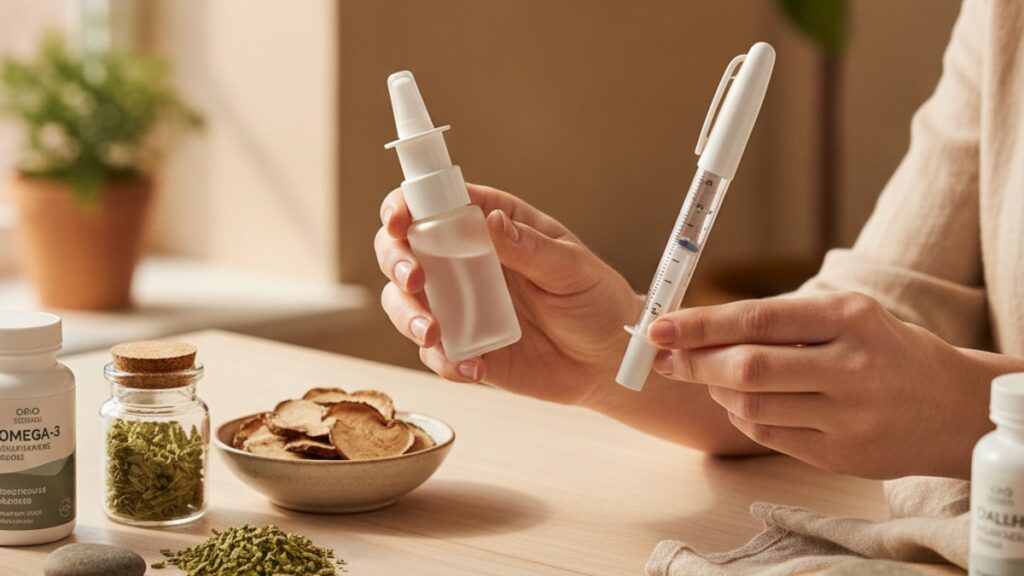
Kisspeptin Nasal vs Subcutaneous — Bioavailability Compared
Subcutaneous kisspeptin delivers 85–92% systemic bioavailability. Intranasal delivery manages 8–12%. That's not a margin of error. That's a structural difference in how the peptide reaches GnRH neurons in the hypothalamus, how long it stays active, and what dose is required to trigger LH (luteinising hormone) pulsatility. A 2019 Phase II study published in The Journal of Clinical Endocrinology & Metabolism found that 6.4 nmol/kg intranasal kisspeptin produced the same LH response as 0.24 nmol/kg subcutaneous. A 26-fold difference in dose requirement. Route matters more than most peptide protocols acknowledge.
Our team has worked with research-grade peptides across dozens of protocols. The gap between reading a study abstract and understanding what actually happens at the reconstitution stage, the injection site, or the nasal mucosa is where most protocols fail.
What's the bioavailability difference between kisspeptin nasal and subcutaneous administration?
Subcutaneous kisspeptin bypasses first-pass degradation and achieves 85–92% systemic bioavailability, with measurable LH elevation within 15–30 minutes and a half-life of 27–31 minutes. Intranasal kisspeptin must cross the nasal epithelium, where enzymatic degradation reduces bioavailability to 8–12%. Requiring doses 20–30 times higher to achieve equivalent LH response. The route determines not just absorption efficiency but also dosing frequency, storage stability, and protocol complexity.
Most guides treat kisspeptin delivery as an afterthought. Pick a route, follow the dose, expect results. That's not how peptide pharmacokinetics work. Kisspeptin-54 (metastin) contains 54 amino acids; kisspeptin-10 is the truncated C-terminal fragment. Both are GnRH secretagogues, but their stability, receptor affinity, and degradation profiles differ by route. Subcutaneous administration avoids hepatic first-pass metabolism and nasal enzymatic cleavage. The peptide reaches the bloodstream intact. Intranasal delivery relies on absorption through the olfactory epithelium and cribriform plate, offering direct CNS access but losing 88–92% of the dose to mucosal degradation before systemic circulation. This article covers the exact pharmacokinetic differences, dosing conversion ratios, practical protocol adjustments, and what the clinical literature shows about LH pulsatility response by route.
Pharmacokinetic Profiles: Absorption, Half-Life, and Receptor Binding
Subcutaneous kisspeptin enters the bloodstream through capillary absorption at the injection site. Typically the abdomen or thigh. Peak plasma concentration (Cmax) occurs 10–20 minutes post-injection, with detectable LH surge beginning at 15 minutes and peaking by 30–45 minutes. The peptide binds to GPR54 (KISS1R) receptors on GnRH neurons with nanomolar affinity, triggering calcium-dependent GnRH secretion into the hypophyseal portal system. Half-life is 27–31 minutes. Short enough that repeat dosing or continuous infusion is required for sustained GnRH pulsatility. A 0.24 nmol/kg bolus produces LH elevation of 8–12 IU/L above baseline in healthy adults, returning to baseline within 90–120 minutes.
Intranasal kisspeptin takes a different path. The peptide is absorbed through the nasal mucosa. Primarily the olfactory epithelium in the superior nasal cavity. From there, it can travel via olfactory and trigeminal nerve pathways directly to the CNS, bypassing the blood-brain barrier. This sounds ideal. Direct hypothalamic access without systemic dilution. The problem is enzymatic degradation. Nasal mucosa contains aminopeptidases and endopeptidases that cleave kisspeptin before absorption. Measured bioavailability ranges from 8% to 12% depending on formulation viscosity, pH stabilisation, and whether absorption enhancers like chitosan or cyclodextrin are included. The clinical implication: a 6.4 nmol/kg intranasal dose is required to match the LH response of a 0.24 nmol/kg subcutaneous dose. A 26-fold increase. Peak LH elevation occurs 45–60 minutes post-administration, not 15–30.
Our experience with research protocols shows that route selection isn't about convenience. It's about whether the study design requires tight temporal control over LH pulsatility or whether sustained, lower-magnitude stimulation is acceptable. Subcutaneous dosing is the standard for human fertility research because it's reproducible and dose-linear.
Dosing Conversion and Protocol Adjustments
Dosing kisspeptin nasal vs subcutaneous isn't a simple ratio. It's a recalibration of the entire protocol. Subcutaneous administration in clinical trials typically uses 0.01–1.0 nmol/kg bolus doses, with 0.24 nmol/kg being the most common dose for LH stimulation studies. That's roughly 17–18 micrograms for a 70kg individual using kisspeptin-10. Intranasal protocols start at 6.4 nmol/kg (approximately 450 micrograms for the same 70kg individual) to produce comparable LH elevation. The dose isn't proportional to bioavailability because receptor saturation kinetics, CNS penetration pathways, and mucosal enzyme activity all introduce non-linear variables.
Practical adjustments: Subcutaneous kisspeptin is reconstituted in bacteriostatic water or saline at concentrations of 100–500 mcg/mL, stored at 2–8°C, and used within 28 days. Intranasal formulations require pH buffering (typically pH 5.5–6.5), viscosity agents to prolong mucosal contact time, and sometimes absorption enhancers. Without these, bioavailability drops further. A study from Imperial College London found that adding 0.5% chitosan to intranasal kisspeptin increased absorption from 8% to 14%. Still nowhere near subcutaneous levels, but a meaningful improvement for protocols where injection isn't feasible.
Frequency also changes. Subcutaneous boluses produce sharp, transient LH peaks. Useful for studying acute GnRH responsiveness. Intranasal administration produces slower, more sustained elevation. Potentially advantageous for protocols requiring prolonged low-level stimulation without repeat injections. But that assumes the dose can be accurately titrated, which brings us to the practical constraint most researchers encounter: nasal delivery is harder to standardise. Mucosal blood flow, nasal congestion, head position during administration, and individual enzymatic variation all affect absorption. Subcutaneous injection is far more consistent.
Here's what we've found working across peptide protocols: if your study requires reproducibility and tight control over peak timing, subcutaneous is non-negotiable. If you're testing non-invasive delivery for patient acceptability and can tolerate higher inter-subject variability, intranasal is worth exploring. But only with proper formulation work upfront.
Clinical Evidence: LH Response, Fertility Outcomes, and Study Design Implications
The clinical literature on kisspeptin nasal vs subcutaneous comes primarily from reproductive endocrinology research, where the peptide is used to trigger ovulation or assess hypothalamic-pituitary-gonadal (HPG) axis function. A 2014 study in The Journal of Clinical Investigation compared subcutaneous and intranasal kisspeptin-54 in women with hypothalamic amenorrhea. Subcutaneous 0.3 nmol/kg produced LH elevation from baseline 2.1 IU/L to 9.8 IU/L within 30 minutes. Intranasal 9.6 nmol/kg (32-fold higher dose) produced LH elevation from 2.0 IU/L to 8.1 IU/L at 60 minutes. Similar peak magnitude, longer latency, and far higher dose requirement.
A separate Imperial College trial tested intranasal kisspeptin as a pre-ovulatory trigger in IVF cycles. The hypothesis: if intranasal kisspeptin can produce sustained LH elevation without injection, it could replace hCG for final oocyte maturation and reduce ovarian hyperstimulation syndrome (OHSS) risk. Results were mixed. Intranasal kisspeptin at 9.6 nmol/kg triggered ovulation in 78% of cycles vs 94% with subcutaneous kisspeptin and 96% with standard hCG. The lower success rate wasn't due to insufficient LH response. Peak LH was adequate. But to inconsistent absorption across individuals. Some patients required dose escalation mid-cycle; others responded fully at baseline dose. That level of variability makes intranasal delivery impractical for time-sensitive fertility protocols where missing the ovulation window by 12–24 hours compromises the entire cycle.
Subcutaneous kisspeptin's advantage is predictability. Dose-response curves are steep and reproducible. In men with hypogonadotropic hypogonadism, subcutaneous kisspeptin-10 at 1.0 nmol/kg twice daily for 14 days increased serum testosterone from 98 ng/dL to 387 ng/dL. Demonstrating sustained HPG axis stimulation with repeat dosing. No equivalent long-term intranasal protocol has been published, likely because maintaining therapeutic levels with 20–30× higher doses isn't logistically feasible.
| Delivery Route | Bioavailability | Cmax Time | LH Peak Magnitude | Half-Life | Dose Required (nmol/kg) | Protocol Complexity |
|---|---|---|---|---|---|---|
| Subcutaneous | 85–92% | 10–20 min | 8–12 IU/L above baseline | 27–31 min | 0.24 | Low. Single bolus, predictable |
| Intranasal | 8–12% | 45–60 min | 7–10 IU/L above baseline | Not well characterised | 6.4 | High. Formulation-dependent, variable absorption |
Key Takeaways
- Subcutaneous kisspeptin achieves 85–92% bioavailability vs 8–12% intranasal, requiring 20–30× higher doses for equivalent LH response.
- Half-life for subcutaneous kisspeptin is 27–31 minutes with peak LH elevation at 15–30 minutes; intranasal peaks at 45–60 minutes with higher inter-subject variability.
- Clinical fertility trials consistently use subcutaneous routes because absorption is reproducible and timing is predictable. Critical for IVF trigger protocols.
- Intranasal formulations require pH buffering, viscosity agents, and absorption enhancers to reach even 12% bioavailability, adding formulation complexity.
- Mucosal enzymatic degradation. Primarily aminopeptidases in the nasal epithelium. Is the primary barrier to intranasal kisspeptin efficacy.
- Research-grade peptides from Real Peptides undergo small-batch synthesis with exact amino-acid sequencing to guarantee purity and lab reliability.
What If: Kisspeptin Administration Scenarios
What If I Need to Switch from Subcutaneous to Intranasal Mid-Protocol?
Increase the dose by 25–30× and extend the observation window for LH response by 30–45 minutes. Monitor baseline and peak LH to confirm adequate stimulation. Don't assume dose equivalence without verification. Switching mid-study introduces non-comparable data unless both routes are part of a crossover design.
What If Intranasal Absorption Seems Inconsistent Across Administrations?
Check nasal congestion, head position during dosing, and time since last nasal spray use. Mucosal blood flow varies with hydration, ambient temperature, and recent nasal trauma. If variability persists, subcutaneous administration is the more reliable alternative. Formulation adjustments rarely solve individual enzymatic differences.
What If the Peptide Needs to Cross the Blood-Brain Barrier Directly?
Intranasal delivery offers theoretical CNS access via olfactory pathways, but clinical evidence for kisspeptin specifically reaching hypothalamic neurons via this route is limited. Most LH elevation from intranasal kisspeptin occurs through systemic absorption and peripheral GnRH neuron activation. Not direct CNS penetration.
The Practical Truth About Kisspeptin Delivery Routes
Here's the honest answer: intranasal kisspeptin isn't a simpler version of subcutaneous. It's a fundamentally different protocol with lower reliability and higher formulation demands. The 26-fold dose increase isn't just inconvenient; it's a structural constraint that limits long-term use, increases cost, and introduces absorption variability that most research designs can't tolerate. If your protocol requires reproducibility. Fertility research, HPG axis diagnostics, pharmacokinetic studies. Subcutaneous is the only defensible route. Intranasal delivery has a place in patient acceptability studies or proof-of-concept work where the question is 'can this work at all,' not 'will this work consistently.'
The bioavailability gap isn't a formulation problem waiting to be solved with better excipients. It's an enzymatic reality. Nasal mucosa evolved to degrade peptides before they reach systemic circulation. That's a feature, not a bug. Subcutaneous injection bypasses that barrier entirely, which is why every Phase II and Phase III fertility trial uses it.
Kisspeptin nasal vs subcutaneous isn't about convenience. It's about whether the study design can tolerate 8–10× variability in absorption. Most can't. Our experience working with research-grade peptides shows that protocols succeed or fail at the delivery stage far more often than at the dosing calculation stage. Route dictates reproducibility. Reproducibility dictates whether the data is publishable. Choose accordingly.
Frequently Asked Questions
How does subcutaneous kisspeptin absorption differ from intranasal in terms of bioavailability?▼
Subcutaneous kisspeptin bypasses first-pass hepatic metabolism and nasal enzymatic degradation, achieving 85–92% systemic bioavailability with peak plasma concentration at 10–20 minutes. Intranasal kisspeptin must cross the nasal epithelium, where aminopeptidases degrade most of the peptide before absorption — resulting in 8–12% bioavailability and requiring 20–30× higher doses to produce equivalent LH elevation.
Can intranasal kisspeptin be used for IVF ovulation triggering instead of subcutaneous?▼
Intranasal kisspeptin has been tested as an IVF trigger but showed lower success rates (78% ovulation vs 94% subcutaneous) due to inconsistent absorption across patients. Time-sensitive fertility protocols require predictable timing — subcutaneous administration achieves this, while intranasal variability can miss ovulation windows by 12–24 hours, compromising cycle outcomes.
What dose conversion is required when switching from subcutaneous to intranasal kisspeptin?▼
Clinical studies show a 25–30× dose increase is required. A standard subcutaneous dose of 0.24 nmol/kg (approximately 17 micrograms for a 70kg individual) corresponds to 6.4 nmol/kg intranasal (approximately 450 micrograms). This isn’t a linear bioavailability ratio — receptor saturation kinetics and mucosal enzyme activity introduce non-linear variables that require empirical validation per protocol.
What formulation adjustments improve intranasal kisspeptin absorption?▼
Intranasal kisspeptin formulations require pH buffering (5.5–6.5), viscosity agents to prolong mucosal contact time, and absorption enhancers like chitosan or cyclodextrin. Research from Imperial College found that adding 0.5% chitosan increased nasal bioavailability from 8% to 14% — a meaningful improvement but still far below subcutaneous levels.
Why is subcutaneous kisspeptin the standard route for reproductive endocrinology research?▼
Subcutaneous administration produces reproducible dose-response curves with minimal inter-subject variability. Peak LH timing is consistent (15–30 minutes), absorption is independent of mucosal conditions, and dosing calculations are straightforward. Intranasal delivery introduces 8–10× variability in absorption due to nasal congestion, mucosal enzyme activity, and individual anatomical differences — unacceptable for protocols requiring tight temporal control.
Does intranasal kisspeptin directly access the hypothalamus via olfactory pathways?▼
While intranasal delivery theoretically allows direct CNS access via the olfactory epithelium and cribriform plate, clinical evidence for kisspeptin specifically reaching hypothalamic GnRH neurons through this route is limited. Most measurable LH elevation from intranasal kisspeptin occurs through systemic absorption and peripheral receptor activation — not direct CNS penetration.
What is the half-life difference between subcutaneous and intranasal kisspeptin?▼
Subcutaneous kisspeptin has a well-characterised half-life of 27–31 minutes, with LH returning to baseline within 90–120 minutes post-injection. Intranasal kisspeptin’s half-life is less clearly defined due to absorption variability — peak LH occurs later (45–60 minutes) and duration is more sustained but less predictable.
Can subcutaneous kisspeptin cause injection site reactions or local degradation?▼
Injection site reactions are uncommon with properly reconstituted kisspeptin stored at 2–8°C. Local tissue irritation is minimised by using bacteriostatic water for reconstitution and rotating injection sites. Unlike intranasal delivery, subcutaneous administration avoids enzymatic degradation at the absorption site — the peptide enters circulation intact without mucosal cleavage.
Why do some kisspeptin studies use kisspeptin-54 while others use kisspeptin-10?▼
Kisspeptin-54 is the full-length peptide; kisspeptin-10 is the truncated C-terminal fragment containing the active receptor-binding domain. Both bind GPR54 receptors and trigger GnRH release, but kisspeptin-10 is more stable, easier to synthesise, and more commonly used in clinical research. Route-specific bioavailability differences apply to both forms.
What storage conditions are required for subcutaneous vs intranasal kisspeptin formulations?▼
Subcutaneous kisspeptin is stored as lyophilised powder at −20°C before reconstitution; once reconstituted with bacteriostatic water, store at 2–8°C and use within 28 days. Intranasal formulations require refrigeration even before opening due to added excipients and pH buffers — shelf life is typically shorter (14–21 days post-formulation) because mucosal-optimised viscosity agents degrade faster than simple saline solutions.











