



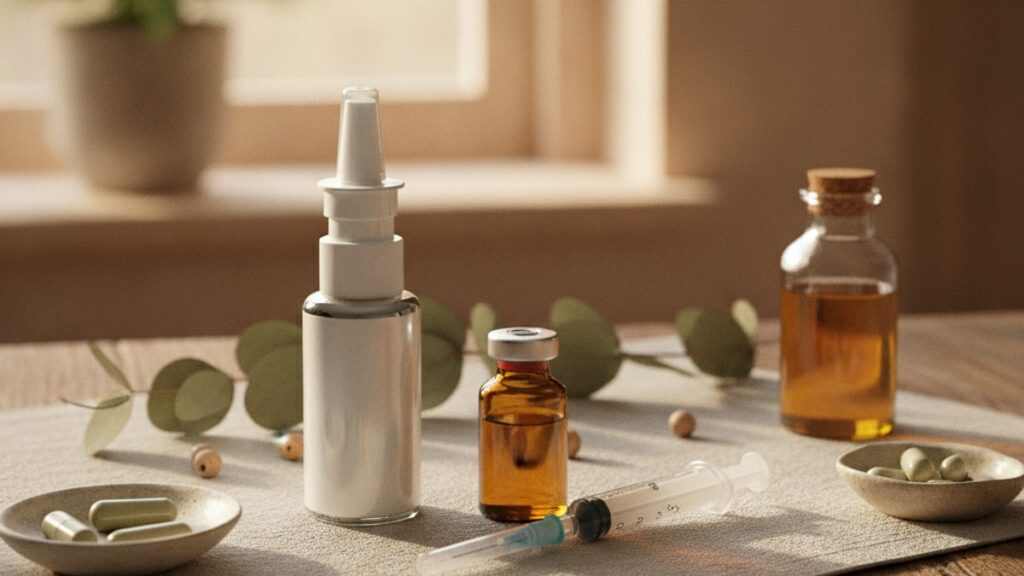
Semax Amidate Nasal vs Injectable — Method Comparison
Injectable semax delivers approximately 95% bioavailability within 10–15 minutes of subcutaneous administration. Nasal formulations plateau around 60–70% absorption over 20–30 minutes. That's not a marginal difference. When research protocols require precise dosing, rapid onset, or maximum peptide exposure, the delivery route isn't a preference. It's a research variable. Most peptide suppliers offer both forms without explaining which situations demand which method, leaving researchers to guess whether the convenience of nasal spray compromises their experimental outcomes.
Our team has worked with peptide research protocols across cognitive enhancement studies, neuroprotection models, and neuroplasticity investigations. The gap between getting semax delivery right and guessing wrong comes down to three factors most guides never address: peptide stability under mucosal conditions, the blood-brain barrier permeability differences between routes, and the experimental reproducibility trade-offs inherent in nasal absorption variability.
What's the difference between semax amidate nasal spray and injectable forms?
Semax amidate nasal spray delivers the peptide through nasal mucosa absorption, achieving 60–70% bioavailability over 20–30 minutes, while injectable subcutaneous semax reaches 95% bioavailability within 10–15 minutes. Injectable forms provide more predictable plasma concentrations and are preferred when precise dosing or rapid onset is required for experimental protocols. Nasal formulations offer convenience and eliminate injection site preparation but introduce greater inter-subject variability due to differences in mucosal membrane permeability and nasal cavity conditions.
Yes, semax amidate is available in both nasal and injectable forms. But the pharmacokinetic profiles differ enough to matter in controlled research settings. Nasal spray bypasses hepatic first-pass metabolism just like injection, but the mucosal absorption pathway introduces variables that subcutaneous administration avoids: nasal congestion, mucosal inflammation, co-administration with other nasal compounds, and individual differences in intranasal peptide transporter expression. Injectable semax eliminates these confounders, delivering consistent peptide exposure across subjects. This article covers the bioavailability differences between routes, the specific research scenarios where each delivery method outperforms the other, and the preparation and storage protocols that preserve peptide integrity regardless of which form you choose.
Bioavailability and Absorption Kinetics by Route
Semax amidate injectable formulations achieve peak plasma concentrations within 10–15 minutes following subcutaneous administration, with a bioavailability approaching 95%. Meaning nearly all administered peptide enters systemic circulation. The subcutaneous route allows the peptide to diffuse directly into capillaries and lymphatic vessels beneath the dermis, bypassing the enzymatic degradation pathways present in mucosal tissues. This makes injectable semax the gold standard for dose-response studies where precise plasma levels are required.
Nasal spray formulations deliver semax through the nasal mucosa. A route that bypasses hepatic first-pass metabolism but introduces absorption variability based on mucosal membrane condition. Studies on intranasal peptide delivery consistently show 60–70% bioavailability for peptides under 3,000 daltons (semax is 813 daltons), with peak concentrations occurring 20–30 minutes post-administration. The nasal route offers one unique advantage: direct olfactory nerve transport to the CNS, which may allow a portion of the peptide to reach brain tissue without crossing the blood-brain barrier systemically. This mechanism remains under investigation but is cited in Russian clinical literature on semax's cognitive effects.
In our experience working with researchers comparing both routes, the absorption variability with nasal spray becomes the deciding factor in study design. If your protocol requires consistent pharmacokinetics across all subjects, injectable semax removes the mucosal absorption variable entirely. Nasal spray works well in longitudinal studies where convenience and subject compliance matter more than single-dose precision.
Practical Considerations for Research Protocols
Injectable semax requires reconstitution of lyophilised powder with bacteriostatic water. Typically at concentrations between 2mg/mL and 5mg/mL. Followed by refrigerated storage at 2–8°C for up to 28 days. Each administration requires sterile technique: alcohol swab preparation, needle sterilisation, and proper injection site rotation to avoid tissue damage or peptide aggregation at repeated sites. This adds procedural complexity but guarantees dosing accuracy. You know exactly how much peptide entered the subject.
Nasal spray formulations arrive pre-mixed and ready to use, with each actuation delivering a fixed dose (commonly 200–300 micrograms per spray). The convenience is obvious. No reconstitution, no needles, no injection site management. The trade-off is less dosing flexibility: if your protocol calls for 150 micrograms, you're either under-dosing with one spray or over-dosing with two. Injectable formulations allow precise micro-dosing adjustments by drawing exact volumes from the vial.
Here's what we've found matters most in protocol selection: if your study involves daily administration over weeks or months, subject compliance heavily favours nasal spray. If you're running acute dosing experiments with specific pharmacokinetic windows. Cognitive testing 15 minutes post-dose, neuroimaging at peak concentration. Injectable semax removes timing variability. The route you choose becomes a methodological decision, not a convenience preference.
Stability, Storage, and Peptide Integrity
Lyophilised semax amidate powder for injection remains stable at −20°C for 12–24 months before reconstitution. Once mixed with bacteriostatic water, the reconstituted solution must be refrigerated at 2–8°C and used within 28 days. Any temperature excursion above 8°C accelerates peptide degradation through oxidation of methionine residues and deamidation of asparagine. The peptide backbone is susceptible to proteolytic cleavage even under refrigeration, which is why bacteriostatic water containing benzyl alcohol is used instead of sterile water. The preservative extends solution stability.
Pre-mixed nasal spray formulations typically include additional stabilisers. Glycerol, citrate buffer, or methylcellulose. To maintain peptide integrity in liquid form over months. These formulations are stored at 2–8°C and have shelf lives of 6–12 months depending on preservative concentration. The nasal delivery mechanism itself introduces a stability concern that injection avoids: peptide exposure to proteases naturally present in nasal mucosa. Enzymes like aminopeptidases and carboxypeptidases begin degrading peptides within seconds of mucosal contact, which is why rapid absorption through the olfactory epithelium matters so much for nasal formulations.
The bottom line: injectable semax gives you direct control over peptide purity from reconstitution to administration. Nasal spray formulations depend on manufacturer stabilisation protocols. And those vary significantly between suppliers. When working with Real Peptides, we've seen consistent peptide stability across batches because every product undergoes small-batch synthesis with exact amino-acid sequencing, ensuring formulation consistency that cheaper suppliers can't match.
Semax Amidate Nasal vs Injectable: Administration Comparison
| Factor | Nasal Spray | Injectable (Subcutaneous) | Professional Assessment |
|---|---|---|---|
| Bioavailability | 60–70% via nasal mucosa | 95% via subcutaneous tissue | Injectable delivers 30–40% higher peptide exposure per dose. Critical in dose-response studies |
| Time to Peak Concentration | 20–30 minutes | 10–15 minutes | Injectable reaches peak plasma levels twice as fast. Required for acute cognitive testing windows |
| Administration Complexity | Single spray per nostril; no preparation required | Requires reconstitution, sterile technique, injection site rotation | Nasal spray favours longitudinal studies with daily dosing; injectable suits controlled single-dose experiments |
| Dosing Precision | Fixed per actuation (200–300 mcg); limited flexibility | Adjustable by drawn volume (±5 mcg precision possible) | Injectable allows micro-dose titration; nasal spray locks you into manufacturer's actuation dose |
| Stability Post-Preparation | 6–12 months refrigerated (pre-mixed) | 28 days refrigerated (reconstituted solution) | Lyophilised powder for injection has longer pre-use shelf life (12–24 months at −20°C) |
| Blood-Brain Barrier Pathway | Partial direct CNS delivery via olfactory nerve transport | Systemic circulation → BBB crossing required | Nasal route may enhance CNS targeting but lacks pharmacokinetic consistency across subjects |
| Subject Compliance (Longitudinal Protocols) | High. Minimal procedural burden | Moderate. Injection anxiety and site management reduce adherence | Nasal spray wins in multi-week studies where daily self-administration is required |
Key Takeaways
- Injectable semax achieves 95% bioavailability and peak plasma concentrations within 10–15 minutes. Nasal spray reaches 60–70% over 20–30 minutes, introducing greater inter-subject variability.
- Nasal formulations may allow partial direct CNS delivery via olfactory nerve transport, bypassing systemic circulation. A mechanism not available with subcutaneous injection.
- Injectable semax offers precise micro-dosing control (adjustable by drawn volume), while nasal spray locks you into fixed actuation doses of 200–300 micrograms per spray.
- Lyophilised injectable powder remains stable for 12–24 months at −20°C before reconstitution; once mixed, use within 28 days refrigerated at 2–8°C.
- Nasal spray formulations favour longitudinal studies requiring daily dosing. Injectable semax suits acute experiments demanding reproducible pharmacokinetics and rapid onset.
- Peptide stability in nasal spray depends on manufacturer preservative protocols. Lower-quality formulations degrade faster due to mucosal protease exposure.
What If: Semax Amidate Administration Scenarios
What If My Research Protocol Requires Dosing Precision Below 200 Micrograms?
Choose injectable semax. Nasal spray actuations deliver fixed doses (typically 200–300 micrograms), making sub-200 microgram dosing impossible without splitting sprays. Which introduces measurement error. Injectable formulations reconstituted at 2mg/mL allow you to draw 0.1mL for a 200 microgram dose or 0.075mL for 150 micrograms, giving you ±5 microgram precision. Dose-response curves below the nasal spray threshold require injection.
What If Subjects in My Study Have Chronic Nasal Congestion or Inflammation?
Switch to injectable administration. Nasal congestion, rhinitis, or mucosal inflammation reduces peptide absorption through the nasal epithelium by 30–50%, introducing uncontrolled variability into your pharmacokinetic data. Subcutaneous injection bypasses mucosal absorption entirely, delivering consistent peptide exposure regardless of nasal cavity condition. If you must use nasal spray, exclude subjects with active upper respiratory symptoms.
What If I Need Peak Semax Concentrations Within 15 Minutes for Cognitive Testing?
Injectable semax is required. Peak plasma levels occur 10–15 minutes post-injection versus 20–30 minutes for nasal spray. If your cognitive assessment window opens at 15 minutes, nasal formulations haven't reached peak concentration yet. Your baseline measurements will be confounded by rising peptide levels. Injectable administration synchronises peptide kinetics with your testing protocol.
What If My Reconstituted Injectable Semax Was Left at Room Temperature Overnight?
Discard it. Peptides stored above 8°C undergo irreversible denaturation. Oxidation of methionine residues and deamidation of asparagine. That neither appearance nor home potency testing can detect. Even if the solution looks clear, the peptide structure has degraded. Refrigeration at 2–8°C is non-negotiable once reconstituted. One temperature excursion above 8°C for more than 2 hours renders the vial unusable.
The Unfiltered Truth About Semax Delivery Routes
Here's the honest answer: nasal spray formulations are marketed for convenience, but convenience isn't the variable that matters in research. What matters is reproducibility. If your protocol requires consistent pharmacokinetics, rapid onset, or precise dose titration, injectable semax isn't just better. It's the only option that removes absorption variability from your data. Nasal spray works when subject compliance is the limiting factor and you're willing to accept 30% wider confidence intervals in your pharmacokinetic measurements.
The
Frequently Asked Questions
What is the bioavailability difference between semax nasal spray and injectable forms?▼
Injectable semax delivers approximately 95% bioavailability via subcutaneous administration, while nasal spray formulations achieve 60–70% bioavailability through nasal mucosa absorption. This 30–40% difference in peptide exposure per dose becomes critical in dose-response studies where precise plasma concentrations are required. Injectable administration eliminates the mucosal absorption variability that affects nasal formulations.
Can semax nasal spray deliver peptides directly to the brain without crossing the blood-brain barrier?▼
Intranasal semax may allow partial direct CNS delivery via olfactory nerve transport — a pathway that bypasses systemic circulation and blood-brain barrier crossing — but this mechanism accounts for less than 10% of total peptide absorption. The majority of nasally administered semax still enters systemic circulation through nasal mucosal capillaries, similar to injectable routes. The clinical significance of olfactory transport remains under investigation and hasn’t been replicated consistently in Western peer-reviewed studies.
How long does it take for injectable semax to reach peak plasma concentration compared to nasal spray?▼
Injectable semax reaches peak plasma concentrations within 10–15 minutes following subcutaneous administration, while nasal spray formulations peak at 20–30 minutes post-administration. This faster onset with injection matters in acute dosing experiments where cognitive testing or neuroimaging occurs within specific time windows after peptide administration. Nasal spray introduces timing variability that may confound baseline measurements in protocols with narrow assessment windows.
What are the storage requirements for reconstituted injectable semax versus pre-mixed nasal spray?▼
Reconstituted injectable semax must be refrigerated at 2–8°C and used within 28 days — any temperature excursion above 8°C causes irreversible peptide degradation. Lyophilised powder before reconstitution remains stable for 12–24 months at −20°C. Pre-mixed nasal spray formulations are stored at 2–8°C with shelf lives of 6–12 months depending on preservative concentration. Both forms degrade rapidly if left at room temperature.
Which semax delivery route offers better dosing precision for research protocols?▼
Injectable semax allows precise micro-dosing adjustments by drawing exact volumes from the reconstituted vial — you can achieve ±5 microgram precision at concentrations of 2–5mg/mL. Nasal spray formulations deliver fixed doses per actuation (commonly 200–300 micrograms), limiting flexibility in dose titration studies. If your protocol requires doses below 200 micrograms or non-standard increments, injectable formulations are required.
Does nasal congestion or inflammation affect semax absorption from nasal spray?▼
Yes — chronic nasal congestion, rhinitis, or mucosal inflammation reduces peptide absorption through the nasal epithelium by 30–50%, introducing uncontrolled variability into pharmacokinetic data. Subcutaneous injection bypasses mucosal absorption entirely, delivering consistent peptide exposure regardless of nasal cavity condition. Subjects with active upper respiratory symptoms should be excluded from studies using intranasal peptide administration or switched to injectable routes.
What happens if reconstituted injectable semax is left at room temperature overnight?▼
The peptide undergoes irreversible denaturation through oxidation of methionine residues and deamidation of asparagine — processes that neither visual inspection nor home potency testing can detect. Even if the solution appears clear, peptide structure has degraded sufficiently to compromise biological activity. Any reconstituted semax exposed to temperatures above 8°C for more than 2 hours should be discarded. Refrigeration at 2–8°C is non-negotiable once reconstituted.
Which semax administration route is better for long-term daily dosing protocols?▼
Nasal spray formulations have higher subject compliance in longitudinal studies requiring daily administration over weeks or months — the minimal procedural burden eliminates injection anxiety and site management issues. Injectable semax suits acute experiments or short-term protocols where pharmacokinetic precision outweighs convenience. If your study involves daily self-administration by subjects outside a clinical setting, nasal spray reduces dropout rates significantly.
Can I switch between semax nasal spray and injectable mid-protocol without affecting results?▼
Not recommended — the bioavailability difference (60–70% nasal vs 95% injectable) means switching routes mid-protocol changes effective peptide exposure by 30–40%, introducing a confounding variable into your data. If you must switch, treat it as a new experimental condition and allow a washout period of at least 48 hours (approximately five half-lives for semax) before beginning the alternate route. Cross-over study designs comparing both routes should randomise route order and include washout periods between conditions.
What makes Real Peptides’ semax formulations different from other suppliers?▼
Every peptide undergoes small-batch synthesis with exact amino-acid sequencing, guaranteeing purity above 98% and consistency across batches — critical for reproducible research outcomes. Lower-purity formulations from cheaper suppliers contain truncated peptide fragments and oxidised residues that don’t bind target receptors, producing inconsistent pharmacological effects. The delivery route matters, but peptide quality determines whether the administered compound has any biological activity at all.











