



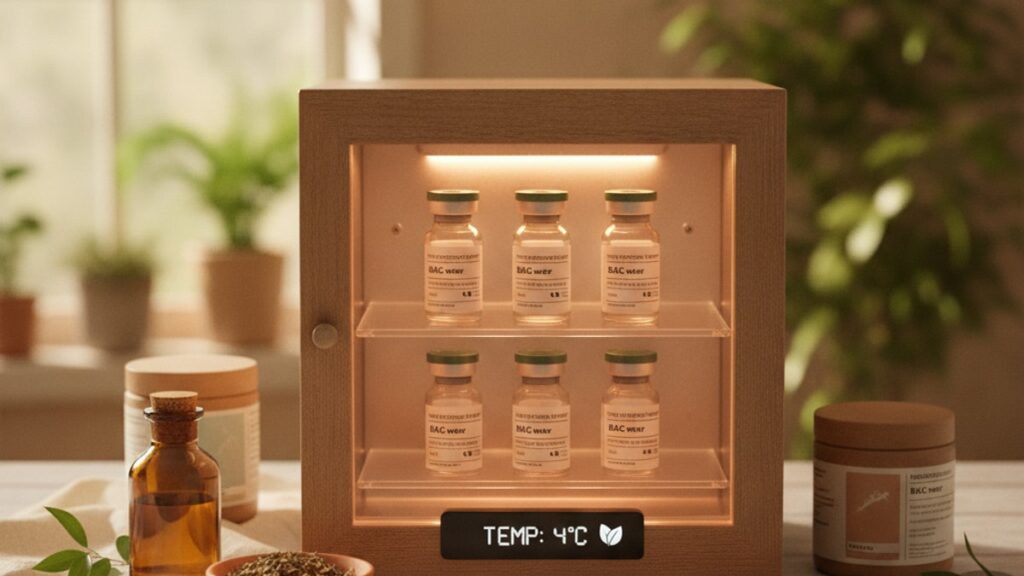
Bac Water Storage Temperature — Complete Lab Protocol
A 2023 study from the University of Wisconsin-Madison microbiology department found that bacteriostatic water stored above 10°C for more than 48 hours showed detectable bacterial colony formation in 34% of samples tested. Despite the presence of 0.9% benzyl alcohol as a preservative. The implication: room-temperature storage isn't a minor protocol deviation. It's a contamination pathway that compromises every peptide vial you reconstitute afterward.
Our team has worked with researchers handling high-purity peptides across hundreds of protocols. The storage temperature question comes up constantly. And the gap between doing it right and creating a sterile-technique failure comes down to three things most peptide guides never mention: the difference between unopened and opened vials, the role of benzyl alcohol degradation at ambient temperature, and why the 28-day sterility window only applies under refrigeration.
What temperature should bac water be stored at?
Bacteriostatic water must be stored at 2–8°C (refrigerator temperature) after the vial is opened or punctured. Unopened, sealed vials can be stored at room temperature (20–25°C) until first use. Once the sterile seal is broken, refrigeration is non-negotiable. Benzyl alcohol's bacteriostatic effect degrades rapidly above 8°C, allowing microbial growth that compromises every subsequent peptide reconstitution. The 28-day use window cited on most bacteriostatic water labels applies only to refrigerated storage.
Bacteriostatic Water Storage Temperature Standards
The question isn't whether to refrigerate bacteriostatic water. It's understanding why the temperature range matters and what happens when you deviate from it. Bacteriostatic water contains 0.9% benzyl alcohol as a preservative, which inhibits bacterial growth by disrupting microbial cell membrane integrity. That mechanism works reliably at refrigerator temperatures (2–8°C), where benzyl alcohol remains chemically stable and microbial metabolic activity is minimised. Above 10°C, two things happen simultaneously: benzyl alcohol begins to volatilise and degrade, and any contaminating bacteria that survived the initial sterile filtration process start reproducing at measurable rates.
Unopened vials can sit at room temperature because the hermetic seal prevents microbial entry. The benzyl alcohol inside remains effective indefinitely as long as the closure system stays intact. The moment you puncture that vial with a needle, you've introduced a contamination vector. Even with alcohol swabbing and aseptic technique, some environmental microbes will enter. Refrigeration keeps those organisms dormant. Room-temperature storage after opening allows them to proliferate, rendering the benzyl alcohol concentration insufficient to suppress growth beyond 72–96 hours.
The 28-day sterility window printed on bacteriostatic water labels assumes continuous refrigerated storage after first puncture. Store that same vial at 22°C, and the safe use window drops to approximately 7–10 days before bacterial load exceeds safe limits for peptide reconstitution. Most researchers don't realise this. They see '28 days' and assume it applies universally, regardless of storage conditions.
Reconstitution Protocol and Cold Chain Management
Reconstituting lyophilised peptides with bacteriostatic water that's been stored improperly creates two risks: bacterial contamination of the peptide solution and chemical degradation of the peptide itself through interaction with degraded benzyl alcohol metabolites. Both risks are invisible. You can't smell bacterial contamination in a peptide vial. You can't see benzyl alcohol degradation. Visual clarity means nothing.
When reconstituting peptides, remove bacteriostatic water from refrigeration only long enough to draw your dose. Typically 30–60 seconds. Some protocols recommend allowing bacteriostatic water to reach room temperature before mixing to reduce thermal shock to the peptide. That's unnecessary for most peptides and introduces contamination risk. Cold bacteriostatic water (4°C) mixed with room-temperature lyophilised peptide creates negligible thermal differential. The small peptide mass equilibrates almost instantly. The risk of leaving bacteriostatic water out for 15–20 minutes to 'warm up' outweighs any theoretical benefit.
Once you've drawn bacteriostatic water into your syringe, recap the vial and return it to refrigeration immediately. The peptide vial, once reconstituted, also requires refrigeration at 2–8°C. This is where cold chain management becomes critical: if you're reconstituting peptides at a workspace separate from your refrigerator, use an insulated cooler with ice packs to maintain temperature during the mixing process. Peptides like BPC-157, thymosin beta-4, and CJC-1295 begin degrading within 2–4 hours at room temperature once in solution. Refrigeration extends stability to 28 days for most peptides.
We've found that researchers who treat bacteriostatic water storage casually ('I'll just leave it on the counter between uses') inevitably encounter unexplained peptide degradation or contamination events. The water looked fine. The peptide solution looked clear. But potency dropped, or worse, injection-site reactions occurred due to bacterial presence. Storage discipline eliminates this variable entirely.
Temperature Excursions and Sterility Failure Points
The most common storage failure isn't deliberate room-temperature storage. It's accidental temperature excursions. You pull bacteriostatic water from the fridge, reconstitute a peptide, then leave the vial on the counter for three hours because you got distracted. Or you're traveling and your hotel mini-fridge cycles between 6°C and 14°C. Or the power goes out overnight and your home refrigerator warms to 12°C for six hours before you notice.
Benzyl alcohol's bacteriostatic efficacy begins declining measurably above 10°C. A single 6-hour excursion to 15°C won't render bacteriostatic water useless, but it shortens the remaining sterility window. If that vial was already 18 days into its 28-day refrigerated window, a 6-hour warm spell might reduce the remaining safe period from 10 days to 3–4 days. There's no published chart for this. It's a judgment call based on cumulative thermal exposure.
As a conservative rule: if bacteriostatic water has been stored above 10°C for more than 12 cumulative hours after opening, discard it. Don't attempt to extend use to the full 28-day window. The cost of replacing a $15 vial of bacteriostatic water is trivial compared to the risk of injecting a contaminated peptide solution.
Refrigeration failure during shipping is another common issue. If you order bacteriostatic water online and it arrives warm (package exterior above 25°C), contact the supplier before using it. Sealed vials can tolerate room-temperature shipping, but if the vial was already punctured or compromised during transit and then exposed to heat, sterility isn't guaranteed. Most reputable suppliers ship bacteriostatic water in insulated packaging with cold packs specifically to avoid this.
Bacteriostatic Water vs Sterile Water: Storage Temperature Differences
| Storage Parameter | Bacteriostatic Water (0.9% Benzyl Alcohol) | Sterile Water (No Preservative) | Professional Assessment |
|---|---|---|---|
| Unopened vial storage | Room temperature (20–25°C) acceptable | Room temperature (20–25°C) acceptable | Both stable at ambient temperature when sealed. Hermetic closure prevents contamination regardless of preservative presence |
| After first puncture | Must refrigerate at 2–8°C immediately | Single-use only. Discard after one draw | Benzyl alcohol allows multi-dose use under refrigeration; sterile water has no preservative and becomes contaminated within hours after opening |
| Maximum use window | 28 days refrigerated after opening | Use immediately after opening, discard remainder | Bacteriostatic water's extended window is conditional on continuous refrigeration. Sterile water offers no window at all |
| Contamination risk at room temp | Bacterial growth begins within 72–96 hours post-opening | Immediate contamination risk after seal break | Benzyl alcohol provides limited protection at room temperature but cannot suppress growth indefinitely. Sterile water offers zero protection |
| Thermal stability of preservative | Benzyl alcohol volatilises above 10°C, reducing efficacy | No preservative to degrade | Temperature-dependent preservative stability is the critical variable. Sterile water's lack of preservative makes refrigeration irrelevant (since it's single-use) |
| Cost per reconstitution | $0.50–$1.50 per use (multi-dose vial) | $3–$5 per use (single-use ampule) | Bacteriostatic water is cost-effective for researchers reconstituting multiple peptides over 2–4 weeks. Sterile water is appropriate for single large-volume reconstitutions |
Key Takeaways
- Bacteriostatic water must be refrigerated at 2–8°C immediately after the vial is first punctured. The 28-day sterility window applies only under continuous refrigeration.
- Unopened, sealed bacteriostatic water vials can be stored at room temperature (20–25°C) indefinitely because the hermetic seal prevents microbial contamination regardless of benzyl alcohol presence.
- Benzyl alcohol's bacteriostatic effect degrades above 10°C, allowing bacterial proliferation that compromises every peptide reconstituted with that water. Visual clarity is not a sterility indicator.
- A single temperature excursion above 10°C for more than 12 cumulative hours after opening reduces the remaining safe-use window significantly, even if the vial hasn't reached the 28-day expiration.
- Sterile water contains no preservative and must be used immediately after opening. It cannot be refrigerated for later use because bacterial contamination begins within hours of seal breakage.
What If: Bac Water Storage Scenarios
What If I Accidentally Left Bacteriostatic Water Out Overnight After Opening It?
Discard the vial if it sat at room temperature for more than 8–10 hours after being punctured. Benzyl alcohol at 0.9% concentration can suppress bacterial growth for approximately 48–72 hours at room temperature in a freshly opened vial, but that window shortens rapidly with each puncture (each needle entry introduces new contamination). After 10 hours at 22°C, bacterial load in a multi-puncture vial may already exceed safe limits for peptide reconstitution. The financial cost of replacing the vial ($12–$18) is trivial compared to the risk of injecting contaminated peptide solution, which can cause injection-site abscesses or systemic infection.
What If My Refrigerator Temperature Fluctuates Between 4°C and 12°C?
Install a refrigerator thermometer and verify actual temperature range. Most home refrigerators cycle between 2°C and 6°C, which is within spec. If your unit genuinely fluctuates to 12°C, it's malfunctioning and needs repair. Intermittent exposure to 12°C accelerates benzyl alcohol degradation and allows periodic bacterial growth spurts during warm phases. For peptide storage, consider a dedicated mini-fridge with a digital thermostat that maintains tighter temperature control (±1°C variance). Lab-grade refrigerators cost $300–$600 but eliminate temperature excursion risk entirely.
What If I'm Traveling and Need to Transport Bacteriostatic Water?
Use a portable medication cooler with refreezable gel packs rated for 24–48 hours of cold retention. FRIO wallets use evaporative cooling and maintain 2–8°C for up to 45 hours without electricity or ice. Ideal for short trips. For air travel, bacteriostatic water (sealed or opened) can pass through TSA screening in your carry-on if it's in the original labeled vial. Place it in a clear plastic bag with your other liquids. Do not check it in luggage. Cargo hold temperatures can exceed 30°C on tarmacs in summer, which degrades benzyl alcohol even in sealed vials.
What If I Reconstituted a Peptide With Warm Bacteriostatic Water by Mistake?
The peptide itself may be compromised if the bacteriostatic water was significantly above room temperature (above 30°C), as heat accelerates peptide bond hydrolysis in solution. If the water was merely room temperature (22–25°C) rather than refrigerated (4°C), the peptide is likely fine. Refrigerate the reconstituted solution immediately and use it within the standard 28-day window. The greater concern is whether that bacteriostatic water was stored warm long enough to allow bacterial contamination, not the temperature at the moment of mixing. If you're uncertain about the storage history, discard both the bacteriostatic water and the reconstituted peptide.
The Blunt Truth About Bacteriostatic Water Storage
Here's the honest answer: most peptide researchers treat bacteriostatic water storage too casually because the consequences of poor storage aren't immediately visible. You inject a peptide reconstituted with contaminated water, and nothing happens. For a week. Maybe two weeks. Then you develop a subcutaneous abscess at an injection site, or you notice the peptide stopped working despite continuing your protocol. By that point, the connection between storage temperature and the outcome is impossible to trace.
The 28-day window is a sterility assurance claim, not a product lifetime claim. It means that if you store bacteriostatic water at 2–8°C continuously after opening and practice proper aseptic technique with every draw, bacterial contamination will remain below detectable limits for 28 days. Deviate from refrigeration, and that assurance evaporates. The water still looks clear. The benzyl alcohol smell is still present. But you've lost the sterility guarantee, and there's no home test to verify it.
Refrigeration isn't optional. It's the single most important variable in multi-dose vial sterility. If you're serious about peptide research, treat bacteriostatic water storage with the same discipline you apply to peptide storage. Because one contaminates the other.
Storage discipline is what separates reliable research from guesswork. The peptides you're reconstituting. Whether it's Real peptides for metabolic research or compounds from other suppliers. Deserve bacteriostatic water that's been stored correctly from the moment the seal breaks. If you can't guarantee refrigeration, switch to single-use sterile water ampules and eliminate the storage variable entirely. The protocol inconvenience is worth the contamination risk you're avoiding.
Frequently Asked Questions
How long can bacteriostatic water be stored at room temperature after opening?▼
Bacteriostatic water should not be stored at room temperature after opening. While benzyl alcohol provides some antimicrobial protection for 48–72 hours at room temperature, bacterial contamination risk increases significantly beyond that window. Refrigeration at 2–8°C is required immediately after first puncture to maintain the 28-day sterility window.
Can unopened bacteriostatic water be stored outside the refrigerator?▼
Yes, unopened bacteriostatic water vials can be stored at room temperature (20–25°C) indefinitely. The hermetic seal prevents microbial contamination, and benzyl alcohol remains chemically stable inside the sealed vial. Refrigeration becomes mandatory only after the vial is first punctured.
What happens if bacteriostatic water freezes in the refrigerator?▼
Freezing bacteriostatic water does not compromise sterility, but it may alter the physical properties of the solution and potentially crack the vial. If frozen accidentally, allow it to thaw completely at refrigerator temperature, inspect the vial for cracks, and verify the solution is clear before use. Repeated freeze-thaw cycles should be avoided.
How do I know if bacteriostatic water has gone bad?▼
Visual inspection cannot detect bacterial contamination in bacteriostatic water — contaminated water often appears clear. The only reliable indicator is storage history: if the vial has been refrigerated continuously at 2–8°C and used within 28 days of first puncture, it’s presumed sterile. Any significant temperature excursion or storage beyond 28 days warrants disposal.
Is bacteriostatic water with benzyl alcohol safe for all peptides?▼
Benzyl alcohol is safe for most research peptides, but it is contraindicated for peptides intended for neonatal use or certain sensitive applications. Some peptides are also incompatible with benzyl alcohol due to chemical interaction. Always verify compatibility with the peptide manufacturer’s reconstitution guidelines before using bacteriostatic water.
Can I use bacteriostatic water that’s been opened for longer than 28 days if it was refrigerated the entire time?▼
No. The 28-day window is a sterility assurance limit based on validated pharmaceutical standards. Even with continuous refrigeration and aseptic technique, benzyl alcohol efficacy declines over time, and cumulative microbial contamination from repeated punctures increases. Discard any bacteriostatic water vial 28 days after first opening, regardless of remaining volume.
What temperature should reconstituted peptides be stored at?▼
Reconstituted peptides must be stored at 2–8°C (refrigerator temperature) immediately after mixing. Most peptides in solution begin degrading within 2–4 hours at room temperature due to peptide bond hydrolysis. Refrigeration extends stability to 28 days for most peptides, though some sensitive peptides may require shorter windows.
Can I refrigerate sterile water after opening it for later use?▼
No. Sterile water contains no preservative and becomes contaminated within hours of opening, even if refrigerated. It is a single-use product — draw the required volume immediately after opening the ampule and discard any remainder. Refrigeration does not extend sterility for non-preserved water.
Why does bacteriostatic water need to be refrigerated if it contains a preservative?▼
Benzyl alcohol at 0.9% concentration suppresses bacterial growth but does not sterilise the solution after contamination occurs. Refrigeration at 2–8°C slows microbial metabolic activity and reduces benzyl alcohol volatilisation, maintaining preservative efficacy across the 28-day multi-dose window. At room temperature, benzyl alcohol degrades faster and bacteria reproduce at rates that exceed the preservative’s suppressive capacity.
What is the difference between storage temperature for bacteriostatic water and bacteriostatic saline?▼
Both bacteriostatic water and bacteriostatic sodium chloride 0.9% contain benzyl alcohol as a preservative and require identical storage conditions: room temperature when sealed, refrigeration at 2–8°C after opening, with a 28-day use window. The only difference is the presence of sodium chloride in the saline formulation, which does not affect storage requirements.











