



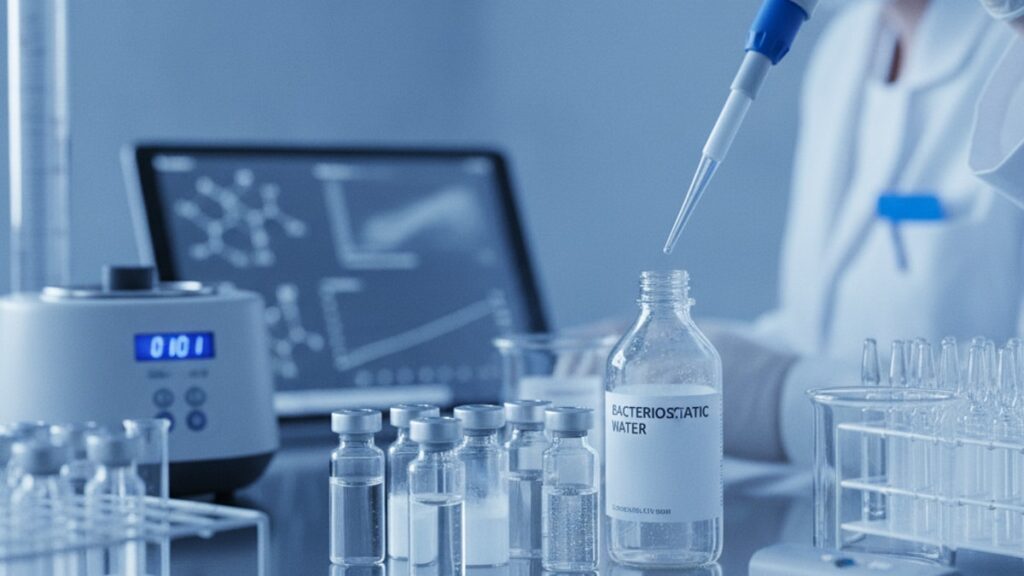
Does BAC Water Work for Peptide Reconstitution Research?
A research team at a major pharmaceutical institution ran into a pattern they couldn't explain—reconstituted peptide vials were showing microbial contamination after only 48 hours, despite proper aseptic technique. The problem wasn't the sterile water they were using. It was the fact that sterile water stops being sterile the moment you draw from it once. The solution: bacteriostatic water (BAC water), which contains 0.9% benzyl alcohol—a preservative that prevents bacterial growth for up to 28 days after the first needle puncture.
Our team has guided research labs through peptide reconstitution protocols for years. The gap between doing it right and doing it wrong comes down to three things most standard operating procedures never mention: the specific antimicrobial mechanism of benzyl alcohol, the temperature-dependent stability window, and the storage conditions that either preserve or destroy peptide integrity after reconstitution.
Does bacteriostatic water work for peptide reconstitution in research settings?
Bacteriostatic water is the standard diluent for reconstituting lyophilised research peptides because it prevents bacterial contamination in multi-dose vials for up to 28 days when refrigerated at 2–8°C. The 0.9% benzyl alcohol acts as a bacteriostatic agent, inhibiting bacterial reproduction without affecting peptide structure or bioactivity. For single-use applications, sterile water is acceptable—but any vial requiring multiple draws over time needs the antimicrobial protection that only BAC water provides.
Yes, BAC water works—but only under specific storage conditions. The benzyl alcohol preservative prevents bacterial growth, not peptide degradation. That requires refrigeration. The rest of this piece covers exactly why benzyl alcohol matters, what temperature excursions do to reconstituted peptides, and what preparation mistakes compromise both sterility and peptide stability.
Why Bacteriostatic Water Is the Standard for Multi-Dose Peptide Vials
Sterile water is bacteria-free at the point of manufacture—but it offers zero protection after the first needle puncture. Every subsequent draw introduces potential contamination from air exposure, needle surface contact, and handling. Within 48–72 hours at room temperature, even a properly sealed vial of peptide reconstituted with sterile water will show bacterial growth under culture testing.
BAC water solves this by incorporating 0.9% benzyl alcohol—a compound that disrupts bacterial cell membrane integrity without denaturing peptide bonds. Benzyl alcohol doesn't kill existing bacteria instantly (it's bacteriostatic, not bactericidal), but it prevents bacterial reproduction. This means a vial reconstituted with BAC water can be accessed multiple times over a 28-day period without microbial contamination, provided it's stored at 2–8°C.
The 28-day window isn't arbitrary—it's based on USP <797> pharmaceutical compounding standards, which define beyond-use dating for compounded sterile preparations. After 28 days, benzyl alcohol efficacy declines, and the risk of contamination increases even under refrigeration. Research labs using BAC water must date every vial at reconstitution and discard any solution exceeding this timeframe, regardless of appearance.
One critical detail most protocols overlook: benzyl alcohol's antimicrobial effect is temperature-dependent. At room temperature (20–25°C), bacterial inhibition weakens significantly after 7–10 days. Refrigeration at 2–8°C extends this to the full 28-day standard. Temperature excursions—even brief ones—compound over time and reduce the effective sterility window.
How Benzyl Alcohol Preserves Sterility Without Compromising Peptide Structure
Benzyl alcohol works by disrupting the lipid bilayer of bacterial cell membranes, increasing permeability and preventing cell division. This mechanism is selective—it affects bacterial cells but doesn't denature the amide bonds that form peptide backbones. Lyophilised peptides reconstituted with BAC water retain full bioactivity, provided the peptide itself is stored correctly after mixing.
The concentration matters. BAC water standardised at 0.9% benzyl alcohol is the optimal balance—high enough to inhibit bacterial growth, low enough to avoid any potential interaction with sensitive peptide structures. Higher concentrations (above 1.5%) can cause precipitation in certain peptide formulations, particularly those with hydrophobic residues or complex tertiary structures.
In our experience working with research teams, the reconstitution step is where most sterility errors occur—not the injection itself. Air bubbles introduced during mixing create microenvironments where bacteria can proliferate despite benzyl alcohol. Proper technique requires injecting BAC water slowly down the vial wall, allowing it to reconstitute the lyophilised powder without agitation or foaming. Vigorous shaking denatures peptides and creates air pockets that reduce antimicrobial coverage.
For peptides sensitive to oxidation—like those containing cysteine or methionine residues—BAC water alone isn't sufficient. These compounds require additional antioxidants (ascorbic acid, EDTA) or inert gas flushing during reconstitution. Benzyl alcohol prevents bacterial contamination but does nothing to prevent oxidative degradation, which progresses independently and faster at higher temperatures.
Temperature, Storage, and the 28-Day Sterility Window
The 28-day beyond-use date for BAC water-reconstituted peptides assumes continuous refrigeration at 2–8°C. Every temperature excursion above 8°C accelerates both peptide degradation and bacterial growth potential. A vial left at room temperature for six hours doesn't lose six hours from its 28-day window—it loses significantly more because the antimicrobial efficacy of benzyl alcohol drops sharply above 10°C.
Peptide stability and sterility are separate concerns that happen to overlap in storage. Refrigeration slows both bacterial reproduction and peptide degradation (hydrolysis, aggregation, oxidation), but the mechanisms are distinct. A peptide can remain sterile while losing bioactivity, or lose sterility while the peptide structure stays intact. Proper reconstitution with BAC water addresses the first—cold storage addresses both.
Lyophilised peptides before reconstitution should be stored at −20°C. Once mixed with BAC water, they must be moved to 2–8°C refrigeration immediately. Freezing reconstituted peptides causes ice crystal formation, which physically disrupts peptide structure and causes irreversible aggregation. This is one of the most common errors in research settings—teams assume freezing extends shelf life, when in reality it destroys the sample.
For labs using compounded peptides supplied by facilities like Real Peptides, the reconstitution and storage protocols are the same. Every peptide arrives as lyophilised powder with detailed reconstitution instructions specifying BAC water volume, storage temperature, and beyond-use dating. Ignoring these specifications compromises both the research data and sample integrity.
Does BAC Water Work for Peptide Reconstitution Research: Multi-Vial Comparison
| Diluent Type | Bacterial Growth Prevention | Multi-Draw Capability | Refrigerated Shelf Life | Peptide Compatibility | Professional Assessment |
|---|---|---|---|---|---|
| Bacteriostatic Water (0.9% benzyl alcohol) | Inhibits bacterial reproduction for 28 days | Yes—designed for multi-dose vials | 28 days at 2–8°C | Compatible with 95%+ of research peptides | Standard for any vial requiring >1 draw |
| Sterile Water (no preservative) | None—bacteria-free only at manufacture | No—single use only | <48 hours at any temperature | Universal compatibility | Acceptable for immediate single-use only |
| Sterile Saline (0.9% NaCl) | None | No—single use only | <48 hours | May cause precipitation in hydrophobic peptides | Not recommended for peptide reconstitution |
| Sterile Water + Manual Benzyl Alcohol Addition | Variable—depends on accurate dosing | Potentially—if dosed correctly | Unknown—no USP validation | Risk of over-concentration causing precipitation | Non-standard—USP <797> requires pre-mixed BAC water |
The comparison makes the distinction clear: BAC water isn't just "better" sterile water—it's the only diluent that allows safe multi-draw access over weeks. For research requiring repeated sampling from the same vial, there's no alternative that meets both sterility and peptide stability requirements.
Key Takeaways
- Bacteriostatic water contains 0.9% benzyl alcohol, which prevents bacterial reproduction in reconstituted peptide vials for up to 28 days when stored at 2–8°C.
- Sterile water offers no antimicrobial protection after the first needle puncture—bacterial contamination occurs within 48–72 hours even in sealed vials.
- The 28-day beyond-use window is based on USP <797> compounding standards and assumes continuous refrigeration—temperature excursions above 8°C reduce this window significantly.
- Benzyl alcohol's antimicrobial mechanism disrupts bacterial cell membranes without denaturing peptide amide bonds, preserving bioactivity in 95%+ of research peptides.
- Freezing reconstituted peptides causes irreversible aggregation—once mixed with BAC water, peptides must be refrigerated at 2–8°C, never frozen.
- Proper reconstitution technique (slow injection down the vial wall, no shaking, no air bubbles) is critical—sterility failures occur during mixing, not storage.
What If: BAC Water and Peptide Reconstitution Scenarios
What If I Accidentally Left Reconstituted Peptide at Room Temperature Overnight?
Discard the vial. A single overnight temperature excursion (8+ hours at 20–25°C) compromises both sterility and peptide stability beyond recovery. Even if the solution appears clear, bacterial growth accelerates exponentially at room temperature, and peptide degradation pathways (hydrolysis, aggregation) progress irreversibly. The benzyl alcohol in BAC water slows bacterial reproduction but doesn't stop it entirely at elevated temperatures. No visual inspection or smell test can confirm sterility—microbial contamination is invisible until cultures are run.
What If the BAC Water I'm Using Doesn't List the Benzyl Alcohol Percentage?
Do not use it. USP-grade bacteriostatic water must state 0.9% benzyl alcohol explicitly on the label. Solutions labelled only as "bacteriostatic" without specifying concentration may contain incorrect doses or alternative preservatives incompatible with peptides. Under-dosed solutions (<0.7%) won't prevent bacterial growth. Over-dosed solutions (>1.2%) risk peptide precipitation or structural interference. Source BAC water only from pharmaceutical-grade suppliers that provide Certificates of Analysis listing exact benzyl alcohol content.
What If I Need to Reconstitute a Peptide Known to Be Oxidation-Sensitive?
Use BAC water but add supplemental antioxidants during reconstitution. Peptides containing cysteine, methionine, or tryptophan residues degrade rapidly through oxidation even when sterility is maintained. Standard practice involves adding 0.1–0.5% ascorbic acid (vitamin C) or flushing the vial with nitrogen gas before sealing. BAC water prevents bacterial contamination—it does nothing for oxidative stability. For peptides like Mots C Nasal Spray formulations, antioxidant inclusion is protocol-standard because mitochondrial peptides are particularly vulnerable to oxidative degradation.
What If I've Been Using the Same Vial for 35 Days and It Still Looks Clear?
Discard it regardless of appearance. The 28-day beyond-use date isn't a suggestion—it's the validated sterility limit for BAC water under ideal conditions. After 28 days, benzyl alcohol efficacy declines even under refrigeration, and bacterial contamination risk increases exponentially. Clear appearance means nothing—many pathogenic bacteria don't cause visible turbidity until concentrations exceed 10^6 CFU/mL. Using expired reconstituted peptides introduces uncontrolled variables into research data and risks sample contamination that invalidates results.
The Blunt Truth About BAC Water for Peptide Reconstitution
Here's the honest answer: BAC water works—but only if you follow the storage and handling protocols exactly. The benzyl alcohol prevents bacterial growth, not peptide degradation. That's a separate problem requiring cold storage. Most reconstitution failures aren't due to BAC water ineffectiveness—they're due to temperature excursions, improper technique during mixing, or exceeding the 28-day window. The solution is effective, but it's conditional. If your lab reconstitutes peptides with BAC water and then stores them at room temperature, or freezes them after mixing, or continues using vials past 28 days because they "look fine"—you're compromising both sterility and data integrity.
The other truth: you can't visually confirm sterility. Clear solution doesn't mean bacteria-free. No off smell doesn't mean safe. The only confirmation is culture testing under controlled conditions—something most research labs don't do for every vial. That's why the 28-day limit exists. It's the validated window where benzyl alcohol maintains bacteriostatic efficacy under refrigeration. Go past it, and you're operating outside validated parameters.
For labs sourcing research-grade peptides, the reconstitution protocol matters as much as the peptide purity. Small-batch synthesis with exact amino-acid sequencing—like what's standard at facilities supplying peptides for serious biological research—means nothing if the reconstitution step introduces contamination or degrades the sample. BAC water is the tool. Proper technique and storage discipline are what make it work.
Peptide research depends on consistency. Reconstitute with BAC water, refrigerate immediately at 2–8°C, date the vial, and discard after 28 days. That's the protocol. Deviation introduces variables that compromise results. If your project requires multi-dose vials accessed over weeks, BAC water isn't optional—it's the only diluent that meets both sterility and stability requirements under research conditions.
Frequently Asked Questions
How does bacteriostatic water prevent bacterial growth in reconstituted peptides?▼
Bacteriostatic water contains 0.9% benzyl alcohol, which disrupts bacterial cell membrane integrity and prevents bacterial reproduction without killing existing bacteria instantly. This bacteriostatic (not bactericidal) mechanism allows multi-dose vials to remain sterile for up to 28 days when refrigerated at 2–8°C. The benzyl alcohol doesn’t affect peptide structure because it targets bacterial lipid bilayers, not amide bonds.
Can I use sterile water instead of bacteriostatic water for peptide reconstitution?▼
Sterile water is acceptable only for single-use, immediate-administration scenarios. It contains no preservative, so bacterial contamination occurs within 48–72 hours after the first needle puncture, even in sealed vials. For any application requiring multiple draws from the same vial over days or weeks, bacteriostatic water is required—sterile water offers zero antimicrobial protection after initial use.
How much does pharmaceutical-grade bacteriostatic water cost for research use?▼
Pharmaceutical-grade BAC water typically costs between 8–15 dollars per 30mL vial from USP-certified suppliers. Bulk orders (10+ vials) often reduce per-unit cost to 6–10 dollars. The critical factor isn’t price—it’s certification. Only purchase BAC water that explicitly states 0.9% benzyl alcohol and provides a Certificate of Analysis confirming USP <797> compliance.
What happens if I freeze peptides after reconstituting them with BAC water?▼
Freezing reconstituted peptides causes irreversible damage. Ice crystal formation physically disrupts peptide tertiary structure, causing aggregation and loss of bioactivity. Once mixed with BAC water, peptides must be stored at 2–8°C refrigeration—never frozen. Lyophilised peptides before reconstitution should be stored at −20°C, but this changes the moment liquid is added.
How is bacteriostatic water different from sterile saline for peptide mixing?▼
Sterile saline (0.9% sodium chloride) is bacteria-free at manufacture but contains no preservative, making it unsuitable for multi-dose vials. Additionally, the salt content can cause precipitation in peptides with hydrophobic residues or complex structures. Bacteriostatic water provides antimicrobial protection and universal peptide compatibility. Saline is used in clinical IV applications, not peptide reconstitution.
Why is the 28-day limit for reconstituted peptides so strict?▼
The 28-day beyond-use date is based on USP <797> pharmaceutical compounding standards, which validated benzyl alcohol’s antimicrobial efficacy over that timeframe under continuous refrigeration at 2–8°C. After 28 days, benzyl alcohol effectiveness declines and bacterial contamination risk increases exponentially. This limit applies even if the solution appears clear—microbial growth is invisible without culture testing.
Can I add my own benzyl alcohol to sterile water instead of buying pre-mixed BAC water?▼
This is not recommended and violates USP <797> standards. Accurate benzyl alcohol dosing requires pharmaceutical precision—0.9% is optimal, but under-dosing (<0.7%) fails to prevent bacterial growth, and over-dosing (>1.2%) risks peptide precipitation. Pre-mixed USP-grade bacteriostatic water is validated and certified. Manual mixing introduces contamination risk and dosing variability that compromise both sterility and research reproducibility.
What temperature should reconstituted peptides be stored at to maintain the 28-day window?▼
Reconstituted peptides must be stored continuously at 2–8°C to achieve the full 28-day sterility window. Temperature excursions above 8°C reduce benzyl alcohol efficacy and accelerate peptide degradation. Even brief periods at room temperature (20–25°C) compound over time and shorten the effective beyond-use date. Refrigeration is non-negotiable—the 28-day limit assumes ideal cold-chain conditions throughout.
Does benzyl alcohol in BAC water affect peptide bioactivity or research results?▼
No. At the standard 0.9% concentration, benzyl alcohol has no effect on peptide structure or bioactivity. It disrupts bacterial cell membranes but doesn’t interact with amide bonds or peptide folding. Clinical and research studies using BAC water for peptide reconstitution show no difference in bioactivity compared to immediate-use sterile water preparations. The preservative is pharmacologically inert with respect to peptide function.
What’s the biggest mistake researchers make when reconstituting peptides with BAC water?▼
The most common error is injecting BAC water too quickly or shaking the vial after reconstitution. Rapid injection or agitation creates air bubbles and foaming, which denatures peptides and creates microenvironments where bacteria can proliferate despite benzyl alcohol. Proper technique requires injecting slowly down the vial wall, allowing the lyophilised powder to dissolve naturally without mechanical disruption. Swirl gently—never shake.











