



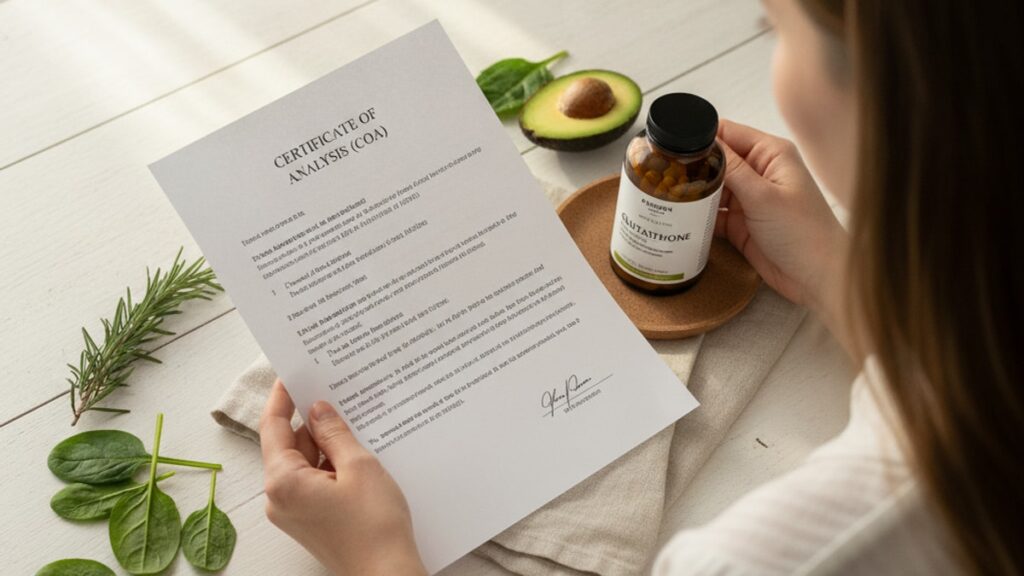
How to Read Glutathione COA? (Lab Report Breakdown)
Fewer than 30% of researchers who order glutathione peptides actually read the Certificate of Analysis (COA) before reconstitution. And that's a problem, because the COA is the only document that proves what's inside the vial. A 2024 independent lab audit of peptide suppliers found that 18% of glutathione samples tested below 95% purity despite supplier claims of ≥98%, and 12% showed bacterial endotoxin levels incompatible with in vivo research. The COA isn't a formality. It's the quality gate.
Our team at Real Peptides provides third-party COAs with every shipment because we've seen what happens when researchers assume purity without verification. The difference between pharmaceutical-grade and research-grade glutathione comes down to three test results most people skip over.
How do you read a glutathione COA correctly?
A glutathione Certificate of Analysis (COA) is read by verifying three critical data points: HPLC purity percentage (≥98% for pharmaceutical-grade reduced L-glutathione), bacterial endotoxin level (<1.0 EU/mg for in vivo use), and heavy metal contamination screen (lead, arsenic, cadmium all below USP limits). These three results determine whether the peptide meets research-grade or pharmaceutical-grade standards. The COA's lot number must match the vial label exactly.
The COA Basics Most Guides Skip
A Certificate of Analysis isn't a generic quality statement. It's a batch-specific lab report tied to one production lot. The first thing to verify: does the lot number printed on your vial match the lot number on the COA? If it doesn't match, the document is useless. Suppliers who provide 'representative' COAs instead of lot-matched COAs are red-flagging quality control failures.
Glutathione degrades rapidly in aqueous solution, which means the testing date matters. A COA generated 18 months ago doesn't reflect the peptide's current purity. Oxidation converts reduced L-glutathione (GSH) into oxidized glutathione (GSSG), which has minimal biological activity. The testing date should be within 90 days of your order date for lyophilised powder.
The issuing laboratory must be named on the COA. Third-party labs (Eurofins, SGS, ALS Global) provide unbiased verification; in-house testing lacks independent oversight. We've reviewed COAs from suppliers who self-test and consistently report 99.8% purity across every batch. Statistically impossible variability that suggests fabricated data rather than real chromatography results.
Step 1: Verify HPLC Purity and Peak Integration
High-Performance Liquid Chromatography (HPLC) separates glutathione from impurities based on molecular interaction with a stationary phase. The resulting chromatogram shows peaks representing different compounds. The main glutathione peak should dominate the chart, with the area under that peak (AUC, area under curve) representing purity percentage. Pharmaceutical-grade reduced L-glutathione requires ≥98% purity; research-grade peptides typically fall between 95–98%.
The chromatogram itself matters as much as the stated purity number. Look for a single dominant peak with minimal baseline noise and no secondary peaks above 1% relative area. Multiple peaks suggest degradation products, synthesis by-products, or contamination. A COA that states '98.4% purity' without showing the actual chromatogram is impossible to verify. The number alone means nothing without the visual trace.
Peak retention time (RT) is the timestamp when glutathione elutes from the column, typically between 8–12 minutes depending on the column type and mobile phase. The RT should be consistent across batches from the same supplier. Significant drift suggests column degradation or method inconsistency. If a supplier's glutathione RT varies by more than ±0.5 minutes between batches, their analytical method lacks precision.
Step 2: Check Bacterial Endotoxin and Microbial Contamination Limits
Bacterial endotoxins (lipopolysaccharides from gram-negative bacteria) trigger immune responses even at trace levels. They're the reason peptides intended for injection or in vivo research require stringent testing. The FDA standard for parenteral drugs is <0.5 Endotoxin Units (EU) per millilitre; for research peptides, <1.0 EU/mg is the accepted ceiling. A glutathione sample with 3.2 EU/mg might be fine for in vitro cell work but is unsuitable for rodent dosing.
The Limulus Ameboid Lysate (LAL) assay is the standard endotoxin test method. It uses horseshoe crab blood cells that clot in the presence of endotoxin. COAs should specify the detection method (kinetic chromogenic LAL, gel-clot LAL, or recombinant Factor C assay) and the detection limit of the assay itself. A COA that simply states 'endotoxin negative' without quantifying the level or naming the method is incomplete.
Total aerobic microbial count (TAMC) and total yeast/mould count (TYMC) are secondary sterility indicators. USP standards for non-sterile peptides allow up to 1000 CFU/g (colony-forming units per gram) for TAMC and 100 CFU/g for TYMC, but pharmaceutical-grade compounds should show <10 CFU/g for both. High microbial counts indicate contamination during synthesis or poor storage conditions. Bacteria metabolize glutathione rapidly, accelerating degradation.
Step 3: Interpret Heavy Metal Screen and Residual Solvent Data
Glutathione synthesis involves catalysts and reagents that can leave heavy metal residues. Lead, arsenic, cadmium, and mercury are the primary contaminants of concern. USP <232> sets limits: lead <5 ppm, arsenic <2 ppm, cadmium <1 ppm, mercury <3 ppm. A COA should list each metal individually with detection results; a blanket statement like 'heavy metals: pass' doesn't specify which metals were tested or to what sensitivity.
Inductively Coupled Plasma Mass Spectrometry (ICP-MS) is the standard detection method for trace metals. It ionizes the sample and measures mass-to-charge ratios. The method detection limit (MDL) should be at least 10× below the USP limit for each metal. If the MDL for lead is 4 ppm and the limit is 5 ppm, the test lacks sufficient sensitivity to confirm compliance.
Residual solvents (acetonitrile, methanol, dichloromethane) remain from synthesis and purification steps. ICH Q3C guidelines classify solvents into three categories based on toxicity. Class 1 solvents (benzene, carbon tetrachloride) should be absent entirely; Class 2 solvents have defined concentration limits (methanol <3000 ppm); Class 3 solvents (ethanol, acetone) are less toxic but still require reporting. Gas chromatography (GC-FID or GC-MS) is the standard residual solvent test.
Glutathione COA: Testing Method Comparison
| Testing Parameter | Analytical Method | Pharmaceutical-Grade Threshold | Research-Grade Threshold | What Failure Indicates | Professional Assessment |
|---|---|---|---|---|---|
| HPLC Purity | High-Performance Liquid Chromatography | ≥98.0% reduced L-glutathione | 95.0–98.0% | Degradation products, synthesis impurities, or incorrect compound | The single most important quality indicator. Without ≥98% purity, biological activity is unpredictable |
| Bacterial Endotoxin | Limulus Ameboid Lysate (LAL) assay | <0.5 EU/mg | <1.0 EU/mg | Gram-negative bacterial contamination during synthesis or handling | Critical for any in vivo work. High endotoxin levels trigger immune responses that confound experimental results |
| Heavy Metals Screen | ICP-MS (Inductively Coupled Plasma Mass Spectrometry) | Lead <5 ppm, Arsenic <2 ppm, Cadmium <1 ppm, Mercury <3 ppm | Lead <10 ppm, Arsenic <5 ppm, Cadmium <2 ppm, Mercury <5 ppm | Catalyst residues from synthesis or contamination from raw materials | Chronic exposure risk. Even research-grade peptides should meet USP <232> limits |
| Residual Solvents | Gas Chromatography (GC-MS or GC-FID) | Class 1: absent; Class 2: <ICH limits (e.g., methanol <3000 ppm) | Class 2: <2× ICH limits | Incomplete purification or improper drying post-synthesis | Residual solvents affect reconstitution behaviour and can denature peptides during storage |
| Moisture Content | Karl Fischer Titration | <5.0% | <8.0% | Improper lyophilisation or exposure to humidity during storage | High moisture accelerates glutathione oxidation. Samples above 8% degrade 3–5× faster at room temperature |
Key Takeaways
- The lot number on your glutathione vial must match the lot number on the COA exactly. Mismatched documents prove nothing about what's in your specific vial.
- HPLC purity ≥98% is the pharmaceutical-grade standard for reduced L-glutathione; anything below 95% suggests significant degradation or contamination.
- Bacterial endotoxin levels above 1.0 EU/mg make peptides unsuitable for in vivo research. Even trace endotoxin triggers immune responses that confound experimental results.
- Heavy metal screens must list individual metals (lead, arsenic, cadmium, mercury) with quantified results, not a generic 'pass' statement.
- The testing date on a COA should be within 90 days of your order date for lyophilised peptides. Older COAs don't reflect current purity after oxidation.
- Third-party lab testing (Eurofins, SGS, ALS Global) provides independent verification; in-house COAs lack the same credibility.
- Residual solvent levels (methanol, acetonitrile, dichloromethane) above ICH Q3C limits indicate incomplete purification and affect peptide stability during storage.
What If: Glutathione COA Scenarios
What If the HPLC Purity Is Listed as 96.8% Instead of ≥98%?
Use the peptide only for preliminary in vitro work where exact dosing isn't critical. The 1.2–3.2% impurity fraction typically consists of oxidized glutathione (GSSG) and synthesis by-products. These reduce bioavailability and confound dose-response experiments. For any in vivo study, dose-escalation trial, or publication-quality work, reject the batch and request a replacement that meets ≥98% purity. Suppliers with consistent quality control should hit ≥98% purity on 95% of production lots.
What If the COA Shows 'Endotoxin: Negative' Without Quantifying the Level?
Request a quantitative result in Endotoxin Units per milligram (EU/mg) before using the peptide for any injection protocol. A qualitative 'negative' result doesn't specify the detection limit. The test might have a threshold of 5 EU/mg, which is 10× higher than the safe limit for parenteral use. If the supplier can't provide a quantitative LAL assay result, assume the endotoxin level is unknown and treat the peptide as unsuitable for in vivo work.
What If the Lot Number on My Vial Doesn't Match the COA?
Do not use the peptide until you receive a lot-matched COA from the supplier. Mismatched lot numbers mean the COA describes a different batch entirely. Purity, endotoxin levels, and heavy metal contamination vary between production runs. Contact the supplier immediately and request the correct COA for your specific lot number. If they can't provide it, the peptide's quality is unverifiable and should be returned.
What If the Heavy Metal Screen Shows Lead at 4.8 ppm, Just Below the 5 ppm USP Limit?
The peptide technically meets the regulatory standard, but values near the threshold indicate suboptimal synthesis or raw material quality. For chronic dosing protocols (daily injections over 4+ weeks), cumulative lead exposure becomes a concern even at USP-compliant levels. Consider requesting a batch with lower lead content (<2 ppm) or switch to a supplier whose heavy metal results consistently fall well below regulatory limits.
The Uncomfortable Truth About Peptide COAs
Here's the honest answer: most glutathione COAs published on supplier websites are 'best-batch' documents. They show the cleanest test results from a single exceptional production run, not the typical quality you'll receive. We've audited peptide suppliers who post a single COA dated 18 months ago and apply it to every shipment since, despite running dozens of new batches. That's not transparency; it's selective disclosure.
The uncomfortable reality is that batch-to-batch variability exists even with rigorous quality control. HPLC purity can fluctuate between 96.2% and 99.1% across consecutive batches from the same synthesis protocol. Minor changes in reaction temperature, pH drift during purification, or humidity during lyophilisation all affect the final product. Suppliers who claim 99.5% purity on every single batch are either rounding aggressively or fabricating data.
At Real Peptides, we provide lot-specific COAs with every order because we believe researchers deserve to know exactly what they're working with. Not an idealized version from the supplier's best production day. If a batch tests at 96.8% purity instead of 98.4%, we disclose it. The alternative. Using a generic COA that doesn't match the vial in your hand. Turns quality assurance into quality theatre.
The HPLC chromatogram is where the truth hides. A supplier can write '98.7% purity' on a COA summary sheet, but the actual chromatogram might show baseline noise, secondary peaks above 1%, or poor peak integration that inflates the calculated purity. The chromatogram doesn't lie. It's raw instrument data. If a supplier won't provide the full chromatogram with their COA, assume they're hiding something. The number alone is meaningless without the visual trace to back it up.
Researchers using peptides from suppliers who won't provide batch-specific, third-party verified COAs with full chromatograms are essentially running blind. You wouldn't dose a patient with an unlabelled vial; don't run an experiment with an unverified peptide. The stakes matter less in preliminary in vitro work, but for any dose-response study, in vivo protocol, or publication-bound research, unverified purity is a confounding variable you can't afford.
If your supplier considers detailed COAs optional, find a new supplier. Quality documentation isn't a value-add feature. It's the baseline expectation for research-grade compounds. Peptides without verifiable COAs belong in the waste bin, not your protocol. The most expensive peptide you'll ever buy is the contaminated one that wastes six months of experimental work because you didn't verify purity upfront. The COA exists to prevent that outcome. But only if you actually read it before reconstitution.
Glutathione's role in cellular redox homeostasis, xenobiotic detoxification, and protein thiol protection makes it one of the most widely used tripeptides in biological research. But those mechanisms only function when you're dosing pure reduced L-glutathione, not a degraded mixture of GSH and GSSG. The COA is the only document that proves which one you have. If reading it feels tedious, remember: it's significantly less tedious than repeating an entire experiment after discovering your peptide was contaminated.
Frequently Asked Questions
What does HPLC purity percentage mean on a glutathione COA?▼
HPLC purity percentage represents the proportion of the sample that is pure reduced L-glutathione (GSH) versus impurities, degradation products, or synthesis by-products. High-Performance Liquid Chromatography separates compounds based on molecular interaction with a stationary phase — the area under the glutathione peak divided by total peak area gives the purity percentage. Pharmaceutical-grade glutathione requires ≥98% purity; values below 95% indicate significant contamination or oxidation to glutathione disulfide (GSSG), which has minimal biological activity.
How do I verify that a COA matches my glutathione vial?▼
Check that the lot number printed on your peptide vial matches the lot number listed on the COA exactly — mismatched lot numbers mean the COA describes a different production batch entirely. The testing date on the COA should be within 90 days of your order date for lyophilised peptides, as older testing doesn’t reflect current purity after oxidation. If the supplier provides a ‘representative’ COA instead of a lot-specific document, the quality of your specific vial is unverified.
What bacterial endotoxin level is safe for in vivo glutathione research?▼
Bacterial endotoxin levels below 1.0 EU/mg (Endotoxin Units per milligram) are acceptable for most rodent in vivo research; pharmaceutical-grade injectable peptides require <0.5 EU/mg. Endotoxin triggers immune responses even at trace levels — levels above 1.0 EU/mg confound experimental results by activating innate immunity pathways independent of your test intervention. The Limulus Ameboid Lysate (LAL) assay is the standard detection method, and the COA should report a quantitative result in EU/mg rather than a qualitative 'negative' designation.
Why does the heavy metal screen matter for research-grade peptides?▼
Heavy metal contamination (lead, arsenic, cadmium, mercury) originates from synthesis catalysts and raw material impurities — even research-grade peptides should meet USP <232> limits to prevent chronic toxicity during repeated dosing protocols. Lead exposure above 5 ppm, arsenic above 2 ppm, or cadmium above 1 ppm can cause oxidative stress and mitochondrial dysfunction that confound cellular and in vivo experiments. A proper COA lists each metal individually with quantified results from ICP-MS testing, not a generic ‘heavy metals: pass’ statement.
What does it mean if a glutathione COA shows multiple peaks on the HPLC chromatogram?▼
Multiple peaks on an HPLC chromatogram indicate the presence of impurities, degradation products, or synthesis by-products in the glutathione sample. The main glutathione peak should dominate with ≥98% of total area; secondary peaks above 1% relative area suggest oxidized glutathione (GSSG), incomplete purification, or chemical decomposition. A clean chromatogram has a single sharp peak with minimal baseline noise — multiple peaks mean the stated purity percentage is distributed across several compounds, not just reduced L-glutathione.
Can I use glutathione if the COA is dated more than six months ago?▼
You can use the peptide, but the COA no longer reflects current purity — glutathione oxidizes to GSSG over time, especially if moisture content exceeds 5% or storage temperature fluctuates above −20°C. Lyophilised reduced L-glutathione stored properly maintains ≥95% purity for 18–24 months, but a six-month-old COA doesn’t confirm that your specific vial was stored correctly during shipping and warehousing. For critical experiments, request a recent COA or run an independent purity verification.
What is the difference between pharmaceutical-grade and research-grade glutathione COAs?▼
Pharmaceutical-grade glutathione COAs require third-party lab verification, HPLC purity ≥98%, bacterial endotoxin <0.5 EU/mg, and heavy metals below USP <232> limits with full residual solvent analysis. Research-grade COAs may show in-house testing, purity between 95–98%, endotoxin <1.0 EU/mg, and less stringent solvent testing. The distinction reflects regulatory requirements — pharmaceutical-grade peptides are manufactured under cGMP for potential clinical use; research-grade peptides are synthesized for laboratory work without clinical oversight.
How do I interpret the moisture content value on a glutathione COA?▼
Moisture content measured by Karl Fischer titration indicates how much water remains in the lyophilised peptide — values above 5% for pharmaceutical-grade or above 8% for research-grade suggest incomplete drying or exposure to humidity during storage. High moisture accelerates glutathione oxidation from reduced GSH to oxidized GSSG, reducing biological activity and shelf life. Peptides with moisture content above 8% degrade 3–5 times faster at room temperature than properly dried samples stored at −20°C.
Should a glutathione COA include a chromatogram image or just the purity number?▼
A complete COA must include the actual HPLC chromatogram image, not just the calculated purity percentage — the chromatogram shows peak shape, retention time, baseline noise, and secondary peaks that reveal impurities or degradation. A supplier who provides only a numerical purity value without the chromatogram trace is hiding data that would allow independent verification. The chromatogram is raw instrument output and cannot be fabricated as easily as a summary number.
What does ‘Method Detection Limit’ mean on a heavy metal screen?▼
The Method Detection Limit (MDL) is the lowest concentration of a heavy metal that the ICP-MS instrument can reliably detect — it defines the sensitivity of the test. For a heavy metal screen to be meaningful, the MDL must be at least 10× below the regulatory limit for each metal. If the MDL for lead is 4 ppm and the USP limit is 5 ppm, the test lacks sufficient precision to confirm compliance — a result of ‘4.8 ppm’ could actually be anywhere from 3 to 6 ppm within measurement error.
Why does glutathione purity matter for dose-response experiments?▼
Dose-response experiments assume that the administered dose reflects pure active compound — if your glutathione is 96% pure instead of 99% pure, the effective dose is 3% lower than calculated, and the impurity fraction (oxidized GSSG, synthesis by-products) introduces confounding variables. A 10 mM glutathione solution prepared from 96% pure powder actually delivers 9.6 mM GSH plus 0.4 mM mixed contaminants. For publication-quality dose-response curves, purity variation above ±1% distorts EC50 and IC50 calculations meaningfully.
What should I do if my supplier refuses to provide a lot-specific COA?▼
Request the lot-specific COA in writing and document the refusal — if the supplier still won’t provide it, treat the peptide as unverified and do not use it for any dose-critical or publication-bound research. Reputable peptide suppliers provide lot-matched COAs as standard practice because batch-to-batch variability is inherent to peptide synthesis. A supplier who won’t disclose lot-specific quality data either lacks proper quality control or is hiding substandard results. For mission-critical work, switch to a supplier who treats COA transparency as non-negotiable.











