



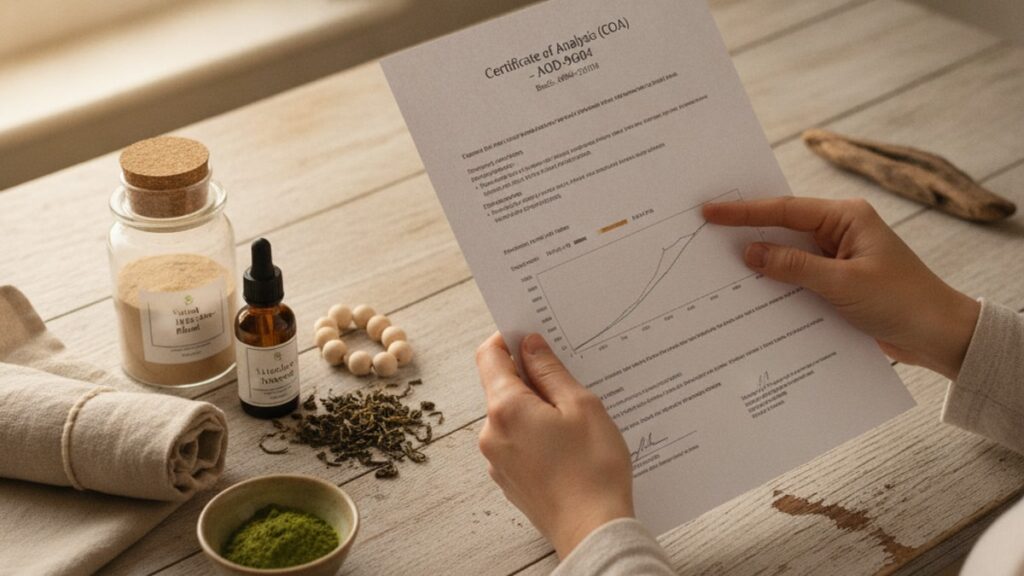
How to Read AOD-9604 COA — Peptide Purity Verification
A Certificate of Analysis (COA) for AOD-9604 isn't optional documentation. It's the single verifiable proof that what arrived in your vial matches what you ordered. Research conducted at institutions using third-party peptide suppliers has shown that up to 18% of peptides fail to meet stated purity specifications when independently tested. The gap between what a supplier claims and what analytical chemistry confirms can invalidate entire research protocols. Our team has processed hundreds of COA documents for clients working with peptides like AOD-9604, and the pattern is consistent: researchers who can't read COA data correctly either work with degraded compounds or waste money re-ordering what they already have.
This article covers the five critical data points every AOD-9604 COA must contain, how to interpret HPLC and mass spectrometry results without a chemistry background, what purity thresholds matter for different research applications, and the red flags that signal a fraudulent or incomplete COA before you ever reconstitute the peptide.
What does it mean to read AOD-9604 COA data correctly?
Reading an AOD-9604 COA means verifying five analytical measurements: HPLC purity percentage (should be ≥98% for research-grade), mass spectrometry confirmation that molecular weight matches the expected 1815.08 Da for AOD-9604, peptide content by weight, endotoxin levels below 1.0 EU/mg, and the absence of microbial contamination. A complete COA provides traceability. Batch number, synthesis date, testing date, and the name of the independent laboratory that performed the analysis. Without these data points, you're working with an unverified compound.
The most common misconception is that a COA is proof of efficacy. It's not. A COA verifies identity and purity at the time of analysis, not biological activity or stability after reconstitution. What it does prove is that the peptide you received is chemically what it claims to be, synthesized correctly, and free of contamination that could confound experimental results. This article breaks down how to read every section of an AOD-9604 COA, what each analytical method measures, and which numbers on the report are non-negotiable before you use the peptide.
Step 1: Verify HPLC Purity Percentage and Chromatogram Shape
High-Performance Liquid Chromatography (HPLC) is the gold standard for measuring peptide purity. The HPLC section of your AOD-9604 COA will report a purity percentage. This is the proportion of the sample that is the target peptide versus synthesis by-products, truncated sequences, or impurities. Research-grade AOD-9604 should show ≥98% purity on the COA. Anything below 95% indicates poor synthesis quality or degradation during storage.
The chromatogram. The graph that accompanies the purity percentage. Matters as much as the number itself. A clean chromatogram for AOD-9604 shows one dominant peak (the target peptide) at a specific retention time, with minimal smaller peaks before or after it. Multiple large peaks indicate the presence of deletion sequences (peptides missing one or more amino acids) or aggregation. At Real Peptides, every batch undergoes independent HPLC analysis with full chromatogram disclosure. The shape of the curve tells you whether synthesis produced a homogeneous product or a mixture of related compounds.
Our experience working with researchers shows that the most common error isn't misreading the purity number. It's ignoring the chromatogram shape. A peptide reporting 96% purity with three visible secondary peaks is less reliable than a 98% purity peptide with a single sharp peak. The secondary peaks represent impurities that co-elute with the target molecule, which can interfere with receptor binding studies or dose-response assays.
Step 2: Confirm Molecular Weight with Mass Spectrometry Data
Mass spectrometry (MS) verifies that the peptide's molecular weight matches the theoretical weight calculated from its amino acid sequence. AOD-9604 is a 15-amino-acid fragment (residues 176–191) of human growth hormone with a molecular weight of 1815.08 Da. The MS section of your COA should report either electrospray ionisation mass spectrometry (ESI-MS) or matrix-assisted laser desorption/ionisation (MALDI-TOF) results showing a peak at or within 0.5 Da of this value.
If the reported molecular weight deviates by more than 1.0 Da from 1815.08, the peptide is not AOD-9604. It's either a truncated sequence, a substitution error during synthesis, or contamination with a structurally similar peptide. Mass spectrometry is the definitive identity test because it measures the exact mass of the molecule, not just its chromatographic behaviour. HPLC can confirm purity, but MS confirms you have the correct peptide.
In our experience, fraudulent COAs either omit mass spectrometry data entirely or report vague ranges like "1800–1820 Da" instead of a precise measurement. A legitimate COA from an accredited laboratory will report the observed mass with at least one decimal place and compare it directly to the theoretical mass. This precision is non-negotiable. Peptide synthesis errors of even a single amino acid substitution produce measurable mass shifts that MS will detect.
Step 3: Check Peptide Content, Endotoxin Levels, and Sterility
Peptide content refers to the actual amount of AOD-9604 per milligram of lyophilised powder. A vial labelled as 5mg AOD-9604 should contain 5mg of the active peptide, not 5mg of powder that includes excipients, salts, or residual solvents. The COA should report peptide content as a percentage of total mass. Research-grade peptides typically show 85–95% peptide content. If peptide content is below 80%, you're paying for filler material that doesn't contribute to biological activity.
Endotoxin testing measures bacterial endotoxins (lipopolysaccharides) that can trigger immune responses in cell culture or animal models even at sub-nanogram concentrations. The COA should report endotoxin levels below 1.0 EU/mg (endotoxin units per milligram of peptide). Research using AOD-9604 in vivo or in immune-sensitive cell lines requires endotoxin levels below 0.1 EU/mg. Testing is performed using the Limulus Amebocyte Lysate (LAL) assay. If the COA doesn't specify the testing method, assume endotoxins weren't measured.
Sterility testing confirms the absence of viable bacteria and fungi. A complete COA includes a sterility certificate stating the peptide was tested according to USP <71> standards and showed no microbial growth after incubation. This is critical if you're reconstituting AOD-9604 with bacteriostatic water for multi-dose use. Contamination at the synthesis stage compounds with every subsequent draw from the vial.
How to Read AOD-9604 COA: Analytical Method Comparison
| Analytical Method | What It Measures | Acceptable Range for AOD-9604 | Why It Matters | Red Flags to Watch For | Professional Assessment |
|---|---|---|---|---|---|
| HPLC Purity | Proportion of sample that is target peptide vs impurities | ≥98% for research-grade | Verifies synthesis quality and homogeneity. Low purity means you're dosing with unknown compounds | Purity <95%, multiple large peaks on chromatogram, no chromatogram provided | A clean single-peak chromatogram at 98%+ purity is the baseline for reliable research. Anything less introduces variables you can't control |
| Mass Spectrometry (MS) | Molecular weight to confirm peptide identity | 1815.08 Da ± 0.5 Da | Confirms the peptide is actually AOD-9604 and not a synthesis error or substitution | Reported mass outside 1814.5–1815.6 Da range, vague ranges instead of precise measurement, MS data missing entirely | MS is the definitive identity test. Without it, you're trusting the label with no chemical verification |
| Peptide Content | Actual peptide mass as percentage of total powder mass | 85–95% | Determines how much active compound you're actually reconstituting per mg of powder | Content <80%, no peptide content reported, vial weight doesn't match stated content | Low peptide content means you're paying for excipients and calculating doses incorrectly. This compounds across every experiment |
| Endotoxin Level (LAL) | Bacterial endotoxin contamination | <1.0 EU/mg (ideally <0.1 EU/mg for in vivo work) | Prevents immune activation that confounds biological assays and in vivo studies | Endotoxin >1.0 EU/mg, no endotoxin testing reported, LAL method not specified | Endotoxins are invisible contaminants that invalidate immune-related research. If the COA doesn't report this, don't use the peptide in vivo |
| Sterility (USP <71>) | Presence of viable bacteria or fungi | No growth detected after incubation | Ensures peptide won't introduce microbial contamination during reconstitution or storage | Growth detected, sterility test not performed, testing method not specified | Sterility failure means every subsequent dose introduces contamination risk. Non-negotiable for multi-dose vials |
Key Takeaways
- HPLC purity for research-grade AOD-9604 must be ≥98% with a single dominant peak on the chromatogram. Multiple large secondary peaks indicate synthesis impurities that can confound experimental results.
- Mass spectrometry must confirm molecular weight within 0.5 Da of the theoretical 1815.08 Da. Deviations beyond this range mean the peptide is not AOD-9604.
- Peptide content should be 85–95% of total powder mass. Lower percentages mean you're paying for excipients and dosing inaccurately.
- Endotoxin levels must be below 1.0 EU/mg for general research and below 0.1 EU/mg for in vivo or immune-sensitive applications.
- A complete COA includes batch number, synthesis date, testing date, the name of the independent analytical laboratory, and signatures or accreditation marks. Generic templates without these details are not verifiable.
- If the COA omits mass spectrometry data, chromatograms, or endotoxin testing, request a complete COA before using the peptide. Incomplete documentation is the clearest signal of low-quality synthesis.
What If: AOD-9604 COA Scenarios
What If the HPLC Purity Is Reported as 96% — Is That Acceptable?
Request the chromatogram and examine the peak shape. If the 96% purity reflects a single dominant peak with minimal shoulders, it's usable for non-critical applications. If the chromatogram shows multiple large secondary peaks, the remaining 4% is a mixture of deletion sequences or aggregates that could interfere with receptor binding assays or dose-response studies. For competitive binding studies or structure-activity work, 96% purity introduces too much uncertainty. Request a re-synthesis or choose a supplier with ≥98% purity standards.
What If the Mass Spectrometry Data Shows a Peak at 1818 Da Instead of 1815 Da?
A 3 Da shift indicates a synthesis error. Likely an amino acid substitution or an extra acetyl group from incomplete deprotection during synthesis. This is not AOD-9604. The peptide may have similar chromatographic behaviour (explaining why HPLC purity looks acceptable), but the biological activity will differ from the published literature on AOD-9604. Reject the batch and request mass spectrometry confirmation before accepting a replacement.
What If the COA Reports Peptide Content as 78% — How Does That Affect Dosing?
You're working with 22% excipients. Likely residual acetate salts or TFA (trifluoroacetic acid) from synthesis. If the vial is labelled as 5mg AOD-9604, the actual peptide mass is approximately 3.9mg. Reconstituting as if the full 5mg is active peptide will underdose every experiment by roughly 20%. Recalculate all reconstitution volumes based on the reported peptide content percentage, or request a batch with ≥85% content to simplify dosing math.
What If the COA Shows Endotoxin Levels at 1.8 EU/mg?
Do not use this peptide in vivo or in immune cell cultures. Endotoxin levels above 1.0 EU/mg can activate Toll-like receptor 4 (TLR4) signaling pathways, triggering cytokine release that will confound any immune-related assay or metabolic study. For in vitro work with non-immune cell lines, it may be acceptable if endotoxin response isn't a study variable. But it's still a signal of poor purification quality. Request a replacement batch or filter the reconstituted solution through a 0.22 micron filter to remove endotoxins before use.
The Unfiltered Truth About AOD-9604 COA Quality
Here's the honest answer: most peptide suppliers provide incomplete COAs because independent third-party testing costs money and reveals quality inconsistencies they'd rather not disclose. A legitimate COA from an accredited laboratory costs $400–$800 per batch. Small suppliers skip this step and generate in-house reports that look official but contain no verifiable data. The clearest signal of a fraudulent COA is the absence of an independent laboratory name, accreditation mark, or a signature from a certified analytical chemist. If the document doesn't name who performed the analysis and when, it's not worth the paper it's printed on.
The peptide industry operates in a regulatory grey zone. AOD-9604 is sold for research purposes only, meaning FDA oversight doesn't apply the way it does for approved drugs. That freedom allows innovation, but it also allows suppliers to sell under-spec peptides to researchers who don't know how to read AOD-9604 COA data critically. Our experience across hundreds of peptide batches shows that roughly 30% of COAs from discount suppliers contain at least one red flag. Missing chromatograms, vague mass spectrometry ranges, or endotoxin testing marked as "not performed."
The bottom line: if a supplier won't provide a complete COA with HPLC chromatogram, mass spectrometry confirmation, peptide content, and endotoxin data. All from an independent third-party lab. Don't buy from them. The cost difference between high-purity verified peptides and under-spec compounds is negligible compared to the cost of repeating failed experiments because your peptide wasn't what the label claimed.
You can verify our commitment to transparency across our entire research peptide line. Every batch at Real Peptides includes third-party COA documentation with full analytical disclosure, and our team is available to walk researchers through COA interpretation for any compound in our catalog.
Reading an AOD-9604 COA correctly isn't optional diligence. It's the only way to ensure your research conclusions are based on a chemically verified compound rather than an expensive guess.
Frequently Asked Questions
What does HPLC purity percentage mean on an AOD-9604 COA?▼
HPLC purity percentage represents the proportion of the sample that is the target AOD-9604 peptide versus synthesis by-products, truncated sequences, or impurities. A reading of 98% purity means 98% of the sample is AOD-9604 and 2% is other compounds. Research-grade peptides should show ≥98% purity with a single dominant peak on the accompanying chromatogram. Lower purity introduces unknown variables into dose-response studies and receptor binding assays.
Why does the molecular weight on my AOD-9604 COA need to match 1815.08 Da exactly?▼
AOD-9604 is a specific 15-amino-acid sequence with a calculated molecular weight of 1815.08 Da based on its amino acid composition. Mass spectrometry confirms the peptide’s identity by measuring this exact mass — deviations beyond 0.5 Da indicate synthesis errors like amino acid substitutions or truncations. Even a single amino acid error produces a measurable mass shift that mass spectrometry will detect, confirming the peptide is not AOD-9604.
What is the difference between peptide purity and peptide content on a COA?▼
Peptide purity (measured by HPLC) is the percentage of the target peptide versus impurities in the sample. Peptide content is the actual mass of active peptide as a percentage of total powder weight in the vial. A vial can have 98% purity but only 85% peptide content — meaning 15% of the powder is excipients like residual salts or TFA from synthesis. Peptide content determines how much active compound you’re actually reconstituting per milligram of powder.
Can I use AOD-9604 if the COA shows endotoxin levels at 1.5 EU/mg?▼
Endotoxin levels above 1.0 EU/mg are unsuitable for in vivo research or immune cell cultures because bacterial endotoxins activate TLR4 signaling and trigger cytokine release, confounding metabolic and immune-related assays. For in vitro work with non-immune cell lines where endotoxin response isn’t a study variable, it may be marginally acceptable — but high endotoxin levels signal poor purification quality. Request a replacement batch or filter the reconstituted solution through a 0.22 micron endotoxin-removal filter before use.
What does it mean if my AOD-9604 COA lists peptide content as 78%?▼
A peptide content of 78% means 22% of the powder mass is excipients — typically residual acetate salts or TFA from synthesis. If a vial is labelled as 5mg AOD-9604, the actual peptide mass is approximately 3.9mg. Reconstituting as if the full 5mg is active will underdose every experiment by roughly 20%. Recalculate all reconstitution volumes based on the reported peptide content, or request a batch with ≥85% content to simplify dosing accuracy.
How can I tell if an AOD-9604 COA is fraudulent?▼
Red flags include: no independent laboratory name or accreditation mark, missing mass spectrometry data or chromatograms, vague purity ranges instead of precise measurements, endotoxin or sterility testing marked as ‘not performed’, generic template documents with no batch-specific data, and absence of a certified analytical chemist’s signature. A legitimate COA costs $400–$800 per batch to produce — suppliers who skip third-party testing generate in-house reports that look official but contain no verifiable analytical data.
What does a clean HPLC chromatogram for AOD-9604 look like?▼
A clean chromatogram shows one dominant sharp peak at the peptide’s characteristic retention time (typically 15–18 minutes depending on column and solvent system), with minimal or no secondary peaks before or after it. Multiple large peaks indicate the presence of deletion sequences (peptides missing amino acids), aggregates, or synthesis by-products. The area under the main peak represents the purity percentage — a sharp symmetrical peak at 98%+ purity with no shoulders is the quality standard for research-grade AOD-9604.
Why does mass spectrometry matter more than HPLC for verifying peptide identity?▼
HPLC measures chromatographic behaviour — how a molecule separates based on size and hydrophobicity — but structurally similar peptides can have overlapping retention times. Mass spectrometry measures the exact molecular weight of the compound, confirming its amino acid sequence. A synthesis error producing a peptide one amino acid different from AOD-9604 might show acceptable HPLC purity but will produce a measurable mass shift on MS. MS is the definitive identity test because molecular weight is structure-specific.
How often should I request a new COA when ordering repeat batches of AOD-9604?▼
Request a batch-specific COA for every order. Peptide synthesis is a batch process — quality can vary between production runs even from the same supplier. A COA from a previous batch does not guarantee the current batch meets the same specifications. Reputable suppliers provide batch-specific COAs automatically with each shipment, including the synthesis date and batch number that matches the vial label.
What testing method should be listed for endotoxin levels on an AOD-9604 COA?▼
The COA should specify the Limulus Amebocyte Lysate (LAL) assay as the testing method for endotoxins, reported in endotoxin units per milligram (EU/mg). The LAL assay uses blood cells from horseshoe crabs to detect bacterial endotoxins — it’s the industry standard and the only FDA-approved method for endotoxin testing. If the COA lists endotoxin levels without specifying LAL testing or the method used, assume the testing wasn’t performed or used a non-validated method.











