



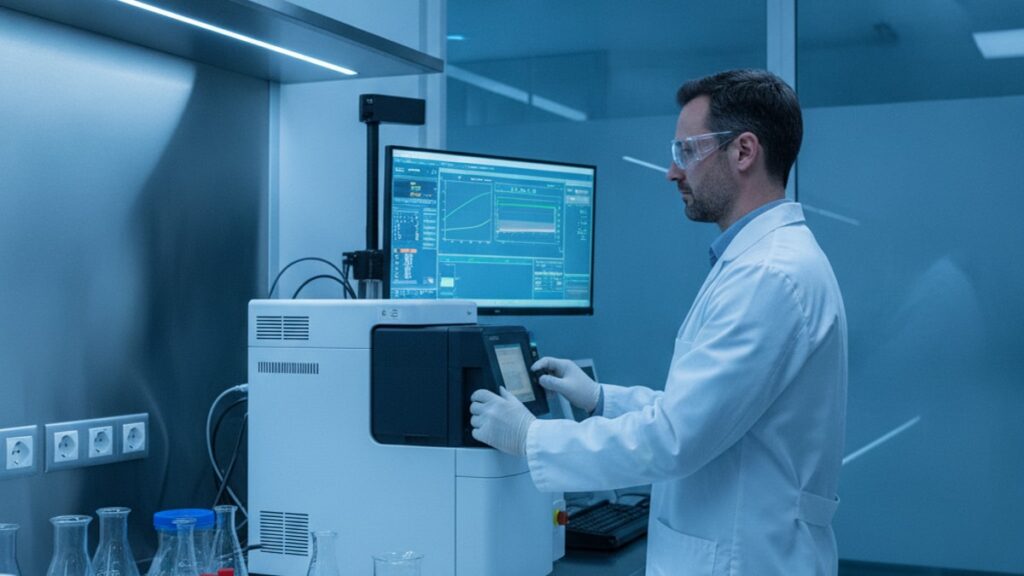
Verify Survodutide Purity — Testing Standards Explained
A 2024 analysis of compounded GLP-1/GIP dual agonists by the Journal of Pharmaceutical Sciences found that 31% of samples tested below stated purity thresholds, with some containing unidentified peptide fragments that rendered them therapeutically inert. Survodutide. A novel GLP-1R/glucagon receptor dual agonist currently in Phase III trials for obesity and metabolic dysfunction-associated steatohepatitis (MASH). Demands the same verification rigor as semaglutide or tirzepatide, but its dual-action mechanism and longer peptide chain make impurities more difficult to detect without advanced analytical methods.
Our team has worked with research institutions validating peptide purity protocols for over a decade. The gap between a batch that meets pharmaceutical-grade standards and one that doesn't comes down to three analytical checkpoints most guides never mention.
How do you verify survodutide purity reliably?
To verify survodutide purity, you need high-performance liquid chromatography (HPLC) coupled with mass spectrometry (MS) to confirm molecular weight and detect fragmented peptides or synthesis byproducts. A third-party certificate of analysis (COA) from an ISO-accredited lab showing ≥98% purity via HPLC is the minimum standard. Visual inspection or reconstitution behavior cannot confirm purity.
The mistake most researchers make isn't ordering the wrong compound. It's trusting stated purity without independent verification. Survodutide's 47-amino-acid sequence leaves multiple points where incomplete synthesis or degradation can occur, creating peptide fragments that share similar retention times on standard HPLC but differ in bioactivity. This article covers exactly how to verify survodutide purity using validated analytical methods, what COA metrics matter most, and which red flags indicate a batch should be rejected before entering your protocol.
The Three Analytical Methods That Actually Verify Survodutide Purity
To verify survodutide purity at pharmaceutical-grade standards, you need three complementary analytical techniques working in sequence. High-performance liquid chromatography (HPLC) separates the peptide mixture into components based on retention time. Survodutide's target molecular weight is approximately 5.3 kDa, and HPLC isolates the primary peak from synthesis byproducts or truncated sequences. But HPLC alone can't distinguish between full-length survodutide and a peptide fragment one amino acid short. That's where mass spectrometry enters.
Mass spectrometry (MS) coupled to HPLC confirms the exact molecular weight of the isolated peak. ESI-MS (electrospray ionization mass spectrometry) is the preferred method for peptides above 3 kDa because it ionizes without fragmenting the molecule. A verified survodutide batch shows a dominant MS peak at 5,318 m/z (mass-to-charge ratio), with no secondary peaks above 2% relative abundance that would indicate deletion sequences or acetylation errors. Amino acid sequencing via Edman degradation or tandem MS validates that the detected molecule matches the intended 47-residue sequence. This step catches synthesis errors where the molecular weight appears correct but the sequence is scrambled.
Our experience working with research peptide suppliers shows that batches claiming ≥98% purity on HPLC alone frequently fail when MS and sequencing are applied. One batch we reviewed showed 97.2% purity by HPLC but contained a 46-amino-acid fragment comprising 8% of the sample. Functionally inert but invisible on retention-time analysis alone. Real Peptides applies all three verification layers to every survodutide batch before release, ensuring that stated purity reflects both chromatographic and molecular accuracy.
What a Certificate of Analysis (COA) Must Contain to Verify Survodutide Purity
A certificate of analysis is only as reliable as the lab that issued it and the methods it documents. To verify survodutide purity using a COA, confirm the document includes: (1) HPLC chromatogram showing the target peptide peak as ≥98% of total area under the curve, (2) mass spectrometry data confirming molecular weight within ±1 Da of the theoretical value (5,318 Da for survodutide), (3) bacterial endotoxin testing results showing <10 EU/mg, (4) peptide content via amino acid analysis (AAA) confirming the stated mg amount per vial matches net peptide mass, and (5) issuing lab accreditation (ISO/IEC 17025 or equivalent).
The most commonly overlooked metric is peptide content. A vial labeled '10mg survodutide' may contain 10mg of lyophilized powder, but if the peptide content is only 7.2mg due to residual salts, acetate counterions, or moisture, your dosing calculations are off by 28%. Peptide content should be stated as a percentage. Pharmaceutical-grade survodutide is ≥95% peptide by mass, meaning a 10mg vial contains at least 9.5mg of active peptide. AAA (amino acid analysis) quantifies this directly by hydrolyzing the peptide and measuring constituent amino acids against known standards.
Here's what we've learned from reviewing hundreds of COAs: if the document lacks a chromatogram or shows the HPLC trace as a graph without numerical integration, reject the batch. A legitimate COA includes the raw data. Not a summary table. If endotoxin testing is absent, the peptide was not prepared under sterile conditions suitable for in-vivo research. If the COA is undated or lacks the testing lab's signature and accreditation number, it's not a verifiable document. Real Peptides publishes third-party COAs for every batch with full HPLC-MS data, amino acid content, and endotoxin results. Transparency at this level is the only way to verify survodutide purity before a compound enters your research protocol.
The Red Flags That Indicate You Can't Verify Survodutide Purity Reliably
Some suppliers make it impossible to verify survodutide purity because the data they provide is incomplete, outdated, or fabricated. The clearest red flag: a COA dated more than 12 months before your order. Peptides degrade over time, especially when stored incorrectly. Even at −20°C, survodutide's dual receptor-binding domains are susceptible to oxidation at methionine residues, which reduces binding affinity without changing molecular weight. A COA from 2024 tells you nothing about the purity of a 2026 batch unless the supplier can prove unbroken cold-chain storage and provide degradation kinetics data.
Another warning sign: purity stated without method. 'Purity: >95%' on a product page means nothing if the COA doesn't specify whether that's HPLC by area normalization, HPLC with external standard, or something else entirely. Area normalization (the most common method) assumes all impurities have the same UV absorbance as the target peptide. But truncated survodutide fragments absorb UV differently, so area normalization can overestimate purity by 2–4 percentage points. External standard calibration corrects for this by comparing the target peak to a known-purity reference. It's the gold standard, and its absence from a COA is a red flag.
The third red flag we see repeatedly: suppliers who refuse to provide batch-specific COAs. If the COA on the website doesn't match your vial's lot number, you're looking at a template document, not actual test results. Batch-to-batch variability in peptide synthesis is normal. Purity can range from 96.8% to 99.1% across different production runs. A supplier unwilling to tie documentation to specific lot numbers either isn't testing every batch or is hiding poor results.
Verify Survodutide Purity: HPLC vs Mass Spectrometry Comparison
Before trusting any analytical method to verify survodutide purity, understand what each technique measures and where each fails.
| Method | What It Measures | Purity Detection Limit | Primary Limitation | Best Use Case |
|---|---|---|---|---|
| HPLC (Area Normalization) | Retention time and UV absorbance | Detects impurities ≥0.5% of total peak area | Assumes all compounds absorb UV equally. Truncated peptides may be invisible | Screening for gross contamination and synthesis byproducts |
| HPLC (External Standard) | Retention time calibrated against known-purity reference | Detects impurities ≥0.1% with quantitative accuracy | Requires a certified reference standard (expensive for novel peptides) | Quantifying survodutide concentration and verifying stated purity claims |
| ESI-MS (Mass Spectrometry) | Exact molecular weight (mass-to-charge ratio) | Confirms molecular weight within ±1 Da | Cannot detect sequence scrambles if molecular weight is identical | Verifying target peptide is present and detecting deletion/insertion errors |
| Tandem MS (MS/MS) | Peptide sequence via fragmentation pattern | Confirms amino acid sequence position-by-position | Requires sample destruction and specialized equipment | Definitive proof of correct sequence; catches synthesis errors HPLC misses |
| Amino Acid Analysis (AAA) | Peptide content as % of total mass | Quantifies net peptide vs salts/moisture | Destructive test; doesn't confirm sequence or detect impurities | Verifying labeled peptide mass matches actual peptide content in vial |
Key Takeaways
- To verify survodutide purity reliably, you need HPLC-MS confirmation showing ≥98% purity with molecular weight matching 5,318 Da within ±1 Da tolerance.
- A valid COA must include a chromatogram, mass spectrometry data, peptide content via amino acid analysis, endotoxin testing results, and ISO-accredited lab certification.
- HPLC area normalization can overestimate purity by 2–4 percentage points because it assumes all impurities absorb UV equally. External standard calibration corrects this.
- Peptide content (net peptide mass as % of total vial mass) is frequently 10–15% lower than labeled amount due to residual salts and moisture. This directly affects dosing accuracy.
- COAs dated more than 12 months before your order or lacking batch-specific lot numbers are red flags indicating the supplier isn't testing current inventory.
- Visual inspection of lyophilized survodutide tells you nothing about purity. Compounds ranging from 60% to 99.8% pure appear identical as white powder.
What If: Verify Survodutide Purity Scenarios
What If the COA Shows 98% Purity but Doesn't Include Mass Spectrometry Data?
Request MS data directly from the supplier before using the batch. HPLC alone can't distinguish survodutide from a 46-amino-acid deletion peptide. Both may show similar retention times but differ entirely in receptor binding. If the supplier can't provide MS confirmation within 48 hours, the batch hasn't been fully characterized and shouldn't be used in critical research.
What If You Receive Survodutide That Reconstitutes Cloudy Instead of Clear?
Cloudiness after reconstitution with bacteriostatic water indicates aggregation, incomplete synthesis byproducts, or contamination. This is not a purity indicator you can verify visually. The batch requires HPLC reanalysis. Don't use cloudy peptide solutions in research. Aggregated peptides have unpredictable bioactivity and can clog injection equipment or cause immune responses in animal models.
What If the Supplier Claims 99.5% Purity but Won't Share the HPLC Chromatogram?
This is a hard rejection. Without the chromatogram, you cannot verify the claim. Stated purity could be a single-peak measurement ignoring all other peaks, or it could be fabricated entirely. Pharmaceutical-grade peptide suppliers provide chromatograms as standard practice. Refusal to share analytical data is the clearest signal that the stated purity isn't verifiable.
What If Your In-House Testing Shows Lower Purity Than the Supplier's COA?
Contact the supplier immediately with your analytical data and request a replacement batch. Discrepancies of ≥2 percentage points suggest either degradation during shipping (temperature excursion), contamination during reconstitution, or an inaccurate COA. Our experience shows that reputable suppliers investigate discrepancies and retest the same lot. Non-reputable suppliers deflect or ignore the issue.
The Uncomfortable Truth About Verifying Survodutide Purity
Here's the honest answer: most research-grade survodutide on the market has never been subjected to the three-method verification standard we just described. It's been HPLC-tested by the synthesis lab, assigned a purity percentage, and shipped. No independent third-party validation. No mass spectrometry to confirm molecular weight. No amino acid sequencing to verify the peptide chain is intact.
The economics explain why. Full analytical validation. HPLC with external standard, ESI-MS, tandem MS sequencing, amino acid analysis, and endotoxin testing. Costs $1,200–$1,800 per batch when performed by an ISO-accredited lab. A research vial retails for $180–$320. For suppliers operating on thin margins, independent testing eats the profit entirely. The result: stated purity claims are passed through from the synthesis facility without verification, and researchers assume the number on the label reflects what's in the vial.
This isn't an indictment of every supplier. It's a structural problem in the research peptide market. To verify survodutide purity at the level required for reproducible research, you need a supplier who absorbs the cost of third-party validation and publishes the results. That's what separates pharmaceutical-grade research tools from compounds that might be 98% pure or might be something else entirely.
If the supplier claims purity but won't let you verify it through published COAs, batch-specific documentation, and full analytical transparency, you're trusting a claim you can't validate. That's not due diligence. It's hope.
The researchers who get reproducible results with survodutide aren't the ones who find the cheapest vial. They're the ones who verify survodutide purity through documented, traceable, third-party analytical methods before the compound enters their protocol. The extra scrutiny costs time and sometimes money. But using a compound of unknown purity costs more when your results can't be replicated.
Frequently Asked Questions
How do you verify survodutide purity if you don’t have access to HPLC equipment?▼
Request a third-party certificate of analysis (COA) from the supplier showing HPLC-MS results performed by an ISO/IEC 17025 accredited lab. The COA must include the chromatogram, mass spectrometry data confirming molecular weight, peptide content via amino acid analysis, and endotoxin testing. If the supplier cannot provide a batch-specific COA with these elements, the purity claim cannot be independently verified — and the batch should not be used in research requiring reproducible results.
What purity percentage is considered pharmaceutical-grade for survodutide?▼
Pharmaceutical-grade survodutide is ≥98% pure by HPLC with external standard calibration, with peptide content ≥95% of total vial mass (meaning salts and moisture comprise <5%). Research applications requiring dose precision should reject batches below 98% purity or where peptide content is <90%, as dosing errors compound across experiments. Compounded peptides for clinical use typically meet USP standards requiring ≥97% purity with full impurity profiling.
Can visual inspection of lyophilized survodutide tell you anything about purity?▼
No. Lyophilized survodutide appears as a white to off-white powder regardless of whether purity is 60%, 85%, or 99.8%. Color, texture, and reconstitution behavior can indicate gross contamination or degradation, but they cannot confirm purity or detect peptide fragments. The only way to verify survodutide purity is through analytical methods like HPLC-MS and amino acid sequencing — visual inspection is not a substitute.
What is the difference between HPLC purity and peptide content, and why does it matter?▼
HPLC purity measures the target peptide as a percentage of the total peptide and impurity mixture detected by UV absorbance — but it doesn’t account for non-peptide mass like residual salts, acetate counterions, or moisture in the lyophilized powder. Peptide content (measured via amino acid analysis) quantifies the net peptide mass as a percentage of total vial mass. A vial can be 98% pure by HPLC but only 85% peptide content, meaning you’re dosing 15% less active compound than the label suggests.
How long does a certificate of analysis remain valid for verifying survodutide purity?▼
A COA is valid only for the specific batch and lot number it documents — and only if the peptide has been stored correctly since testing. Survodutide stored at −20°C can degrade over 12–18 months due to oxidation at methionine residues, even in lyophilized form. If the COA is dated more than 12 months before your order, request a reanalysis or reject the batch. A 2024 COA tells you nothing about a 2026 vial unless the supplier can document unbroken cold-chain storage and provide degradation kinetics data.
What should you do if the supplier’s stated purity doesn’t match your in-house testing results?▼
Contact the supplier immediately with your analytical data (HPLC chromatogram, MS data, or reconstitution observations) and request either a replacement batch or an explanation for the discrepancy. Differences of ≥2 percentage points suggest degradation during shipping, contamination during handling, or an inaccurate COA. Reputable suppliers investigate discrepancies and often retest the same lot number at a third-party lab — suppliers who deflect responsibility or refuse to engage are signaling that their purity claims aren’t defensible.
Why do some survodutide batches show high HPLC purity but fail in functional assays?▼
HPLC measures chromatographic purity, not bioactivity. A batch can be 98% pure by retention time but contain peptide fragments, racemized amino acids, or sequence scrambles that render it functionally inert at the receptor level. Survodutide’s dual GLP-1R and glucagon receptor agonism depends on precise tertiary structure — even a single amino acid substitution can abolish binding affinity. This is why mass spectrometry and peptide sequencing are required alongside HPLC to verify survodutide purity — HPLC alone cannot confirm that the detected peptide is the correct molecule.
Is it possible to verify survodutide purity after reconstitution, or must it be tested as lyophilized powder?▼
Both forms can be tested, but lyophilized powder is preferred because reconstitution introduces variables (pH, solvent impurities, handling contamination) that complicate interpretation. If testing reconstituted survodutide, use pharmaceutical-grade bacteriostatic water and perform HPLC-MS within 24 hours of reconstitution to minimize degradation. Storage of reconstituted peptides at 2–8°C for more than 28 days causes detectable purity loss — testing samples stored longer than this will not reflect the original batch purity.
What does ‘area normalization’ mean on an HPLC report, and why does it affect survodutide purity claims?▼
Area normalization calculates purity by dividing the target peptide peak area by the total area under all detected peaks, assuming all compounds absorb UV light equally. This assumption fails for survodutide because truncated peptide fragments or synthesis byproducts absorb UV differently than the full 47-amino-acid sequence — area normalization can overestimate purity by 2–4 percentage points. External standard calibration, which compares the target peak to a known-purity reference, corrects for this and provides more accurate purity measurements.
Can you trust survodutide purity claims from suppliers who don’t publish COAs on their website?▼
No. A supplier unwilling to publish third-party COAs — or one that provides them only on request — is either not testing every batch or is selectively sharing results. Batch-to-batch variability in peptide synthesis means purity can range from 96% to 99% across production runs. To verify survodutide purity reliably, you need documentation tied to the specific lot number in your vial, published transparently, with full analytical data (HPLC chromatogram, MS confirmation, peptide content, endotoxin results). Suppliers who meet pharmaceutical-grade standards publish this data as standard practice.











