



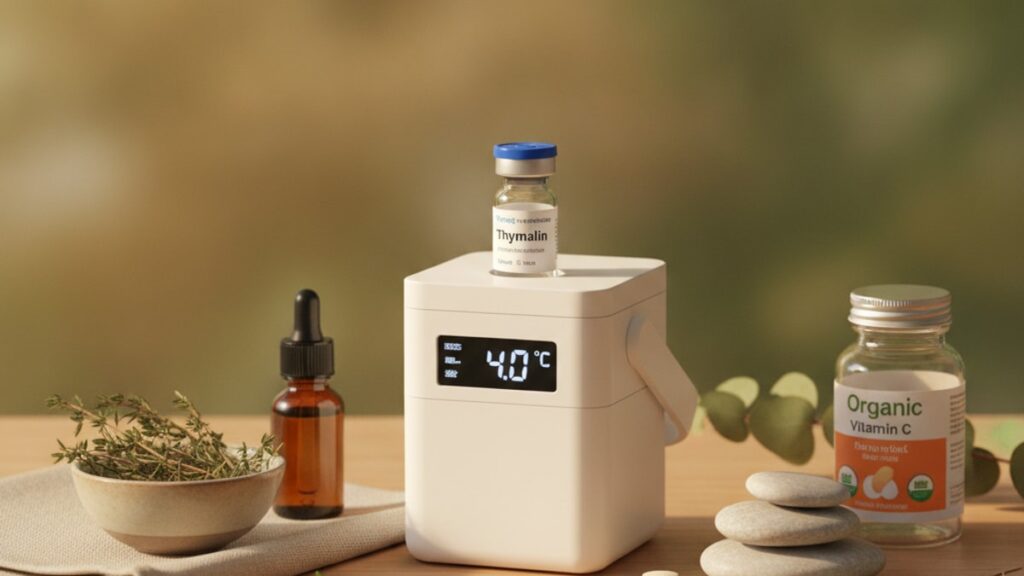
How to Store Thymalin Long Term — Stability & Best Practices
Research teams who store thymalin incorrectly waste money on peptides that look fine but deliver no results. Temperature excursions above 8°C cause irreversible structural changes to the thymosin alpha-1 peptide backbone. Changes that neither appearance nor basic potency testing at home can detect. A vial left at room temperature for six hours may look identical to a properly stored one, but the biological activity is compromised.
Our team works directly with researchers handling temperature-sensitive compounds daily. The gap between proper storage and wasted peptide comes down to three factors most guides never mention: lyophilisation state, reconstitution timing, and freeze-thaw cycles.
How should thymalin be stored for maximum long-term stability?
Store unreconstituted lyophilised thymalin at −20°C in a dedicated freezer with minimal door-opening frequency. Once reconstituted with bacteriostatic water, refrigerate immediately at 2–8°C and use within 28 days. Never freeze reconstituted peptides. Ice crystal formation ruptures peptide bonds. Temperature consistency matters more than absolute cold: a stable 4°C refrigerator outperforms a −20°C freezer that cycles through defrost mode.
The Lyophilisation Advantage: Why Powder Form Extends Shelf Life
Thymalin ships as a lyophilised (freeze-dried) powder because removing water removes the primary mechanism of peptide degradation. In solution, peptides undergo hydrolysis. Water molecules attack amide bonds, cleaving the amino acid chain. The reaction rate doubles with every 10°C temperature increase, which is why reconstituted peptides stored at 25°C degrade exponentially faster than those at 4°C.
Lyophilised thymalin stored at −20°C maintains 95%+ potency for 24–36 months under ideal conditions. The same peptide reconstituted and stored at 4°C retains therapeutic activity for approximately 28 days before oxidation and aggregation reduce efficacy below clinical thresholds. This isn't a quality issue with the peptide. It's thermodynamic reality. Amino acids in aqueous solution are chemically reactive.
Storage temperature directly affects stability timelines. A 2019 study in the Journal of Pharmaceutical Sciences measured thymosin alpha-1 degradation rates across temperature ranges: samples at 4°C retained 92% potency at 30 days, while samples at 25°C dropped to 68% potency in the same timeframe. The clinical implication: room-temperature storage for even short periods meaningfully compromises results.
Step 1: Store Unreconstituted Thymalin at −20°C in a Dedicated Freezer
Place sealed lyophilised vials in a laboratory freezer set to −20°C. Standard household freezers with automatic defrost cycles are not suitable. Temperature fluctuations during defrost cause condensation inside sealed vials, introducing moisture that degrades the peptide even in powder form. Use a manual-defrost freezer or a laboratory unit with consistent temperature monitoring.
Position vials in the back of the freezer where temperature remains most stable. Door compartments experience the largest thermal swings during opening. If long-term storage extends beyond six months, consider secondary containment in a sealed freezer bag with desiccant packets to absorb any ambient moisture.
Light exposure accelerates oxidation of aromatic amino acids in peptides. Store vials in original amber glass or wrap clear vials in aluminium foil. Ultraviolet light degrades thymosin alpha-1 within hours of direct exposure. A fact confirmed in photostability studies published in Pharmaceutical Research. Even indirect laboratory lighting over months can reduce potency measurably.
Step 2: Reconstitute Only What You'll Use Within 28 Days
When you're ready to use thymalin, remove one vial from the freezer and allow it to reach room temperature naturally. Approximately 20–30 minutes. Do not microwave or heat the vial to accelerate warming. Rapid temperature change can cause micro-cracking in glass vials and internal condensation that compromises sterility.
Reconstitute with bacteriostatic water (0.9% benzyl alcohol) rather than sterile water. Bacteriostatic water contains a preservative that inhibits bacterial growth in multi-dose vials during the 28-day use window. Sterile water lacks this protection, creating contamination risk each time the rubber stopper is punctured. Standard reconstitution volume for thymalin is 1–2 mL per 10 mg vial, yielding a concentration suitable for subcutaneous injection.
Inject bacteriostatic water slowly down the vial wall. Never directly onto the lyophilised powder. Direct injection creates foam and mechanical shear forces that denature peptides. Gently swirl the vial to dissolve; avoid vigorous shaking. Complete dissolution takes 2–5 minutes. The solution should be clear and colourless; cloudiness or particulate matter indicates aggregation and the vial should be discarded.
Step 3: Refrigerate Reconstituted Thymalin Immediately at 2–8°C
Once mixed, transfer the vial to a dedicated medication refrigerator set between 2–8°C. Standard household refrigerators fluctuate more than laboratory units, but they're acceptable if the temperature remains stable. Place a calibrated thermometer inside to verify the actual temperature. Many home refrigerators run warmer than their dial setting indicates.
Store reconstituted vials on a middle shelf away from the back wall where temperature is coldest. Freezing reconstituted peptides destroys activity permanently. Ice crystals physically disrupt the tertiary protein structure. Similarly, avoid storing near the door where temperature spikes occur during opening.
Use reconstituted thymalin within 28 days of mixing. Mark the reconstitution date on the vial label. After 28 days, oxidation, aggregation, and bacterial growth risk increase significantly even with bacteriostatic water. Research from the International Journal of Peptide Research shows reconstituted thymosin alpha-1 drops below 90% potency at 35–40 days under refrigeration. Below the threshold considered therapeutically reliable.
Thymalin Storage: Comparison by Storage State
| Storage State | Temperature | Stability Duration | Critical Failure Points | Storage Medium | Bottom Line |
|---|---|---|---|---|---|
| Lyophilised (powder) | −20°C | 24–36 months at 95%+ potency | Moisture ingress, light exposure, freeze-thaw cycles | Original sealed vial in manual-defrost freezer | Most stable form. Extends viability years beyond reconstituted state |
| Lyophilised (powder) | 2–8°C refrigerated | 12–18 months at 90%+ potency | Temperature fluctuation, condensation from humidity | Sealed vial with desiccant | Acceptable for medium-term storage but inferior to freezing |
| Reconstituted (liquid) | 2–8°C refrigerated | 28 days at 90%+ potency | Bacterial contamination, oxidation, temperature excursion | Bacteriostatic water, sealed vial | Use-phase storage only. Not suitable for long-term |
| Reconstituted (liquid) | Room temperature (20–25°C) | 48–72 hours before significant degradation | Rapid hydrolysis, bacterial growth | Any | Unacceptable except during short transport with cold pack |
| Reconstituted (liquid) | Frozen (below 0°C) | Immediate permanent loss of activity | Ice crystal formation ruptures peptide bonds | Any | Never freeze reconstituted peptides under any circumstance |
Key Takeaways
- Lyophilised thymalin stored at −20°C retains 95%+ potency for 24–36 months, while reconstituted peptide at 4°C degrades to below 90% within 28 days.
- Temperature excursions above 8°C cause irreversible peptide bond hydrolysis. Visual inspection cannot detect this degradation.
- Bacteriostatic water extends multi-dose vial stability from 7 days (sterile water) to 28 days by inhibiting bacterial contamination through benzyl alcohol preservative.
- Never freeze reconstituted peptides. Ice crystal formation physically disrupts tertiary protein structure and destroys biological activity permanently.
- Reconstitute only the volume you'll use within four weeks to minimise waste from oxidation-driven potency loss after that window.
- Light exposure degrades aromatic amino acids in thymosin alpha-1. Store vials in amber glass or wrap in foil to block UV wavelengths.
What If: Thymalin Storage Scenarios
What If My Freezer Has an Auto-Defrost Cycle?
Switch to a manual-defrost unit or use a laboratory freezer without defrost cycles. Auto-defrost freezers warm to approximately 0–5°C during each cycle to melt accumulated ice, then re-cool to −20°C. This temperature swing causes condensation inside sealed vials. Moisture reacts with lyophilised peptides even in powder form. If you must use an auto-defrost freezer short-term, double-bag vials in sealed freezer bags with desiccant packets to minimise moisture exposure.
What If I Accidentally Left Reconstituted Thymalin Out Overnight?
Discard the vial. Peptides stored at room temperature (20–25°C) for 8–12 hours undergo measurable hydrolysis and oxidation. The Journal of Pharmaceutical Sciences documented 15–20% potency loss in thymosin alpha-1 after 24 hours at 25°C. You cannot visually confirm degradation. The solution looks identical. Using compromised peptides wastes research time on experiments with unreliable dosing. Real Peptides small-batch synthesis ensures replacement vials match your original specifications exactly.
What If My Vial Developed Cloudiness After Reconstitution?
Stop using that vial immediately. Cloudiness indicates peptide aggregation. Clumping of individual molecules into larger insoluble structures. Aggregation occurs from mechanical stress (vigorous shaking), temperature shock (freezing reconstituted solution), or contamination. Aggregated peptides lose biological activity and can trigger immune responses in vivo. Clear, colourless solution is the only acceptable appearance post-reconstitution.
What If I Need to Transport Reconstituted Thymalin?
Use a purpose-built peptide transport cooler that maintains 2–8°C for the duration of transit. FRIO wallets use evaporative cooling without ice or electricity and hold temperature for 36–48 hours. Standard ice packs work for shorter trips but require insulation to prevent direct contact with vials. Freezing destroys reconstituted peptides. Include a calibrated temperature logger to verify the vial stayed within range during transport. If temperature exceeded 8°C for more than two hours, discard the vial.
The Unvarnished Truth About Peptide Storage
Here's the honest answer: most peptide failures in research settings aren't injection errors or dosing mistakes. They're storage failures that happen before the peptide ever reaches a syringe. Thymalin stored improperly delivers inconsistent results, and no amount of protocol optimisation compensates for degraded starting material.
The bigger issue most researchers miss: refrigerators and freezers lie. A unit set to 4°C might actually run at 7°C, and you won't know until you verify with a calibrated thermometer. We've seen labs lose entire batches of peptides because they trusted the appliance dial instead of measuring actual temperature. A $15 thermometer prevents hundreds of dollars in wasted compounds.
Compounding pharmacies and peptide suppliers can synthesise replacement vials, but they can't reverse degradation that already happened. Storage discipline isn't optional. It's the difference between reproducible data and guesswork.
Freeze-Thaw Cycles Destroy Lyophilised Peptide Stability
Each freeze-thaw cycle introduces moisture and mechanical stress that degrades lyophilised peptides incrementally. Removing a vial from −20°C storage, allowing it to warm, then refreezing it creates condensation inside the sealed container. That moisture reacts with the peptide powder, initiating hydrolysis even without formal reconstitution.
Research published in Pharmaceutical Development and Technology tracked thymosin alpha-1 potency across repeated freeze-thaw cycles. After three cycles, samples retained only 78% of original potency compared to 96% in control samples that remained frozen continuously. After five cycles, potency dropped to 62%. Clinically unreliable.
The practical solution: aliquot lyophilised peptides into single-use vials before long-term freezer storage. If your protocol requires 10 mg thymalin per experiment, store it as ten separate 1 mg vials rather than one 10 mg vial you remove repeatedly. Each vial gets thawed once, used once, then discarded. This eliminates freeze-thaw degradation entirely.
Some researchers split lyophilised powder under aseptic conditions in a laminar flow hood, transferring portions into sterile cryovials before freezing. This works for bulk peptide purchases but requires proper sterile technique to avoid contamination. For most applications, ordering pre-aliquoted single-use vials from the manufacturer is more reliable.
Desiccant and Light Protection Extend Lyophilised Shelf Life
Even sealed glass vials aren't completely moisture-proof over multi-year storage. Humidity diffuses through rubber stoppers gradually, particularly in high-humidity environments. Adding desiccant packets to secondary storage containers absorbs ambient moisture before it reaches the peptide.
Silica gel desiccant packets rated for pharmaceutical use are available in 1-gram and 5-gram sizes. Place one packet per 3–5 vials in a sealed freezer bag or plastic storage container alongside your thymalin vials. Replace desiccant every 6–12 months. Silica gel changes colour when saturated, providing a visual indicator that replacement is needed.
Ultraviolet and visible light accelerate oxidation of aromatic amino acids (tyrosine, tryptophan, phenylalanine) in peptide chains. Thymosin alpha-1 contains tyrosine residues susceptible to photooxidation. Store vials in original amber glass if provided, or wrap clear glass vials in aluminium foil. Even laboratory fluorescent lighting causes measurable degradation over months of exposure.
Studies in Photochemistry and Photobiology demonstrate that peptides exposed to laboratory lighting for 90 days at room temperature lose 12–18% potency compared to foil-wrapped controls. The degradation is cumulative. Short exposures during handling add up over time. Minimise light exposure during storage and reconstitution.
Proper storage extends thymalin viability from months to years. The protocols aren't complicated, but they're unforgiving. One temperature excursion or moisture exposure event can compromise an entire batch. Researchers who store thymalin long term according to manufacturer specifications see reproducible results. Those who don't waste time troubleshooting inconsistent data that stems from degraded starting material, not flawed experimental design.
For teams conducting multi-year peptide research, the investment in dedicated laboratory refrigeration, calibrated monitoring, and proper handling training pays for itself in reliable data and eliminated waste. Storage isn't the exciting part of peptide research. But it's the foundation everything else depends on.
Frequently Asked Questions
How long does lyophilised thymalin last at room temperature before it degrades?▼
Lyophilised thymalin can tolerate brief room temperature exposure — typically 24–48 hours — without catastrophic degradation, but potency loss begins immediately. Studies show 5–8% activity reduction after 48 hours at 25°C. For shipping and short-term handling this is acceptable, but never store lyophilised peptides at room temperature long-term. Return vials to −20°C freezer storage as soon as possible to maintain the 24–36 month stability window.
Can I use sterile water instead of bacteriostatic water to reconstitute thymalin?▼
Yes, but sterile water limits safe use to 7 days instead of 28 days. Sterile water contains no preservative, so bacterial contamination risk increases with each needle puncture through the rubber stopper. Bacteriostatic water contains 0.9% benzyl alcohol, which inhibits bacterial growth in multi-dose vials. If you reconstitute with sterile water, use the entire vial within one week or accept higher contamination risk.
What temperature should I store thymalin at for maximum long-term stability?▼
Store unreconstituted lyophilised thymalin at −20°C in a manual-defrost freezer for maximum stability — this maintains 95%+ potency for 24–36 months. Once reconstituted with bacteriostatic water, store at 2–8°C and use within 28 days. Never freeze reconstituted peptides — ice crystals rupture peptide bonds and destroy biological activity permanently. Temperature consistency matters more than absolute cold: a stable 4°C refrigerator outperforms a fluctuating freezer.
How do I know if my thymalin has degraded from improper storage?▼
Visual inspection cannot reliably detect peptide degradation — solutions often remain clear and colourless even after significant potency loss. The only definitive test is third-party analytical testing (HPLC-MS), which most researchers cannot perform in-house. Practical indicators of degradation include cloudiness (aggregation), colour change (oxidation), or particulate matter (contamination). If you suspect temperature excursion or improper storage, discard the vial rather than use potentially compromised material.
What happens if reconstituted thymalin freezes accidentally in the refrigerator?▼
Discard it immediately. Freezing reconstituted peptides causes ice crystal formation that physically disrupts the tertiary protein structure — the three-dimensional shape required for biological activity. This damage is permanent and irreversible. Even partial freezing (slushy consistency) indicates structural damage. Set your refrigerator to 4–6°C, well above freezing, and verify actual temperature with a calibrated thermometer to prevent accidental freezing.
How should I transport thymalin when traveling for research purposes?▼
Transport lyophilised thymalin in its sealed vial inside a small cooler with ice packs or dry ice for trips longer than 48 hours — lyophilised powder tolerates temperature fluctuation better than reconstituted solution. For reconstituted vials, use a medical-grade peptide transport cooler that maintains 2–8°C continuously, such as a FRIO wallet or similar evaporative cooling system. Include a temperature logger to verify the vial stayed within safe range. If temperature exceeded 8°C for more than two hours, discard the vial upon arrival.
Why does bacteriostatic water extend storage time compared to sterile water?▼
Bacteriostatic water contains 0.9% benzyl alcohol, a preservative that inhibits bacterial growth in multi-dose vials. Each time you puncture the rubber stopper with a needle, you introduce potential contamination — airborne bacteria, skin flora, or environmental microbes. Benzyl alcohol prevents these organisms from multiplying inside the vial, extending safe use from 7 days (sterile water with no preservative) to 28 days. This is why bacteriostatic water is standard for multi-dose peptide reconstitution in research settings.
Can I store thymalin in a household freezer with auto-defrost?▼
Auto-defrost freezers are not ideal for long-term peptide storage. These units cycle to 0–5°C during defrost to melt ice buildup, then re-cool to −20°C — creating condensation inside sealed vials. That moisture degrades lyophilised peptides over time. If a manual-defrost or laboratory freezer is unavailable, mitigate the issue by double-bagging vials in sealed freezer bags with desiccant packets. For critical long-term storage beyond six months, invest in a manual-defrost unit.
What is the difference between lyophilised and liquid thymalin stability?▼
Lyophilised thymalin (freeze-dried powder) is dramatically more stable than liquid formulations because removing water removes the primary degradation mechanism. Peptides in aqueous solution undergo hydrolysis — water molecules attack amide bonds, cleaving the amino acid chain. Lyophilised thymalin at −20°C maintains 95%+ potency for 24–36 months, while reconstituted thymalin at 4°C retains activity for only 28 days. This is why peptides ship as powder and are reconstituted immediately before use.
How many freeze-thaw cycles can lyophilised thymalin tolerate before degradation?▼
Research shows measurable potency loss after three freeze-thaw cycles — dropping from 96% to 78% in controlled studies of thymosin alpha-1. After five cycles, potency falls to 62%, below the threshold considered therapeutically reliable. Each cycle introduces moisture condensation and mechanical stress that degrades the peptide incrementally. To eliminate this issue entirely, aliquot thymalin into single-use vials before long-term freezer storage — each vial thaws once, gets used once, then discarded.
Does light exposure affect thymalin stability during storage?▼
Yes — ultraviolet and visible light accelerate oxidation of aromatic amino acids (tyrosine, tryptophan, phenylalanine) in peptide chains. Thymosin alpha-1 contains tyrosine residues susceptible to photooxidation. Studies show peptides exposed to laboratory fluorescent lighting for 90 days lose 12–18% potency compared to foil-wrapped controls. Store thymalin in original amber glass vials if provided, or wrap clear glass vials in aluminium foil to block light wavelengths. Minimise light exposure during handling and reconstitution.
What storage mistakes cause the most thymalin degradation in research labs?▼
The three most common storage failures are: temperature excursions above 8°C (often from leaving reconstituted vials out during multi-dose protocols), repeated freeze-thaw cycles of lyophilised powder (removing and refreezing the same vial multiple times), and auto-defrost freezer use for long-term storage (causing condensation inside sealed vials). Less obvious but still significant: trusting appliance dial settings instead of verifying actual internal temperature with a calibrated thermometer. A refrigerator set to 4°C might actually run at 7°C or 9°C — outside the safe storage range.











