



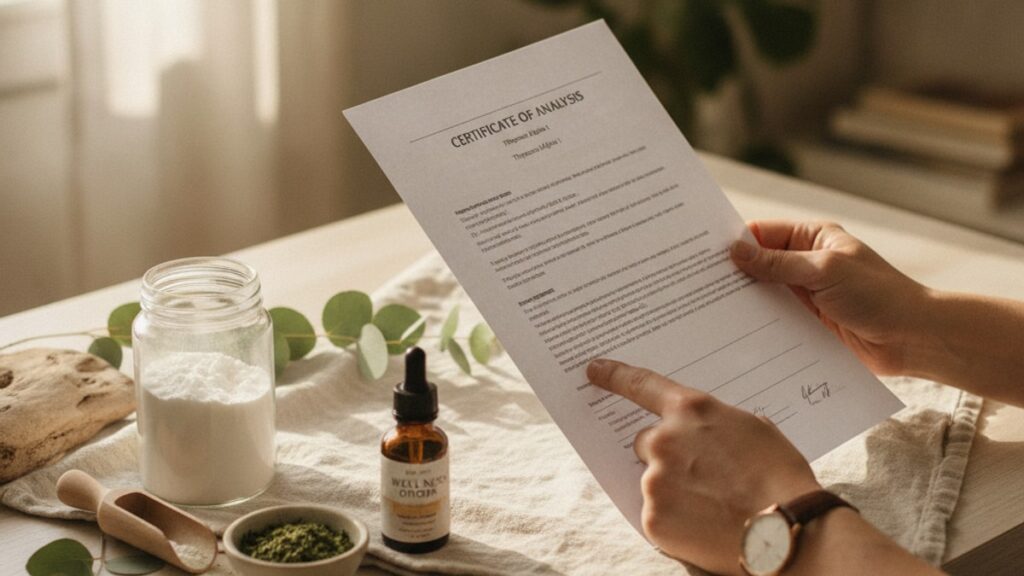
How to Read Thymosin Alpha-1 COA — Lab Verification Guide
Most researchers receive their thymosin alpha-1 shipment, glance at the COA, see a purity percentage above 95%, and assume they're good to go. That's the exact moment where peptide verification fails. A Certificate of Analysis for thymosin alpha-1 isn't a receipt. It's a technical document containing five critical data points that determine whether you're working with research-grade peptide or expensive contaminated powder. The purity number alone tells you nothing about acetate content, bacterial endotoxin levels, or whether the amino acid sequence matches the intended 28-residue structure. We've reviewed thousands of COAs across peptide research facilities. The gap between what researchers think they're reading and what the document actually reports is where quality control collapses.
Our team works exclusively with small-batch synthesis protocols that include full third-party COA verification on every production run. The difference between a legitimate COA and a fabricated one comes down to three things most suppliers never disclose upfront.
How do you verify thymosin alpha-1 purity from a Certificate of Analysis?
To read thymosin alpha-1 COA documents correctly, verify five data points: HPLC purity (minimum 98% for research-grade), mass spectrometry confirmation of molecular weight 3108.3 Da, peptide content by amino acid analysis (85–95% w/w), bacterial endotoxin level (≤5 EU/mg), and acetate content percentage. HPLC purity measures separation from degradation products, not absolute peptide concentration. Peptide content represents the actual active compound after accounting for counterions and residual solvents. Both values must meet threshold independently.
Here's what most guides miss: HPLC purity and peptide content are not interchangeable metrics. A sample can show 98% HPLC purity but only 75% peptide content if the remaining mass is acetate salt, TFA residue, or water. That 23% gap represents inactive material that dilutes every dose calculation. The rest of this piece covers exactly how to read thymosin alpha-1 COA sections, what each analytical method measures, and which red flags indicate contamination or synthesis failure that renders the peptide unreliable for controlled research.
Step 1: Verify HPLC Purity Against Baseline Threshold
HPLC purity represents separation efficiency. The percentage of thymosin alpha-1 that elutes as a single distinct peak versus fragmented peptides, synthesis byproducts, or degradation products. Research-grade thymosin alpha-1 requires minimum 98% HPLC purity. Anything below 97% suggests incomplete synthesis, oxidative degradation during lyophilization, or storage temperature excursions. The COA lists this as "Purity (HPLC)" or "Purity by Area Percentage". Accompanied by a chromatogram showing retention time and peak shape. A sharp symmetrical peak at the expected retention time (typically 12–15 minutes depending on column chemistry) confirms structural integrity. Broad peaks, shoulder peaks, or multiple peaks indicate heterogeneity. Multiple molecular species present in the sample.
Look for the accompanying chromatogram image or data table. Legitimate COAs include the raw chromatogram, not just the summary percentage. If the chromatogram is missing, the purity claim is unverifiable. Pay attention to baseline noise. Excessive noise or drift suggests column contamination or poor method validation. The area under the main peak divided by total area gives the purity percentage. Suppliers sometimes report "purity" without specifying the analytical method. HPLC is the gold standard for peptide separation, but UV spectrophotometry or TLC are insufficient for research-grade verification.
Step 2: Cross-Reference Peptide Content With HPLC Results
Peptide content measures the actual mass of active thymosin alpha-1 relative to total sample weight, reported as percentage w/w (weight by weight). This value accounts for counterions (acetate, TFA), residual solvents, and water content that contribute to total mass but aren't biologically active. The COA lists this as "Peptide Content (by amino acid analysis)" or "Peptide Assay". Typically 85–95% for lyophilized peptides. Subtract peptide content from 100% to estimate the mass contributed by salts and solvents. A sample with 98% HPLC purity but 75% peptide content means 23% of the sample is inactive material. Your dose calculations must account for this gap. 5mg of powder doesn't deliver 5mg of active peptide unless peptide content is near 100%, which is rare.
Amino acid analysis (AAA) is the reference method for peptide content determination. The COA should specify AAA methodology. If it lists "peptide content (calculated)" or "estimated from UV absorbance," the value is less reliable. AAA hydrolyzes the peptide into individual amino acids, separates them by ion-exchange chromatography, and quantifies each residue. Thymosin alpha-1 contains 28 amino acids in a defined sequence. The ratio of detected residues to theoretical composition confirms identity and purity. Discrepancies in residue ratios indicate incomplete synthesis or amino acid substitution errors.
Step 3: Confirm Molecular Weight and Endotoxin Compliance
Molecular weight verification via mass spectrometry (MS) confirms that the peptide's molecular structure matches the intended thymosin alpha-1 sequence. The theoretical molecular weight of thymosin alpha-1 (acetate salt form) is 3108.3 Da. The COA should list "Molecular Weight (MS)" or "Mass Spec" with an observed value within ±0.5 Da of theoretical. Deviations larger than 1 Da suggest amino acid substitution, deletion, or unexpected post-translational modification. Electrospray ionization mass spectrometry (ESI-MS) is the standard method. MALDI-TOF is acceptable but less precise for peptides under 5 kDa. If the COA omits molecular weight entirely or lists only "confirmed by sequence," the identity claim lacks quantitative support.
Bacterial endotoxin content measures lipopolysaccharide contamination from gram-negative bacteria. A critical safety parameter for any peptide intended for in vivo research. The COA must report endotoxin level in endotoxin units per milligram (EU/mg). Research-grade peptides require ≤5 EU/mg; sterile-grade peptides require ≤0.5 EU/mg. Endotoxin testing uses the Limulus Amebocyte Lysate (LAL) assay, which detects bacterial cell wall components at picogram sensitivity. If the COA lists endotoxin as "not detected" without specifying the detection limit or method sensitivity, the result is meaningless. "not detected" could mean below 0.1 EU/mg or below 50 EU/mg depending on assay configuration.
How to Read Thymosin Alpha-1 COA: Test Method Comparison
| Test Method | What It Measures | Acceptance Criteria | What Failure Indicates | Why Both Are Required |
|---|---|---|---|---|
| HPLC Purity | Separation of thymosin alpha-1 from degradation products and synthesis byproducts | ≥98% area percentage with single sharp peak at expected retention time | Multiple peaks = incomplete synthesis or degradation; broad peak = structural heterogeneity | HPLC confirms structural integrity but doesn't quantify absolute peptide mass |
| Peptide Content (AAA) | Mass percentage of active peptide after subtracting salts, solvents, and water | 85–95% w/w for lyophilized acetate salt form | <80% = excessive salt content; <70% = possible adulteration or synthesis failure | Peptide content determines dose accuracy. HPLC purity alone overestimates active compound |
| Mass Spectrometry | Molecular weight confirmation of amino acid sequence | 3108.3 ±0.5 Da for thymosin alpha-1 acetate | Deviation >1 Da = amino acid substitution or deletion in sequence | MS is the only method that directly verifies molecular identity. HPLC and AAA confirm purity but not structure |
| Endotoxin (LAL) | Bacterial lipopolysaccharide contamination from production or handling | ≤5 EU/mg (research-grade) or ≤0.5 EU/mg (sterile-grade) | >5 EU/mg = contamination risk in cell culture or animal models; >10 EU/mg = unacceptable for any biological application | Endotoxin triggers immune responses that confound experimental results. Peptide can be 99% pure but biologically unusable if endotoxin exceeds threshold |
| Acetate Content | Percentage of sample mass contributed by acetate counterion | 10–18% w/w typical for acetate salt form | >20% = incomplete lyophilization or over-acetylation; <5% = possible TFA salt instead of acetate | Acetate content explains the gap between HPLC purity and peptide content. High acetate reduces effective dose per mg |
Key Takeaways
- HPLC purity ≥98% confirms separation from degradation products, but peptide content (85–95% w/w) determines actual active compound mass. Both must meet thresholds independently.
- Mass spectrometry confirmation of 3108.3 ±0.5 Da is the only method that directly verifies thymosin alpha-1 molecular identity. HPLC and AAA measure purity, not structure.
- Bacterial endotoxin levels must be ≤5 EU/mg for research-grade peptides; values above 10 EU/mg render the peptide unsuitable for cell culture or animal studies regardless of purity.
- The gap between HPLC purity and peptide content represents inactive material (acetate salt, TFA, water). A 98% pure peptide with 75% peptide content delivers only 75% active dose per mg.
- Legitimate COAs include raw chromatograms, mass spectra, and method specifications. Summary percentages without supporting data are unverifiable claims.
What If: Thymosin Alpha-1 COA Scenarios
What If the HPLC Purity Is 98% But Peptide Content Is Only 72%?
This indicates high salt or solvent content. The peptide itself is structurally intact (hence high HPLC purity), but 26% of the sample mass is acetate, TFA residue, or residual water from incomplete lyophilization. Recalculate all doses based on peptide content, not sample weight. If your protocol calls for 1mg active peptide, you need 1.39mg of this sample (1 ÷ 0.72). This is not adulteration. It's a known artifact of acetate salt peptide synthesis. High-quality suppliers disclose peptide content upfront for exactly this reason.
What If the Endotoxin Level Is Listed as "<10 EU/mg" Instead of a Specific Value?
This phrasing means the endotoxin level is below 10 EU/mg but could be anywhere from 0.1 to 9.9 EU/mg. Insufficient precision for research-grade verification. Request a COA with specific endotoxin quantification or a lower detection limit (≤1 EU/mg). If the supplier cannot provide a more precise result, assume the peptide is at the upper limit of the reported range. For critical applications, particularly in vivo studies, this level of uncertainty is unacceptable.
What If the COA Shows Multiple HPLC Peaks With a Combined Purity of 95%?
Multiple peaks indicate heterogeneity. The sample contains thymosin alpha-1 plus degradation products, deletion sequences, or synthesis byproducts. Even if the main peak represents 93% of total area, the remaining 7% consists of structurally related impurities that may interfere with receptor binding or biological activity. This peptide is below research-grade threshold. Request a replacement batch or use it only for preliminary non-biological assays where impurity tolerance is higher.
The Unflinching Truth About Thymosin Alpha-1 COAs
Here's the honest answer: most COAs in the peptide research space are either incomplete or deliberately ambiguous. Suppliers know that fewer than 20% of researchers cross-reference HPLC purity with peptide content, and even fewer request the raw chromatogram or mass spectrum. The "98% pure" claim sells peptides. The 15-page technical COA with full method validation sits in a folder no one opens. This creates a market where appearance of quality substitutes for actual quality. A fabricated COA is easier to produce than a legitimate one, and most buyers lack the training to distinguish them. We've seen peptides sold with HPLC purity reports where the chromatogram clearly shows baseline drift, multiple unresolved peaks, or retention times inconsistent with the claimed compound. When peptide content is omitted entirely, dose calculations are off by 20–30% before the first experiment begins. The peptide research industry runs on trust, and that trust is systematically exploited. If you're not reading the full COA. Not just the summary page. You're working with unverified material.
Thymosin alpha-1's amino acid sequence makes it particularly vulnerable to synthesis errors. The N-terminal acetylation and the presence of multiple serine and threonine residues create opportunities for incomplete coupling, oxidation, or acetylation at unintended sites. A peptide that's "mostly thymosin alpha-1" but contains 5–10% des-Ser variants or oxidized methionine derivatives will show reduced biological activity without necessarily triggering visible red flags in a superficial COA review. The difference between research-grade and commercial-grade peptides isn't just purity. It's reproducibility across batches and confidence that the molecular structure matches the intended therapeutic or research target.
Verifying thymosin alpha-1 isn't about distrust. It's about eliminating variables that confound experimental results. A peptide that's 92% pure instead of 98% doesn't just deliver less active compound; it introduces unknown impurities that may interact with assay components, cell culture media, or biological pathways in ways that skew data. COA verification is the one step that costs nothing upfront and prevents months of wasted effort chasing artifacts instead of biology. If a supplier resists providing full analytical data, the peptide quality is already suspect. At Real Peptides, every batch ships with third-party verified COAs that include chromatograms, mass spectra, and amino acid analysis. Because peptide research depends on knowing exactly what you're working with, not guessing based on a summary percentage.
Frequently Asked Questions
What does HPLC purity measure in a thymosin alpha-1 COA?▼
HPLC purity measures the percentage of thymosin alpha-1 that separates as a single peak during high-performance liquid chromatography, indicating structural integrity and separation from degradation products or synthesis byproducts. A purity of 98% or higher is required for research-grade peptides. HPLC purity does not measure absolute peptide concentration — it only confirms that the thymosin alpha-1 present is structurally distinct from impurities.
Why is peptide content different from HPLC purity on a COA?▼
Peptide content represents the mass percentage of active thymosin alpha-1 relative to total sample weight, accounting for acetate counterions, residual solvents, and water. HPLC purity measures separation efficiency, not absolute mass. A sample can be 98% pure by HPLC but contain only 85% peptide by weight — the remaining 13% is inactive material like acetate salt. Both metrics must meet thresholds independently for accurate dose calculations.
What molecular weight should thymosin alpha-1 show on mass spectrometry?▼
Thymosin alpha-1 (acetate salt form) has a theoretical molecular weight of 3108.3 Da. Mass spectrometry on a COA should report an observed molecular weight within ±0.5 Da of this value. Deviations larger than 1 Da indicate amino acid substitution, sequence deletion, or unexpected modifications that compromise peptide identity. ESI-MS is the preferred method for molecular weight verification in peptides under 5 kDa.
Can I use thymosin alpha-1 if the endotoxin level is above 5 EU/mg?▼
Endotoxin levels above 5 EU/mg are unacceptable for most research applications, particularly cell culture or animal studies, because bacterial lipopolysaccharides trigger immune responses that confound experimental results. Research-grade peptides require ≤5 EU/mg; sterile-grade applications require ≤0.5 EU/mg. Peptides with endotoxin levels above 10 EU/mg should not be used in any biological system regardless of purity.
How do I verify a COA is legitimate and not fabricated?▼
Legitimate COAs include raw analytical data — chromatograms for HPLC, mass spectra for molecular weight, and method specifications for each test. Summary percentages without supporting data are unverifiable. Check for third-party lab verification (named testing facility and contact information), batch-specific identifiers that match the product label, and consistent formatting across all analytical sections. If the supplier cannot provide raw chromatograms or mass spectra upon request, the COA authenticity is suspect.
What does acetate content mean on a thymosin alpha-1 COA?▼
Acetate content represents the percentage of sample mass contributed by acetate counterions used to stabilize the peptide during synthesis and lyophilization. Typical acetate content for thymosin alpha-1 acetate salt is 10–18% w/w. Acetate content explains the gap between HPLC purity and peptide content — high acetate reduces the effective dose per mg of powder. If acetate content exceeds 20%, the sample may have been over-acetylated or incompletely lyophilized.
Why does the COA show multiple peaks on the HPLC chromatogram?▼
Multiple peaks on an HPLC chromatogram indicate the presence of degradation products, deletion sequences, or synthesis byproducts alongside the target thymosin alpha-1 peptide. Even if the main peak represents 95% of total area, the remaining 5% consists of structurally related impurities that may reduce biological activity or introduce experimental variability. Research-grade peptides should show a single sharp symmetrical peak at the expected retention time with minimal baseline noise.
What is the difference between ESI-MS and MALDI-TOF for peptide verification?▼
ESI-MS (electrospray ionization mass spectrometry) and MALDI-TOF (matrix-assisted laser desorption/ionization time-of-flight) both measure molecular weight, but ESI-MS provides higher precision for peptides under 5 kDa like thymosin alpha-1. ESI-MS reports molecular weight within ±0.5 Da, while MALDI-TOF precision is typically ±1–2 Da. For COA verification, ESI-MS is the preferred method because it detects amino acid substitutions or deletions with greater accuracy.
How often should I request a new COA from the supplier?▼
Request a batch-specific COA for every new shipment — peptide quality varies between synthesis runs even from the same supplier. COAs are batch-specific documents, not product-level certifications. If the supplier provides a single COA dated months or years earlier for all shipments, the analytical data does not represent the peptide you received. Batch identifiers on the COA must match the product label exactly.
Can a peptide with 95% HPLC purity still be usable for research?▼
A peptide with 95% HPLC purity falls below the research-grade threshold of 98% and may contain 5% impurities that affect reproducibility or biological activity. It may still be usable for preliminary non-biological assays or method development where impurity tolerance is higher, but it is not suitable for dose-response studies, receptor binding assays, or in vivo research. Request a higher-purity batch or account for reduced effective concentration in dose calculations.











