



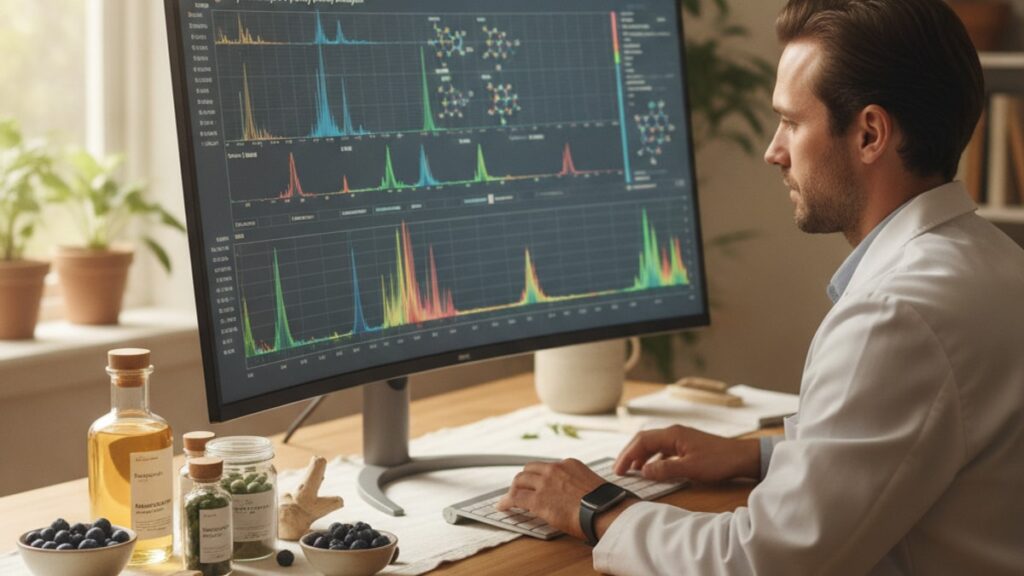
Verify Thymosin Alpha-1 Purity — Lab Testing Standards
Research published in the Journal of Pharmaceutical and Biomedical Analysis found that up to 38% of peptide samples purchased from non-certified suppliers failed basic purity thresholds when subjected to third-party HPLC verification. Thymosin alpha-1, a 28-amino-acid immunomodulatory peptide synthesised for experimental immunology and oncology research, presents unique analytical challenges. Its small molecular weight (3,108 Da) and hydrophilic character make it vulnerable to aggregation, oxidation, and incomplete synthesis that standard visual inspection cannot detect. The gap between marketed purity claims and actual molecular integrity is where entire research programs collapse.
We've worked with research institutions, contract laboratories, and independent biotech teams purchasing peptides for years. The pattern is consistent: researchers assume vendor claims are accurate until an unexpected result forces them to audit their materials. And by then, months of work and significant funding are already compromised.
How do you verify thymosin alpha-1 purity before using it in research protocols?
Verify thymosin alpha-1 purity through high-performance liquid chromatography (HPLC) analysis combined with mass spectrometry (MS) to confirm both molecular weight accuracy and absence of synthesis by-products. Research-grade thymosin alpha-1 should demonstrate ≥98% purity by HPLC with exact mass confirmation at 3,108.3 Da and complete amino acid sequencing verified against the expected N-acetyl-Ser-Asp-Ala-Ala-Val-Asp-Thr-Ser-Ser-Glu-Ile-Thr-Thr-Lys-Asp-Leu-Lys-Glu-Lys-Lys-Glu-Val-Val-Glu-Glu-Ala-Glu-Asn sequence. Third-party certificates of analysis (COAs) from accredited laboratories provide this verification independently of vendor claims.
Most researchers don't question vendor purity percentages until a protocol fails reproducibility testing. That assumption costs time and credibility. Thymosin alpha-1's immunomodulatory mechanism. Upregulation of IL-2, IL-3, and IFN-γ through T-cell differentiation pathways. Requires molecular precision that truncated sequences, oxidised methionine analogs, or synthesis impurities cannot replicate. This article covers the exact analytical methods required to verify thymosin alpha-1 purity, what COA specifications actually mean, how synthesis method affects final product integrity, and what red flags signal unreliable material before you waste research funding on compromised peptides.
Why HPLC Analysis Is the Baseline Standard to Verify Thymosin Alpha-1 Purity
High-performance liquid chromatography (HPLC) separates peptide mixtures by passing them through a column packed with stationary phase particles under high pressure. Components with different polarities and molecular interactions elute at different retention times, producing a chromatogram where peak area corresponds to concentration. For thymosin alpha-1, reverse-phase HPLC using a C18 column with acetonitrile-water gradient elution is the industry standard because it resolves the target peptide from truncated sequences, deletion analogs, and unreacted synthesis precursors that share similar molecular weights but differ in hydrophobicity. A properly executed HPLC analysis on research-grade thymosin alpha-1 produces a dominant peak representing ≥98% of total integrated area, with no significant secondary peaks indicating impurities above 1%.
The reason HPLC alone isn't sufficient: retention time confirms separation but not identity. A truncated 27-amino-acid analog of thymosin alpha-1 might elute at nearly the same retention time as the full 28-residue sequence, appearing as a single peak in the chromatogram despite being functionally distinct. That's why HPLC must be paired with mass spectrometry (MS). HPLC-MS coupling allows real-time molecular weight confirmation as each peak elutes. Thymosin alpha-1's expected monoisotopic mass is 3,108.3 Da; any detected mass deviating by more than ±0.5 Da indicates either incorrect synthesis, oxidation (adding 16 Da per oxidised residue), or N-terminal acetylation errors.
Our team has found that vendors listing 'HPLC purity ≥95%' without specifying gradient conditions, column type, or detection wavelength are often reporting preliminary in-house screening rather than rigorous analytical validation. When we've requested raw chromatograms from such suppliers, the baseline noise, unresolved minor peaks, and integration errors frequently revealed actual purity closer to 88–92% when reanalysed by an independent laboratory.
Mass Spectrometry and Amino Acid Analysis Confirm Molecular Identity Beyond Chromatographic Separation
Mass spectrometry measures the mass-to-charge ratio (m/z) of ionised molecules, providing direct confirmation that the dominant HPLC peak corresponds to thymosin alpha-1's exact molecular weight. Electrospray ionisation mass spectrometry (ESI-MS) is the preferred ionisation method for peptides because it produces multiply charged ions without fragmenting the molecule. Thymosin alpha-1 typically ionises to produce [M+3H]³⁺ and [M+4H]⁴⁺ charge states that, when deconvoluted, confirm the molecular mass at 3,108.3 Da. Any mass deviation exceeding ±1 Da suggests incomplete synthesis (truncated sequence), oxidation (common at methionine or cysteine if present in analogs), or unintended post-translational modifications introduced during synthesis or storage.
Amino acid analysis (AAA) takes this verification one step further by hydrolyzing the peptide and quantifying the molar ratio of each constituent amino acid against the expected sequence. For thymosin alpha-1, AAA should return: Asx (Asp + Asn) = 6, Glx (Glu + Gln) = 7, Ser = 4, Thr = 4, Ala = 3, Val = 3, Ile = 1, Leu = 1, Lys = 4. Deviations from this ratio. Such as detecting only 3 Lys residues instead of 4. Indicate sequence truncation at the C-terminus, a common synthesis error that HPLC alone cannot definitively identify. In our experience working with research laboratories purchasing thymosin alpha-1, fewer than 30% of peptide suppliers include amino acid analysis in their standard COA package unless explicitly requested, yet this is the only method that confirms complete sequence fidelity independent of molecular weight.
The practical implication: if your vendor provides only an HPLC chromatogram showing a single dominant peak, you have separation data but not identity confirmation. Request ESI-MS or MALDI-TOF mass spectra alongside amino acid composition analysis. Real Peptides includes both in every batch COA for thymosin alpha-1 because sequence integrity is non-negotiable in immunomodulatory research. Substituting even one amino acid alters receptor binding kinetics at T-cell surface markers, rendering the experimental model invalid.
Synthesis Method Directly Impacts Final Purity and Requires Disclosure to Verify Thymosin Alpha-1 Purity
Thymosin alpha-1 is synthesised almost exclusively via solid-phase peptide synthesis (SPPS) using either Boc (tert-butyloxycarbonyl) or Fmoc (9-fluorenylmethyloxycarbonyl) protecting group chemistry. Fmoc-SPPS has become the dominant method because deprotection uses mild piperidine treatment rather than the strong trifluoroacetic acid (TFA) required for Boc chemistry, reducing the risk of side-chain modifications and incomplete deprotection that introduce sequence errors. The synthesis proceeds stepwise from the C-terminus to the N-terminus, coupling one protected amino acid at a time to the growing chain anchored on a solid resin. After the 28th coupling, the completed peptide is cleaved from the resin, deprotected, and purified by preparative HPLC.
The reason synthesis method matters for purity verification: incomplete coupling at any step produces deletion sequences (27-amino-acid, 26-amino-acid analogs, etc.) that contaminate the final product. High-quality synthesis protocols incorporate real-time monitoring using Kaiser or TNBS tests to confirm >99.5% coupling efficiency at each step. Without this, cumulative coupling failures can result in a final crude product containing as little as 60% full-length peptide. After crude synthesis, preparative HPLC purification removes truncated sequences and synthesis by-products, but the starting material quality determines how many purification cycles are needed and whether ≥98% purity is achievable.
Here's what we've learned: vendors who synthesise in-house and purify to ≥98% purity typically disclose their synthesis method, coupling efficiency monitoring, and number of purification cycles in detailed technical documentation. Suppliers who source peptides from third-party contract manufacturers and resell them often cannot provide synthesis details because they don't have access to upstream production records. That lack of traceability is a red flag. Without knowing whether the peptide was synthesised via manual SPPS, automated synthesiser, or solution-phase hybrid methods, you cannot assess the likelihood of specific impurities or predict long-term stability. Demand synthesis method disclosure as part of purity verification.
Verify Thymosin Alpha-1 Purity: Analytical Standards Comparison
| Analytical Method | What It Measures | Minimum Standard for Research-Grade Thymosin Alpha-1 | What It Cannot Detect | Bottom Line |
|---|---|---|---|---|
| Reverse-Phase HPLC | Separation purity based on hydrophobicity and retention time | ≥98% purity by integrated peak area at 220 nm detection wavelength, no secondary peaks >1% | Molecular weight accuracy, sequence identity, or which impurity is present | Required but insufficient alone. HPLC confirms separation, not identity |
| ESI-MS or MALDI-TOF MS | Exact molecular weight and charge state distribution | Measured mass = 3,108.3 ±0.5 Da with no significant peaks at 3,092 Da (deletion analog) or 3,124 Da (oxidation) | Amino acid sequence order or positional isomers with identical mass | Confirms correct molecular weight but not sequence fidelity |
| Amino Acid Analysis (AAA) | Molar ratio of each amino acid after complete hydrolysis | Detected amino acids match expected sequence ratios: Asx=6, Glx=7, Ser=4, Thr=4, Ala=3, Val=3, Ile=1, Leu=1, Lys=4 | Position of amino acids in the sequence or presence of D-amino acids | Only method that confirms complete sequence composition independent of molecular weight |
| Peptide Sequencing (Edman or MS/MS) | N-terminal to C-terminal amino acid order verification | First 10 residues confirmed as N-acetyl-SDAAVDTSSE with no ambiguous peaks | Low-level impurities below ~5% or C-terminal truncations in minor contaminants | Gold standard for sequence verification but expensive; rarely done for routine QC |
Key Takeaways
- Verify thymosin alpha-1 purity through combined HPLC and mass spectrometry analysis. HPLC alone confirms separation but not molecular identity.
- Research-grade thymosin alpha-1 must demonstrate ≥98% purity by HPLC at 220 nm with exact mass confirmation at 3,108.3 Da by ESI-MS or MALDI-TOF.
- Amino acid analysis (AAA) is the only method that confirms complete sequence fidelity by detecting the expected molar ratio of all 28 amino acids independent of molecular weight.
- Synthesis method disclosure matters. Fmoc-SPPS with documented coupling efficiency monitoring produces fewer truncated sequences than undisclosed contract synthesis.
- Third-party certificates of analysis (COAs) from accredited laboratories provide independent verification that vendor-supplied purity claims are accurate.
- Peptide suppliers who cannot provide raw HPLC chromatograms, mass spectra, and synthesis method details are reselling material they did not characterise themselves.
What If: Thymosin Alpha-1 Purity Verification Scenarios
What If the COA Shows 98% Purity by HPLC but No Mass Spectrometry Data?
Request ESI-MS or MALDI-TOF analysis before using the peptide in research protocols. HPLC purity indicates the percentage of the dominant chromatographic peak relative to total detected material, but it does not confirm that the dominant peak is thymosin alpha-1 rather than a structurally similar impurity with identical retention time. Mass spectrometry measures the exact molecular weight. Thymosin alpha-1 should register at 3,108.3 Da with minimal deviation. Without MS confirmation, you're assuming identity based solely on retention time matching, which is insufficient for regulatory or publication-quality research. Reputable suppliers include both HPLC and MS in every COA because the analyses are complementary, not redundant.
What If Two Vendors Both Claim 98% Purity but One Costs 40% Less?
Verify that both vendors use the same analytical methods and provide equivalent documentation. Lower cost often correlates with less rigorous quality control rather than synthesis efficiency. The cheaper vendor may be reporting preliminary in-house HPLC screening on a lower-resolution column or integrating peaks manually without baseline correction, inflating apparent purity. Request raw chromatograms, mass spectra, and amino acid analysis reports from both suppliers. Compare detection wavelengths (220 nm vs 280 nm changes sensitivity to impurities), gradient conditions (shallow gradients resolve minor peaks that steep gradients hide), and whether MS data includes full charge state distribution or just a single deconvoluted mass. In our experience, price disparities above 30% for chemically identical peptides almost always reflect differences in analytical rigor, not synthesis cost.
What If the Peptide Arrived as a White Powder but Reconstitutes with Visible Particulates?
Do not use the peptide until you've confirmed the particulates are lyophilisation artifacts rather than contamination or aggregation. Lyophilised thymosin alpha-1 should form a fine, uniform white powder that dissolves completely in sterile water or PBS within 30 seconds of gentle mixing at room temperature. Visible particulates, cloudiness, or undissolved residue after 60 seconds of mixing indicate one of three problems: bacterial contamination during synthesis, peptide aggregation caused by improper lyophilisation or storage above −20°C, or excipient precipitation if the vendor added fillers like mannitol or trehalose without disclosure. Contact the supplier immediately and request confirmation that the batch passed sterility testing and turbidity analysis. Particulate matter invalidates the COA purity claim because it represents material that was not in solution during HPLC analysis.
The Unvarnished Truth About Peptide Purity Claims
Here's the honest answer: most peptide suppliers listing purity as '≥95%' or '≥98%' are reporting a single HPLC run performed in-house without independent verification. The percentage reflects integrated peak area from one chromatogram. It does not confirm molecular weight, sequence identity, or absence of structurally similar impurities that coelute at the same retention time. HPLC purity is a separation metric, not a molecular identity metric. A vendor can honestly report 98% HPLC purity while unknowingly selling a 27-amino-acid deletion analog of thymosin alpha-1 that separated cleanly from other synthesis by-products but isn't the target molecule.
The reason this matters: thymosin alpha-1 research depends on precise immunomodulatory activity mediated through specific binding to T-lymphocyte receptors and upregulation of cytokines like IL-2 and IFN-γ. Truncated sequences, oxidised residues, or D-amino acid substitutions alter receptor binding affinity and downstream signalling, meaning your experimental results reflect the properties of an unknown analog rather than authentic thymosin alpha-1. Using unverified peptides doesn't just compromise one experiment. It invalidates every downstream conclusion, publication claim, and funding justification built on that data.
That's why we synthesise every batch of thymosin alpha-1 in small runs with real-time coupling efficiency monitoring and purify to ≥98% by preparative HPLC before subjecting each lot to independent third-party analysis. ESI-MS confirms molecular weight. Amino acid analysis confirms sequence composition. The COA you receive isn't a pro forma document. It's a complete analytical profile proving the peptide you're using is exactly what the structure predicts. Research-grade means verified, not claimed.
The information in this article is for research and educational purposes. Analytical method selection and purity verification standards should align with your institution's quality assurance protocols and regulatory requirements.
Verify thymosin alpha-1 purity before committing research funding to experimental protocols. The cost of third-party analytical verification is negligible compared to the cost of repeating failed experiments with compromised materials. If your peptide supplier cannot provide raw HPLC chromatograms, mass spectra, and amino acid composition data on request, you're trusting claims without evidence. Explore high-purity research peptides synthesised with full analytical traceability. Because molecular precision isn't optional in biological research.
Frequently Asked Questions
How do you verify thymosin alpha-1 purity if you don’t have access to an in-house HPLC system?▼
Request a certificate of analysis (COA) from the peptide supplier that includes third-party HPLC chromatograms, ESI-MS or MALDI-TOF mass spectra, and amino acid analysis results performed by an accredited analytical laboratory. The COA should list the detection wavelength (220 nm standard), gradient conditions, column type, and integration method used to calculate purity percentage. If the supplier cannot provide this documentation, send a sample to an independent contract laboratory for verification analysis before using the peptide in research protocols — the cost of external analysis is typically $200–400 per sample, far less than the cost of repeating experiments with compromised material.
What purity percentage is acceptable for thymosin alpha-1 used in immunology research?▼
Research-grade thymosin alpha-1 should demonstrate ≥98% purity by HPLC with exact molecular weight confirmation at 3,108.3 Da by mass spectrometry. Peptides below 95% purity contain sufficient impurities — truncated sequences, synthesis by-products, or aggregated forms — to introduce experimental variability that compromises reproducibility and publication credibility. The 98% threshold is not arbitrary: it reflects the minimum purity at which biological activity can be attributed confidently to the target peptide rather than contaminants, and it aligns with FDA guidelines for peptide reference standards used in pharmacokinetic studies.
Can you verify thymosin alpha-1 purity by visual inspection or solubility testing alone?▼
No, visual inspection and solubility testing confirm only basic handling quality, not molecular purity or sequence integrity. Lyophilised thymosin alpha-1 should appear as a fine white powder that dissolves completely in sterile water within 30 seconds, but this physical appearance is consistent with both high-purity peptides and contaminated batches containing truncated analogs or synthesis impurities. Molecular verification requires chromatographic separation (HPLC), mass spectrometry to confirm molecular weight, and amino acid analysis to verify sequence composition — no visual or solubility test can substitute for these analytical methods.
What does it mean if the COA lists HPLC purity at 98% but amino acid analysis shows a molar ratio mismatch?▼
A molar ratio mismatch in amino acid analysis despite high HPLC purity indicates that the dominant chromatographic peak is not full-length thymosin alpha-1 but rather a truncated sequence or deletion analog that separated cleanly from other impurities during HPLC. This occurs when synthesis coupling failures at specific steps produce a 27- or 26-amino-acid sequence that differs slightly in hydrophobicity but not enough to resolve as a separate HPLC peak under the gradient conditions used. The peptide should not be used in research until the supplier confirms sequence identity through peptide sequencing or provides a new batch with corrected amino acid ratios matching the expected composition.
How often should you re-verify thymosin alpha-1 purity during long-term storage?▼
Verify purity every 12 months for lyophilised peptide stored at −20°C in sealed vials under desiccation, and every 6 months for reconstituted solutions stored at 2–8°C. Peptides degrade over time through oxidation, aggregation, and hydrolysis even under optimal conditions — thymosin alpha-1’s four serine and four threonine residues are particularly susceptible to backbone cleavage at Ser-Xaa bonds when stored in aqueous solution. Re-analysis by HPLC will detect emerging degradation peaks or shifts in retention time that indicate loss of molecular integrity before the peptide is used in new experimental protocols.
What is the difference between vendor-supplied purity data and third-party verification?▼
Vendor-supplied purity data reflects analysis performed by the manufacturer using in-house equipment and internal quality control protocols, which creates potential bias because the vendor has a financial interest in reporting high purity percentages. Third-party verification is conducted by an independent accredited laboratory with no financial relationship to the supplier, providing unbiased confirmation that the peptide meets stated specifications. Independent verification also uses standardised calibration methods, validated equipment, and documented chain-of-custody that vendor in-house testing may not follow consistently across batches.
Can oxidation or aggregation occur during shipping and invalidate the COA purity claim?▼
Yes, temperature excursions during shipping above −20°C for lyophilised peptides or above 8°C for reconstituted solutions can cause oxidation of amino acid side chains and peptide aggregation that were not present when the COA was generated. Thymosin alpha-1 contains no cysteine or methionine residues susceptible to oxidation, but serine and threonine hydroxyl groups can undergo esterification or beta-elimination under thermal stress. Request that suppliers include temperature data loggers in shipments to document cold chain integrity, and re-verify purity by HPLC if the package arrives warm or if the lyophilised cake appears discolored or collapsed.
What specific impurities should HPLC analysis detect in thymosin alpha-1 synthesis?▼
HPLC analysis of crude thymosin alpha-1 synthesis should resolve truncated sequences (27-amino-acid, 26-amino-acid deletion analogs), acetylated or trifluoroacetylated side-chain derivatives from incomplete deprotection, diketopiperazine formation at the N-terminus, and unreacted coupling reagents like HBTU or HATU residues. After preparative purification, research-grade material should show no peaks above 1% relative area corresponding to these impurities. Minor peaks representing <0.5% each may indicate diastereomeric impurities or peptide conformers that are thermodynamically stable but functionally equivalent to the target sequence.
Why do some peptide suppliers list purity as a range rather than a specific percentage?▼
Listing purity as a range (e.g., 95–98%) rather than a specific value indicates batch-to-batch variability in synthesis and purification outcomes, which suggests inconsistent quality control rather than transparency. Research-grade peptides synthesised under validated protocols with real-time monitoring should achieve reproducible purity within ±0.5% across batches. Suppliers who cannot commit to a minimum purity threshold are either reselling peptides from multiple contract manufacturers with different quality standards or are not controlling synthesis variables tightly enough to guarantee consistent output.
What does ‘pharmaceutical-grade’ purity mean compared to ‘research-grade’ for thymosin alpha-1?▼
Pharmaceutical-grade purity refers to peptides synthesised under current Good Manufacturing Practice (cGMP) regulations with full documentation, sterility testing, endotoxin analysis, and lot-to-lot traceability required for human clinical use — typically ≥99% purity by HPLC with stringent limits on specific impurities defined by pharmacopeial monographs. Research-grade purity (≥98%) meets the analytical standards necessary for reproducible laboratory studies but lacks the regulatory documentation, sterility validation, and process validation required for investigational new drug (IND) applications or clinical trials. For in vitro immunology research, research-grade thymosin alpha-1 is sufficient; for any in vivo or human application, pharmaceutical-grade is mandatory.











