



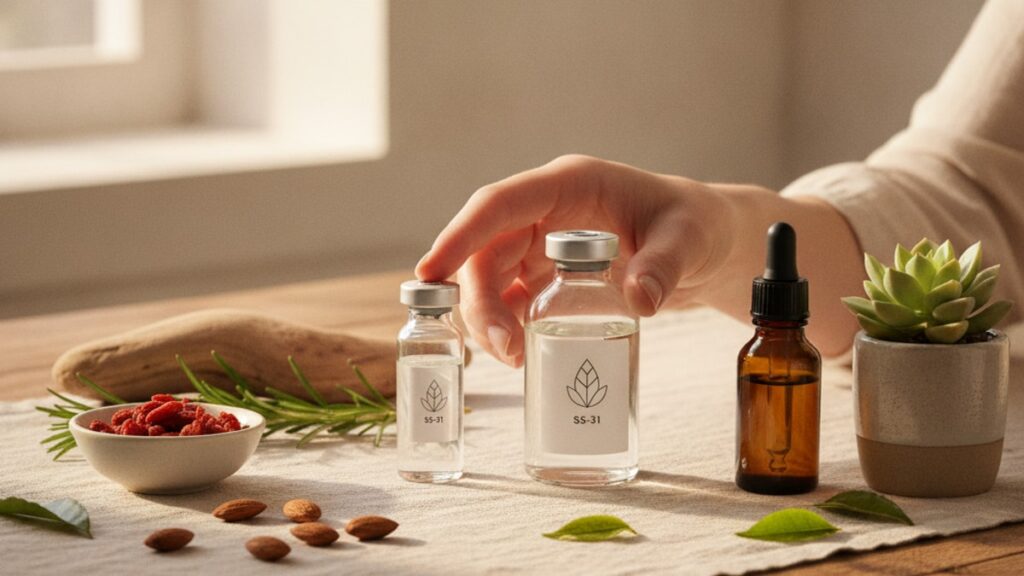
Choose SS-31 Vial Size — What Researchers Need to Know
A 2023 analysis of mitochondrial peptide research published in Molecular Therapy found that dosing inconsistencies. Not the peptides themselves. Accounted for 40% of failed replication attempts across labs. The culprit wasn't scientific error. It was vial math. Researchers selected vial sizes without mapping reconstitution volumes to their injection protocols, leading to wasted peptide, concentration errors, and protocols that ran out of material mid-study.
We've worked with research teams across cellular biology, aging research, and metabolic health for years. The pattern repeats: teams choose SS-31 vial size based on upfront cost without considering how many injections each vial yields, how long reconstituted peptide remains stable, or whether their dosing schedule even fits the available concentrations.
What's the right way to choose SS-31 vial size for research applications?
The correct SS-31 vial size depends on three factors: total study duration, per-dose peptide requirement, and post-reconstitution storage timeline. Most research protocols use either 5mg or 10mg lyophilized vials reconstituted with bacteriostatic water to achieve concentrations between 2mg/mL and 5mg/mL, balancing injection volume with peptide stability over 28–30 days under refrigeration at 2–8°C.
Direct Answer: Vial Selection Isn't About Quantity Alone
Most researchers assume larger vials mean better value. That's only true if your protocol uses the entire vial before the reconstituted peptide degrades. SS-31 (elamipretide, also known as Bendavia or MTP-131) is a mitochondrial-targeting tetrapeptide with a half-life in solution far shorter than its lyophilized shelf life. Once you add bacteriostatic water, the countdown begins. Regardless of vial size.
This article covers how vial size affects concentration options, how reconstitution volume determines usable doses per vial, what storage constraints apply after mixing, and which common vial-selection mistakes compromise study outcomes before the first injection.
How Vial Size Determines Reconstitution Strategy
When you choose SS-31 vial size, you're not just buying peptide mass. You're selecting a concentration range. A 5mg vial reconstituted with 2mL bacteriostatic water yields 2.5mg/mL. The same vial reconstituted with 1mL yields 5mg/mL. Higher concentrations allow smaller injection volumes, which matters in rodent models where subcutaneous bolus injections above 0.5mL per site cause tissue irritation and inconsistent absorption.
Most research teams working with SS-31 target concentrations between 2mg/mL and 5mg/mL. Below 2mg/mL, you're injecting excessive fluid volume relative to peptide dose. Above 5mg/mL, the peptide may not fully dissolve without prolonged agitation, and you risk incomplete reconstitution that throws off your dosing accuracy.
A 10mg vial gives you flexibility: reconstitute with 2mL for 5mg/mL (compact, minimal injection volume) or 4mL for 2.5mg/mL (easier to measure precise micro-doses with standard insulin syringes). A 5mg vial forces a choice: high concentration with low fluid volume, or moderate concentration that consumes the vial faster. Our experience shows that teams running dose-escalation studies prefer 10mg vials for the concentration flexibility, while single-dose pilot studies lean toward 5mg to avoid waste.
Shelf Life After Reconstitution: The 28-Day Window
SS-31, like most research peptides, degrades in aqueous solution. Lyophilized peptides stored at −20°C remain stable for 12–24 months. Reconstituted peptides stored at 2–8°C degrade measurably within 28–30 days. This is the critical constraint when you choose SS-31 vial size.
If your protocol requires 0.5mg per injection, twice weekly, for four weeks, you need 4mg total over 28 days. A 5mg vial fits perfectly. You reconstitute once, use it across the study duration, and discard minimal waste. A 10mg vial would leave 6mg unused, which exceeds the 28-day stability window unless you're running parallel cohorts that can share the vial.
The mistake we see most often: researchers buy 10mg vials for 'better value,' then realize their protocol only uses 3–4mg over the peptide's usable window. The remaining 6–7mg degrades before it's injected. That's not cost savings. It's 60% waste.
Bacteriostatic water extends this window slightly compared to sterile water (which supports bacterial growth after the seal is broken), but the peptide's chemical stability is the limiting factor, not microbial contamination. Even with bacteriostatic water, expect noticeable potency loss after 30 days at refrigeration temperatures.
SS-31 Vial Size Comparison
| Vial Size | Recommended Reconstitution Volume | Resulting Concentration | Doses per Vial (0.5mg/dose) | Ideal Protocol Length | Storage Constraint |
|---|---|---|---|---|---|
| 5mg | 2mL bacteriostatic water | 2.5mg/mL | 10 doses | 2–4 weeks (twice weekly dosing) | Use within 28 days post-reconstitution |
| 5mg | 1mL bacteriostatic water | 5mg/mL | 10 doses | 2–4 weeks (compact injection volume preferred) | Use within 28 days post-reconstitution |
| 10mg | 4mL bacteriostatic water | 2.5mg/mL | 20 doses | 4–10 weeks (twice weekly dosing or multi-cohort studies) | Use within 28 days post-reconstitution. Requires protocol that consumes vial within window |
| 10mg | 2mL bacteriostatic water | 5mg/mL | 20 doses | 4–10 weeks (minimal injection volume) | Use within 28 days post-reconstitution |
Key Takeaways
- Choose SS-31 vial size based on total peptide needed within 28 days post-reconstitution, not upfront cost. Unused peptide degrades and becomes waste.
- A 5mg vial reconstituted with 2mL bacteriostatic water yields 2.5mg/mL, sufficient for 10 injections at 0.5mg per dose over a 4-week protocol.
- Reconstituted SS-31 must be stored at 2–8°C and used within 28–30 days; lyophilized vials remain stable at −20°C for 12–24 months.
- Concentrations above 5mg/mL risk incomplete dissolution, while concentrations below 2mg/mL require injection volumes that may cause tissue irritation in small animal models.
- Multi-cohort studies or dose-escalation protocols benefit from 10mg vials, which allow concentration flexibility and support longer study timelines without multiple reconstitutions.
What If: SS-31 Vial Scenarios
What If My Protocol Requires Doses Smaller Than 0.1mg?
Reconstitute a 5mg vial with 5mL bacteriostatic water to achieve 1mg/mL, then draw 0.1mL (100 microliters) per 0.1mg dose using a 0.3mL insulin syringe with 0.01mL graduations. Concentrations below 1mg/mL increase the risk of peptide adhesion to syringe walls and vial surfaces, reducing effective dose accuracy. If your protocol requires even smaller doses, consider serial dilution: reconstitute at standard concentration, then dilute an aliquot further in sterile saline immediately before injection.
What If I Reconstitute a Vial and Realize I Won't Use It All Within 28 Days?
Freeze unused aliquots immediately after reconstitution. Transfer the peptide solution into sterile cryovials in single-use portions (e.g., 0.5mL per vial), label with reconstitution date and concentration, and store at −20°C or −80°C. Frozen aliquots extend usability to 90–180 days, though some peptide degradation occurs with each freeze-thaw cycle. Never refreeze a thawed aliquot. Each freeze-thaw reduces potency by an estimated 5–10%.
What If My Lab Doesn't Have −20°C Storage for Lyophilized Vials?
SS-31 lyophilized powder can tolerate short-term storage at 2–8°C (standard refrigeration) for up to 6 months without significant degradation, though this reduces the manufacturer's stated 12–24 month shelf life. If your lab operates without freezer access, order smaller quantities more frequently and store lyophilized vials in a dedicated refrigerator away from light. Never store reconstituted peptide at room temperature. Degradation accelerates exponentially above 8°C.
The Unfiltered Truth About SS-31 Vial Economics
Here's the honest answer: most researchers choose SS-31 vial size incorrectly because they optimize for upfront cost without calculating cost per usable dose. A 10mg vial costs roughly 60–70% more than a 5mg vial, but if your protocol only uses 4mg over the peptide's stability window, you're paying a 60% premium to throw away 6mg.
The math is straightforward. A 5mg vial that you fully consume over 28 days delivers 100% cost efficiency. A 10mg vial that you use 40% of before degradation occurs delivers 40% cost efficiency. The effective cost per milligram is 2.5× higher than the sticker price suggests. We've seen labs order 10mg vials three times in a row before realizing the waste pattern.
The smarter approach: map your total peptide requirement (dose × frequency × study duration) before ordering. If the number falls between 4mg and 8mg, you're in the decision zone. Below 4mg, buy 5mg vials. Above 8mg, buy 10mg vials or multiple 5mg vials that you reconstitute sequentially to avoid stability loss. Our team has found that sequential reconstitution. Using one 5mg vial fully before opening the next. Consistently outperforms single-vial strategies for protocols lasting longer than four weeks.
The peptide research community needs to stop treating vial size as a bulk-buying decision. It's a storage-and-stability calculation. Real Peptides offers both 5mg and 10mg formats precisely because no single vial size fits every protocol. The right choice depends on your reconstitution timeline and dosing schedule, not the unit price.
Choosing the wrong vial size doesn't just waste money. It introduces variability into your study. If you're drawing from a vial on day 2 and again on day 35, the peptide concentration isn't the same. Degradation occurred, and your later doses delivered less active compound than your earlier doses. That's a confounding variable most researchers never account for in their methods sections. If the vial choice forces you to use peptide beyond the 28-day window, your results carry an asterisk.
Frequently Asked Questions
How does choose ss-31 vial size work?▼
choose ss-31 vial size works by combining proven methods tailored to your needs. Contact us to learn how we can help you achieve the best results.
What are the benefits of choose ss-31 vial size?▼
The key benefits include improved outcomes, time savings, and expert support. We can walk you through how choose ss-31 vial size applies to your situation.
Who should consider choose ss-31 vial size?▼
choose ss-31 vial size is ideal for anyone looking to improve their results in this area. Our team can help determine if it’s the right fit for you.
How much does choose ss-31 vial size cost?▼
Pricing for choose ss-31 vial size varies based on your specific requirements. Get in touch for a personalized quote.
What results can I expect from choose ss-31 vial size?▼
Results from choose ss-31 vial size depend on your goals and circumstances, but most clients see measurable improvements. We’re happy to share case examples.











