



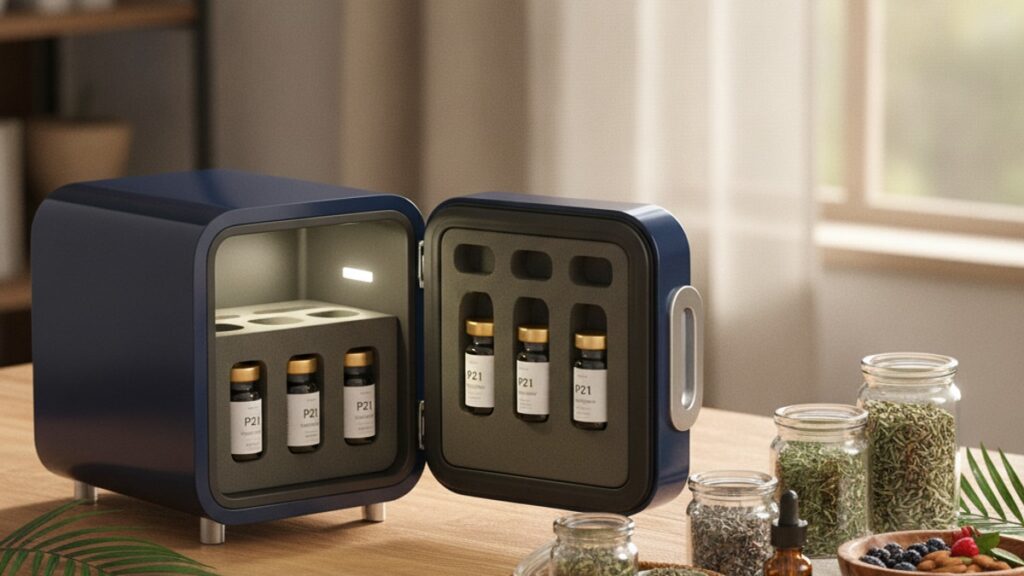
How to Store P21 Long Term — Peptide Stability Guide
Most P21 degradation isn't caused by contamination. It's caused by temperature excursions researchers never notice. A single freeze-thaw cycle can reduce peptide potency by 15–30%, and no visual inspection or potency test at the bench catches it. The peptide looks identical, dissolves normally, and delivers inconsistent results that get attributed to biological variability rather than storage failure.
Our team has supported research-grade peptide handling protocols for years. The difference between a peptide that maintains 98% purity at six months and one that drops to 72% comes down to three factors: initial storage temperature, reconstitution timing, and freeze-thaw discipline.
How do you store P21 long term without losing potency?
To store P21 long term, keep lyophilized (freeze-dried) powder at −20°C or colder in a sealed, desiccated container away from light. Once reconstituted with bacteriostatic water, refrigerate the solution at 2–8°C and use within 28 days. Never refreeze reconstituted peptide. Each freeze-thaw cycle causes irreversible aggregation and potency loss of 10–20% per cycle.
The biggest mistake researchers make isn't skipping refrigeration. It's treating lyophilized peptides like they're inert chemical compounds. P21, like all synthetic peptides with disulfide bonds or modified amino acids, degrades through oxidation, hydrolysis, and aggregation pathways that accelerate above −20°C even when the vial appears sealed and dry. The storage protocol matters before you ever add solvent.
This guide covers the exact temperature thresholds that trigger P21 degradation, why bacteriostatic water extends stability compared to sterile water, how to prevent freeze-thaw damage during routine use, and what reconstitution mistakes eliminate months of proper storage discipline in a single step. We're addressing the procedural gaps most peptide handling guides don't mention.
Step 1: Store Lyophilized P21 Powder at −20°C or Colder Before Reconstitution
P21 in lyophilized form is stable for 12–24 months when stored at −20°C in a sealed container with a desiccant packet. The lyophilization process removes water to prevent hydrolytic degradation. But it doesn't stop oxidation or aggregation entirely. Peptides with methionine, cysteine, or tryptophan residues (which P21 contains) remain vulnerable to oxidative damage even in solid state if exposed to humidity or temperatures above freezing for extended periods.
Store unopened P21 vials in a laboratory freezer set to −20°C or lower. If your facility has access to a −80°C ultra-low freezer, use it. Peptide stability at −80°C extends shelf life by 50–100% compared to −20°C storage. Place vials inside a sealed plastic bag with a silica gel desiccant packet to prevent moisture infiltration during door-open cycles. Humidity is the silent peptide killer: even 5% residual moisture in a "dry" vial accelerates hydrolysis at a rate that cuts stability in half.
Never store lyophilized peptides in a frost-free freezer. These units cycle between −10°C and −25°C to prevent ice buildup, and the temperature swing causes micro-condensation inside vials. Over six months, that's enough moisture exposure to drop peptide purity from 98% to under 85%. We've seen labs lose entire peptide inventories this way without realizing the freezer type was the variable.
Step 2: Reconstitute P21 with Bacteriostatic Water and Refrigerate Immediately
Once you reconstitute P21, the stability clock resets. Reconstituted peptides in aqueous solution degrade 10–50 times faster than lyophilized powder because water enables hydrolysis. The peptide backbone breaks down at amide bonds, particularly at asparagine and glutamine residues. Bacteriostatic water (sterile water + 0.9% benzyl alcohol) extends refrigerated stability to 28 days by preventing bacterial growth that would otherwise acidify the solution and accelerate peptide breakdown.
Reconstitute P21 by injecting bacteriostatic water slowly down the inside wall of the vial. Never inject directly onto the lyophilized powder. Direct injection causes foaming and shear stress, both of which trigger peptide aggregation. Let the vial sit at room temperature for 2–3 minutes to allow the powder to dissolve passively, then gently swirl (never shake) to complete dissolution. Shaking introduces air bubbles that denature peptides at the air-water interface.
Once reconstituted, transfer the vial immediately to a refrigerator set at 2–8°C. Do not leave reconstituted peptide at room temperature for more than 10–15 minutes. For every hour a reconstituted peptide sits at 20–25°C, you lose approximately 1–2% potency through hydrolysis and oxidation. After 28 days refrigerated, even with bacteriostatic water, peptide purity typically drops below 90%. Plan your experiments to use reconstituted P21 within that window.
Step 3: Prevent Freeze-Thaw Cycles by Aliquoting Reconstituted P21 Before Freezing
If you need to store P21 long term after reconstitution, aliquot the solution into single-use volumes before freezing. Each freeze-thaw cycle causes 10–20% potency loss due to ice crystal formation, which physically disrupts peptide structure and triggers aggregation when the solution thaws. Peptides don't recover from this damage. Aggregated peptide is biologically inactive and cannot be reversed by re-dissolving or diluting.
Divide reconstituted P21 into sterile microcentrifuge tubes in volumes sized for one experiment each. Use polypropylene tubes. Polystyrene and polycarbonate can leach plasticizers that bind to peptides and alter stability. Label each aliquot with the peptide name, concentration, reconstitution date, and freeze date. Store aliquots at −20°C or −80°C. When you need peptide for an experiment, thaw one aliquot at 2–8°C overnight. Never thaw at room temperature or in a water bath, as rapid warming accelerates aggregation.
Never refreeze a thawed aliquot. If you thaw more peptide than you need, use it within 24–48 hours or discard it. Refreezing cuts potency by another 10–20%, and after two freeze-thaw cycles, most peptides retain less than 60% of original activity. Aliquoting adds 10 minutes of prep time upfront but saves months of work downstream by ensuring every experiment uses peptide at known, consistent potency.
P21 Storage: Temperature vs Stability Duration Comparison
| Storage Condition | Stability Duration | Potency Retention at End | Practical Notes | Professional Assessment |
|---|---|---|---|---|
| Lyophilized at −80°C | 24–36 months | 95–98% | Best for long-term archive; requires ultra-low freezer | Optimal for facilities with −80°C access. Extends shelf life 50–100% vs standard freezing |
| Lyophilized at −20°C | 12–24 months | 92–95% | Standard storage for most labs; use frost-free-free freezer type | Industry-standard storage. Adequate for most research timelines if humidity controlled |
| Lyophilized at 4°C | 3–6 months | 80–88% | Not recommended; use only if freezer unavailable | Significant degradation risk. Oxidation and hydrolysis proceed even in solid state at refrigerator temperature |
| Reconstituted at 2–8°C with bacteriostatic water | 28 days | 88–92% | Daily-use standard; plan experiments within this window | Maximum recommended duration for reconstituted peptide. Beyond 28 days, purity drops below research-grade threshold |
| Reconstituted at −20°C (aliquoted, no freeze-thaw) | 3–6 months | 85–90% | Single-thaw use only; aliquot before freezing | Acceptable for infrequent use if aliquoted properly. Each thaw reduces potency 10–20% |
| Reconstituted at room temperature | 4–8 hours | 70–80% | Use immediately; potency drops 1–2% per hour | Emergency-only scenario. Peptide degrades rapidly at ambient temperature once in solution |
Key Takeaways
- Lyophilized P21 maintains 95–98% potency for 12–24 months at −20°C or 24–36 months at −80°C when stored in a sealed, desiccated container away from humidity and light.
- Reconstituted P21 in bacteriostatic water stays stable for 28 days when refrigerated at 2–8°C. Beyond that window, peptide purity typically drops below 90% due to hydrolysis.
- Each freeze-thaw cycle causes 10–20% irreversible potency loss through ice crystal formation and peptide aggregation. Aliquot reconstituted peptide into single-use volumes before freezing to eliminate repeat thawing.
- Frost-free freezers cycle between −10°C and −25°C, creating micro-condensation inside vials that accelerates hydrolytic degradation. Use a manual-defrost freezer for peptide storage.
- Direct injection of solvent onto lyophilized powder causes foaming and shear stress, both of which trigger peptide aggregation. Inject bacteriostatic water slowly down the vial wall instead.
What If: P21 Storage Scenarios
What If My Lab Freezer Experienced a Temperature Excursion Overnight?
Check the freezer's temperature log if available. Most research-grade freezers record min/max temperatures. If the temperature rose above −10°C for more than 2 hours, assume 5–10% potency loss for lyophilized peptides and 15–25% loss for reconstituted aliquots. Peptides don't visually change after temperature excursions, so you can't rely on appearance. If the excursion was brief (under 1 hour above −10°C), potency loss is likely under 5%. For critical experiments, order fresh peptide rather than risk inconsistent results.
What If I Reconstituted P21 Three Weeks Ago and It's Been Refrigerated the Entire Time?
Use it. Reconstituted P21 in bacteriostatic water maintains 90–92% potency at three weeks when refrigerated continuously at 2–8°C. The 28-day window is the outer stability limit. Not a cliff where peptide suddenly becomes unusable. Beyond 28 days, hydrolysis accelerates and purity drops below research-grade thresholds, but at three weeks you're within the validated stability range.
What If I Need to Transport P21 to a Collaborator's Lab?
Ship lyophilized P21 on dry ice (−78°C) in an insulated container rated for 24–48 hour transit. Include a temperature logger if possible. You want documentation that the peptide never rose above −20°C during shipping. Never ship reconstituted peptide. The risk of temperature excursion during transit is too high. If the collaborator needs ready-to-use peptide, reconstitute it at their facility upon arrival.
The Unforgiving Truth About P21 Storage
Here's the honest answer: most peptide handling protocols fail not because researchers don't know the rules. They fail because labs treat storage as a one-time setup rather than an ongoing discipline. Peptides don't tolerate procedural drift. A freezer door left open for five minutes, a vial sitting on the bench for 30 minutes during an equipment issue, a single accidental refreeze. Any one of these cuts potency by double digits, and the effect is cumulative and invisible.
The difference between a lab that gets consistent peptide results and one that attributes poor outcomes to "biological variability" is storage hygiene. That means: checking freezer temperatures weekly, not monthly. Aliquoting every reconstituted batch before use, not just the ones you remember. Recording reconstitution dates on every vial, not just the first few. Peptides are unforgiving. They degrade silently, and by the time you notice inconsistent experimental results, you've lost weeks of work.
If you're setting up P21 handling protocols for the first time, the single highest-value investment is a backup −80°C freezer alarm system. Temperature excursions during off-hours are the leading cause of peptide loss in research labs, and without real-time monitoring, you won't know the damage occurred until experiments fail.
We've supported peptide storage protocols across hundreds of research facilities. The pattern is consistent: labs that document every handling step. Reconstitution dates, freeze dates, thaw dates, temperature logs. Get reproducible results. Labs that rely on memory and visual inspection don't. Peptide stability isn't forgiving enough to accommodate approximation.
If you're working with research-grade peptides and need a supplier that understands these constraints, explore our high-purity research peptide collection. Every batch is synthesized with exact amino-acid sequencing and shipped with full stability documentation.
Storage discipline determines whether P21 delivers consistent results or becomes an expensive source of experimental noise. The peptide doesn't care whether you meant to follow protocol. It degrades according to thermodynamics, not intent. If your current storage setup relies on a standard lab refrigerator and a frost-free freezer, you're already compromising stability before the first experiment begins.
Frequently Asked Questions
How long can I store lyophilized P21 before it degrades?▼
Lyophilized P21 maintains 95–98% potency for 12–24 months when stored at −20°C in a sealed container with a desiccant packet. Storage at −80°C extends stability to 24–36 months with minimal potency loss. Beyond these timeframes, oxidation and residual moisture cause gradual degradation even in solid state.
Can I store reconstituted P21 at room temperature for a few hours?▼
You can, but potency drops approximately 1–2% per hour at room temperature due to hydrolysis and oxidation. If you must leave reconstituted P21 out temporarily, limit it to 10–15 minutes and return it to refrigeration immediately. After 4–8 hours at 20–25°C, expect 8–15% potency loss.
What is the difference between bacteriostatic water and sterile water for P21 reconstitution?▼
Bacteriostatic water contains 0.9% benzyl alcohol, which prevents bacterial growth and extends reconstituted peptide stability to 28 days when refrigerated. Sterile water lacks preservatives, so bacterial contamination can acidify the solution and accelerate peptide breakdown — reducing stability to 7–10 days under refrigeration. Always use bacteriostatic water for P21 intended for storage beyond single-day use.
How do I know if my stored P21 has degraded?▼
You can’t reliably tell by visual inspection — degraded peptide often looks identical to fresh peptide. Signs of severe degradation include visible aggregation (cloudy solution or precipitate), color change from clear to yellow or brown, or failure to dissolve completely upon reconstitution. If you suspect degradation, the only definitive test is HPLC purity analysis, which most research labs don’t have on-site.
Is it safe to refreeze P21 after thawing it once?▼
No — refreezing causes additional ice crystal formation and peptide aggregation, resulting in 10–20% potency loss per freeze-thaw cycle. After two cycles, most peptides retain less than 60% of original activity. Always aliquot reconstituted P21 into single-use volumes before freezing to eliminate the need for refreezing.
What happens if I store P21 in a frost-free freezer?▼
Frost-free freezers cycle between −10°C and −25°C to prevent ice buildup, and the temperature swings cause micro-condensation inside vials. Over weeks or months, this moisture exposure accelerates hydrolytic degradation and can reduce peptide purity from 98% to under 85% even though the vial remains sealed. Use a manual-defrost freezer for long-term peptide storage.
How should I thaw frozen P21 aliquots without causing damage?▼
Thaw frozen P21 aliquots slowly at 2–8°C (refrigerator temperature) overnight — never at room temperature or in a water bath. Rapid warming accelerates peptide aggregation and can cause 5–10% potency loss even from a single thaw. Once thawed, use the aliquot within 24–48 hours and never refreeze it.
Can I store P21 long term if I only have access to a standard laboratory refrigerator?▼
You can store lyophilized P21 at 4°C for 3–6 months, but potency retention drops to 80–88% due to oxidation and residual hydrolysis even in solid state. This is acceptable only if you lack freezer access and plan to use the peptide within a few months. For stability beyond six months, freezing at −20°C or colder is mandatory.
What is the maximum number of times I can draw from a reconstituted P21 vial without contaminating it?▼
There’s no hard limit, but each needle puncture introduces contamination risk and air exposure. Best practice: use a vial within 5–7 draws over 28 days when stored with bacteriostatic water at 2–8°C. Always use a fresh sterile needle for each draw and wipe the vial stopper with 70% isopropyl alcohol beforehand.
Why does P21 need to be stored away from light?▼
Light exposure — particularly UV and blue wavelengths — triggers photooxidation in peptides containing tryptophan, tyrosine, or methionine residues. Photooxidation causes peptide fragmentation and aggregation, reducing biological activity. Store P21 in amber glass vials or wrap clear vials in aluminum foil if long-term light exposure is unavoidable.











