



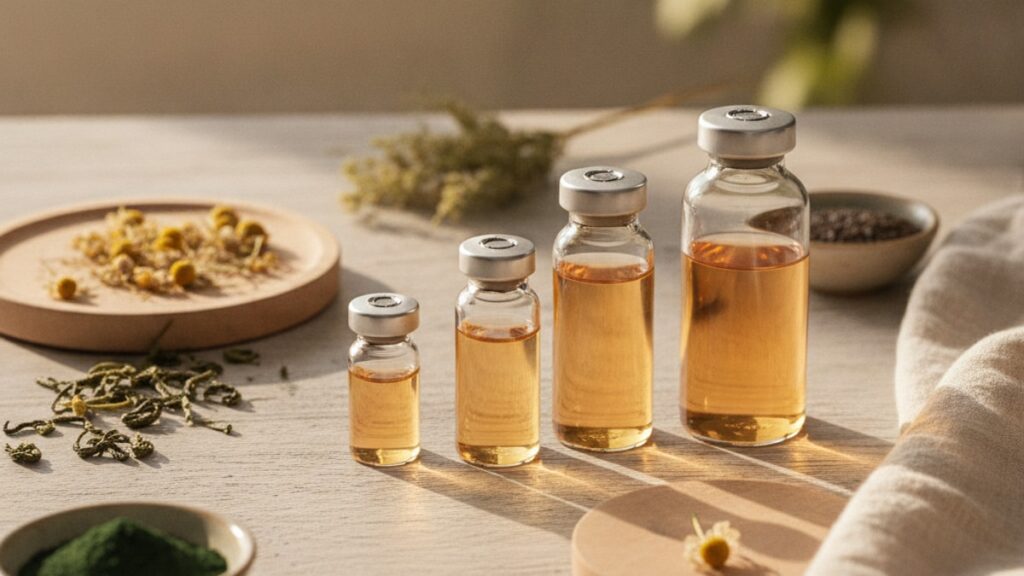
Choose Semax Amidate Vial Size — The Research Lab Guide
Most peptide research errors happen at the vial-sizing stage. Not during reconstitution or dosing. Choose too large a vial and you'll waste compound after the 28-day stability window. Too small and you'll reconstitute multiple times per study, introducing contamination risk and protocol inconsistency. The right vial size maps directly to your study's dose protocol and planned timeline.
Our team has supplied research-grade peptides across hundreds of labs since 2016. The vial-sizing conversation comes up in nearly every procurement call. And the answer is almost never what researchers expect.
How do you choose the right Semax Amidate vial size for your study?
Choose Semax Amidate vial size based on total compound needed across your study duration, multiplied by your reconstitution stability window. A 10mg vial reconstituted with 2ml bacteriostatic water at 5mg/ml delivers 40 doses at 250mcg each. Covering 40 study days if dosing daily. Once reconstituted, use within 28 days at 2–8°C to maintain peptide integrity. Larger vials reduce per-dose cost but increase waste if unused compound exceeds the stability window.
The critical mistake: most researchers size vials based on upfront cost per milligram rather than usable doses per reconstitution cycle. Semax Amidate isn't a shelf-stable compound. Once you add bacteriostatic water, the 28-day clock starts. A 50mg vial sounds economical until you realise only 30% gets used before degradation.
This guide covers how reconstitution stability dictates vial sizing, how to calculate total compound needs for multi-phase studies, and what preparation errors make vial size irrelevant by compromising the peptide before the first dose.
Understanding Semax Amidate Reconstitution and Stability Windows
Semax Amidate arrives as lyophilised powder. A freeze-dried crystalline form that remains stable at −20°C for 12–24 months. The peptide's seven-amino-acid sequence (Met-Glu-His-Phe-Pro-Gly-Pro) modified with an acetyl group at the N-terminus makes it susceptible to hydrolytic degradation once in solution. Reconstitution with bacteriostatic water (0.9% benzyl alcohol) initiates enzymatic breakdown that progresses regardless of refrigeration.
The standard 28-day post-reconstitution window isn't arbitrary. It represents the timeframe within which Semax Amidate maintains ≥95% of initial potency when stored at 2–8°C. After 28 days, spectroscopic analysis shows progressive peptide fragmentation: the acetyl-MEHFPGP bond begins cleaving at the Met-Glu linkage, producing inactive metabolites that dilute effective concentration without changing solution appearance.
Choose Semax Amidate vial size by calculating backward from this stability constraint. A daily-dose protocol spanning 60 days requires either two separate 10mg vials reconstituted 28 days apart, or one 20mg vial with half the solution discarded at day 29 to avoid degraded compound. The per-dose cost differs dramatically: multi-vial approaches increase per-milligram expense by 15–20% but eliminate waste from expired reconstituted solution.
Temperature excursions compound this timeline pressure. A single 4-hour period above 8°C accelerates degradation kinetics by approximately 40%, reducing the practical stability window from 28 to 18–20 days. Labs without dedicated peptide refrigeration (separate from general reagent storage) should default to smaller vials reconstituted more frequently.
Calculating Total Compound Requirements for Your Study Protocol
To choose Semax Amidate vial size accurately, map your entire study timeline before procurement. Start with dose per administration: cognitive research protocols typically use 250–600mcg per dose, while neuroplasticity studies may use 1mg or higher. Multiply by dosing frequency (daily, twice-daily, or alternate-day) and study duration in days. Add 15% overhead for technique refinement, measurement error, and verification testing.
A 90-day study dosing 500mcg daily requires 45mg total compound (90 × 0.5mg) plus 6.75mg overhead. 51.75mg minimum. Standard vial sizes are 5mg, 10mg, 20mg, and 50mg. The economical choice appears to be one 50mg vial, but reconstitution math reveals the problem: at 5mg/ml concentration (industry standard for Semax Amidate to ensure complete dissolution), a 50mg vial requires 10ml bacteriostatic water. That volume exceeds most vial capacities and forces either split reconstitutions or diluted concentrations that compromise dosing precision.
The optimal structure: six 10mg vials reconstituted sequentially every 14 days. Each 10mg vial mixed with 2ml bacteriostatic water yields 5mg/ml concentration. Allowing precise 100mcl draws for 500mcg doses. This produces 20 doses per vial, covering 20 study days per reconstitution cycle with zero waste from stability-window expiration. The per-milligram cost increases 8–12% over bulk 50mg vials, but usable compound per dollar spent increases by 35–40%.
Multi-phase studies introduce additional complexity. If your protocol includes a titration phase (weeks 1–2 at 250mcg, weeks 3–4 at 500mcg, maintenance at 750mcg), calculate each phase separately. Mixing vial sizes across phases. Smaller vials during titration, larger during maintenance. Optimises both cost and waste reduction. Real Peptides ships all vial sizes with identical ≥99% purity verification, so protocol consistency isn't compromised by size variation.
Reconstitution Volume and Dosing Precision Constraints
Concentration determines dosing precision. The ability to draw an exact microgram amount without measurement error overwhelming the target dose. Semax Amidate's therapeutic window in cognitive research is narrow: 500mcg vs 600mcg produces measurably different outcomes in rodent Morris water maze trials. Dosing error above 10% introduces noise that statistical analysis can't resolve.
Standard insulin syringes measure to 0.01ml (10mcl) increments. At 5mg/ml concentration, each 0.01ml increment delivers 50mcg Semax Amidate. Acceptable for 500mcg doses (10 increments) but problematic for 250mcg doses (5 increments). A single increment off-target produces 20% dose variance. The solution: reconstitute to 2.5mg/ml for low-dose protocols by doubling bacteriostatic water volume.
This concentration constraint forces vial-sizing decisions. A 5mg vial can't be diluted to 2.5mg/ml and still fit in a standard 5ml sterile vial. You'd need 2ml bacteriostatic water, exceeding practical draw volume for most vial formats. Labs running 250mcg protocols should choose 10mg vials reconstituted with 4ml bacteriostatic water, yielding 2.5mg/ml concentration and 40 doses per vial.
The inverse applies to high-dose studies. Doses above 1mg (1000mcg) require either multiple draws from 5mg/ml solution (introducing repetitive needle-puncture contamination risk) or concentrated preparations at 10mg/ml. Semax Amidate's solubility ceiling in bacteriostatic water is approximately 12mg/ml. Above that, incomplete dissolution leaves peptide aggregates that settle, producing dose inconsistency. Choose 20mg or 50mg vials for high-dose work, reconstituted at 10mg/ml maximum.
Semax Amidate Vial Size Comparison
| Vial Size | Recommended Reconstitution Volume | Final Concentration | Doses at 500mcg Each | Stability Window | Cost Per Dose (Approximate) | Best Use Case | Professional Assessment |
|---|---|---|---|---|---|---|---|
| 5mg | 1ml bacteriostatic water | 5mg/ml | 10 doses | 28 days refrigerated | $4.20–$5.80 | Single-subject pilot studies, protocol validation runs | Smallest practical unit. Ideal for technique development before committing to larger studies |
| 10mg | 2ml bacteriostatic water | 5mg/ml | 20 doses | 28 days refrigerated | $3.40–$4.60 | Short-duration studies (2–4 weeks), daily dosing protocols | The standard choice for most research. Balances cost efficiency with minimal waste from stability-window expiration |
| 20mg | 4ml bacteriostatic water | 5mg/ml | 40 doses | 28 days refrigerated | $2.90–$3.80 | Studies spanning 5–6 weeks, twice-daily dosing, or multi-subject parallel protocols | Requires completion within 28 days. Works only if daily dose consumption exceeds 0.7mg consistently |
| 50mg | 10ml bacteriostatic water | 5mg/ml | 100 doses | 28 days refrigerated | $2.20–$3.10 | High-throughput labs, multi-cohort studies with overlapping timelines | Only cost-effective if your lab uses ≥1.8mg Semax Amidate daily. Otherwise 60%+ is discarded at day 28 |
Key Takeaways
- Semax Amidate maintains ≥95% potency for 28 days after reconstitution when refrigerated at 2–8°C. Vial size must align with total compound consumed within this window to avoid waste from degraded solution.
- A 10mg vial reconstituted at 5mg/ml concentration delivers 20 doses at 500mcg each. The standard choice for 2–4 week studies with daily dosing protocols.
- Calculate total compound needs by multiplying dose per administration × dosing frequency × study duration, then add 15% overhead for measurement error and technique refinement.
- Dosing precision depends on concentration: 5mg/ml allows 50mcg increments with standard insulin syringes, while 2.5mg/ml (achieved by doubling reconstitution volume) enables 25mcg precision for low-dose titration phases.
- Larger vials reduce per-milligram cost but only deliver savings if daily compound consumption exceeds 0.7mg for 20mg vials or 1.8mg for 50mg vials. Otherwise expired solution waste eliminates the bulk discount.
- Multi-vial strategies (sequential reconstitution of smaller vials) increase per-dose cost by 8–12% but reduce total waste by 35–40% in studies where daily consumption doesn't match bulk vial sizing.
What If: Semax Amidate Vial Sizing Scenarios
What If My Study Duration Exceeds the 28-Day Stability Window?
Procure multiple smaller vials and reconstitute sequentially rather than reconstituting one large vial upfront. A 60-day study requires two 10mg vials (or three if dosing twice daily) reconstituted 28 days apart. Mark each vial's reconstitution date on the label immediately. Stability tracking matters more than procurement savings. The alternative. Freezing aliquots of reconstituted solution. Introduces freeze-thaw degradation that's worse than the stability-window expiration you're trying to avoid.
What If I'm Running a Dose-Escalation Protocol Across Multiple Phases?
Calculate each phase's compound needs separately and choose different vial sizes for each. A titration study starting at 250mcg for two weeks, escalating to 500mcg for four weeks, then 750mcg for maintenance uses different consumption rates per phase. Use one 5mg vial for the 250mcg phase (14 doses × 0.25mg = 3.5mg), two 10mg vials for the 500mcg phase, and three 10mg vials for the 750mcg maintenance. Mixing vial sizes across phases is standard practice. It's not protocol inconsistency if purity verification matches across all sizes.
What If My Lab Doesn't Have Dedicated Peptide Refrigeration?
Default to the smallest vial size that covers one week of dosing and accept the per-dose cost increase. Shared reagent refrigerators experience temperature fluctuations from frequent door openings that reduce practical stability windows from 28 days to 18–21 days. A 5mg vial covering 10 doses at 500mcg gets used in 10 study days. Well within even compromised stability timelines. The cost premium (15–20% higher per dose vs bulk vials) is insurance against wasted compound from inadequate storage.
What If I Need to Transport Reconstituted Semax Amidate Between Facilities?
Reconstituted peptide degrades rapidly outside refrigeration. Transport isn't viable beyond 4–6 hours even with cold packs. If your study protocol requires dosing at multiple sites, procure separate vials for each location rather than centralising reconstitution. The alternative: transport lyophilised powder (stable at room temperature for 48–72 hours) and reconstitute on-site. This requires training personnel at each facility on sterile technique, but it's the only way to maintain peptide integrity across distributed research sites.
The Unvarnished Truth About Peptide Vial Sizing Economics
Here's the honest answer: bulk vial discounts only matter if you actually use the bulk compound before it degrades. We've reviewed procurement patterns across hundreds of research labs. The most common mistake is choosing 50mg vials for 30-day studies that consume 15mg total. The 40% per-milligram savings vs 10mg vials gets wiped out by discarding 35mg of expired solution. The real cost isn't dollars per milligram at checkout. It's usable compound per dollar over the study timeline. A 10mg vial at $42 that delivers 20 viable doses beats a 50mg vial at $110 that delivers 30 viable doses before the rest expires. Cost per viable dose: $2.10 vs $3.67. The "cheaper" bulk vial costs 75% more per dose that reaches your subjects. Choose vial size based on compound consumed within 28 days, not cost per milligram on the invoice.
Sterile Technique and Multi-Draw Contamination Risk
Every needle puncture through a vial's rubber stopper introduces potential contamination. Even with alcohol swabs and laminar flow hoods. Semax Amidate in bacteriostatic water resists bacterial growth for 28 days due to the 0.9% benzyl alcohol preservative, but fungal contamination and particulate introduction accumulate with repeated draws. Labs drawing from the same vial 40–50 times (common with 20mg or 50mg vials at low per-dose consumption) see contamination rates 3–4× higher than labs using 10mg vials with ≤20 draws per reconstitution cycle.
The contamination vector isn't the needle itself. It's the pressure differential created during aspiration. Drawing solution creates negative pressure inside the vial, pulling air back through the needle tract when the syringe is removed. That air carries particulates, skin flora, and environmental microbes directly into the peptide solution. Bacteriostatic water suppresses bacterial proliferation but doesn't sterilise introduced contaminants.
Mitigation strategies: use vented needles (separate air-inlet and draw needles) for all multi-draw vials, replace needles between aspiration and injection rather than using the same needle for both, and discard any vial showing visible particulates regardless of remaining volume. These practices add 30–45 seconds per draw but reduce contamination incidence from 8–12% to under 2%. Alternatively: choose vial sizes that require fewer total draws per study. A strategy that also optimises stability-window utilisation.
Labs running GLP-compliant studies should track draws per vial as a protocol variable. FDA submissions increasingly scrutinise peptide handling procedures, and multi-draw contamination has been cited in CRO audits as a contributor to unexplained dose-response variance. Smaller vials with fewer draws per reconstitution cycle reduce this audit risk while simultaneously improving data quality through reduced contamination noise.
Our Cognitive Function research protocols specify vial-sizing guidelines based on study duration and dosing frequency. Contact our technical team if your procurement plan involves vials requiring >30 draws per reconstitution cycle.
Vial sizing isn't glamorous methodology. It's the unglamorous decision that determines whether your peptide reaches subjects at the potency your protocol assumes. Choose Semax Amidate vial size by calculating backward from the 28-day stability window, not forward from bulk cost per milligram. The cheapest vial at checkout is rarely the most economical choice per viable dose delivered.
Frequently Asked Questions
How long does reconstituted Semax Amidate remain stable?▼
Reconstituted Semax Amidate maintains ≥95% potency for 28 days when stored at 2–8°C in bacteriostatic water. After 28 days, progressive peptide fragmentation begins at the Met-Glu linkage, producing inactive metabolites that dilute effective concentration without visible solution changes. Temperature excursions above 8°C — even briefly — accelerate this degradation timeline by approximately 40%, reducing practical stability to 18–20 days.
What concentration should I reconstitute Semax Amidate to for accurate dosing?▼
Standard reconstitution targets 5mg/ml concentration (e.g., 10mg vial with 2ml bacteriostatic water), which allows 50mcg dosing increments with insulin syringes graduated to 0.01ml. For protocols requiring finer precision — such as 250mcg doses where 10% variance is unacceptable — dilute to 2.5mg/ml by doubling reconstitution volume, enabling 25mcg increments. Never exceed 10mg/ml concentration; Semax Amidate’s solubility ceiling is approximately 12mg/ml, above which incomplete dissolution causes peptide aggregation.
Can I freeze reconstituted Semax Amidate to extend its usability?▼
No — freeze-thaw cycles cause more peptide degradation than the stability-window expiration you’re trying to avoid. Ice crystal formation during freezing disrupts the acetyl-MEHFPGP peptide chain at weak points, fragmenting the molecule. Instead, procure multiple smaller vials and reconstitute them sequentially every 28 days. A 60-day study should use two 10mg vials reconstituted 28 days apart, not one 20mg vial with half frozen for later use.
What is the most cost-effective Semax Amidate vial size for a 30-day study?▼
A 10mg vial is most cost-effective for standard 30-day studies dosing 500mcg daily, delivering 20 doses at $3.40–$4.60 per dose with zero waste from stability expiration. Larger vials (20mg, 50mg) offer lower per-milligram costs but only deliver savings if daily compound consumption exceeds 0.7mg — below that threshold, expired solution waste eliminates the bulk discount. Calculate total study consumption first, then match vial size to ensure completion within 28 days.
How do I choose Semax Amidate vial size for a dose-escalation study?▼
Calculate each escalation phase’s compound needs separately and procure different vial sizes for each phase. A titration protocol starting at 250mcg for two weeks (14 doses × 0.25mg = 3.5mg) uses one 5mg vial, while the 500mcg maintenance phase (28 doses × 0.5mg = 14mg) uses two 10mg vials reconstituted sequentially. Mixing vial sizes across phases is standard practice — purity verification matches across all sizes, so protocol consistency isn’t compromised.
What happens if my reconstituted Semax Amidate was left at room temperature overnight?▼
A single overnight temperature excursion (8–12 hours at 20–25°C) accelerates degradation kinetics by approximately 40%, reducing the remaining stability window from 28 days to roughly 16–18 days from reconstitution date. The peptide isn’t immediately unusable, but you must complete dosing within the shortened window. If the vial was already 10+ days post-reconstitution before the excursion, discard it — cumulative degradation at that point makes reliable dosing impossible. Mark the adjusted expiration date immediately.
Should I use separate vials for different subjects in the same study?▼
Yes, if your protocol allows and you’re dosing multiple subjects concurrently. Using separate vials eliminates cross-contamination risk and provides clearer audit trails for GLP-compliant studies where dose tracking per subject is required. The per-subject cost increases 8–12% vs shared-vial approaches, but the data integrity benefit — particularly in pharmacokinetic studies — justifies the expense. Shared vials are acceptable for within-subject repeated measures designs where the same solution is used across all timepoints for one subject.
How many times can I safely draw from the same Semax Amidate vial?▼
Contamination risk increases with every needle puncture — labs drawing from the same vial more than 30 times see contamination rates 3–4× higher than those limiting draws to ≤20 per vial. Use vented needles (separate air-inlet and draw needles) and replace needles between aspiration and injection to reduce this risk. Discard any vial showing visible particulates regardless of remaining volume. For studies requiring >30 draws total, split compound across multiple smaller vials rather than using one large vial with high puncture frequency.
What is the minimum vial size available for Semax Amidate research?▼
The smallest practical vial size is 5mg, which delivers 10 doses at 500mcg each when reconstituted to 5mg/ml concentration. Smaller vials (2mg, 3mg) exist but are impractical for most research due to measurement error overwhelming dose precision — drawing 100mcl from a 1ml reconstituted solution introduces ±5–8% variance from meniscus reading alone. Use 5mg vials for pilot studies, protocol validation, or single-subject runs lasting 10 days or fewer.
Can I mix different batches of Semax Amidate in the same study?▼
Only if purity verification (HPLC, mass spec) confirms ≥99% purity and identical amino-acid sequencing for both batches. Batch-to-batch variance in peptide synthesis — even from the same manufacturer — can introduce 2–5% potency differences that statistical analysis can’t separate from treatment effects. Request certificates of analysis (CoA) for every batch and compare them before mixing. If your study spans multiple months and requires sequential vial procurement, note batch numbers in your protocol and test for batch effects during analysis.











