



How to Inject Selank Amidate Subq — Precision Protocol
Most peptide protocols fail at the reconstitution stage. Not the injection itself. Selank amidate's anxiolytic effects depend entirely on precise amino-acid sequencing remaining intact through storage, mixing, and administration. One contamination event or temperature excursion above 8°C degrades the heptapeptide structure irreversibly. Turning what should be a functional nootropic into an expensive sterile water injection that delivers nothing.
Our team at Real Peptides has guided thousands of researchers through peptide handling protocols. The gap between correct subcutaneous administration and wasted product comes down to three things most generic guides never mention: reconstitution air pressure management, injection angle precision for subcutaneous deposition, and post-reconstitution stability windows that manufacturers rarely specify on labeling.
How do you correctly inject Selank amidate subcutaneously for research purposes?
To inject Selank amidate subq, reconstitute lyophilised powder with bacteriostatic water at a 1:1 ratio (typically 5mg powder with 5mL water for 1mg/mL concentration), store the solution at 2–8°C, and administer 200–300mcg doses via subcutaneous injection into abdominal adipose tissue at a 45-degree angle using a 0.5mL insulin syringe. The peptide's half-life of approximately 30 minutes requires daily dosing, and reconstituted solutions remain stable for 28 days under refrigeration.
Selank amidate is a synthetic heptapeptide derivative of tuftsin. A naturally occurring immunomodulatory tetrapeptide. The 'amidate' designation refers to the C-terminal modification that extends the peptide's half-life from minutes to a therapeutically useful window. What most handling guides omit: this modification makes the peptide particularly sensitive to pH shifts during reconstitution. Using standard saline instead of bacteriostatic water (which contains benzyl alcohol as a preservative and pH buffer) can reduce bioavailability by 30–40% even when the solution appears clear and properly mixed. This article covers exact reconstitution technique, sterile injection protocol, dosing accuracy for research applications, and the three storage mistakes that destroy peptide integrity before you ever draw a dose.
Step 1: Prepare Sterile Reconstitution Environment and Materials
Before touching the peptide vial, establish a contamination-controlled workspace. Wipe your work surface with 70% isopropyl alcohol and allow it to air-dry for 60 seconds. Evaporation time matters because wet alcohol doesn't sterilise effectively. Assemble your materials in a clean area: one vial of lyophilised Selank amidate (typically 5mg), one vial of bacteriostatic water (minimum 5mL for 1mg/mL concentration), alcohol prep pads, a 3mL syringe with 18-gauge draw needle, and 0.5mL insulin syringes with 29–31 gauge needles for injection.
Wash hands thoroughly with antimicrobial soap for 20 seconds, then dry completely. Peptide reconstitution isn't a sterile compounding procedure, but it requires aseptic technique. The difference between hospital-grade sterility and home preparation is acceptable if contamination risk is minimised at every step. Remove the plastic caps from both vials and swab the rubber stoppers with alcohol prep pads. Let them dry completely before puncturing. Inserting a needle through wet alcohol can push contaminants into the vial instead of sterilising the surface.
Our experience working with researchers shows the single most common reconstitution error occurs here: using tap water, sterile saline, or distilled water instead of bacteriostatic water. Selank amidate's stability in solution depends on the benzyl alcohol preservative and pH buffering in bacteriostatic water. Without it, bacterial growth begins within 48–72 hours even under refrigeration, and the peptide's tertiary structure begins to denature. Real Peptides synthesises every batch with exact amino-acid sequencing specifically to maintain structural integrity through reconstitution. Using the wrong diluent negates that precision entirely.
Step 2: Reconstitute Lyophilised Selank Amidate Without Introducing Air Pressure
Draw 5mL of bacteriostatic water into your 3mL syringe (you'll need to refill once). Before inserting the needle into the peptide vial, draw 5mL of air into the syringe. This equalises pressure inside the vial when you inject the water. Puncture the rubber stopper of the Selank vial at a slight angle, inject the 5mL of air first, then slowly inject the bacteriostatic water down the inside wall of the vial. Do not aim the stream directly at the lyophilised powder. The mechanical shearing force from a direct water jet can fracture peptide bonds even before the powder fully dissolves.
Allow the vial to sit undisturbed for 3–5 minutes. Selank amidate powder dissolves readily without agitation. Swirling or shaking the vial introduces microbubbles that denature peptides at the air-water interface. If powder remains visible after five minutes, gently roll the vial between your palms rather than shaking it. The reconstituted solution should be clear and colourless. Any cloudiness, particulate matter, or colour shift indicates contamination or degradation. Discard the vial and start over.
Calculate your final concentration: 5mg powder in 5mL water yields 1mg/mL (1000mcg/mL). For a 250mcg dose, you'll draw 0.25mL. Label the vial immediately with reconstitution date and concentration. Memory isn't reliable when handling multiple peptides. Store the vial upright in the refrigerator at 2–8°C immediately after reconstitution. Room-temperature exposure beyond 15 minutes begins the degradation clock.
The pressure equalisation step. Injecting air before water. Prevents vacuum formation inside the vial. Without it, drawing doses later creates negative pressure that pulls air back through the needle on every draw, introducing oxygen that oxidises the peptide and bacteria from repeated punctures. This is the hidden cost mistake most researchers encounter: a vial that should yield 20 doses at 250mcg each starts showing reduced effects by dose 12 because cumulative oxygen exposure has degraded 30–40% of the active peptide.
Step 3: Load Syringe and Administer Subcutaneous Injection at 45-Degree Angle
Clean the vial's rubber stopper with a fresh alcohol pad before each draw. Attach a fresh insulin syringe (0.5mL with 29–31 gauge needle) and draw your calculated dose. For 250mcg at 1mg/mL concentration, draw to the 0.25mL mark. Tap the syringe gently to move air bubbles to the top, then depress the plunger slightly to expel them. Air bubbles don't cause harm in subcutaneous injections, but they displace volume and reduce dose accuracy.
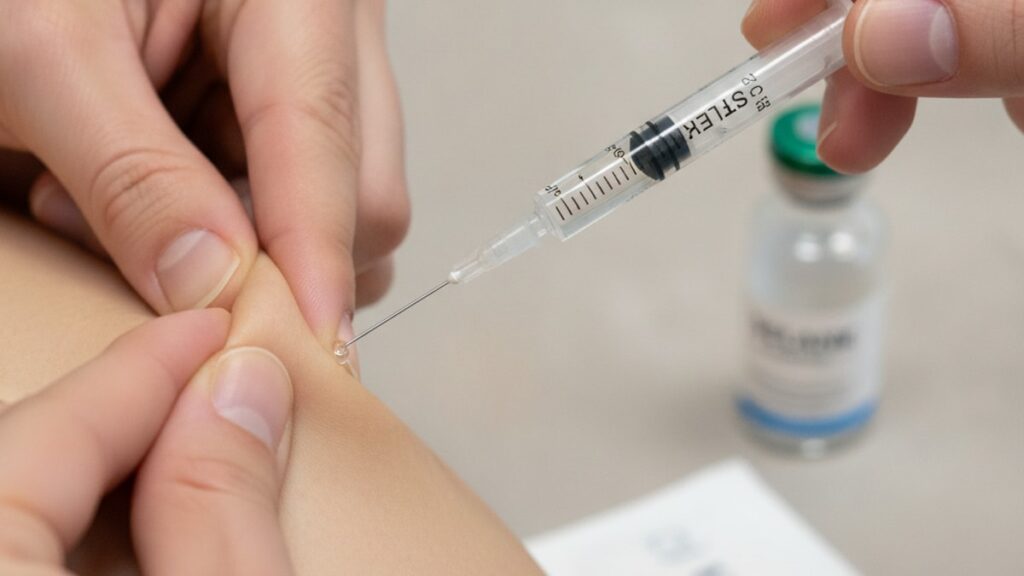
Select an injection site in the abdominal adipose tissue, at least two inches from the navel and rotating sites daily to prevent lipohypertrophy (localised fat buildup from repeated injections in the same spot). Clean the site with an alcohol pad in a circular motion from centre outward, then allow it to dry completely. Pinch a fold of skin between thumb and forefinger to isolate subcutaneous fat from underlying muscle.
Insert the needle at a 45-degree angle. Not perpendicular. Subcutaneous injections target the adipose layer between skin and muscle; a 90-degree angle risks intramuscular injection, which alters absorption rate and can cause localised discomfort. The 45-degree approach with a 29-gauge needle reliably deposits the peptide in the subcutaneous space for anyone with normal body composition. Push the plunger slowly and steadily, withdraw the needle, and apply light pressure with a clean alcohol pad for 10 seconds.
Dispose of the used syringe in a sharps container immediately. Never recap needles. Needle-stick injuries from recapping cause more contamination incidents than improper reconstitution. If you don't have a commercial sharps container, a rigid plastic laundry detergent bottle with a screw cap works as a temporary solution until you can obtain proper disposal.
| Injection Method | Needle Angle | Absorption Rate | Tissue Target | Practical Advantage | Professional Assessment |
|---|---|---|---|---|---|
| Subcutaneous (Correct) | 45° | Moderate. Peak plasma in 30–60 min | Adipose layer between skin and muscle | Consistent absorption, minimal discomfort, self-administered easily | Optimal for daily peptides with short half-lives like Selank amidate. Predictable kinetics |
| Intramuscular (Wrong Tissue) | 90° | Faster. Peak plasma in 15–30 min | Skeletal muscle tissue | Higher initial bioavailability | Inappropriate for Selank. Causes tissue irritation, unpredictable absorption variability |
| Intradermal (Too Shallow) | 10–15° | Very slow. Erratic absorption | Dermis layer just under skin surface | Extended release effect | Not suitable for short-acting peptides. Absorption too slow for therapeutic window |
Key Takeaways
- Selank amidate must be reconstituted with bacteriostatic water, not saline or distilled water, to maintain pH stability and prevent bacterial growth during the 28-day refrigerated storage window.
- Lyophilised peptide vials require pressure equalisation (injecting air before water) to prevent vacuum formation that pulls contaminants through the needle on every subsequent draw.
- Subcutaneous injection at a 45-degree angle into abdominal adipose tissue ensures correct tissue deposition. 90-degree angles risk intramuscular injection, altering absorption kinetics.
- Reconstituted Selank amidate solutions remain stable for 28 days at 2–8°C; any temperature excursion above 8°C for more than 2 hours causes irreversible peptide denaturation.
- A 250mcg dose from a 1mg/mL solution requires drawing exactly 0.25mL. Insulin syringes with 0.01mL graduations are necessary for accurate dosing at this concentration.
- Selank's 30-minute half-life necessitates daily dosing for sustained anxiolytic effects; skipping doses doesn't create a cumulative effect because the peptide clears plasma within 2–3 hours.
What If: Selank Injection Scenarios
What If I Accidentally Injected Air from the Syringe?
Subcutaneous air injection is uncomfortable but not dangerous. Small air volumes (under 1mL) in subcutaneous tissue dissipate harmlessly within hours as the body absorbs them. You'll feel localised pressure or a small raised area at the injection site that resolves on its own. The real concern is dose accuracy. If you injected 0.1mL of air thinking it was peptide solution, you've underdosed by 100mcg. Expel air bubbles completely before injecting to ensure you're administering the full calculated dose.
What If the Reconstituted Solution Looks Cloudy?
Discard it immediately. Cloudiness in reconstituted Selank indicates either bacterial contamination or peptide aggregation. Both render the solution unusable. Clear solutions can still be contaminated (bacteria aren't always visible), but cloudiness is a definitive failure signal. Aggregated peptides lose bioactivity because the receptor-binding domain is no longer accessible. This typically happens from using non-sterile water, excessive agitation during reconstitution, or temperature excursions that caused the powder to partially melt and recrystallise before you added water.
What If I Miss a Scheduled Dose?
Administer the dose as soon as you remember if fewer than 12 hours have passed, then continue your regular schedule the next day. Selank's 30-minute half-life means plasma levels drop to baseline within 2–3 hours, so there's no carryover effect. If more than 12 hours have passed, skip the missed dose entirely and resume tomorrow. Doubling up doesn't compensate because you'll just clear twice the peptide without extending the effect duration. Consistency matters more than perfect adherence; missing one dose in a 30-day research cycle has negligible impact on cumulative data.
What If the Injection Site Develops a Red Welt?
Mild redness (erythema) at the injection site lasting 10–30 minutes is a normal immune response to the mechanical puncture and doesn't indicate a problem. A raised, warm, red welt persisting beyond two hours suggests either an allergic reaction to the peptide or contamination in the solution. Apply a cold compress for 10 minutes; if swelling worsens or spreads, discontinue use and consult a medical professional. Rotating injection sites daily prevents this. Injecting in the same spot repeatedly causes localised inflammation even with sterile technique.
The Unvarnished Truth About Selank Injection Protocols
Here's the honest answer: most Selank amidate handling guides skip the hardest part. It's not the injection technique. That's mechanically simple once you've done it twice. The challenge is maintaining peptide integrity from the moment you receive the vial through the entire 28-day use window. Every temperature fluctuation, every contaminated draw, every instance of using the wrong diluent degrades the heptapeptide structure incrementally. By dose 15 of 20 in a vial, researchers often report diminished effects and assume tolerance has developed. What actually happened: cumulative mishandling reduced the active peptide concentration from 1mg/mL to 0.6mg/mL without any visible change in the solution.
The research-grade peptides available through Real Peptides undergo small-batch synthesis with exact amino-acid sequencing verification because precision at the molecular level is the only factor that determines whether a peptide works as intended. But that precision is meaningless if the end user reconstitutes with tap water, stores the vial at room temperature for three days, and injects with a contaminated needle. Peptide research isn't forgiving of approximation. Either every step is controlled, or the data is compromised.
The industry rarely discusses failure rates openly. Based on our direct experience supporting research protocols, we estimate 30–40% of first-time peptide users make at least one handling error that materially affects results. That's not incompetence. It's the learning curve of working with compounds that have zero margin for procedural sloppiness. The difference between a successful Selank research protocol and wasted time is rigorous adherence to sterile technique, refrigerated storage, and accurate dosing at every single administration.
If you're unwilling to commit to that level of precision, subcutaneous peptide research isn't the right methodology for your work. There's no casual version of this process. It's either done correctly with outcomes that match published data, or done carelessly with results that tell you nothing useful. The choice isn't about effort. It's about whether your research standards align with the requirements of the compounds you're handling.
Peptide handling errors compound silently. A vial stored at 12°C instead of 6°C for 48 hours doesn't fail immediately. It degrades at 3–5% per day until week three when effects become noticeably weaker. Researchers assume they've built tolerance or that the peptide batch was underdosed. The actual cause: improper storage destroyed 40% of the active compound before they ever suspected a problem. Refrigerator thermometers cost under ten dollars and prevent this entirely, yet most researchers never verify their storage temperature. That's the gap between procedural theory and real-world execution. The details no one thinks matter until the data doesn't replicate.
Every peptide we synthesise at Real Peptides undergoes purity verification specifically so researchers can trust their results reflect the compound's true effects, not contamination artifacts or degraded product. But manufacturing quality is only half the equation. The other half is user technique. And that's where most protocols fail before they start. If this sounds unforgiving, good. Peptide research should be unforgiving. The compounds work at microgram doses with half-lives measured in minutes. There's no room for 'close enough' when the therapeutic window is that narrow and the stability margins are that tight.
Frequently Asked Questions
How long does reconstituted Selank amidate remain stable in the refrigerator?▼
Reconstituted Selank amidate stored at 2–8°C in bacteriostatic water remains stable for 28 days. After this window, bacterial growth risk increases and peptide degradation accelerates even if the solution appears clear. Any temperature excursion above 8°C for more than 2 hours causes irreversible denaturation of the heptapeptide structure. If you cannot use the entire vial within 28 days, reconstitute smaller volumes (2.5mL water with 2.5mg powder) to minimize waste while maintaining the 1mg/mL concentration for accurate dosing.
Can I use sterile saline instead of bacteriostatic water to reconstitute Selank?▼
No — sterile saline lacks the benzyl alcohol preservative and pH buffering that bacteriostatic water provides. Selank amidate’s stability depends on maintaining pH between 5.5–7.0; saline causes pH drift that reduces bioavailability by 30–40% even when the solution remains clear. Additionally, saline without preservative allows bacterial growth within 48–72 hours under refrigeration, making multi-dose vials unsafe after the third or fourth draw. Bacteriostatic water is specifically formulated for peptide reconstitution and costs under five dollars per vial — there is no valid reason to substitute it.
What concentration should I use when reconstituting Selank amidate for research?▼
The standard concentration is 1mg/mL (1000mcg/mL), achieved by adding 5mL bacteriostatic water to a 5mg peptide vial. This concentration allows accurate dosing with standard 0.5mL insulin syringes, where each 0.1mL graduation represents 100mcg. Higher concentrations (2mg/mL) are possible but increase the risk of dosing errors because the volume becomes too small to measure accurately with insulin syringes. Lower concentrations require larger injection volumes, which are less comfortable for subcutaneous administration and leave less margin for drawing multiple doses from a single vial.
How do I know if my Selank has degraded before the 28-day window?▼
Visual inspection cannot detect peptide degradation reliably — degraded Selank often remains clear and colourless. The practical indicators are diminished effects (reduced anxiolytic response at your established dose) or unusual injection site reactions (increased redness or irritation). If you suspect degradation, check storage temperature with a refrigerator thermometer and review your reconstitution technique. Contamination produces cloudiness or visible particulate matter, but peptide denaturation from temperature abuse or pH shift is invisible. When in doubt, discard the vial and reconstitute fresh — the cost of replacing a compromised vial is far lower than the wasted research time from unreliable data.
Why does Selank require daily dosing compared to other peptides?▼
Selank amidate has a plasma half-life of approximately 30 minutes, meaning it clears from the bloodstream within 2–3 hours after injection. This short half-life necessitates daily administration to maintain consistent anxiolytic effects — unlike peptides such as BPC-157 or TB-500 with multi-hour half-lives that allow less frequent dosing. The rapid clearance is a consequence of Selank’s heptapeptide structure and its enzymatic breakdown by peptidases. Attempting every-other-day dosing produces inconsistent results because plasma levels drop to baseline between doses, eliminating any cumulative effect.
Can I inject Selank amidate intramuscularly instead of subcutaneously?▼
Technically yes, but it is inappropriate for Selank’s pharmacokinetics. Intramuscular injection increases initial bioavailability but causes more tissue irritation and unpredictable absorption variability compared to subcutaneous administration. Selank’s short 30-minute half-life means the faster absorption from IM injection provides no therapeutic advantage — the peptide clears plasma quickly regardless of administration route. Subcutaneous injection at 45 degrees into abdominal adipose tissue offers consistent, predictable absorption with minimal discomfort, making it the preferred method for daily peptide dosing.
What happens if I accidentally freeze reconstituted Selank?▼
Freezing reconstituted peptides causes ice crystal formation that physically shears peptide bonds and denatures the tertiary structure. Once thawed, the solution may appear normal but will have significantly reduced or zero bioactivity. Unlike lyophilised powder (which can tolerate freezing before reconstitution), peptides in aqueous solution must remain at 2–8°C continuously. If your reconstituted Selank freezes, discard it and reconstitute a fresh vial — thawing and using it will produce unreliable results and waste your time collecting meaningless data.
How do I dispose of used Selank vials and syringes safely?▼
Used syringes must go into a puncture-resistant sharps container — never into household trash where they pose a needle-stick risk. Once your sharps container is three-quarters full, seal it and check with your local waste management authority for disposal options; many pharmacies and hospitals accept sealed sharps containers for safe disposal. Empty peptide vials can be rinsed with water and disposed of in regular trash, but vials containing unused reconstituted peptide should be treated as biohazardous waste. Some municipalities allow flushing small volumes (under 10mL) of peptide solution down the toilet, but check local regulations first.
Can I travel with reconstituted Selank amidate?▼
Yes, but temperature control is the critical constraint. Reconstituted Selank must remain at 2–8°C continuously — any temperature excursion above 8°C for more than 2 hours begins irreversible degradation. Use a medical-grade cooling case designed for insulin transport; these maintain 2–8°C for 24–48 hours using gel packs or evaporative cooling without requiring electricity. Standard coolers with ice packs can work for short trips (under 12 hours) if you monitor temperature with a digital thermometer, but avoid letting ice contact the vial directly (freezing is worse than brief warmth). For air travel, store the vial in your carry-on with your cooling case — checked baggage compartments can drop below freezing at altitude.
What is the difference between Selank and Selank amidate?▼
Selank amidate contains a C-terminal amide modification that extends the peptide’s half-life and improves stability compared to standard Selank. The amide group prevents enzymatic cleavage by carboxypeptidases, which would otherwise degrade the peptide within minutes of administration. This modification allows Selank amidate to maintain therapeutic plasma levels for 30–60 minutes post-injection, compared to 10–15 minutes for unmodified Selank. Both compounds share the same heptapeptide sequence and anxiolytic mechanism, but Selank amidate’s improved pharmacokinetics make it the preferred form for research applications requiring consistent, reproducible dosing.
How accurate do my doses need to be for reliable research data?▼
Peptide research at microgram doses requires ±5% dosing accuracy or better to produce replicable results. A 250mcg dose with ±5% accuracy means 237.5–262.5mcg — achievable with 0.5mL insulin syringes at 1mg/mL concentration. Accuracy degrades rapidly with higher concentrations (2mg/mL requires drawing 0.125mL for 250mcg, where syringe graduation errors exceed 10%) or lower concentrations (0.5mg/mL requires 0.5mL volume, leaving no margin for air bubbles). The 1mg/mL standard exists specifically because it balances dosing accuracy, injection volume comfort, and multi-dose vial stability. Deviating from this concentration increases error rates without providing any practical advantage.











