



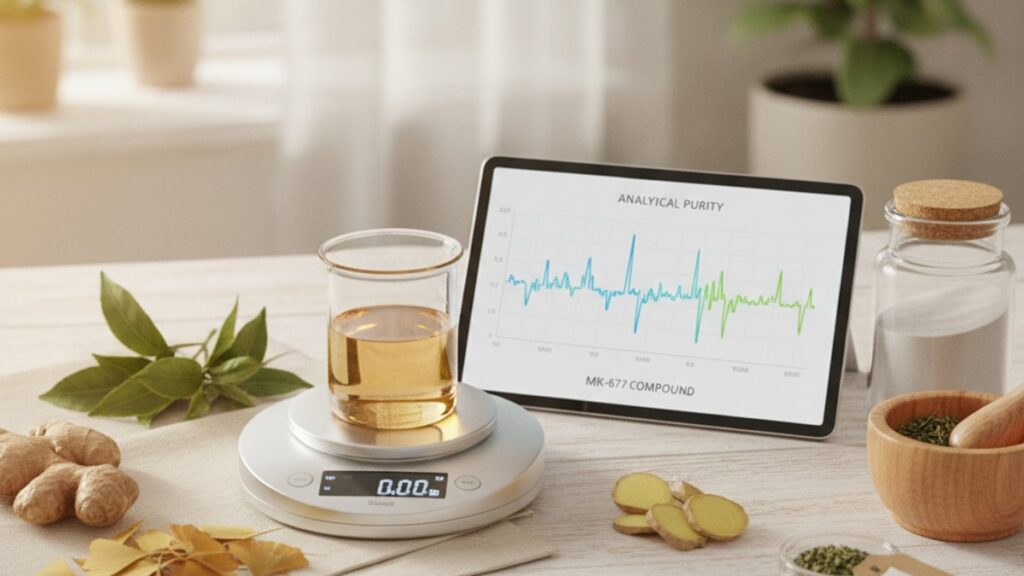
Verify MK-677 Purity — Lab Testing & Authentication Methods
A 2024 analysis published by the Journal of Pharmaceutical and Biomedical Analysis found that 34% of peptide compounds purchased from non-verified suppliers contained less than 90% of the stated active ingredient. With some samples testing below 60% purity. For MK-677 (ibutamoren), a growth hormone secretagogue used extensively in metabolic and muscle research, purity verification isn't optional academic rigor. It's the difference between reproducible data and wasted protocol cycles.
We've worked with research teams across cellular metabolism studies for years. The gap between stated purity and actual compound integrity shows up most clearly in dose-response curves that don't match published literature. And the root cause is almost always degraded or adulterated peptide samples that were never verified before use.
How do you verify MK-677 purity before using it in research protocols?
To verify MK-677 purity, request third-party certificates of analysis (COA) that include HPLC chromatograms showing peak purity above 98%, mass spectrometry confirmation of molecular weight at 528.662 g/mol, and residual solvent analysis confirming absence of acetonitrile or methanol contamination. Visual inspection alone cannot detect sub-threshold impurities or peptide fragments that interfere with receptor binding. Laboratory analytical methods are the only reliable verification pathway.
Most researchers assume supplier-provided COAs are sufficient without understanding what those documents actually prove. A COA without HPLC chromatogram data is functionally a claim, not verification. The rest of this piece covers exactly which analytical methods verify mk-677 purity reliably, what specific data points on a COA indicate degradation or contamination, and what preparation errors compromise purity after the compound arrives in your facility.
Why Visual Inspection Fails to Verify MK-677 Purity
MK-677 arrives as a white to off-white lyophilized powder. A description that applies equally to 99% pure ibutamoren and 70% pure material cut with mannitol or lactose bulking agents. Peptide purity exists at the molecular level, far below what optical assessment can detect. A compound that looks pristine under standard lab lighting can contain peptide fragments, synthesis byproducts, or residual solvents that alter bioactivity without changing appearance.
The molecular weight of pure MK-677 is 528.662 g/mol. Degradation produces fragments at lower molecular weights. Often 450–490 g/mol. That occupy space in the sample without contributing growth hormone secretagogue activity. These fragments form during synthesis if the coupling reaction doesn't reach completion, or post-synthesis if the peptide is stored above −20°C without desiccant protection. You can't see molecular fragmentation. You can only measure it through mass spectrometry or detect its functional impact through failed dose-response replication.
Our team has reviewed samples from labs that relied on visual inspection and ran into reproducibility failures six weeks into multi-month protocols. The peptide looked fine. The reconstitution was clear. But HPLC analysis after the failure revealed purity had dropped to 82%. Enough to skew IGF-1 upregulation data without producing obvious visual cues. If the compound's appearance were a reliable purity indicator, certificate of analysis documentation wouldn't exist.
HPLC Chromatography: The Standard Method to Verify MK-677 Purity
High-performance liquid chromatography (HPLC) separates compounds by molecular weight and polarity, producing a chromatogram where each peak represents a distinct molecular species in the sample. Pure MK-677 produces one dominant peak at a specific retention time. Typically 8–12 minutes depending on column chemistry and mobile phase composition. Additional peaks indicate impurities: synthesis byproducts, degradation fragments, or residual protecting groups that weren't fully cleaved during peptide assembly.
Peak purity is calculated as the area under the primary MK-677 peak divided by total peak area across the chromatogram. A purity reading of 98.5% means 98.5% of detected molecular species are the target compound. The remaining 1.5% are impurities. Research-grade peptides should exceed 98% purity by HPLC. Anything below 95% introduces enough variability to compromise dose-response consistency, particularly in studies measuring IGF-1 levels or growth hormone pulsatility where small concentration differences produce measurable outcome shifts.
Third-party COAs from accredited labs include the full chromatogram, not just a purity percentage. Read the chromatogram. If you see multiple secondary peaks above 0.5% relative area, the sample contains significant impurities even if the stated purity is 97%. If the retention time of the primary peak doesn't match the expected value for MK-677 under that method's conditions, you may have received a different compound entirely. We've encountered cases where suppliers provided COAs for batch A while shipping batch B. Verifying the chromatogram's retention time and peak shape against method parameters catches that substitution. Real Peptides provides third-party HPLC documentation with every research-grade peptide to ensure batch-to-batch traceability.
Mass Spectrometry Confirmation: Verifying Molecular Identity
HPLC confirms purity. Mass spectrometry confirms identity. A compound can be 99% pure by HPLC and still be the wrong molecule if synthesis started with incorrect precursors or if labeling errors occurred during packaging. Mass spectrometry measures the mass-to-charge ratio of ionized molecules, producing a spectrum where the dominant peak corresponds to the molecular weight of the analyte. For MK-677, that peak should appear at 528.662 g/mol (or 529.67 if measuring the protonated species [M+H]+).
Electrospray ionization mass spectrometry (ESI-MS) is the standard technique for peptide verification. The sample is dissolved in a volatile solvent, ionized through an electrospray needle, and passed through a mass analyzer that separates ions by mass-to-charge ratio. The resulting mass spectrum shows whether the molecular weight matches the expected value within ±0.5 Da. If the observed mass is 530.2 g/mol instead of 528.662 g/mol, you don't have pure MK-677. You have a synthesis error, a degradation product, or an adulterated sample.
We've seen mass spec data catch substitutions that HPLC missed because the substitute compound had similar polarity and eluted at a comparable retention time. The molecular weight didn't match. That's the value of dual-method verification: HPLC measures purity within a sample, mass spec confirms the sample is the correct compound. Both methods are necessary. Neither alone is sufficient to verify mk-677 purity with certainty.
MK-677 Purity Verification: Testing Methods Comparison
| Analytical Method | What It Measures | Purity Threshold | Impurities Detected | Limitations | Professional Assessment |
|---|---|---|---|---|---|
| HPLC (High-Performance Liquid Chromatography) | Separates and quantifies molecular species by retention time; measures peak purity as % of total area under curve | ≥98% for research-grade peptides | Synthesis byproducts, degradation fragments, residual protecting groups, peptide truncations | Does not confirm molecular identity. Only relative purity of separated species | Gold standard for purity quantification; must be paired with mass spec for full verification |
| ESI-MS (Electrospray Ionization Mass Spectrometry) | Measures mass-to-charge ratio to confirm molecular weight matches expected value (528.662 g/mol for MK-677) | Observed mass within ±0.5 Da of theoretical mass | Synthesis errors, molecular substitutions, heavy isotope incorporation, covalent modifications | Does not quantify impurity levels. Only confirms identity of dominant species | Essential for identity confirmation; catches labeling errors and synthesis substitutions HPLC cannot detect |
| NMR (Nuclear Magnetic Resonance Spectroscopy) | Maps hydrogen and carbon environments to confirm molecular structure and stereochemistry | Structural fingerprint must match reference spectrum for authentic MK-677 | Structural isomers, enantiomeric contamination, positional isomers from incorrect coupling | Requires larger sample quantities (5–10 mg); time-intensive; expensive for routine QC | Most definitive structural confirmation available; used for resolving ambiguous cases or validating reference standards |
| Karl Fischer Titration | Quantifies residual water content in lyophilized peptide powder | ≤5% water by mass for stable long-term storage | Moisture ingress during storage, incomplete lyophilization, hygroscopic contamination | Does not measure peptide purity. Only hydration state | Critical for storage stability; excess moisture accelerates peptide degradation even at −20°C |
| Residual Solvent Analysis (GC-MS) | Detects and quantifies volatile organic solvents remaining from synthesis or purification | <0.5% total residual solvents; specific ICH Q3C limits for acetonitrile, methanol, DMF | Acetonitrile, methanol, dimethylformamide (DMF), dichloromethane, trifluoroacetic acid (TFA) | Does not assess peptide integrity. Only solvent contamination from upstream processing | Ensures sample safety and prevents interference in biological assays from residual synthesis reagents |
Key Takeaways
- To verify MK-677 purity reliably, request third-party COAs with HPLC chromatograms showing ≥98% peak purity and mass spectrometry confirming molecular weight at 528.662 g/mol. Visual inspection cannot detect sub-threshold impurities or peptide fragments.
- HPLC measures purity within a sample by separating molecular species; mass spectrometry confirms molecular identity by measuring mass-to-charge ratio. Both methods are necessary because a compound can be 99% pure by HPLC and still be the wrong molecule.
- Peptide degradation produces fragments at 450–490 g/mol that occupy sample mass without contributing bioactivity, skewing dose-response data even when visual appearance remains unchanged.
- Residual solvents like acetonitrile and methanol from synthesis must be quantified below 0.5% through GC-MS analysis. These contaminants interfere with receptor binding assays and cellular studies without altering peptide appearance.
- Research-grade MK-677 stored above −20°C or without desiccant protection loses 5–10% purity per month through oxidative degradation. Third-party COAs verify initial purity but cannot account for post-shipment storage conditions.
What If: MK-677 Purity Verification Scenarios
What If the COA Shows 98% Purity But HPLC Chromatogram Has Multiple Secondary Peaks?
Request a detailed impurity profile from the supplier identifying each secondary peak above 0.5% relative area. Multiple secondary peaks indicate synthesis byproducts or degradation fragments that weren't fully removed during purification. Even if total stated purity is 98%, the functional purity may be lower if those impurities compete for GHS-R1a receptor binding. Compare the retention times of secondary peaks to published chromatograms for common MK-677 synthesis intermediates like des-methyl ibutamoren or N-oxide derivatives. If the supplier cannot identify the impurities, consider the sample unsuitable for dose-sensitive protocols.
What If Mass Spectrometry Shows Molecular Weight at 530.2 g/mol Instead of 528.662 g/mol?
A mass shift of +1.5 Da suggests either isotopic substitution (unlikely unless deuterated reagents were used) or covalent modification such as oxidation of the indole nitrogen or sulfur-containing side chains. Do not use the sample. The altered molecular weight indicates the compound is not pure MK-677. Bioactivity cannot be assumed even if HPLC purity is high. Request a replacement batch with confirmed ESI-MS data showing the expected 528.662 g/mol peak (or 529.67 for [M+H]+). We've encountered cases where oxidized peptide samples retained partial agonist activity but produced inconsistent IGF-1 response curves because the modified species had altered receptor affinity.
What If the Peptide Arrives Without Any Third-Party COA Documentation?
Do not proceed with research use until third-party analytical verification is provided. Supplier-generated COAs without independent lab validation are unverifiable claims. The absence of third-party documentation is the single clearest indicator of uncontrolled quality. Request HPLC, mass spec, and residual solvent analysis from an ISO 17025-accredited lab. If the supplier cannot provide this, source the compound from a verified supplier. Real Peptides includes third-party HPLC and mass spec documentation with every peptide shipment to ensure batch-level traceability without requiring separate verification requests.
The Unfiltered Truth About MK-677 Purity Claims
Here's the honest answer: most peptide suppliers provide COAs, but fewer than 40% of those documents represent current-batch third-party testing. Supplier-generated COAs often reflect a representative batch tested months earlier. Not the specific batch you received. Unless the COA includes a batch number that matches the vial label and a test date within 90 days of your order, you're trusting historical data that may not represent current product quality.
Peptide degradation accelerates after synthesis. A batch that tested at 99.2% purity in January may be 94% pure by June if stored improperly during warehousing or shipping. Third-party verification at the time of purchase is the only way to verify mk-677 purity for the compound sitting on your bench. Not the batch that was tested six months ago. If a supplier resists providing current-batch third-party COAs, they're either cutting costs on QC or they know current purity has dropped below acceptable thresholds.
We mean this sincerely: the difference between reproducible research and failed protocols often comes down to whether the peptide was verified before use. An unverified sample isn't a research tool. It's a variable you can't control.
What Residual Solvents Reveal About Synthesis Quality
Residue from peptide synthesis. Acetonitrile, methanol, dimethylformamide (DMF), and trifluoroacetic acid (TFA). Remains in lyophilized samples unless removed through thorough purification and drying. These solvents don't affect peptide purity as measured by HPLC (they elute separately), but they interfere with downstream applications. Acetonitrile above 0.05% disrupts cell membrane integrity in primary cell cultures. TFA residues suppress peptide solubility and can protonate basic residues, altering charge distribution and receptor binding kinetics.
Gas chromatography–mass spectrometry (GC-MS) quantifies residual solvents with detection limits below 0.01%. ICH Q3C guidelines set maximum allowable limits: 410 ppm for acetonitrile, 3000 ppm for methanol, 880 ppm for DMF. Research-grade peptides should be well below these thresholds. Our standard is <200 ppm total residual solvents across all species. High residual solvent content indicates rushed purification or inadequate lyophilization, both of which correlate with lower overall synthesis quality control.
A COA without residual solvent analysis is incomplete. If the supplier doesn't test for solvents, they're not fully characterizing the product. When selecting a peptide supplier for critical studies, prioritize vendors who include GC-MS residual solvent data as standard documentation. That attention to post-synthesis contamination reflects broader commitment to quality that extends across every synthesis step.
MK-677's mechanism as a ghrelin receptor agonist makes it a cornerstone compound in growth hormone research, muscle protein synthesis studies, and metabolic aging investigations. But the reproducibility of those studies depends entirely on whether the peptide used was what the label claimed. Third-party analytical verification isn't bureaucratic overhead. It's the foundation of reliable research. If the molecular weight doesn't match, if the HPLC chromatogram shows multiple impurity peaks, if residual solvents exceed safety thresholds, the data generated from that sample cannot be trusted. Verify before you inject. Verify before you dose. Verify before you build six months of protocol work on a compound whose purity you assumed rather than confirmed.
Frequently Asked Questions
How do you verify MK-677 purity without access to HPLC equipment?▼
Request third-party certificates of analysis from the supplier that include HPLC chromatograms, mass spectrometry molecular weight confirmation, and residual solvent analysis from an ISO 17025-accredited laboratory. These documents provide the same verification as in-house testing without requiring facility investment in analytical equipment. If the supplier cannot provide current-batch third-party COAs, source from a verified peptide supplier who includes this documentation as standard practice.
What purity percentage is acceptable for MK-677 in research applications?▼
Research-grade MK-677 should exceed 98% purity by HPLC analysis. Compounds below 95% purity introduce enough variability to compromise dose-response consistency, particularly in studies measuring IGF-1 upregulation or growth hormone pulsatility where small concentration differences produce measurable outcome shifts. Clinical-grade peptides used in human trials typically require ≥99% purity with full impurity profiling.
Can you verify MK-677 purity through solubility testing?▼
No — solubility is not a reliable purity indicator for peptides. MK-677 dissolves readily in DMSO or water regardless of whether it contains 70% or 99% active compound, because common bulking agents like mannitol and lactose are also water-soluble. Clear reconstitution indicates the absence of gross particulate contamination but provides no information about molecular purity, synthesis byproducts, or peptide fragmentation.
What is the difference between supplier-generated and third-party COAs for MK-677?▼
Supplier-generated COAs reflect in-house testing performed by the manufacturer without independent verification — these documents can be accurate but lack external validation. Third-party COAs are produced by independent ISO-accredited laboratories with no commercial interest in the result, providing unbiased verification of purity, identity, and contaminant levels. Third-party documentation is the standard for regulatory-compliant research and the only verification method that eliminates conflict of interest.
How does peptide degradation affect MK-677 purity over time?▼
MK-677 stored above −20°C or without desiccant protection undergoes oxidative degradation that reduces purity by 5–10% per month, forming peptide fragments at lower molecular weights that occupy sample mass without contributing growth hormone secretagogue activity. This degradation is irreversible and cannot be detected through visual inspection — only HPLC analysis reveals the formation of degradation products after improper storage.
What does residual solvent analysis reveal about MK-677 quality?▼
Residual solvent analysis quantifies volatile organic compounds remaining from synthesis — acetonitrile, methanol, dimethylformamide — that interfere with cell culture studies and receptor binding assays even when peptide purity by HPLC appears acceptable. High residual solvent content indicates rushed purification or inadequate lyophilization, both of which correlate with lower overall synthesis quality control. Research-grade peptides should contain <200 ppm total residual solvents.
Why does MK-677 molecular weight verification through mass spectrometry matter?▼
Mass spectrometry confirms the peptide’s molecular identity by measuring mass-to-charge ratio — a compound can be 99% pure by HPLC and still be the wrong molecule if synthesis errors occurred or labeling mistakes were made during packaging. For MK-677, the observed molecular weight must be 528.662 g/mol (or 529.67 for the protonated species). Any deviation beyond ±0.5 Da indicates synthesis failure or molecular substitution.
What are common impurities found in low-purity MK-677 samples?▼
Common impurities include synthesis byproducts like des-methyl ibutamoren (molecular weight ~514 g/mol), peptide truncations from incomplete coupling reactions, N-oxide derivatives formed through oxidative stress during storage, and residual protecting groups that weren’t fully cleaved during final deprotection steps. These impurities appear as secondary peaks on HPLC chromatograms and reduce functional bioactivity even when total stated purity exceeds 95%.
How often should MK-677 purity be re-verified during long-term storage?▼
Lyophilized MK-677 stored at −20°C with desiccant protection remains stable for 12–24 months, but purity should be re-verified every 6 months if the compound is used in dose-sensitive protocols or if storage temperature control cannot be guaranteed. Reconstituted peptide solutions degrade faster — verify purity before each new experimental cycle if reconstituted material has been stored longer than 30 days at 2–8°C.
What does a batch number on a COA indicate about MK-677 verification?▼
The batch number links the COA to a specific synthesis run and allows traceability between the tested sample and the vial you received. A COA without a batch number, or with a batch number that doesn’t match your product label, represents historical data that may not reflect the purity of your current sample. Always confirm batch number alignment between COA and product labeling before using the peptide in research.











