





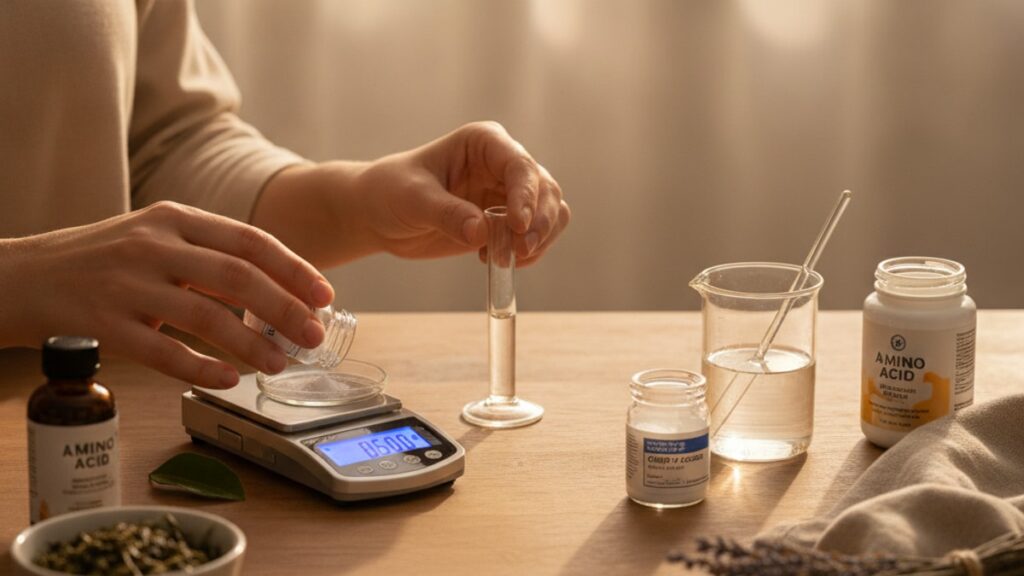
How to Calculate GHRP-2 Acetate Concentration — Lab Guide
Most reconstitution errors happen before the needle touches the vial. Researchers miscalculate GHRP-2 acetate concentration and end up with doses that are either too weak to produce measurable results or strong enough to trigger adverse responses in test subjects. The math itself is straightforward. Molecular weight divided by volume. But one misstep in unit conversion turns a 200mcg dose into 2mg, and that difference matters when you're working with peptides that influence growth hormone release at microgram-level precision.
We've guided hundreds of research teams through peptide preparation protocols. The gap between doing it right and doing it wrong comes down to three things most guides never mention: accurate vial labeling from the supplier, precision in bacteriostatic water measurement, and consistent unit notation throughout your calculation.
How do you calculate GHRP-2 acetate concentration for accurate research dosing?
To calculate GHRP-2 acetate concentration, divide the total peptide mass in the vial (typically 2mg or 5mg) by the volume of bacteriostatic water used for reconstitution. For a 5mg vial reconstituted with 2mL of bacteriostatic water, the concentration is 2.5mg/mL or 2500mcg/mL. Use this concentration to determine injection volume: if your target dose is 200mcg, divide 200mcg by 2500mcg/mL to get 0.08mL per injection.
Yes, calculating GHRP-2 acetate concentration is a straightforward division problem. But the real challenge isn't the arithmetic. It's maintaining unit consistency across every step of the calculation while accounting for peptide salt forms that affect molecular weight. GHRP-2 acetate (molecular weight 817.9 g/mol) contains acetate counterions that add mass compared to the base peptide sequence, and supplier vial labels sometimes reference only the peptide portion. This article covers the exact formula to calculate ghrp-2 acetate concentration, how to adjust for acetate salt mass, which measurement tools deliver precision at the microliter level, and what reconstitution mistakes negate accuracy entirely.
Step 1: Verify Peptide Mass and Molecular Weight from Supplier Documentation
Before you calculate ghrp-2 acetate concentration, confirm two numbers from your supplier's Certificate of Analysis (CoA): the stated peptide mass in the vial and whether that mass includes or excludes acetate salt mass. GHRP-2 acetate has a molecular weight of 817.9 g/mol. This includes the peptide backbone plus acetate counterions. Some suppliers list only the peptide sequence mass (686.7 g/mol for GHRP-2 free base), which creates a 19% discrepancy between labeled and actual mass.
Real Peptides provides every lyophilized peptide vial with a CoA that specifies total peptide mass including salt form. Our GHRP-2 vials are labeled as '5mg GHRP-2 Acetate,' meaning 5mg includes acetate mass. If your supplier lists '5mg GHRP-2 peptide' without specifying salt form, contact them to confirm whether acetate mass is included. This distinction matters when calculating target doses for protocols that reference acetate salt dosing versus free base dosing in published research.
Use a calibrated analytical balance (±0.1mg precision minimum) if you're verifying vial mass independently. Lyophilized peptides can appear as less than the labeled amount due to moisture absorption during storage. A 5mg vial stored at improper humidity may read 4.7mg on a scale, but the peptide content remains 5mg once reconstituted because the lyophilization process accounts for residual water content. Trust the CoA mass for concentration calculations unless you have evidence of supplier mislabeling.
Step 2: Measure Bacteriostatic Water Volume with Precision Syringes
To calculate ghrp-2 acetate concentration accurately, the denominator in your formula. Bacteriostatic water volume. Must be measured with precision syringes, not eyeballed using vial markings. A 1mL insulin syringe with 0.01mL graduations is the minimum standard. Research-grade applications require 1mL glass syringes with luer-lock tips (±0.02mL accuracy), which eliminate the dead space and plunger slip common in disposable plastic syringes.
Standard reconstitution volumes for GHRP-2 acetate range from 1mL to 3mL depending on target concentration. A 5mg vial reconstituted with 2mL yields 2.5mg/mL. Suitable for 200mcg doses delivered in 0.08mL injections. The same 5mg vial reconstituted with 1mL yields 5mg/mL, allowing 200mcg doses in 0.04mL injections but requiring more precise injection technique. Use larger reconstitution volumes (2–3mL) if your protocol involves frequent low-dose injections where measurement error compounds over time.
Draw bacteriostatic water slowly to avoid air bubbles, which displace volume and throw off your calculation. Inject the water down the side of the vial rather than directly onto the lyophilized powder. This prevents foaming and protein denaturation from mechanical shear. Allow the vial to sit at room temperature for 60–90 seconds after water addition, then swirl gently (never shake) until the solution is clear. Vigorous shaking introduces air that oxidizes methionine residues in the peptide backbone.
Step 3: Calculate Final Concentration Using Peptide Mass Divided by Reconstitution Volume
The formula to calculate ghrp-2 acetate concentration is: Concentration (mg/mL) = Total Peptide Mass (mg) ÷ Reconstitution Volume (mL). For a 5mg vial reconstituted with 2mL bacteriostatic water, the calculation is 5mg ÷ 2mL = 2.5mg/mL. Convert to micrograms per milliliter by multiplying by 1000: 2.5mg/mL = 2500mcg/mL. This second unit (mcg/mL) is more practical for dosing because most GHRP-2 protocols specify doses in micrograms (100–300mcg per injection).
Once you know concentration in mcg/mL, calculate injection volume for any target dose using: Injection Volume (mL) = Target Dose (mcg) ÷ Concentration (mcg/mL). For a 200mcg dose from a solution with 2500mcg/mL concentration, the injection volume is 200mcg ÷ 2500mcg/mL = 0.08mL (or 80 microliters). Mark this volume on your dosing syringe before drawing from the vial. Pre-calculation prevents mid-draw math errors.
Store reconstituted GHRP-2 acetate at 2–8°C and use within 28 days. Peptide degradation accelerates at room temperature. A solution left at 25°C for 48 hours loses approximately 8–12% potency due to hydrolysis of amide bonds. If you're preparing multi-week supplies, calculate ghrp-2 acetate concentration conservatively and verify potency at weekly intervals using HPLC if your lab has access to analytical equipment.
GHRP-2 Acetate Reconstitution: Dosing Comparison
Before reconstituting GHRP-2 acetate, understand how vial size and bacteriostatic water volume affect final concentration and injection volume precision.
| Vial Size | Reconstitution Volume | Final Concentration | 200mcg Dose Volume | 300mcg Dose Volume | Professional Assessment |
|---|---|---|---|---|---|
| 2mg | 1mL | 2mg/mL (2000mcg/mL) | 0.10mL | 0.15mL | Suitable for single-subject short-term protocols. Small injection volumes require precise syringe technique. |
| 5mg | 2mL | 2.5mg/mL (2500mcg/mL) | 0.08mL | 0.12mL | Optimal balance for most research applications. Injection volumes fall within high-accuracy range for insulin syringes. |
| 5mg | 3mL | 1.67mg/mL (1670mcg/mL) | 0.12mL | 0.18mL | Best for protocols requiring frequent low-precision injections or when using standard 1mL syringes without fine graduations. |
| 10mg | 2mL | 5mg/mL (5000mcg/mL) | 0.04mL | 0.06mL | High concentration reduces injection volume but increases risk of measurement error. Use glass syringes with luer-lock tips only. |
Key Takeaways
- GHRP-2 acetate concentration equals total peptide mass (mg) divided by bacteriostatic water volume (mL). For a 5mg vial with 2mL water, concentration is 2.5mg/mL or 2500mcg/mL.
- Molecular weight for GHRP-2 acetate is 817.9 g/mol, which includes acetate counterion mass. Verify whether your supplier's labeled mass includes or excludes salt form to avoid 19% dosing errors.
- Use precision syringes with ±0.01mL graduations minimum when measuring bacteriostatic water. Vial markings and standard syringes introduce 10–15% volume error that compounds across multiple doses.
- Injection volume for any target dose is calculated as: target dose (mcg) ÷ concentration (mcg/mL). For 200mcg from a 2500mcg/mL solution, inject 0.08mL.
- Store reconstituted peptide solutions at 2–8°C and use within 28 days. Room temperature storage causes 8–12% potency loss within 48 hours due to amide bond hydrolysis.
- One unit conversion error (mg to mcg or mL to μL) can change your dose by 1000×. Write out units explicitly in every calculation step and verify before drawing from the vial.
What If: GHRP-2 Acetate Concentration Scenarios
What If My Supplier Lists Peptide Mass Without Specifying Salt Form?
Contact the supplier and request clarification on whether the labeled mass includes acetate counterions. If the supplier lists '5mg GHRP-2' without specifying 'acetate' or 'free base,' assume the mass includes salt form unless the molecular weight on the CoA matches 686.7 g/mol (free base) rather than 817.9 g/mol (acetate salt). Using free base mass when the vial actually contains acetate salt results in underdosing by approximately 19%. A 200mcg intended dose becomes 162mcg actual dose, which may fall below the threshold for measurable growth hormone response in your protocol.
What If I Accidentally Added Too Much Bacteriostatic Water to the Vial?
Calculate the new concentration using the actual volume added, not the intended volume. If you added 2.5mL instead of 2mL to a 5mg vial, the concentration is 5mg ÷ 2.5mL = 2mg/mL (2000mcg/mL) instead of 2500mcg/mL. Adjust your injection volume accordingly: for a 200mcg dose from 2000mcg/mL, inject 0.10mL instead of 0.08mL. Do not attempt to remove excess water from the vial. This introduces contamination risk and doesn't reliably restore the intended concentration because you can't control how much peptide solution you withdraw along with the water.
What If My Reconstituted Solution Looks Cloudy Instead of Clear?
Discard the vial. Cloudiness indicates protein aggregation or contamination, both of which render the peptide unsuitable for research use. GHRP-2 acetate should produce a clear, colorless solution when reconstituted correctly. Cloudiness can result from injecting bacteriostatic water too forcefully (mechanical shear denatures proteins), using water that wasn't sterile, or reconstituting peptide that was stored above −20°C before mixing. Our team has found this happens most often when researchers shake the vial instead of swirling it gently. The shear forces from shaking cause peptide chains to unfold and aggregate into visible particles.
The Clinical Truth About GHRP-2 Concentration Calculations
Here's the honest answer: most peptide dosing errors in research settings don't come from bad math. They come from inconsistent labeling, imprecise measurement tools, and failure to verify supplier documentation before reconstitution. A researcher who carefully calculates ghrp-2 acetate concentration down to the third decimal place but uses a syringe with 0.1mL graduations has introduced more error from the measurement tool than the calculation could ever eliminate. Precision in calculation means nothing if your physical tools can't deliver that precision.
The second truth: unit conversion errors kill more protocols than contamination does. Writing '200mg' when you meant '200mcg' is a 1000× dosing mistake, and it happens more often than suppliers want to admit because researchers toggle between mass units (mg, mcg, g) and volume units (mL, μL, L) without writing units explicitly at every step. If you're calculating target doses for a multi-week protocol, write every number with its unit attached. '5mg ÷ 2mL = 2.5mg/mL = 2500mcg/mL'. And verify your final injection volume makes physical sense before drawing from the vial. A calculated injection volume of 5mL for a single dose should trigger immediate recalculation because standard peptide doses don't require that much volume.
The GHRP-2 acetate you're working with is identical in mechanism to what's used in published growth hormone research. But only if you calculate ghrp-2 acetate concentration correctly and deliver the dose your protocol specifies. Accuracy at this stage determines whether your results are reproducible or whether you're introducing a variable you can't control.
Most concentration miscalculations trace back to one overlooked step: researchers assume the peptide mass on the vial label is the peptide they can dose, without confirming whether that mass includes non-peptide components like acetate salts, residual water from lyophilization, or excipients. A '5mg' vial that contains 4.1mg peptide plus 0.9mg acetate delivers only 82% of the expected dose if you calculate ghrp-2 acetate concentration assuming the full 5mg is active peptide. The fix is simple. Request a CoA that breaks down peptide content as a percentage of total mass, then adjust your calculation accordingly. Suppliers who refuse to provide this breakdown aren't worth the risk.
Frequently Asked Questions
How do you calculate GHRP-2 acetate concentration after reconstitution?▼
Divide the total peptide mass in milligrams by the volume of bacteriostatic water in milliliters. For a 5mg vial reconstituted with 2mL water, the concentration is 5mg ÷ 2mL = 2.5mg/mL, which converts to 2500mcg/mL for easier dose calculations. Use this concentration to determine injection volume: target dose (mcg) ÷ concentration (mcg/mL) = injection volume (mL).
What is the molecular weight of GHRP-2 acetate and why does it matter?▼
GHRP-2 acetate has a molecular weight of 817.9 g/mol, which includes both the peptide backbone (686.7 g/mol) and acetate counterions (131.2 g/mol). This matters because some suppliers list only peptide mass without acetate, creating a 19% discrepancy in labeled versus actual mass. Always verify whether your supplier’s vial label includes acetate mass before calculating concentration.
Can you use a standard syringe to measure bacteriostatic water for reconstitution?▼
Standard syringes with 0.2mL graduations introduce 10–15% volume error, which compounds across multiple doses. Use insulin syringes with 0.01mL graduations minimum, or research-grade glass syringes with luer-lock tips (±0.02mL accuracy) for protocols requiring high precision. Volume measurement error directly affects concentration accuracy — a 0.1mL error in 2mL water changes concentration by 5%.
What concentration should you aim for when reconstituting GHRP-2 acetate?▼
Most research protocols use 2–3mg/mL (2000–3000mcg/mL) as the target range. This concentration allows 200–300mcg doses to be delivered in 0.08–0.15mL injection volumes, which fall within the high-accuracy range for insulin syringes. Higher concentrations (5mg/mL) reduce injection volume but increase measurement error risk. Lower concentrations (1mg/mL) require larger injection volumes and use more bacteriostatic water per vial.
How do you convert GHRP-2 concentration from mg/mL to mcg/mL?▼
Multiply the concentration in mg/mL by 1000. A solution with 2.5mg/mL concentration equals 2500mcg/mL. This conversion is necessary because most GHRP-2 protocols specify doses in micrograms (100–300mcg), making mcg/mL the more practical unit for injection volume calculations.
What happens if you calculate GHRP-2 concentration incorrectly?▼
Incorrect concentration calculations result in under-dosing or over-dosing, both of which compromise research outcomes. A 10× calculation error (using 250mcg/mL when actual concentration is 2500mcg/mL) delivers ten times the intended dose, which can trigger adverse responses in test subjects. Conversely, under-dosing by 50% may produce no measurable effect, wasting the vial and the protocol timeline.
Should you account for dead space in the syringe when calculating injection volume?▼
Yes, if you’re using syringes with significant dead space (typically luer-lock syringes). Dead space is the volume that remains in the needle hub after injection — usually 0.02–0.05mL. For low-volume doses (0.08mL), dead space represents 25–60% waste. Use insulin syringes with integrated needles to eliminate dead space, or add the dead space volume to your calculated injection volume so the delivered dose matches your target.
How long does reconstituted GHRP-2 acetate remain stable at 2–8°C?▼
Reconstituted GHRP-2 acetate stored at 2–8°C maintains >95% potency for 28 days when prepared with bacteriostatic water. After 28 days, hydrolysis of peptide bonds accelerates, reducing potency by approximately 5–8% per week. Store vials in the main refrigerator compartment (not the door, where temperature fluctuates), and protect from light using amber vials or foil wrap.
Can you recalculate concentration if you lost track of how much water you added?▼
No reliable method exists to back-calculate volume from a mixed solution without lab equipment. If you don’t know the exact volume of bacteriostatic water added, discard the vial and reconstitute a new one with measured volume. Attempting to estimate volume based on vial markings or visual assessment introduces unacceptable dosing error for peptide research.
What is the difference between calculating concentration for acetate salt versus free base peptides?▼
Acetate salt peptides (like GHRP-2 acetate, MW 817.9 g/mol) include counterion mass in the total molecular weight, while free base peptides (GHRP-2 free base, MW 686.7 g/mol) do not. If your protocol specifies doses based on free base mass but your vial contains acetate salt, you must adjust by multiplying the free base dose by 1.19 (the ratio of 817.9/686.7) to calculate the equivalent acetate salt dose.
Do you need to adjust GHRP-2 concentration calculations for peptide purity?▼
Yes, if your supplier reports purity <95%. A vial labeled '5mg GHRP-2 Acetate, 90% purity' contains 4.5mg active peptide plus 0.5mg impurities. Use the active peptide mass (4.5mg) in your concentration calculation, not the total mass (5mg). High-purity peptides from reputable suppliers like Real Peptides are synthesized to >98% purity, eliminating the need for purity-based adjustments in most cases.
Can you use the same concentration calculation method for other peptides besides GHRP-2?▼
Yes, the formula (peptide mass ÷ reconstitution volume = concentration) applies to all lyophilized peptides, but molecular weight and salt form vary by peptide. BPC-157, for example, has a different molecular weight (1419.5 g/mol as acetate salt), and some peptides are supplied as trifluoroacetate (TFA) salts rather than acetate. Always verify molecular weight and salt form on the supplier’s CoA before calculating concentration.











