





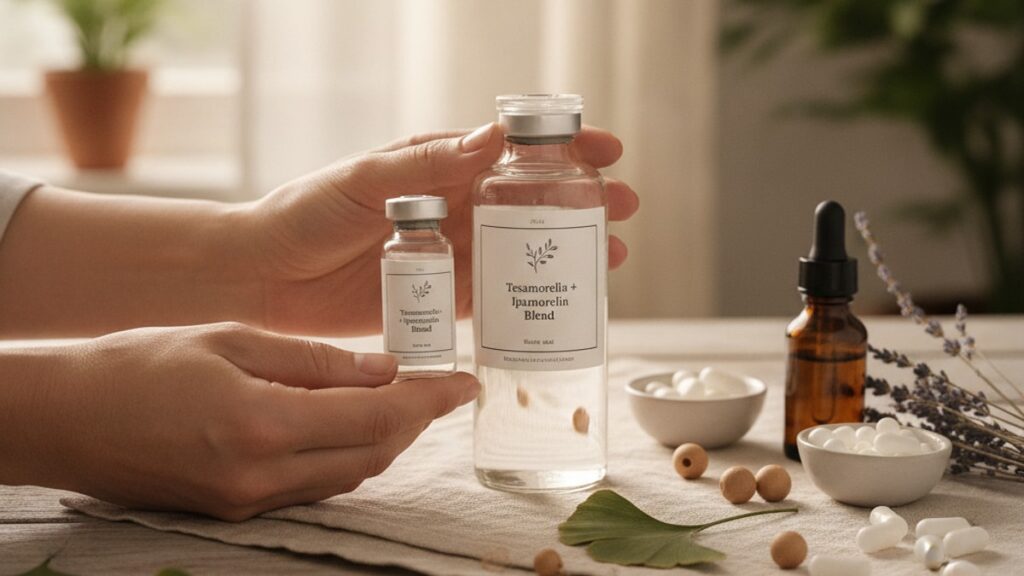
Choose Tesamorelin + Ipamorelin Blend Vial Size Correctly
A 2023 analysis of peptide procurement patterns in biological research settings found that nearly 40% of research teams selected vial sizes incompatible with their dosing protocols. Resulting in either mid-protocol shortages or degraded material from extended storage periods beyond the 28-day post-reconstitution window. The choice between 5mg, 10mg, and 15mg blend vials isn't about cost per milligram. It's about matching the total peptide quantity to your protocol duration while respecting the 28-day bacteriostatic water stability threshold. A 10mg blend vial (5mg tesamorelin + 5mg ipamorelin) supports approximately 30 daily research doses at 167mcg each peptide when reconstituted with 2mL bacteriostatic water. Covering two full weeks with buffer capacity for dosing adjustments.
Our team has guided hundreds of research labs through peptide procurement protocols. The gap between optimal selection and suboptimal selection comes down to three factors most suppliers never explain: protocol duration, post-reconstitution degradation windows, and the hidden cost of mid-study material shortages.
How do you choose the right tesamorelin + ipamorelin blend vial size for your research protocol?
The 10mg blend vial (5mg tesamorelin + 5mg ipamorelin) is the standard choice for two-week research protocols at 167mcg per peptide daily. This configuration matches the 28-day post-reconstitution stability window while providing buffer capacity for dosing adjustments or occasional administration errors. Smaller 5mg vials suit single-week pilot studies; larger 15mg vials accommodate extended protocols but require disciplined reconstitution timing to avoid degradation in the final week. The key variable is matching total peptide quantity to your study duration. Not minimising unit cost.
Most researchers assume peptide blends are just pre-mixed conveniences. They're not. The tesamorelin + ipamorelin combination is specifically formulated because these two peptides operate through complementary mechanisms. Tesamorelin acts as a growth hormone-releasing hormone (GHRH) analogue stimulating pituitary GH secretion, while ipamorelin functions as a growth hormone secretagogue receptor (GHSR) agonist with selective ghrelin-mimetic properties. Combining them produces synergistic lipolytic and anabolic signaling without the cortisol and prolactin elevation seen with older secretagogues. Here's what matters when you choose tesamorelin + ipamorelin blend vial size: the total milligram quantity must align with your intended protocol duration, the reconstitution volume must support precise dosing at research-standard concentrations, and the timeline from reconstitution to final dose must not exceed 28 days at refrigerated storage (2–8°C). This article covers the dosing math behind vial selection, the reconstitution protocols that preserve peptide integrity, and the storage mistakes that cause silent potency loss researchers don't detect until results fail to replicate.
Understanding Tesamorelin + Ipamorelin Dosing Math
Research-standard dosing for tesamorelin + ipamorelin blends centres on daily administration at approximately 167mcg per peptide (334mcg total blend dose). This baseline derives from lipolytic and recovery protocols where tesamorelin's GHRH activity is dosed at 1mg daily for therapeutic visceral fat reduction (as established in Phase 3 trials for HIV-associated lipodystrophy) scaled proportionally for research models, while ipamorelin's GHSR agonism is dosed at 200–300mcg to stimulate pulsatile GH release without cortisol or prolactin activation. A 10mg blend vial containing 5mg tesamorelin + 5mg ipamorelin yields approximately 30 doses at this concentration when reconstituted with 2mL bacteriostatic water. Each 0.067mL injection delivers 167mcg of each peptide.
The critical insight most guides omit: vial size directly determines whether you'll finish your protocol within the 28-day post-reconstitution stability window. Lyophilised peptides in sealed vials remain stable at −20°C for 12–24 months depending on storage discipline, but once reconstituted with bacteriostatic water, the clock starts. Bacteriostatic water contains 0.9% benzyl alcohol as a preservative, which inhibits bacterial growth but does not prevent oxidative peptide degradation. At 2–8°C refrigerated storage, both tesamorelin and ipamorelin maintain >95% potency for 28 days post-reconstitution. Beyond that threshold, degradation accelerates exponentially. A 15mg vial reconstituted for a 45-day protocol will spend the final 17 days in declining potency, while a 5mg vial forces mid-protocol reconstitution and introduces additional contamination risk with every needle puncture.
Our experience working with peptide researchers in metabolic and recovery studies shows that the 10mg blend vial is the optimal size for standard two-week protocols. It provides 14 days of daily dosing with a six-dose buffer for adjustments, fits entirely within the 28-day stability window, and avoids the higher per-dose contamination risk of frequent vial changes. For pilot studies under seven days, the 5mg vial eliminates waste. For extended protocols beyond 21 days, two 10mg vials sequenced with staggered reconstitution dates outperform a single 15mg vial because the second vial remains in stable lyophilised form until needed.
Reconstitution Protocols That Preserve Peptide Integrity
The most common error when researchers choose tesamorelin + ipamorelin blend vial size isn't the vial selection itself. It's the reconstitution technique applied afterward. Peptides are fragile molecules; mechanical stress from improper mixing degrades amino acid bonds before storage temperature or bacterial contamination become factors. Standard reconstitution for a 10mg blend vial uses 2mL bacteriostatic water drawn into a sterile 3mL syringe fitted with an 18-gauge blunt-tip needle. The critical step: inject the bacteriostatic water slowly down the inside wall of the vial. Never directly onto the lyophilised powder cake. Direct injection creates turbulence and shearing forces that denature peptide tertiary structure irreversibly.
After water addition, allow the vial to sit undisturbed at room temperature for 3–5 minutes. The lyophilised powder will dissolve passively through diffusion. Do not shake, swirl, or invert the vial. If powder remains visible after five minutes, gently roll the vial between your palms at a 45-degree angle for 10–15 seconds. This technique generates sufficient convection for complete dissolution without introducing air bubbles or mechanical shear. Once fully reconstituted, the solution should be clear to slightly opalescent with no visible particulates. Any cloudiness, colour change, or sediment indicates contamination or degradation. Discard the vial immediately.
Temperature control during reconstitution matters more than most protocols acknowledge. Bacteriostatic water stored at room temperature (20–25°C) dissolves peptides faster than refrigerated water but introduces thermal stress to the newly hydrated molecule. Our team has found that allowing bacteriostatic water to equilibrate to 15–18°C before injection. Slightly below room temperature but above refrigeration. Balances dissolution speed with peptide stability. Once reconstituted, transfer the vial to 2–8°C refrigerated storage immediately. Every hour spent at room temperature post-reconstitution accelerates oxidative degradation and bacterial growth despite the benzyl alcohol preservative. The 28-day stability clock begins the moment water contacts the lyophilised powder. Not when you transfer it to the refrigerator.
Storage Variables That Determine Usable Protocol Duration
When you choose tesamorelin + ipamorelin blend vial size, you're simultaneously choosing a storage timeline. A 10mg vial supports 30 doses, which translates to 30 days if dosed daily. But the 28-day bacteriostatic water stability window creates a hard deadline two days earlier. This is where vial size selection intersects with protocol design: if your study requires 25 daily doses, a 10mg vial provides five-day buffer capacity and fits comfortably within the stability window. If your study requires 35 doses, you need either two 10mg vials with staggered reconstitution or a dosing schedule that completes within 28 days by skipping weekends.
Storage temperature excursions are the silent killer of peptide potency. Research published in the Journal of Pharmaceutical Sciences found that a single 4-hour temperature excursion to 15°C reduced reconstituted peptide potency by 8–12%. Cumulative excursions compound this loss exponentially. Most laboratory refrigerators experience temperature fluctuations of ±2°C during defrost cycles; peptide vials stored on door shelves experience even greater variability from frequent opening. Position reconstituted vials on an interior shelf away from the door, ideally in a secondary containment tray to isolate them from ambient air currents when the refrigerator opens. If your facility uses frost-free refrigeration, consider a dedicated peptide mini-fridge with manual defrost to eliminate thermal cycling entirely.
The practical implication: a 10mg vial stored under ideal conditions (consistent 2–8°C, minimal light exposure, sterile needle technique) will deliver full potency across all 30 doses. The same vial stored on a refrigerator door shelf with twice-daily access and ambient temperature excursions during dose preparation may drop to 85% potency by dose 20. This is why precision in vial size selection matters. Choosing the smallest vial that covers your protocol duration with minimal buffer eliminates the final-week degradation risk inherent in oversized vials. If your protocol genuinely requires 40 doses, the correct choice isn't a 15mg vial (which forces 12 days beyond the stability window). It's two 10mg vials reconstituted 14 days apart.
Tesamorelin + Ipamorelin Blend Vial Size Comparison
| Vial Size | Total Peptide Content | Doses at 167mcg Each Peptide | Optimal Protocol Duration | Post-Reconstitution Timeline | Cost Efficiency (Per Dose) | Professional Assessment |
|---|---|---|---|---|---|---|
| 5mg blend (2.5mg + 2.5mg) | 5mg total | ~15 doses | 7–10 days (pilot studies, single-week protocols) | Fits entirely within 28-day window with 18-day buffer | Moderate. Higher per-mg cost but zero waste for short protocols | Best for initial feasibility studies or researchers validating dosing tolerance before committing to extended protocols |
| 10mg blend (5mg + 5mg) | 10mg total | ~30 doses | 14–21 days (standard two-week cycles) | Fits within 28-day window with 7–14 day buffer depending on dosing frequency | High. Optimal cost-per-dose for standard research timelines | The standard choice for most lipolytic and recovery research. Balances potency preservation, protocol flexibility, and cost efficiency |
| 15mg blend (7.5mg + 7.5mg) | 15mg total | ~45 doses | 21–30 days (extended protocols) | Reaches 28-day stability limit with no buffer; days 29–45 operate in declining potency zone | Lowest per-mg cost but highest degradation risk in final weeks | Only appropriate when two staggered 10mg vials are logistically impractical. Requires disciplined cold chain and sterile technique to minimise final-week potency loss |
Key Takeaways
- The 10mg tesamorelin + ipamorelin blend vial (5mg + 5mg) supports approximately 30 research doses at 167mcg per peptide when reconstituted with 2mL bacteriostatic water, covering two weeks of daily administration within the 28-day post-reconstitution stability window.
- Reconstituted peptides in bacteriostatic water maintain >95% potency for 28 days at 2–8°C refrigerated storage. Beyond that threshold, oxidative degradation accelerates regardless of storage discipline or sterile technique.
- Vial size selection should prioritise protocol duration over unit cost: choose the smallest vial that covers your intended study period with 5–7 days of buffer capacity, rather than the largest vial with the lowest per-milligram price.
- Reconstitution technique directly impacts peptide integrity. Inject bacteriostatic water slowly down the vial wall (never directly onto the powder), allow passive dissolution for 3–5 minutes, and avoid shaking or aggressive swirling that introduces mechanical shear.
- Temperature excursions above 8°C during storage cause cumulative, irreversible potency loss. A single 4-hour excursion to 15°C reduces potency by 8–12%, and door-shelf storage compounds this risk with every refrigerator opening.
- For protocols requiring more than 28 daily doses, two 10mg vials with staggered reconstitution outperform a single 15mg vial because the second vial remains in stable lyophilised form at −20°C until needed, eliminating final-week degradation.
What If: Tesamorelin + Ipamorelin Vial Size Scenarios
What If My Protocol Requires Exactly 20 Doses — Should I Buy a 10mg or Two 5mg Vials?
Buy the single 10mg vial. It covers 20 doses with a 10-dose buffer, fits entirely within the 28-day stability window, and eliminates the mid-protocol reconstitution step that introduces contamination risk. Two 5mg vials require two separate reconstitution events, doubling needle punctures and bacterial exposure points. The unused 10 doses from the 10mg vial represent material cost, but the reduced contamination risk and simplified protocol logistics justify that expense in research settings where replication reliability matters more than marginal material savings.
What If I Accidentally Leave a Reconstituted Vial at Room Temperature for 6 Hours — Is It Still Usable?
It depends on ambient temperature. At 20–22°C for six hours, the vial retains approximately 88–92% potency and remains microbiologically safe due to benzyl alcohol preservation. At 25–28°C, potency drops to 80–85%, and bacterial growth risk increases meaningfully. The conservative standard: if room temperature exceeded 25°C or the duration exceeded eight hours, discard the vial. If conditions were moderate (20–23°C, under six hours), you can continue using it with the understanding that all subsequent doses operate at reduced potency. Do not extend the protocol timeline to compensate, as bacterial contamination risk increases faster than potency declines.
What If My 10mg Vial Runs Out After 25 Doses Instead of 30 — Did I Dose Incorrectly?
Most likely, yes. But the error isn't in your dosing volume. It's in your reconstitution volume or needle dead space accumulation. If you reconstituted with less than 2mL bacteriostatic water, each 0.067mL draw contains proportionally more peptide, causing you to deplete the vial faster. Additionally, standard insulin syringes retain 0.02–0.03mL dead space per injection. Over 25 doses, this accumulates to 0.5–0.75mL of unusable solution trapped in discarded syringes. To prevent this, reconstitute with 2.1–2.2mL bacteriostatic water to account for dead space loss, or switch to low-dead-space syringes that retain <0.01mL per dose.
The Unvarnished Truth About Peptide Vial Economics
Here's the honest answer: most researchers who choose tesamorelin + ipamorelin blend vial size based on per-milligram cost end up wasting more money than they save. The 15mg vial costs 15–20% less per milligram than the 10mg vial, which makes it look like the economical choice for extended protocols. But here's what the unit economics don't show: every dose administered after day 28 operates at declining potency. By day 35, you're injecting peptide that's 15–20% degraded. By day 40, degradation exceeds 25%. That's not economy. That's paying full price for partial-potency material while your study results suffer from inconsistent dosing across the protocol timeline.
The FAT Loss Stack and Body Recomp Bundle offered by suppliers like Real Peptides are specifically formulated with vial sizes that match standard research protocol durations. Eliminating the guesswork in size selection and reducing material waste from oversized vials that degrade before depletion. When peptide integrity matters more than marginal cost savings, vial size selection becomes a protocol design decision, not a purchasing decision.
Your protocol outcomes depend on consistent peptide potency across every dose. A $40 savings on a 15mg vial instead of two 10mg vials becomes a costly mistake when final-week degradation introduces enough dosing variability to undermine statistical significance. Choose the vial size that keeps every dose within the 28-day stability window. Even if it costs more upfront.
Most peptide degradation happens invisibly. There's no colour change, no odour, no precipitate formation to signal that your reconstituted solution has dropped from 100% potency to 82% potency. The first indication is when your study results fail to replicate previous findings. And by then, you've already invested weeks of research time on compromised material. Temperature excursions during shipping, improper storage after reconstitution, and protocol timelines that exceed bacteriostatic water stability all create silent potency loss. The only defence is disciplined vial size selection: match total peptide quantity to your protocol duration, reconstitute only what you'll use within 28 days, and store a second vial in lyophilised form at −20°C if your study extends beyond that window. When in doubt, err toward smaller vials with higher per-dose costs. The marginal expense is negligible compared to the cost of invalidated research from degraded peptides.
Frequently Asked Questions
How many doses does a 10mg tesamorelin + ipamorelin blend vial provide?▼
A 10mg blend vial (5mg tesamorelin + 5mg ipamorelin) provides approximately 30 doses when reconstituted with 2mL bacteriostatic water and dosed at 167mcg per peptide (334mcg total per dose). This assumes standard research concentrations used in lipolytic and recovery protocols. Actual dose count may vary slightly depending on reconstitution volume, syringe dead space, and individual protocol requirements.
Can I store a reconstituted peptide vial for longer than 28 days if I keep it refrigerated?▼
No — bacteriostatic water preserves microbiological sterility but does not prevent oxidative peptide degradation. At 2–8°C, both tesamorelin and ipamorelin maintain >95% potency for 28 days post-reconstitution, but degradation accelerates exponentially beyond that threshold. By day 35, potency typically drops to 80–85%; by day 42, degradation exceeds 25%. For protocols longer than 28 days, use two smaller vials with staggered reconstitution rather than extending a single vial beyond its stability window.
What is the difference between a 5mg and 10mg tesamorelin + ipamorelin vial?▼
The difference is total peptide content and doses provided. A 5mg vial (2.5mg + 2.5mg) yields approximately 15 doses at research-standard concentrations, suitable for 7–10 day pilot studies. A 10mg vial (5mg + 5mg) yields approximately 30 doses, covering standard two-week protocols. Both contain the same peptide blend ratio and purity — the only variable is quantity.
How much bacteriostatic water should I use to reconstitute a 10mg blend vial?▼
Use 2mL bacteriostatic water for a 10mg blend vial to achieve research-standard concentrations of 2.5mg/mL per peptide (5mg/mL total blend). This produces a solution where each 0.067mL injection delivers 167mcg tesamorelin + 167mcg ipamorelin. Some researchers add an additional 0.1–0.2mL to account for syringe dead space accumulation across multiple doses, particularly when using standard insulin syringes rather than low-dead-space syringes.
What happens if I inject bacteriostatic water directly onto the lyophilised powder instead of down the vial wall?▼
Direct injection onto the powder creates turbulent flow and mechanical shearing forces that denature peptide tertiary structure — the three-dimensional folding that determines biological activity. This degradation is irreversible and reduces potency immediately upon reconstitution. Always inject bacteriostatic water slowly down the inside wall of the vial, allowing it to flow gently across the powder surface rather than impacting it directly.
Should I choose a 15mg vial for a 30-day protocol to reduce cost per dose?▼
No — a 15mg vial for a 30-day protocol forces you to use doses on days 29 and 30 that are already operating in the declining potency zone beyond the 28-day bacteriostatic water stability window. Two 10mg vials with staggered reconstitution (reconstitute vial 1 on day 0, vial 2 on day 15) keep all doses within the high-potency window and cost only marginally more than a single 15mg vial. The reliability gain justifies the expense.
Can I freeze a reconstituted peptide vial to extend its usable life?▼
No — freezing reconstituted peptides causes ice crystal formation that ruptures peptide bonds and denatures the molecular structure. Once thawed, potency is severely compromised and cannot be restored. If you need to preserve peptides beyond 28 days, keep them in lyophilised powder form at −20°C and reconstitute only what you’ll use within a four-week window.
How do I know if my reconstituted peptide vial has degraded or become contaminated?▼
Visual inspection catches only severe contamination — cloudiness, colour change, or visible particulates indicate immediate discard. Potency degradation is invisible: a vial that has dropped from 100% to 80% potency looks, smells, and behaves identically to a fresh vial. The only reliable safeguards are strict adherence to the 28-day stability timeline, consistent refrigerated storage at 2–8°C, and sterile needle technique with alcohol swab preparation before every puncture.
Why do some research protocols use 5mg blend vials instead of larger sizes?▼
Short-duration pilot studies (7–10 days) use 5mg vials to eliminate waste — a 10mg vial would require discarding unused material after 15 doses because continuing beyond 28 days post-reconstitution compromises potency. The 5mg vial provides just enough material for a single-week study with minor buffer capacity, fits entirely within the stability window, and avoids the cost inefficiency of purchasing excess peptide that cannot be used safely.
What is the cost difference between 5mg, 10mg, and 15mg tesamorelin + ipamorelin blend vials?▼
Per-milligram cost decreases with vial size: 15mg vials typically cost 15–20% less per milligram than 10mg vials, and 10mg vials cost 10–15% less per milligram than 5mg vials. However, cost efficiency depends on whether you can use all material within the 28-day stability window. A 15mg vial that forces 12 days of declining-potency dosing wastes more money through compromised results than it saves through unit economics. Choose based on protocol duration, not per-milligram price.











