





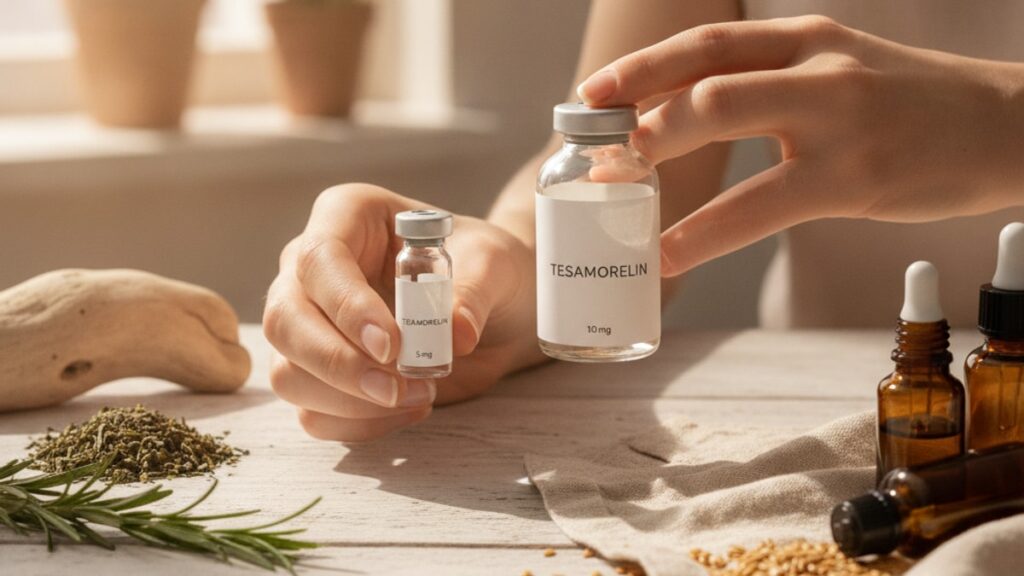
Choose Tesamorelin Vial Size — Dosage & Protocol Guide
Most researchers ordering tesamorelin for the first time assume vial size is interchangeable. That a 2mg vial and a 5mg vial are just different quantities of the same thing. They're not. The vial size you choose determines reconstitution math, bacteriostatic water volume, dosage precision, and how much peptide you'll waste when the 28-day refrigerated stability window expires. A 2mg vial suits protocols calling for 0.2mg–1mg daily injections over 10–20 days; a 5mg vial suits month-long cycles or higher-dose protocols where you're drawing 1mg+ per injection. Choose wrong, and you're either remixing peptides weekly or discarding half a vial.
We've guided hundreds of research teams through peptide procurement decisions. The gap between doing it right and doing it wrong comes down to matching vial size to injection frequency and protocol duration. Not just ordering the cheapest option per milligram.
How do you choose tesamorelin vial size for a research protocol?
Choose tesamorelin vial size by calculating total peptide consumption across the stability window of reconstituted solution. Typically 28 days refrigerated. A 2mg vial suits protocols requiring 0.2mg–1mg daily for 10–20 days; a 5mg vial suits 20–30 day protocols at 1mg+ daily or dual-dosing schedules. Match vial size to protocol duration to minimize waste, since reconstituted tesamorelin degrades after four weeks regardless of remaining volume.
Tesamorelin degrades the moment you add bacteriostatic water — and the clock starts whether you've used 10% of the vial or 90%.
Yes, vial size affects your protocol's practical efficiency. But not through the mechanism most assume. The issue isn't peptide potency per milligram across vial sizes (that's identical). The constraint is the 28-day post-reconstitution stability window mandated by USP <797> guidelines for compounded sterile preparations stored at 2–8°C. Once you pierce the rubber stopper and introduce bacteriostatic water, oxidative degradation and microbial contamination risk both accelerate regardless of peptide concentration. A 5mg vial with 4mg left unused at day 28 is no safer to use than a 2mg vial at the same timepoint. Both exceed the validated sterility window. This piece covers how to calculate protocol-appropriate vial size, what reconstitution math looks like for each standard size, and what preparation mistakes cause researchers to discard perfectly stable peptide prematurely.
Vial Size Determines Reconstitution Volume — and Volume Affects Dosage Precision
Tesamorelin is supplied as lyophilized powder in 2mg, 5mg, and occasionally 10mg vials. The number printed on the label reflects total tesamorelin acetate content after accounting for peptide purity (typically 98–99%). When you reconstitute a 2mg vial with 2mL bacteriostatic water, you create a 1mg/mL solution. Each 0.1mL (10 units on a standard insulin syringe) contains 0.1mg tesamorelin. Reconstitute that same 2mg vial with 1mL water instead, and you get 2mg/mL. Now each 0.1mL contains 0.2mg. The peptide quantity is fixed; concentration changes with solvent volume.
Why this matters: protocols calling for precise low doses (0.2mg–0.5mg daily) require either dilute solutions or insulin syringes capable of measuring 5–10 unit increments accurately. A 5mg vial reconstituted with 2.5mL yields 2mg/mL. If your target dose is 0.3mg, you're drawing 0.15mL, which is 15 units on a U-100 syringe. That's manageable. Reconstitute the same 5mg vial with 1mL to create a 5mg/mL solution, and that same 0.3mg dose becomes 0.06mL. 6 units on a syringe, approaching the limit of reliable measurement without specialized low-dead-space syringes. Our team has found that researchers using 5mg vials for low-dose protocols consistently underestimate peptide waste from measurement error at high concentrations.
The standard recommendation: match bacteriostatic water volume to vial size at a 1:1 ratio (2mg vial + 2mL water, 5mg vial + 5mL water) to create 1mg/mL solutions. This concentration balances dosage precision, injection volume comfort, and ease of calculation. Deviating from 1mg/mL is fine if you have a specific reason. Just recalculate every dose and verify syringe measurement capability before starting the protocol.
Protocol Duration Is the Primary Variable — Not Cost Per Milligram
A 5mg vial costs roughly 1.8–2.2× the price of a 2mg vial when purchased from the same supplier. That looks like better value per milligram. Until you calculate actual peptide consumption. If your protocol calls for 1mg tesamorelin daily for 14 days, you'll use 14mg total. A single 5mg vial leaves 5mg unused at day 14, and that unused portion expires at day 28 post-reconstitution whether you've touched it or not. You've paid for 5mg but only used 5mg across the stability window. Two 2mg vials (4mg total) would leave you 4mg short, forcing you to order a third vial and waste most of it. The optimal choice here is actually three 2mg vials (6mg total, 2mg waste) or rethinking the protocol to align with vial increments.
The honest calculation: map your entire protocol across the 28-day window. If you're dosing 1mg daily for 20 days, that's 20mg consumed. Four 5mg vials give you 20mg exactly with zero waste. But also require reconstituting a fresh vial every five days if you're sticking to the 1:1 ratio (5mg vial + 5mL water used over five days at 1mg/day). Ten 2mg vials give you 20mg total and allow you to reconstitute one vial at a time, each lasting two days. The 5mg approach requires fewer total reconstitutions; the 2mg approach offers finer control over preparation timing. Neither is universally better. The right answer depends on whether your lab prioritizes fewer sterile preparation events or smaller single-use quantities.
The 28-Day Post-Reconstitution Window Is Not Negotiable — Regardless of Vial Size
Unreconstituted lyophilized tesamorelin stored at −20°C maintains stability for 24–36 months when protected from light and moisture. Once you add bacteriostatic water, that timeline collapses to 28 days refrigerated at 2–8°C per USP <797> Category 1 CSP guidelines. This isn't a manufacturer's conservative estimate. It's the outer limit of validated sterility for a multi-dose vial accessed repeatedly with needles. Every needle puncture introduces contamination risk; every temperature excursion accelerates peptide aggregation. By day 28, even a vial stored perfectly and accessed under aseptic technique carries measurable risk of both microbial growth and reduced biological activity from oxidative degradation of the growth hormone-releasing hormone (GHRH) analog structure.
The mistake most teams make: treating the 28-day window as a guideline rather than a hard cutoff. Tesamorelin doesn't 'go bad' suddenly at day 29 in the sense of visible contamination, which leads researchers to extend use beyond the validated window. The degradation is invisible. You're injecting a solution with progressively lower active peptide content and higher aggregated protein content, neither of which you can detect without HPLC analysis. A 5mg vial with 3mg remaining at day 28 is not 'mostly good'. It's expired, and continuing to use it introduces both efficacy variability and safety risk. This is why vial size selection matters: you want to consume most of the vial within 28 days, not perpetually chase the last 20% of an oversized preparation.
Tesamorelin Vial Size Comparison — Standard Research Configurations
| Vial Size | Typical Reconstitution Volume | Resulting Concentration | Recommended Protocol Match | Doses Per Vial (1mg/dose) | Stability Post-Reconstitution | Cost Efficiency |
|---|---|---|---|---|---|---|
| 2mg | 2mL bacteriostatic water | 1mg/mL | Low-dose daily protocols (0.2mg–1mg) lasting 10–20 days; single-subject short-term studies | 2 doses at 1mg each | 28 days refrigerated at 2–8°C | Higher per-mg cost, lower waste for short protocols |
| 5mg | 5mL bacteriostatic water | 1mg/mL | Standard 1mg daily protocols lasting 20–30 days; multi-subject studies with daily dosing | 5 doses at 1mg each | 28 days refrigerated at 2–8°C | Better per-mg pricing, higher waste risk if protocol duration under 20 days |
| 10mg | 10mL bacteriostatic water | 1mg/mL | Extended protocols (30+ days) or dual-dosing schedules (AM/PM); high-throughput lab settings | 10 doses at 1mg each | 28 days refrigerated at 2–8°C | Best per-mg cost, only justified for full-duration consumption within stability window |
Key Takeaways
- Tesamorelin vial size must align with protocol duration and 28-day post-reconstitution stability. A 2mg vial suits 10–20 day protocols at 0.2mg–1mg daily, while 5mg suits 20–30 day cycles.
- Reconstitution volume directly affects concentration and dosage precision. The standard 1:1 ratio (2mg vial + 2mL water = 1mg/mL) balances ease of measurement with injection volume comfort.
- Once reconstituted with bacteriostatic water, tesamorelin degrades after 28 days refrigerated regardless of remaining volume. A half-used 5mg vial at day 28 is expired, not 'mostly good.'
- Cost per milligram favors larger vials only if you consume most of the peptide within the stability window. Paying less per milligram but discarding 40% of a 5mg vial costs more than buying appropriately sized 2mg vials.
- Match vial size to injection frequency and total protocol peptide consumption. Calculate total milligrams needed across 28 days, then select the vial configuration that minimizes waste without forcing premature reconstitution cycles.
What If: Tesamorelin Vial Size Scenarios
What If You're Running a 14-Day Protocol at 1mg Daily — Should You Order a 5mg Vial or Multiple 2mg Vials?
Order multiple 2mg vials. Specifically, seven 2mg vials to cover 14mg total consumption. A single 5mg vial leaves 5mg unused at day 14, and that unused portion expires at day 28 whether touched or not. Seven 2mg vials let you reconstitute one vial every two days, keeping each preparation fresh and minimizing multi-dose contamination risk. The per-milligram cost is slightly higher, but you're paying for usable peptide rather than discarded volume.
What If Your Protocol Requires 0.3mg Daily for 30 Days — Does a 10mg Vial Make Sense?
Yes. A single 10mg vial reconstituted with 10mL bacteriostatic water yields 1mg/mL, and 0.3mg daily for 30 days consumes 9mg total. You're using 90% of the vial within the stability window, which is optimal efficiency. Reconstitute on day 1, draw 0.3mL (30 units on a U-100 syringe) daily, and discard the remaining 1mg on day 28. Alternative: ten 1mg vials if available, reconstituting three per week. But that multiplies sterile preparation events tenfold.
What If You Reconstituted a 5mg Vial But Your Protocol Got Delayed Two Weeks — Can You Freeze It to Extend Stability?
No. Freezing reconstituted peptide solutions causes ice crystal formation that disrupts protein structure irreversibly. The tesamorelin molecule aggregates during freeze-thaw cycles, rendering it biologically inactive even if it appears clear upon thawing. Once reconstituted, the 28-day refrigerated window is absolute. If a protocol delay exceeds the remaining stability period, discard the reconstituted vial and prepare a fresh one when ready to resume. This is why protocol timing must be locked before reconstitution. Not after.
The Unvarnished Truth About Tesamorelin Vial Economics
Here's the honest answer: most labs overspend on tesamorelin because they optimize for per-milligram cost instead of usable peptide. A 5mg vial at $180 looks better than a 2mg vial at $90 until you calculate that your 12-day protocol consumes 12mg total. Meaning you'd need three 5mg vials (15mg supplied, 3mg wasted) at $540, versus six 2mg vials (12mg supplied, zero waste) at $540. Identical total cost, but the 2mg configuration wastes nothing and avoids the pressure to 'use up' a half-empty vial beyond the stability window.
The bigger issue: researchers routinely extend reconstituted vial use past 28 days because 'it still looks clear.' Tesamorelin degradation is invisible. You can't see oxidative peptide cleavage or detect bacterial contamination at sub-clinical levels without lab analysis. A day-32 vial isn't '4 days expired'. It's outside the validated sterility window entirely, and every injection from that vial introduces both efficacy variability (reduced active peptide) and contamination risk (bacterial growth you cannot see). The right move is to calculate protocol duration before ordering, match vial size to consumption, and discard on day 28 without exception. Peptide cost is the smallest line item in most research budgets. Compromising data integrity to squeeze three extra days from an expired vial is false economy.
Real Peptides supplies tesamorelin in 2mg and 5mg configurations with third-party purity verification included with every order. Each vial ships with a certificate of analysis showing exact peptide content and bacterial endotoxin levels. The kind of documentation that matters when you're building a protocol around precise dosing rather than guessing at degraded concentrations from an oversized vial you've been stretching for six weeks.
If vial size seems like a minor detail now, recalculate after your first protocol when you're discarding half a 10mg vial because the 28-day window closed before you hit dose 15. Match the vial to the protocol duration. Not the unit price. And you'll waste less peptide, reduce contamination risk, and spend the same amount for peptide you actually use.
Frequently Asked Questions
What is the difference between a 2mg and 5mg tesamorelin vial?▼
The difference is total peptide content — a 2mg vial contains 2mg tesamorelin acetate, a 5mg vial contains 5mg. The peptide itself is identical in purity and structure; vial size determines how many doses you can draw after reconstitution. A 2mg vial reconstituted with 2mL bacteriostatic water yields 1mg/mL for two 1mg doses; a 5mg vial with 5mL yields the same 1mg/mL concentration for five 1mg doses. Choose based on protocol duration, not cost per milligram.
How long does reconstituted tesamorelin last in the refrigerator?▼
Reconstituted tesamorelin lasts 28 days when stored at 2–8°C in a refrigerator, per USP <797> sterile compounding guidelines. This stability window begins the moment you add bacteriostatic water and applies regardless of how much peptide remains in the vial. After 28 days, both microbial contamination risk and peptide degradation increase beyond validated safety margins — discard any unused solution at that point even if it appears clear.
Can I use a 5mg tesamorelin vial for a 10-day protocol without wasting peptide?▼
No — a 10-day protocol at standard 1mg daily dosing consumes 10mg total, but a single 5mg vial expires 28 days post-reconstitution. You would use 5mg over 5 days, leaving 23 days of remaining stability unused. The second 5mg vial would cover days 6–10, then expire on day 38 (10 days post-reconstitution for that vial). You’re paying for 10mg but discarding the second vial after five uses. Five 2mg vials (one per two days) would deliver 10mg with zero waste.
What happens if I reconstitute tesamorelin with too much bacteriostatic water?▼
Excess bacteriostatic water dilutes peptide concentration below 1mg/mL, requiring larger injection volumes to deliver target doses. A 2mg vial reconstituted with 4mL yields 0.5mg/mL — a 1mg dose now requires drawing 2mL instead of 1mL, which may exceed comfortable subcutaneous injection volume (typically 0.5–1.5mL max). The peptide remains stable at lower concentrations, but dosing becomes cumbersome and measurement precision suffers. Stick to 1:1 ratios unless you have a specific dilution requirement.
Is a 10mg tesamorelin vial cost-effective for short research protocols?▼
No — 10mg vials are cost-effective only for protocols consuming 8mg+ within 28 days. A 15-day protocol at 1mg daily uses 15mg total but requires two 10mg vials (20mg supplied, 5mg wasted), whereas eight 2mg vials deliver 16mg with 1mg waste. The larger vial’s per-milligram savings disappear when you’re discarding 25% of your peptide inventory. Reserve 10mg vials for extended 30+ day protocols or multi-subject studies with predictable daily consumption.
Can I store unopened tesamorelin vials at room temperature?▼
No — unopened lyophilized tesamorelin must be stored at −20°C to maintain stability across the manufacturer’s stated shelf life (typically 24–36 months). Room temperature storage accelerates peptide degradation through moisture absorption and oxidation, reducing potency within weeks. Short-term temperature excursions during shipping (24–48 hours at ambient temperature) are generally tolerable, but long-term storage requires freezer conditions. Once reconstituted, refrigerate at 2–8°C — never freeze.
How do I calculate the right tesamorelin vial size for my protocol?▼
Multiply your daily dose by protocol duration to get total peptide consumption, then select the vial size or combination that delivers that total with minimal waste within the 28-day post-reconstitution window. Example: 0.5mg daily for 20 days = 10mg total. Two 5mg vials provide exactly 10mg. Alternatively, five 2mg vials deliver 10mg with slightly higher per-milligram cost but allow reconstituting one vial every four days instead of every ten days, reducing multi-dose contamination risk. Match vial size to both total consumption and preferred reconstitution frequency.
What should I do if I accidentally inject air into a tesamorelin vial during reconstitution?▼
Injecting air into a peptide vial during reconstitution creates positive pressure inside the vial, which forces solution back through the needle when you withdraw it — increasing contamination risk and potentially spraying peptide solution. To fix: after injecting bacteriostatic water, insert the needle again without pushing the plunger, allow air pressure to equalize, then withdraw the needle. For future reconstitutions, inject water slowly down the vial wall to minimize foaming and air introduction. Never shake peptide vials — swirl gently to dissolve.
Why does tesamorelin vial size affect dosage measurement accuracy?▼
Vial size determines reconstitution concentration, which affects the physical volume you must draw per dose. A 5mg vial reconstituted with 1mL (instead of the standard 5mL) creates a 5mg/mL solution — a 0.2mg dose becomes 0.04mL, or 4 units on a U-100 insulin syringe. Drawing 4 units accurately requires low-dead-space syringes and steady hands; measurement error at this scale can cause 25–50% dose variability. Standard 1mg/mL solutions keep per-dose volumes in the 0.1–1mL range, which standard syringes measure reliably. Choose vial size and reconstitution volume to keep doses above 0.1mL.
Can I mix two different tesamorelin vial sizes in the same protocol?▼
Yes — mixing vial sizes is common when optimizing for both cost and waste reduction. Example: a 25-day protocol at 1mg daily requires 25mg total. Five 5mg vials deliver exactly 25mg, but each vial must be reconstituted and used within 28 days. Alternatively, twelve 2mg vials (24mg) plus one 1mg vial (if available) covers the protocol with near-zero waste. Calculate total consumption first, then select the vial combination that minimizes both unused peptide and reconstitution frequency. Just ensure all vials are from the same supplier batch for consistency.











