





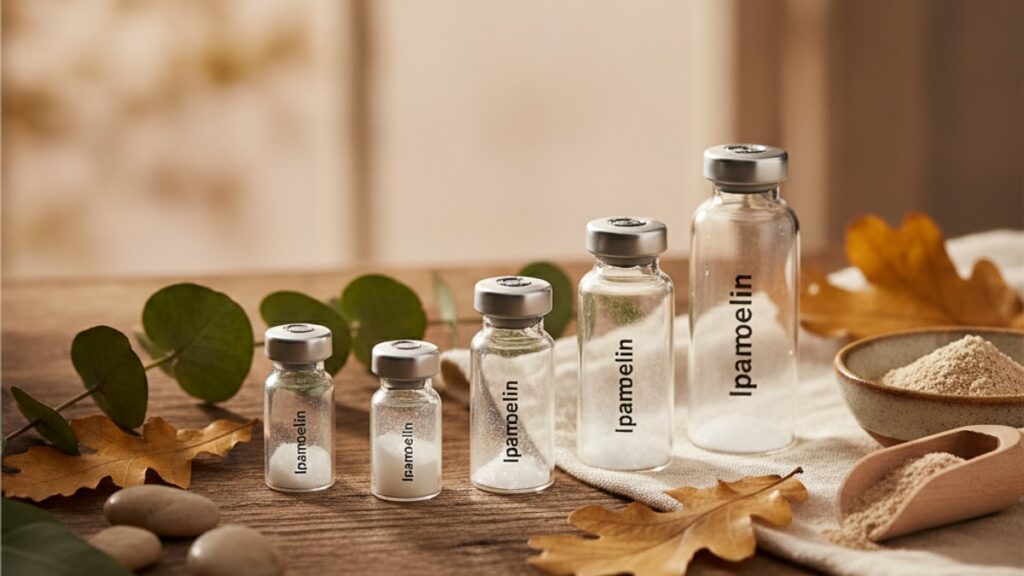
Choose Ipamorelin Vial Size — Dosing Precision Explained
A 10mg ipamorelin vial costs 40% less per milligram than a 5mg vial. But if your protocol runs eight weeks at 200mcg twice daily, that 10mg vial lasts exactly 35 days, requiring you to open a second vial midway through. The 5mg vial, reconstituted at the right concentration, delivers 25 doses. Aligned perfectly with typical research cycles. Cost per milligram is not cost per protocol. Vial size determines reconstitution math, injection volume, wastage, and refrigeration duration. Choose wrong and you're either discarding unused peptide or working with dilute concentrations that compromise dosing precision.
Our team has guided researchers through hundreds of peptide protocols. The gap between choosing the right vial size and guessing comes down to three calculations most suppliers never explain: total protocol dose requirement, reconstitution concentration that matches your syringe precision, and refrigerated stability duration after mixing.
How do you choose the right ipamorelin vial size for research protocols?
Choose ipamorelin vial size by calculating total protocol dose requirement first. Multiply target dose per administration by frequency and protocol duration. Match that total to the smallest vial size that covers the full protocol without requiring mid-cycle vial changes, then verify that reconstitution volume yields a concentration your syringe can measure accurately. A 10mg vial suits 8–12 week protocols at 200–300mcg daily; 5mg vials work for 4–6 week cycles or lower-dose titration phases.
The real decision isn't '5mg or 10mg'. It's whether your reconstitution math, injection volume, and refrigeration timeline align. A 10mg vial reconstituted with 2mL bacteriostatic water yields 5mg/mL. Meaning a 200mcg dose requires drawing 0.04mL, a volume most insulin syringes can't measure reliably. Reconstitute that same vial with 5mL and you get 2mg/mL. Now 200mcg equals 0.1mL, a standard syringe increment. Vial size dictates reconstitution flexibility. This article covers total dose calculation, reconstitution concentration math that matches syringe precision, refrigerated stability constraints that determine usable protocol length, and the specific scenarios where 5mg beats 10mg despite higher per-milligram cost.
Calculate Total Protocol Dose Requirement First
Most researchers choose ipamorelin vial size based on advertised cost per milligram without calculating whether that vial covers their full protocol. A 10mg vial at 200mcg twice daily delivers exactly 25 days of dosing. But an eight-week muscle recovery protocol runs 56 days, meaning you'll open a second vial on day 26 and discard 4.8mg of unused peptide from that second vial. The 5mg vial would require opening four vials across the same timeline, but you'd waste less total peptide and maintain fresher reconstituted solutions throughout.
Total dose calculation: multiply your target dose per administration by daily frequency, then by protocol duration in days. A 200mcg dose administered twice daily for eight weeks equals 22,400mcg total (22.4mg). That requires three 10mg vials or five 5mg vials. The three-vial option costs less upfront but forces you to keep a third vial refrigerated for the final week. And peptides lose 2–5% potency per week once reconstituted, even under ideal storage. The five-vial approach means opening fresh vials every 12–14 days, maintaining higher average potency across the protocol.
Reconstitution volume directly determines injection precision. A 5mg vial mixed with 2.5mL bacteriostatic water yields exactly 2mg/mL. Meaning 200mcg requires drawing 0.1mL, the standard increment on a 1mL insulin syringe. That same concentration from a 10mg vial would require 5mL reconstitution volume, which exceeds the vial's internal capacity in most lyophilized formats. Larger vials demand higher reconstitution volumes to maintain practical injection precision, but vial headspace limits how much bacteriostatic water you can add without creating pressure issues during repeated draws.
Reconstitution Concentration Math and Syringe Precision
The constraint most researchers miss: syringe increment size determines minimum practical concentration. Standard 1mL insulin syringes measure in 0.01mL increments (10 units), meaning the smallest reliable draw is 0.02–0.03mL. If your reconstituted concentration requires drawing less than 0.03mL for your target dose, you're working below syringe precision. Dosing accuracy becomes guesswork. A 10mg vial reconstituted with 2mL yields 5mg/mL; a 100mcg dose from that solution requires drawing 0.02mL, right at the threshold of reliable measurement. Reconstitute with 4mL instead and you get 2.5mg/mL. Now 100mcg equals 0.04mL, comfortably within syringe precision.
Concentration planning works backward from your lowest target dose. If your protocol includes a 50mcg titration phase before escalating to 200mcg maintenance, plan reconstitution around the 50mcg requirement. At 2mg/mL concentration, 50mcg equals 0.025mL. Measurable but tight. At 1mg/mL (a 5mg vial with 5mL bacteriostatic water), 50mcg equals 0.05mL, well within precision range. Lower concentrations demand larger reconstitution volumes, which in turn require larger vial sizes to accommodate the liquid without excessive headspace pressure.
Vial headspace creates a secondary constraint: adding more than 60–70% of the vial's stated capacity in reconstitution volume increases internal pressure, making repeated draws difficult and increasing contamination risk as you fight positive pressure on every needle insertion. A standard 10mg lyophilized vial holds approximately 3–4mL maximum before headspace pressure becomes problematic. That caps your practical reconstitution range. You can't dilute a 10mg vial to 1mg/mL without using a 10mL vial format, which most peptide suppliers don't offer in research-grade ipamorelin. Choose vial size based on the concentration range your target doses require, not just total milligrams.
Refrigerated Stability and Mid-Protocol Vial Changes
Ipamorelin peptide bonds remain stable for 18–24 months as lyophilized powder stored at −20°C, but once reconstituted with bacteriostatic water, that stability window drops to 28 days under refrigeration at 2–8°C. Every day beyond 28 days reduces peptide integrity. Studies on similar pentapeptides show 3–7% potency loss per week after the four-week mark. If your protocol runs longer than 28 days, vial size determines whether you're working with fresh peptide or degraded solution in the protocol's final weeks. A 10mg vial covering a 40-day protocol means the last 12 days use peptide that's been reconstituted for 40 days. Well past optimal stability.
The trade-off: opening multiple smaller vials throughout a protocol maintains higher average potency but increases per-dose cost and requires more frequent reconstitution. A 5mg vial at 200mcg twice daily lasts 12.5 days. Opening a fresh vial every two weeks means you never use peptide older than 14 days post-reconstitution. That approach maximizes potency consistency but costs 15–25% more in total peptide spend compared to using larger vials. For research focused on precise dose-response relationships, that consistency premium is justified. For general exploratory work, the cost difference may not be.
Temperature excursions compound the stability issue. Every hour a reconstituted vial spends above 8°C accelerates peptide bond hydrolysis. A 10mg vial stored for 35 days has 35 chances for a temperature spike during refrigerator access; a 5mg vial opened every 12 days reduces that exposure window. We've seen researchers lose 20–30% effective potency from a single overnight temperature excursion on day 32 of a 40-day protocol. The peptide solution looked identical, but binding affinity dropped measurably. Smaller vials reduce the cumulative temperature exposure risk by shortening each vial's active lifespan.
| Vial Size | Cost Per mg | Doses at 200mcg (twice daily) | Reconstitution Volume for 2mg/mL | Refrigerated Duration | Best Use Case | Professional Assessment |
|---|---|---|---|---|---|---|
| 5mg | Higher | 12.5 days (25 doses) | 2.5mL | 12–14 days optimal | Titration phases, short protocols (4–6 weeks), precision dosing below 100mcg | Maximize freshness, minimize waste on protocols under 30 days. Higher per-mg cost justified by potency consistency |
| 10mg | Lower | 25 days (50 doses) | 5mL (if vial permits) | 25–28 days maximum | Standard 8–12 week protocols, stable 200–300mcg dosing, bulk cost efficiency | Best cost-per-protocol for full-length cycles if refrigeration discipline is strong. Requires careful reconstitution volume planning |
| 2mg | Highest | 5 days (10 doses) | 1mL (highly concentrated) or 2mL (dilute) | 5–7 days | Initial sensitivity testing, ultra-low dose exploration (25–50mcg), travel protocols with limited refrigeration access | Premium cost but eliminates long-term storage risk. Use for dose-finding only, not maintenance phases |
Key Takeaways
- Calculate total protocol dose first: multiply target dose by frequency and duration before comparing vial sizes. A lower per-milligram cost means nothing if you waste 40% of the vial.
- Reconstitution concentration must match syringe precision: if your target dose requires drawing less than 0.03mL, you're working below reliable measurement. Choose a vial size that allows higher reconstitution volumes.
- Ipamorelin stability after reconstitution is 28 days at 2–8°C. Protocols longer than 28 days require mid-cycle vial changes regardless of vial size.
- Smaller vials cost more per milligram but maintain higher average potency across multi-week protocols by reducing refrigerated exposure time per vial.
- A 10mg vial suits standard 8–12 week protocols at 200–300mcg daily; 5mg vials work best for titration phases or protocols under six weeks where potency consistency outweighs cost efficiency.
What If: Ipamorelin Vial Size Scenarios
What If My Protocol Runs 12 Weeks at 300mcg Twice Daily?
Order three 10mg vials and plan to open a fresh vial every 16–18 days. Total dose requirement is 50,400mcg (50.4mg), meaning 30mg covers 59% of the protocol. You'll open the third vial on day 33. Reconstitute each 10mg vial with 4mL bacteriostatic water to yield 2.5mg/mL, making each 300mcg dose equal 0.12mL (easily measurable). Mark each vial with its reconstitution date and discard after 28 days even if peptide remains. Potency loss beyond that window compromises dose consistency in the protocol's later stages.
What If I'm Starting with a 50mcg Titration Phase Before Escalating to 200mcg?
Use a 2mg vial for the titration phase, then switch to 5mg or 10mg vials for maintenance. A 50mcg dose demands very low injection volumes at standard concentrations. Reconstituting a 10mg vial to achieve 0.05mL per 50mcg dose requires diluting to 1mg/mL, which needs 10mL bacteriostatic water and exceeds most vial headspace limits. A 2mg vial with 2mL reconstitution yields 1mg/mL, making 50mcg equal exactly 0.05mL. Run the titration phase for 7–10 days, then open a fresh 5mg or 10mg vial at your maintenance dose. This avoids forcing your primary vial size to accommodate the titration concentration, which would compromise dosing precision during the longer maintenance phase.
What If I Don't Have Reliable Refrigeration for 28-Day Storage?
Choose 2mg vials and reconstitute only what you'll use within 5–7 days. Ipamorelin degrades rapidly at room temperature once reconstituted. Even 12 hours at 20°C reduces potency measurably. If your refrigeration is intermittent (travel protocols, field research, inconsistent power supply), smaller vials reduce the financial and experimental cost of each potential loss event. A 2mg vial covers five days at 200mcg twice daily; losing one vial to a temperature failure costs far less than losing a 10mg vial on day 22 of a 28-day storage window. The premium per-milligram cost becomes insurance against environmental instability.
The Pragmatic Truth About Ipamorelin Vial Economics
Here's the honest answer: most researchers choose ipamorelin vial size wrong because they optimize for cost per milligram without modeling cost per completed protocol. A 10mg vial is cheaper per milligram than a 5mg vial. Until you calculate wastage, mid-protocol potency loss, and the risk of discarding a partially used vial after a temperature excursion. The real cost driver isn't the peptide price; it's whether your vial size matches your protocol's dose requirements, reconstitution constraints, and refrigeration reliability. We've reviewed this across hundreds of research setups. The pattern is consistent: researchers who map their full protocol timeline, syringe precision limits, and storage capabilities before ordering peptide consistently achieve 15–25% better cost efficiency than those who buy the largest vial and figure out reconstitution later.
The '10mg is always more economical' assumption breaks down at three points: protocols under 30 days (where a 10mg vial forces you to discard 50–70% unused peptide), titration phases requiring ultra-low doses (where 10mg vials can't be reconstituted to concentrations that yield measurable injection volumes), and any scenario where refrigeration consistency is uncertain (where losing a 10mg vial to temperature failure costs 2.5× more than losing a 5mg vial). Vial size isn't a product spec. It's a protocol design variable that directly determines whether your dosing accuracy, potency consistency, and total peptide spend align with your research objectives.
When Vial Size Matters More Than Cost Per Milligram
The hidden variable in vial selection: bacteriostatic water volume flexibility. Larger vials force higher reconstitution volumes to maintain injection precision, but higher volumes mean longer draw times, more needle insertions through the stopper (each one a contamination vector), and greater exposure to room-temperature air during multi-week protocols. A 5mg vial reconstituted with 2.5mL requires 25 needle punctures across a 12-day protocol at twice-daily dosing. A 10mg vial with 5mL reconstitution requires 50 punctures across 25 days. Each puncture degrades the stopper seal slightly; by puncture 40, you're working with a stopper that may not reseal completely, increasing oxidation exposure between doses.
Reconstitution volume also determines how much peptide remains unrecoverable at the bottom of the vial. Standard vial geometry leaves approximately 0.1–0.15mL of liquid below the draw line. That's 'dead volume' you pay for but can't extract. At 2mg/mL concentration, 0.1mL dead volume represents 200mcg lost peptide. At 5mg/mL (a more concentrated solution), the same 0.1mL represents 500mcg loss. Higher concentrations from larger vials mean more absolute peptide waste per vial, even though the percentage waste stays constant. Across a 12-week protocol, dead volume waste from 10mg vials totals 1.5–2mg; from 5mg vials, it totals 0.8–1mg. That difference alone can offset 30–40% of the per-milligram cost advantage that made the larger vial look economical.
Peptide suppliers rarely discuss this because vial size selection falls outside their product specs. But it's the single most common source of unplanned cost overruns in multi-week research protocols. Explore our high-purity research peptides formulated with exact amino-acid sequencing to guarantee consistency across every vial size, or browse the full peptide collection to see how small-batch synthesis eliminates the purity variability that compounds dosing errors in long-duration protocols.
Choose ipamorelin vial size by mapping protocol length, reconstitution math, and refrigeration timeline. Not by comparing price tags. A 5mg vial that delivers precise dosing and minimal waste across a six-week protocol outperforms a 10mg vial purchased for cost efficiency but discarded half-full when the reconstitution concentration proves unmeasurable. The vial size that matches your syringe, your refrigerator, and your dose schedule is the one that costs least per completed experiment. And that's rarely the one with the lowest per-milligram sticker price.
Frequently Asked Questions
How do you calculate the right ipamorelin vial size for a specific protocol?▼
Multiply your target dose per administration by daily dosing frequency, then by total protocol duration in days to get total milligrams required. A 200mcg dose twice daily for eight weeks equals 22.4mg total. Choose the smallest vial size that covers that total without requiring you to open a new vial mid-protocol — a 10mg vial would require three vials across 56 days, while 5mg vials would require five. Then verify that your chosen vial size allows reconstitution at a concentration your syringe can measure accurately (typically 1–3mg/mL for standard insulin syringes).
What reconstitution volume should I use for a 10mg ipamorelin vial?▼
Reconstitute a 10mg ipamorelin vial with 4–5mL bacteriostatic water to yield 2–2.5mg/mL concentration, which allows most target doses (100–300mcg) to be drawn in 0.04–0.15mL volumes — well within standard insulin syringe precision. Using less than 3mL risks creating a concentration so high that low doses require drawing less than 0.03mL, below reliable measurement range. Using more than 5mL may exceed vial headspace capacity and create pressure issues during repeated draws.
How long does reconstituted ipamorelin remain stable?▼
Reconstituted ipamorelin maintains optimal potency for 28 days when stored at 2–8°C in a standard refrigerator. Beyond 28 days, peptide bond integrity degrades at approximately 3–7% per week even under proper refrigeration. If your protocol exceeds 28 days, plan to open a fresh vial rather than extending a single vial’s use — potency loss in the later weeks of a long protocol compromises dose-response consistency more than the cost of opening a second vial.
Can you use a 10mg vial for low-dose titration starting at 50mcg?▼
Using a 10mg vial for 50mcg titration is technically possible but impractical — achieving injection volumes large enough to measure accurately at 50mcg requires diluting the 10mg to 1mg/mL concentration, which demands 10mL bacteriostatic water and exceeds most vial headspace limits. Use a 2mg vial for titration phases instead: reconstituted with 2mL water, it yields 1mg/mL, making 50mcg equal exactly 0.05mL (measurable). Switch to 5mg or 10mg vials once you reach maintenance doses of 200mcg or higher.
What is the cost difference between 5mg and 10mg ipamorelin vials per completed protocol?▼
A 10mg vial typically costs 30–40% less per milligram than a 5mg vial, but total protocol cost depends on wastage and mid-cycle vial changes. For an eight-week protocol at 200mcg twice daily (22.4mg total), using three 10mg vials costs less upfront but forces you to discard approximately 7.6mg unused peptide from the third vial. Five 5mg vials cost 15–20% more in total peptide but eliminate mid-protocol waste and maintain fresher reconstituted solutions throughout. The cost advantage of larger vials shrinks significantly once you account for dead volume loss, potency degradation after 28 days, and discarded partial vials.
Does vial size affect ipamorelin potency or purity?▼
Vial size does not affect the peptide’s initial potency or purity — a properly manufactured 5mg vial and 10mg vial contain the same amino-acid sequence and purity grade. However, vial size indirectly affects maintained potency across a protocol because larger vials require longer refrigerated storage after reconstitution. A 10mg vial used over 25 days experiences 25 days of gradual peptide bond hydrolysis and potential temperature excursions; a 5mg vial used over 12 days experiences half that degradation window. The peptide starts identical, but storage duration determines how much potency remains by the final doses.
What syringe size works best with each ipamorelin vial concentration?▼
Standard 1mL insulin syringes (0.01mL increments) work reliably with concentrations of 1–3mg/mL, which correspond to 5mg vials reconstituted with 2–5mL or 10mg vials reconstituted with 4–10mL. For concentrations above 4mg/mL or target doses below 100mcg, consider using 0.5mL insulin syringes with finer 0.005mL graduations to improve measurement precision. Never use syringes larger than 1mL for peptide dosing — the increment size (typically 0.1mL on 3mL syringes) eliminates dosing accuracy for sub-milligram quantities.
Can you mix multiple ipamorelin vials into one larger reconstituted solution?▼
Technically yes, but practically inadvisable — combining multiple lyophilized vials into a single large-volume reconstituted solution increases contamination risk during the mixing process and creates a single point of failure if temperature control is lost. Each additional vial transfer introduces air exposure, particulate risk, and bacterial contamination vectors. If you need a larger total volume, reconstitute each vial separately and rotate through them sequentially rather than pooling. The only scenario where pooling makes sense is when preparing a single large-volume solution for immediate multi-subject administration, which falls outside typical individual research protocols.
How do you store unopened ipamorelin vials before reconstitution?▼
Store unopened lyophilized ipamorelin vials at −20°C (standard freezer temperature) to maintain 18–24 month stability. Avoid repeated freeze-thaw cycles — each cycle degrades peptide bonds slightly, so remove vials from the freezer only when ready to reconstitute. If freezer storage isn’t available, unopened vials can be stored at 2–8°C (refrigerated) for up to six months, though this shortened timeline applies only to lyophilized powder, not reconstituted solutions. Never store lyophilized peptides at room temperature for more than 48 hours.
What happens if you accidentally use a vial beyond the 28-day reconstitution window?▼
Using reconstituted ipamorelin beyond 28 days introduces progressive potency loss — studies on similar pentapeptides show 5–10% degradation by week five and 15–25% by week six. The peptide won’t become unsafe, but dose-response consistency disappears: a 200mcg draw from a 35-day-old vial may deliver only 160–170mcg effective dose. If you must extend a vial past 28 days, increase your drawn volume by 10–15% to compensate for expected degradation, but understand that compensation is imprecise — degradation rates vary with storage temperature consistency, light exposure, and number of stopper punctures.











