



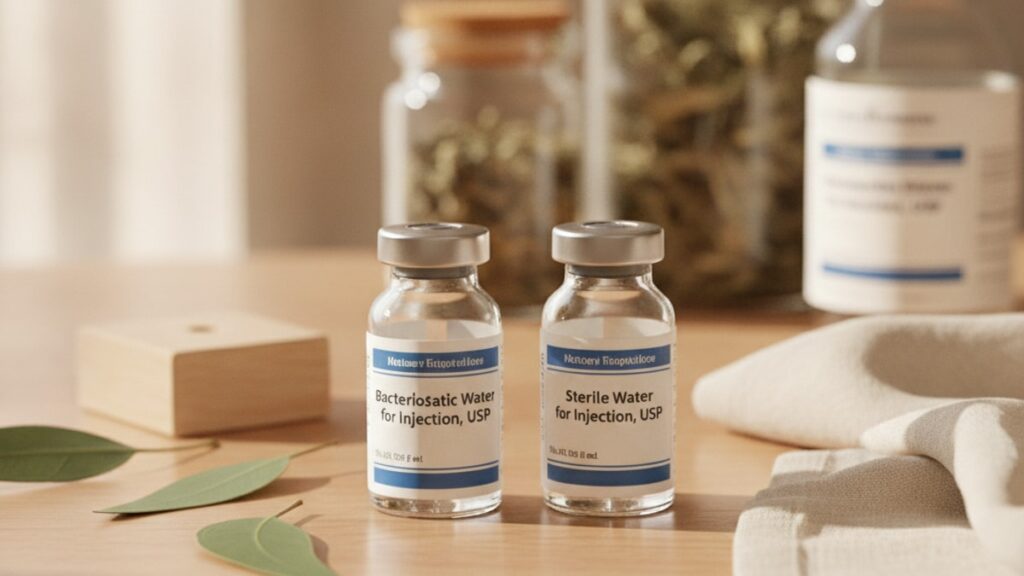
BAC Water vs Bacteriostatic Water — What's the Difference?
Here's what nobody mentions when they tell you to use 'BAC water' for peptide reconstitution: BAC water and bacteriostatic water are identical. Not similar. Identical. The term 'BAC water' is shorthand for bacteriostatic water, used interchangeably across research communities, compounding pharmacies, and peptide suppliers. The confusion exists because informal abbreviation became common parlance before formal terminology was standardized across product labeling. We've fielded hundreds of inquiries from researchers who believed they needed two separate solutions when ordering reconstitution supplies. They don't.
Our team has worked with research-grade peptide synthesis for years, and the single most common procurement error we see is duplicate ordering based on terminology confusion. The distinction researchers should focus on isn't between 'BAC' and 'bacteriostatic'. It's between bacteriostatic water and sterile water for injection, which are genuinely different compounds with distinct preservation mechanisms and stability profiles.
What's the difference between BAC water and bacteriostatic water?
There is no chemical or regulatory difference between BAC water and bacteriostatic water. Both terms refer to sterile water for injection containing 0.9% benzyl alcohol as a bacteriostatic preservative. The abbreviation 'BAC' simply stands for 'bacteriostatic,' not a separate formulation. Both maintain sterility for 28 days after initial puncture when refrigerated at 2–8°C, and both are used for reconstituting lyophilized peptides in research settings.
The direct answer: you're not choosing between two products. You're encountering two names for the same USP-grade solution. The regulatory designation. Bacteriostatic Water for Injection, USP. Is the formal pharmaceutical name. BAC water is the abbreviation researchers and suppliers use in practice. What matters is confirming the benzyl alcohol concentration (0.9%), the sterility certification, and proper refrigerated storage once opened. Not which shorthand label appears on the vial. This article covers what bacteriostatic water actually does at a molecular level, why benzyl alcohol prevents contamination, how it differs from sterile water without preservative, and what reconstitution errors eliminate its protective function entirely.
Why the Naming Confusion Exists in the First Place
The abbreviation 'BAC water' emerged in research and bodybuilding communities where peptide reconstitution became routine before widespread supplier standardization existed. Early peptide distributors. Many operating in grey markets before compounding pharmacy oversight tightened. Used informal shorthand on product labels and order forms. 'BAC' was faster to write and fit better on small vial labels than 'Bacteriostatic Water for Injection, USP.' The term persisted even after regulatory frameworks formalized, creating a split lexicon: researchers say 'BAC water,' compounding pharmacies print 'bacteriostatic water,' and both groups mean the same vial.
The confusion compounds when suppliers list both terms separately in product catalogs or when forum discussions treat them as alternatives. We've reviewed supplier inventories where 'BAC Water' and 'Bacteriostatic Water' appear as distinct line items. Same SKU, same formulation, different label text. This isn't deceptive; it's linguistic drift that predates industry consolidation. The FDA doesn't recognize 'BAC water' as a distinct drug classification. Only Bacteriostatic Water for Injection, USP, which must contain 0.9% benzyl alcohol and meet sterility standards under 21 CFR 211. Any vial meeting that standard is bacteriostatic water, regardless of how the supplier abbreviates it on the label.
What Bacteriostatic Water Actually Does — Mechanism of Preservation
Bacteriostatic water prevents microbial growth through benzyl alcohol's disruption of bacterial cell membrane integrity. At 0.9% concentration, benzyl alcohol denatures membrane proteins and increases permeability, causing cytoplasm leakage and metabolic shutdown. This mechanism is bacteriostatic. It halts bacterial replication. Not bactericidal, meaning it doesn't kill existing bacteria outright but prevents new colony formation. The practical effect: once you puncture a vial and introduce a needle (which carries environmental microbes no matter how sterile your technique), the benzyl alcohol prevents those organisms from multiplying.
Without this preservative, a punctured vial of sterile water becomes a growth medium within 24–48 hours at room temperature. Peptides reconstituted in non-preserved water must be used immediately or frozen, because bacterial contamination renders the solution unsafe and degrades the peptide structure through enzymatic activity. Bacteriostatic water extends usability to 28 days post-puncture when refrigerated, a window that covers most multi-dose peptide protocols. The 28-day limit isn't arbitrary. It's the FDA-established standard based on preservative efficacy studies showing benzyl alcohol concentration drops below bacteriostatic thresholds after repeated punctures and exposure.
The mechanism only works if storage temperature stays between 2–8°C. Benzyl alcohol's bacteriostatic effect weakens at temperatures above 8°C because bacterial metabolic rates increase faster than the preservative can suppress replication. Leaving reconstituted peptides at room temperature. Even for a few hours. Allows microbial doubling times to outpace preservative action.
Bacteriostatic Water vs Sterile Water for Injection — The Real Comparison
| Feature | Bacteriostatic Water (0.9% Benzyl Alcohol) | Sterile Water for Injection (No Preservative) | Why It Matters for Peptide Research |
|---|---|---|---|
| Preservative | 0.9% benzyl alcohol | None | Bacteriostatic water prevents contamination after vial puncture; sterile water does not |
| Multi-dose window | 28 days refrigerated after opening | Single-use only. Discard immediately after puncture | Multi-dose protocols require bacteriostatic water to avoid daily vial replacement |
| Peptide stability | Stable for most peptides; some sensitive compounds (BPC-157, TB-500) degrade slightly faster | No preservative interaction. Pure peptide-water solution | Peptides without documented benzyl alcohol sensitivity should default to bacteriostatic water |
| Sterility assurance | Sterile until opened, then bacteriostatic | Sterile until opened, then unprotected | Both start sterile; only bacteriostatic water maintains safety post-puncture |
| Cost per dose | Lower. One vial supports 20–30 doses | Higher. Each dose requires a new vial | Bacteriostatic water reduces waste and cost in protocols requiring frequent dosing |
| Professional Assessment | Standard for research peptide reconstitution unless compound-specific contraindication exists | Required only for benzyl alcohol-sensitive peptides or single large-volume doses | Use bacteriostatic water by default; switch to sterile water only when peptide manufacturer specifies incompatibility |
The key distinction: sterile water for injection is preservative-free, meaning it must be used immediately after opening or discarded. It's intended for single large-volume injections. IV infusions, large-volume dilutions. Where the entire vial contents are used at once. Bacteriostatic water is formulated for multi-dose applications where the vial will be punctured multiple times over weeks. For peptide reconstitution, where typical protocols involve daily or weekly injections from the same vial, bacteriostatic water is the standard choice unless the peptide itself reacts poorly with benzyl alcohol.
Some peptides. Notably BPC-157 in certain formulations. Show slight degradation when stored long-term in bacteriostatic water, though the mechanism isn't fully characterized in peer-reviewed literature. When peptide suppliers recommend sterile water instead of bacteriostatic, they're flagging a compatibility concern specific to that compound. For the majority of research peptides (semaglutide, tirzepatide, growth hormone secretagogues, cognitive peptides), bacteriostatic water is the optimal reconstitution medium.
Key Takeaways
- BAC water is an abbreviation for bacteriostatic water. They are the same solution containing 0.9% benzyl alcohol as a preservative.
- Benzyl alcohol works by disrupting bacterial cell membrane integrity, preventing microbial replication after vial puncture for up to 28 days when refrigerated at 2–8°C.
- The real comparison researchers should make is bacteriostatic water versus sterile water for injection, which has no preservative and must be used immediately after opening.
- Multi-dose peptide protocols require bacteriostatic water to avoid daily vial replacement; single-dose applications can use sterile water for injection.
- Temperature excursions above 8°C compromise benzyl alcohol's bacteriostatic effect, allowing bacterial metabolic rates to exceed preservative suppression capacity.
- Some peptides (BPC-157, certain TB-500 formulations) show compatibility issues with benzyl alcohol and require preservative-free sterile water instead.
- All bacteriostatic water sold in research contexts should meet USP standards under 21 CFR 211. Verify supplier certification before purchasing.
What If: BAC Water Scenarios
What If I Ordered 'BAC Water' But My Vial Says 'Bacteriostatic Water for Injection, USP'?
You received exactly what you ordered. The formal pharmaceutical name is Bacteriostatic Water for Injection, USP. 'BAC water' is informal shorthand. Verify the vial lists 0.9% benzyl alcohol as the preservative and meets USP standards. If both are present, the solution is correct regardless of label phrasing. Suppliers who use the full regulatory name are typically compounding pharmacies operating under stricter labeling requirements than grey-market distributors who abbreviate.
What If My Supplier Sells Both 'BAC Water' and 'Bacteriostatic Water' as Separate Products?
Check the product specifications. Specifically the benzyl alcohol concentration and volume. In most cases, they're the same formulation listed twice to capture different search terms. If the concentration differs (one lists 0.9% benzyl alcohol, another lists 1.0%), they are technically different products, though the functional difference is negligible. The USP standard is 0.9%; anything significantly higher or lower doesn't meet the regulatory definition.
What If I Accidentally Used Sterile Water Instead of Bacteriostatic Water for a Multi-Dose Vial?
Use the reconstituted peptide within 24 hours or discard it. Sterile water has no preservative, meaning bacterial contamination risk increases exponentially after the first puncture. Do not store a multi-dose vial reconstituted with sterile water beyond 24 hours. Even refrigerated. If you're using a peptide protocol requiring doses over multiple days, reconstitute a new vial with bacteriostatic water and discard the sterile-water vial.
What If I Left My Bacteriostatic Water at Room Temperature for Two Days — Is It Still Safe?
If the vial was unopened, it remains sterile and usable. Once opened, bacteriostatic water stored above 8°C loses preservative efficacy because benzyl alcohol's bacteriostatic effect weakens as bacterial metabolic rates increase. If the vial was punctured and left at room temperature for 48 hours, discard it. The 28-day post-puncture window assumes continuous refrigeration at 2–8°C. Any temperature excursion resets the safety margin.
The Blunt Truth About BAC Water Terminology
Here's the honest answer: the 'BAC water versus bacteriostatic water' question is a linguistic artifact, not a chemical one. Suppliers who list both as separate products are optimizing for search behavior, not offering distinct formulations. Researchers waste time comparing vials that are molecularly identical. The terminology split exists because peptide communities developed their own shorthand before regulatory language standardized, and now both terms persist in parallel. One informal, one official.
What matters isn't which label you see on the vial. What matters is confirming three things: benzyl alcohol concentration is 0.9%, the solution meets USP sterility standards, and you're storing it refrigerated after the first puncture. If those three criteria are met, the solution will do what bacteriostatic water is supposed to do. Keep your reconstituted peptides safe from contamination for 28 days. The label text is irrelevant.
Why Benzyl Alcohol Concentration Matters More Than Label Terminology
The USP monograph for Bacteriostatic Water for Injection specifies 0.9% benzyl alcohol. Not 0.8%, not 1.0%, but 0.9% with a narrow tolerance band. This precision exists because benzyl alcohol's bacteriostatic window is concentration-dependent. Below 0.7%, preservative efficacy drops; bacterial strains with partial benzyl alcohol resistance can replicate slowly, especially in vials stored near the upper temperature limit. Above 1.2%, benzyl alcohol begins to interact with peptide stability. Some amino acid sequences degrade faster in high-preservative environments.
Research-grade suppliers and compounding pharmacies that meet FDA 503B standards test every batch for benzyl alcohol concentration using gas chromatography. Grey-market suppliers. Those operating without formal pharmaceutical licensing. May use visual estimation or skip testing entirely. This is where label terminology becomes a proxy for quality: suppliers who use the full regulatory name 'Bacteriostatic Water for Injection, USP' are signaling compliance with formal testing protocols. Suppliers who abbreviate to 'BAC water' may or may not be testing concentration. Verify certification documentation before purchasing from any supplier, regardless of how they label the product.
Storage and Contamination: Where Bacteriostatic Water's Protection Breaks Down
Bacteriostatic water's 28-day post-puncture window assumes sterile technique and continuous refrigeration. The most common failure mode isn't bacterial contamination. It's particulate contamination from repeated needle punctures. Every time you insert a needle through the rubber stopper, microscopic rubber fragments shear off and fall into the solution. After 15–20 punctures, visible particulate matter accumulates. This doesn't compromise bacteriostatic efficacy, but it does compromise injection safety. Injecting rubber fragments subcutaneously causes localized inflammation.
The second failure mode: cross-contamination from non-sterile needle handling. Benzyl alcohol prevents bacterial replication inside the vial, but it doesn't sterilize needles. If you touch the needle tip before puncturing the vial, or if you use the same needle to draw from multiple vials, you're introducing organisms faster than the preservative can suppress them. Bacteriostatic water buys you a 28-day margin of error, not immunity from poor technique.
Proper storage means refrigeration at 2–8°C in the original vial with minimal light exposure. Benzyl alcohol is photosensitive. UV degradation reduces preservative concentration over time. Vials stored in clear glass under direct light lose bacteriostatic efficacy faster than amber glass vials stored in darkness. If your supplier ships bacteriostatic water in clear glass, transfer it to an amber vial or store it inside a drawer.
Bacteriostatic water and BAC water are the same solution. Two names for a single USP-regulated compound containing 0.9% benzyl alcohol as a bacteriostatic preservative. The terminology confusion stems from informal shorthand that predates regulatory standardization, not from any chemical or functional difference. Researchers choosing reconstitution media should focus on verifying benzyl alcohol concentration, confirming USP certification, and maintaining refrigerated storage post-puncture. Not on reconciling label terminology. The distinction that matters is bacteriostatic water versus sterile water for injection, which are genuinely different products with distinct use cases. For multi-dose peptide protocols, bacteriostatic water is the standard unless peptide-specific compatibility issues require preservative-free alternatives. Explore our full peptide collection to see how precision synthesis and quality verification extend across every compound we supply for research applications.
Frequently Asked Questions
Is BAC water the same as bacteriostatic water?▼
Yes — BAC water is simply an abbreviation for bacteriostatic water. Both terms refer to the same USP-grade solution containing 0.9% benzyl alcohol as a preservative. The abbreviation became common in research and peptide communities before formal pharmaceutical labeling standardized, so both names persist in parallel usage.
Can I use sterile water instead of bacteriostatic water for peptide reconstitution?▼
You can, but only if you plan to use the entire reconstituted vial immediately. Sterile water has no preservative, meaning bacterial contamination risk increases exponentially after the first puncture. Multi-dose peptide protocols require bacteriostatic water to maintain safety over the 28-day post-puncture window.
How long does bacteriostatic water stay sterile after opening?▼
Bacteriostatic water maintains bacteriostatic protection for 28 days after the first puncture when stored refrigerated at 2–8°C. This window is based on FDA preservative efficacy studies showing benzyl alcohol concentration remains above bacteriostatic thresholds for that duration. Temperature excursions above 8°C reduce this window significantly.
What concentration of benzyl alcohol should bacteriostatic water contain?▼
The USP standard for Bacteriostatic Water for Injection specifies 0.9% benzyl alcohol. Concentrations below 0.7% lose bacteriostatic efficacy; concentrations above 1.2% can interact with peptide stability. Verify supplier certification documents confirm 0.9% concentration before purchasing.
Why do some peptides require sterile water instead of bacteriostatic water?▼
Certain peptides — notably BPC-157 and some TB-500 formulations — show slight degradation when stored long-term in bacteriostatic water, likely due to benzyl alcohol interaction with specific amino acid sequences. When peptide suppliers recommend sterile water, they are flagging a compound-specific compatibility concern.
Can bacteriostatic water be stored at room temperature before opening?▼
Yes — unopened bacteriostatic water remains sterile at room temperature according to USP stability guidelines. Once opened, refrigeration at 2–8°C is required to maintain the 28-day bacteriostatic window. Temperature excursions after puncture compromise benzyl alcohol efficacy.
What happens if I inject peptides reconstituted with contaminated bacteriostatic water?▼
Bacterial contamination can cause localized infection at the injection site, systemic infection in immunocompromised individuals, or peptide degradation through enzymatic activity. Symptoms include redness, swelling, fever, and peptide inefficacy. Discard any vial showing cloudiness, particulate matter, or discoloration.
How do I know if my bacteriostatic water meets USP standards?▼
Request a Certificate of Analysis (CoA) from your supplier showing benzyl alcohol concentration via gas chromatography and sterility testing results. Suppliers operating under FDA 503B registration or state pharmacy board licensing are required to provide these documents. Grey-market suppliers without formal certification may not test concentration.
Can I reuse needles when drawing from a bacteriostatic water vial?▼
No — reusing needles introduces contamination risk that bacteriostatic water cannot fully suppress. Benzyl alcohol prevents bacterial replication inside the vial but does not sterilize needles. Each draw from the vial requires a new sterile needle to maintain the 28-day safety window.
What is the difference between bacteriostatic water and bactericidal water?▼
Bacteriostatic water inhibits bacterial replication without killing existing bacteria — it prevents new colony formation. Bactericidal solutions actively kill bacteria. No ‘bactericidal water’ exists as a pharmaceutical product; the term bacteriostatic specifically refers to the replication-inhibiting mechanism of benzyl alcohol in Bacteriostatic Water for Injection, USP.











