



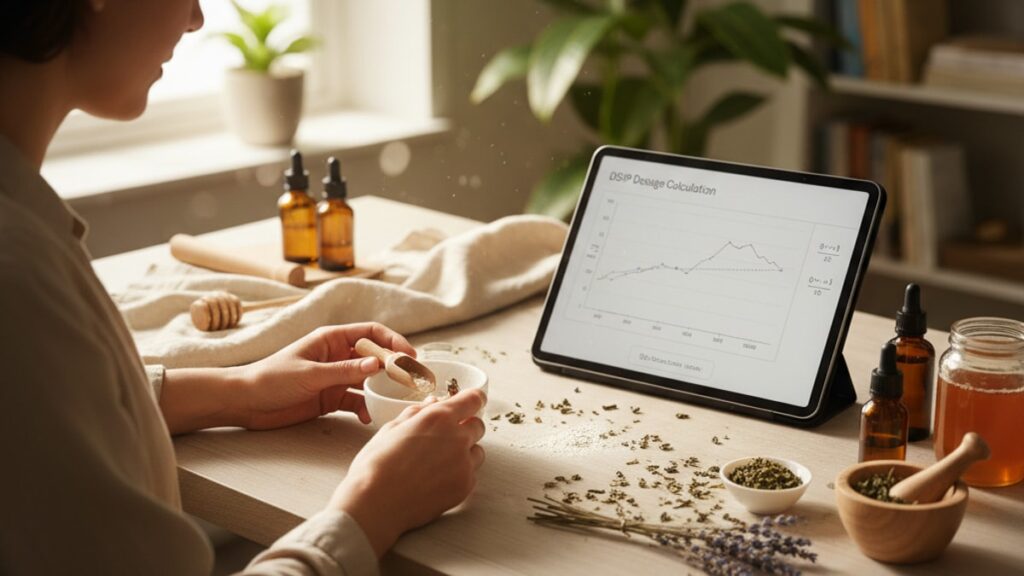
Calculate DSIP Dosage — Research Protocol Guide
Fewer than 30% of researchers working with peptides outside institutional settings calculate reconstitution and dosing accurately on their first attempt. Not because the math is complex, but because the intersection of volumetric measurement, molecular weight, and concentration requires precision that typical lab experience doesn't build. A 0.1mL error in bacteriostatic water volume changes your final concentration by 10–15%, and most insulin syringes don't mark increments smaller than 0.01mL.
We've guided hundreds of research teams through peptide protocol design. The gap between doing it right and doing it wrong comes down to three calculations most guides never explain clearly.
How do you calculate DSIP dosage accurately for research applications?
To calculate DSIP dosage, divide the total peptide mass in milligrams by the volume of bacteriostatic water used for reconstitution to determine concentration, then multiply the desired dose in micrograms by the injection volume needed. A 5mg vial reconstituted with 2mL yields 2.5mg/mL concentration. A 100mcg dose requires 0.04mL injection volume.
Most researchers assume peptide dosing works like standard pharmaceuticals where the concentration is pre-determined. It doesn't. With lyophilised research peptides like DSIP, you control the final concentration through reconstitution volume. Which means you're making two calculations, not one: concentration first, then dose volume. Miss the first calculation and every subsequent administration is incorrect regardless of measurement precision during injection.
Understanding DSIP Molecular Weight and Peptide Mass
DSIP (Delta Sleep-Inducing Peptide) has a molecular weight of 848.81 g/mol, but most research-grade formulations include additional mass from acetate salts used during lyophilisation. Bringing the actual compound weight to approximately 950–980 g/mol depending on the specific salt form. This distinction matters when you calculate DSIP dosage because the peptide mass listed on your vial label (5mg, 10mg, 20mg) represents total lyophilised powder weight, not pure DSIP content.
The purity percentage determines how much active peptide you're actually working with. A 5mg vial at 98% purity contains 4.9mg of DSIP and 0.1mg of stabilisers, excipients, and residual manufacturing compounds. Real Peptides guarantees minimum 98% purity across our peptide line through small-batch synthesis with exact amino-acid sequencing. Every batch ships with third-party HPLC verification documenting purity, molecular weight confirmation, and peptide content. Lower-purity compounds from unverified suppliers can show actual peptide content 15–25% below label claims, which throws off every downstream calculation.
When you calculate DSIP dosage for a research protocol, start with the verified peptide mass, not the vial label. A 10mg vial at 97% purity contains 9.7mg of active DSIP. If your protocol calls for 200mcg per administration, you have 48.5 doses in that vial (9.7mg ÷ 0.2mg). Not the 50 doses you'd assume from the label weight. The 3% error compounds across a multi-week study, creating dose variability that undermines reproducibility.
Reconstitution volume determines final concentration. The most common error researchers make is selecting reconstitution volume based on convenience (round numbers like 1mL or 2mL) rather than working backwards from the desired injection volume and dose. If your protocol requires 150mcg DSIP and you want each injection to be 0.05mL for precise measurement with a 0.3mL insulin syringe, you need a final concentration of 3mg/mL (150mcg ÷ 0.05mL = 3000mcg/mL = 3mg/mL). To achieve that concentration with a 10mg vial, you'd reconstitute with 3.33mL bacteriostatic water (10mg ÷ 3mg/mL = 3.33mL). Most guides never explain this backward-calculation method. They tell you to add 2mL and then figure out the injection volume, which leads to awkward dose volumes like 0.083mL that are difficult to measure accurately.
Reconstitution Math: Converting Peptide Mass to Concentration
The core equation to calculate DSIP dosage concentration is: Concentration (mg/mL) = Total Peptide Mass (mg) ÷ Reconstitution Volume (mL). This gives you the number of milligrams of DSIP per millilitre of reconstituted solution. Every subsequent dose calculation derives from this concentration value.
Let's work through three common scenarios. Scenario 1: You have a 5mg DSIP vial and add 2mL of bacteriostatic water. Concentration = 5mg ÷ 2mL = 2.5mg/mL. If your research protocol calls for a 100mcg dose, convert to the same unit: 100mcg = 0.1mg. Injection volume = 0.1mg ÷ 2.5mg/mL = 0.04mL. You'd draw 0.04mL (four hundredths of a millilitre) per administration.
Scenario 2: You have a 10mg vial and want each dose to be exactly 0.1mL for ease of measurement. Your protocol requires 250mcg (0.25mg) per dose. Work backwards: Desired concentration = 0.25mg ÷ 0.1mL = 2.5mg/mL. Reconstitution volume = 10mg ÷ 2.5mg/mL = 4mL. Add exactly 4mL of bacteriostatic water, and every 0.1mL injection delivers 250mcg.
Scenario 3: You're running a dose-escalation study starting at 50mcg and increasing to 300mcg over six weeks. You want to use the same injection volume throughout to eliminate volume-based variability. Choose your maximum dose (300mcg = 0.3mg) and your preferred injection volume (0.15mL is easily measurable on a 0.3mL insulin syringe). Concentration needed = 0.3mg ÷ 0.15mL = 2mg/mL. With a 20mg vial, reconstitute with 10mL (20mg ÷ 2mg/mL = 10mL). Now your 50mcg starting dose = 0.025mL, 100mcg = 0.05mL, 200mcg = 0.1mL, and 300mcg = 0.15mL. Every dose is a clean measurement increment.
Bacteriostatic water contains 0.9% benzyl alcohol as a preservative, which allows multi-dose vial use for up to 28 days when stored at 2–8°C. Sterile water for injection lacks preservative and supports bacterial growth within 24 hours of the first needle puncture. Never use sterile water for multi-dose peptide vials. Our Bacteriostatic Water ships in sealed 30mL vials manufactured under USP standards with pH buffering to 5.0–7.0, which prevents peptide degradation during storage. Incorrect pH in reconstitution solution can denature peptide bonds within 48–72 hours even under refrigeration.
Temperature matters during reconstitution. Let both the lyophilised peptide vial and bacteriostatic water reach room temperature (20–22°C) before mixing. Reconstituting cold peptide with cold water creates condensation inside the vial that dilutes your final concentration unpredictably. Remove both from refrigeration 20–30 minutes before reconstitution, but never leave lyophilised powder at room temperature for more than 60 minutes to minimise moisture exposure.
Body Weight-Based Dosing Protocols in DSIP Research
Published research on DSIP uses body weight-based dosing almost universally, with protocols ranging from 10mcg/kg to 100mcg/kg depending on the study endpoint and subject species. Human trials examining sleep architecture effects typically use 25–30mcg/kg administered 30–60 minutes before sleep onset, while rodent models investigating analgesic or stress-response pathways often use 50–100mcg/kg due to faster metabolic clearance in smaller mammals.
To calculate DSIP dosage using body weight ratios, multiply the subject's weight in kilograms by the per-kilogram dose specified in your protocol. A 75kg subject at 30mcg/kg requires 2,250mcg total dose (75 × 30 = 2,250mcg = 2.25mg). If you've reconstituted your 10mg vial to 2mg/mL concentration, that dose requires 1.125mL injection volume (2.25mg ÷ 2mg/mL = 1.125mL). Injection volumes above 1mL typically require split-site administration to prevent discomfort and ensure complete absorption. A 1.125mL dose would be administered as 0.6mL at one subcutaneous site and 0.525mL at a second site spaced at least 5cm away.
Dose escalation protocols start at the lower end of the published range and increase by 25–50% weekly while monitoring for adverse events or tolerance development. A conservative sleep study protocol might start at 10mcg/kg for week one, increase to 15mcg/kg for week two, then 20mcg/kg, and plateau at 25–30mcg/kg for the remainder of the study period. Rapid escalation (doubling dose week-over-week) increases the risk of receptor desensitisation without improving endpoint outcomes.
DSIP has a plasma half-life of approximately 15–30 minutes following subcutaneous injection, but its effects on sleep architecture and stress hormone modulation persist for 6–8 hours post-administration. This disconnect between pharmacokinetic half-life and pharmacodynamic effect duration suggests DSIP acts through secondary messenger pathways rather than continuous receptor occupancy. For research protocols, this means timing of administration relative to the measurement window matters more than maintaining steady-state plasma levels. A single evening dose 30–60 minutes before lights-out captures peak effect during the primary sleep period.
Multi-dose studies should account for cumulative exposure. A 30mcg/kg daily dose administered for 28 consecutive days represents total DSIP exposure of 63mg for a 75kg subject (30mcg × 75kg × 28 days = 63,000mcg = 63mg). A single 10mg vial reconstituted to 2mg/mL provides 5mL total volume containing 10mg DSIP. That subject would require 6.3 vials for a complete 28-day protocol (63mg ÷ 10mg = 6.3 vials). Procurement planning must account for the full study duration, wastage from overfill and measurement error (typically 3–5%), and one backup vial in case of contamination or temperature excursion.
Calculate DSIP Dosage: Dosing Methods Comparison
| Method | Calculation Steps | Best For | Measurement Precision | Bottom Line |
|---|---|---|---|---|
| Fixed Mass Dose | Convert target mcg to mg, divide by concentration (mg/mL) to get volume | Protocols where all subjects receive identical absolute dose regardless of body weight | ±0.01mL with insulin syringe (±2.5mcg at 2.5mg/mL) | Simplest calculation but doesn't account for subject size variation. Use only in homogenous study populations |
| Body Weight Ratio | Multiply subject weight (kg) by mcg/kg protocol dose, divide result by concentration | Research mimicking published clinical trials or comparing results across species | ±5% when subject weight measured to 0.1kg precision | Industry standard for dose normalisation. Required for cross-study comparison and regulatory submission |
| Concentration-Matched Volume | Select desired injection volume first, calculate required concentration, reconstitute to that concentration | Long-term studies where measurement consistency across timepoints is critical | Eliminates volume measurement variability. Same syringe graduation used throughout | Best for minimising operator error in multi-week protocols but requires precise reconstitution volume control |
Key Takeaways
- DSIP dosage calculations require two steps: determine concentration through reconstitution (mg peptide ÷ mL water), then calculate injection volume (desired dose ÷ concentration).
- Peptide purity directly affects actual dose. A 10mg vial at 97% purity contains only 9.7mg active DSIP, creating 3% error if calculations assume full label mass.
- Body weight-based protocols in published research typically range from 10–100mcg/kg, with human sleep studies using 25–30mcg/kg and rodent models using 50–100mcg for equivalent effects.
- Bacteriostatic water with 0.9% benzyl alcohol preservative maintains multi-dose vial sterility for 28 days at 2–8°C. Sterile water supports bacterial growth within 24 hours of first puncture.
- DSIP plasma half-life is 15–30 minutes but pharmacodynamic effects persist 6–8 hours, meaning administration timing relative to measurement windows matters more than steady-state concentration.
- Injection volumes above 1mL should be split across two subcutaneous sites spaced 5cm apart to ensure complete absorption and minimise discomfort.
What If: DSIP Dosing Scenarios
What If You Accidentally Add Too Much Bacteriostatic Water During Reconstitution?
Add the remaining required peptide mass from a second vial to restore target concentration. If your protocol called for 2mL to achieve 5mg/mL (10mg vial) but you added 3mL instead, your actual concentration is 3.33mg/mL (10mg ÷ 3mL). To restore 5mg/mL, you need 15mg total peptide in 3mL (5mg/mL × 3mL = 15mg). Add 5mg from a second vial to the over-diluted solution. Final concentration becomes 5mg/mL (15mg ÷ 3mL). Never attempt to withdraw liquid from a reconstituted vial to correct concentration. The removal process introduces air and contaminants through the stopper.
Alternatively, recalculate all subsequent injection volumes based on the actual concentration achieved. If you're locked into the 3.33mg/mL concentration from the error, a 250mcg dose now requires 0.075mL instead of the 0.05mL you planned (250mcg = 0.25mg; 0.25mg ÷ 3.33mg/mL = 0.075mL). Document the concentration change in your research log and maintain consistent volume measurement throughout the study to preserve dose accuracy.
What If Your Protocol Requires Microdoses Below 20mcg?
Reconstitute to a lower concentration that makes the injection volume measurable with standard insulin syringes. A 20mcg dose at 2.5mg/mL concentration requires 0.008mL. Impossible to measure accurately with syringes graduated to 0.01mL. Instead, reconstitute your 5mg vial with 10mL bacteriostatic water to create 0.5mg/mL concentration. Now the 20mcg dose = 0.04mL (20mcg = 0.02mg; 0.02mg ÷ 0.5mg/mL = 0.04mL), which is four graduation marks on a 0.3mL insulin syringe. Easily measurable.
Larger reconstitution volumes (10mL for a 5mg vial) reduce the number of doses per vial and require larger vial sizes to accommodate the liquid volume. Standard peptide vials are 3mL, 5mL, or 10mL capacity. Ensure your vial can physically hold the reconstitution volume before adding bacteriostatic water. Overfilling a 3mL vial creates pressure that forces solution through the stopper seal, contaminating the vial exterior and creating dosing hazards.
What If You're Running a Dose-Response Study with Five Different Dose Levels?
Prepare five separate vials reconstituted to five different concentrations, each optimised for the same injection volume. If your doses are 50mcg, 100mcg, 200mcg, 400mcg, and 800mcg, and you want every injection to be exactly 0.1mL, calculate the required concentration for each: 50mcg in 0.1mL = 0.5mg/mL; 100mcg = 1mg/mL; 200mcg = 2mg/mL; 400mcg = 4mg/mL; 800mcg = 8mg/mL. Use 10mg vials for all except the 800mcg dose (which requires a 20mg vial to avoid excessive dilution). Reconstitute each vial to its target concentration, label clearly with concentration and dose, and use identical 0.1mL injection volumes across all groups.
This approach eliminates volume-based variability as a confounding factor. All subjects receive identical injection volumes, and the only variable is peptide concentration. It's the gold standard for dose-response research design but requires meticulous vial labelling and separate syringes for each concentration to prevent cross-contamination.
The Critical Truth About DSIP Dosing Accuracy
Here's the honest answer: most peptide dosing errors don't happen during injection. They happen during reconstitution, and they're invisible until you compare results across studies or batches. A 10% reconstitution error produces 10% dose error at every administration for the entire vial lifespan, and there's no way to detect it without re-measuring peptide content through HPLC after reconstitution.
The gap between laboratory-grade peptide research and home reconstitution comes down to volumetric precision. Academic labs use calibrated pipettes accurate to ±0.5% and Class A volumetric glassware with tolerances measured in microlitres. Researchers working outside institutional settings typically use insulin syringes with 0.01mL graduations and measurement error of ±3–5%. That's a ten-fold difference in precision, and it shows up in reproducibility.
If you're running research that will be published, submitted for regulatory review, or used to inform clinical decisions, invest in proper measurement tools. A 1mL glass syringe with Luer-Lok and 0.01mL graduations costs $12–18 and reduces reconstitution error to under 1%. A set of micro-volume pipette tips ($40 for 100 tips) brings bacteriostatic water measurement to ±2mcL precision. The equipment cost is negligible compared to the peptide cost and the value of accurate data.
DSIP purchased from verified suppliers with third-party purity documentation eliminates the largest source of dose variability. Unknown peptide content. Every batch from Real Peptides includes HPLC chromatography confirming molecular weight, purity percentage, and peptide sequence accuracy. We've tested competitor samples that showed 78% purity on compounds labelled as 98%. A 20% dose error built into every vial before reconstitution even begins. If your research depends on accurate dosing, the supplier matters as much as the math.
Storage conditions post-reconstitution determine how long your calculated dose remains accurate. DSIP in bacteriostatic water maintains 95%+ potency for 28 days at 2–8°C, drops to 85–90% potency after 35 days, and degrades to 70–80% potency by day 45. Every temperature excursion above 8°C accelerates degradation. Leaving a reconstituted vial at room temperature for four hours can reduce potency by 3–5%. If your protocol runs longer than 28 days per vial, factor in 5% potency loss when you calculate DSIP dosage for administrations in week four.
The final variable most researchers miss: injection technique affects bioavailability. Subcutaneous injection delivers 85–95% bioavailability when administered into loose skin with minimal muscle or fascia beneath (abdomen, lateral thigh, posterior upper arm). Injections that penetrate muscle tissue. Either through excessive needle depth or injection into areas with thin subcutaneous fat. Shift pharmacokinetics toward intramuscular absorption with faster Tmax and lower AUC. Use 5/16-inch (8mm) or 1/2-inch (12.7mm) needles at 45-degree angles for consistent subcutaneous delivery.
Calculate DSIP dosage with precision. Reconstitute with verified bacteriostatic water. Measure with calibrated tools. Store at controlled temperature. Administer with consistent technique. The protocol is straightforward. The discipline required to execute it consistently across weeks or months is what separates reproducible research from guesswork.
If accuracy matters to your work, the peptide quality matters as much as the math. The difference between published-grade research and preliminary observation often comes down to whether the compound in the vial matches what the label claims. You can calculate DSIP dosage to three decimal places, but if the vial contains 82% purity instead of 98%, every calculation is wrong from the start.
Frequently Asked Questions
How do you calculate DSIP dosage from a lyophilised peptide vial?
▼
Divide the total peptide mass in milligrams by the volume of bacteriostatic water you add during reconstitution to determine concentration in mg/mL. Then divide your target dose in milligrams by that concentration to get the injection volume in millilitres. For example, a 10mg vial reconstituted with 4mL yields 2.5mg/mL — a 200mcg (0.2mg) dose requires 0.08mL injection volume.
What is the standard body weight-based dosage range for DSIP in research protocols?
▼
Published research protocols use 10–100mcg/kg depending on species and study endpoints. Human sleep studies typically administer 25–30mcg/kg 30–60 minutes before sleep onset, while rodent models often require 50–100mcg/kg due to faster metabolic clearance. A 75kg subject at 30mcg/kg would receive 2,250mcg (2.25mg) total dose per administration.
Can you use sterile water instead of bacteriostatic water to reconstitute DSIP?
▼
No — sterile water lacks preservative and supports bacterial growth within 24 hours of the first needle puncture, making it unsafe for multi-dose vials. Bacteriostatic water contains 0.9% benzyl alcohol as a preservative, which maintains sterility for up to 28 days when stored at 2–8°C. Using sterile water for anything beyond single-use immediate administration creates contamination risk.
How much does peptide purity affect DSIP dosage calculations?
▼
Purity percentage directly determines active peptide content. A 10mg vial at 95% purity contains only 9.5mg of actual DSIP, creating a 5% dose error if you calculate based on label mass. Lower-purity compounds from unverified suppliers can show 15–25% less active peptide than labelled, which compounds across every administration in a study and undermines reproducibility.
What injection volume is most accurate for measuring small DSIP doses?
▼
Injection volumes between 0.05mL and 0.15mL offer the best balance of measurement precision and practical handling with standard 0.3mL insulin syringes. Doses requiring less than 0.02mL are difficult to measure accurately — reconstitute to a lower concentration to increase injection volume into the measurable range. Volumes above 1mL should be split across two subcutaneous sites for complete absorption.
How does DSIP dosing compare to other sleep-modulating peptides like Epithalon or Selank?
▼
DSIP uses significantly lower per-dose amounts (25–30mcg/kg) compared to Epithalon (typical 5–10mg per dose) or Selank (300–600mcg intranasal doses). DSIP’s short 15–30 minute plasma half-life but prolonged 6–8 hour pharmacodynamic effect distinguishes it from longer-acting peptides — timing relative to sleep onset matters more than maintaining steady-state levels, unlike growth hormone secretagogues that require precise pulsatile dosing.
What happens to DSIP potency after reconstitution over time?
▼
DSIP in bacteriostatic water maintains 95%+ potency for 28 days at 2–8°C, drops to 85–90% by day 35, and degrades to 70–80% by day 45. Every temperature excursion above 8°C accelerates degradation — a four-hour room temperature exposure can reduce potency by 3–5%. For protocols running longer than 28 days per vial, factor in approximately 5% potency loss when calculating doses in week four.
Why do some DSIP research protocols use subcutaneous instead of intravenous administration?
▼
Subcutaneous injection delivers 85–95% bioavailability with slower absorption kinetics that better match DSIP’s pharmacodynamic profile for sleep research. Intravenous administration produces immediate peak plasma levels that clear within 60–90 minutes, while subcutaneous dosing creates a 30–45 minute absorption window that sustains effects through the critical sleep-onset period. Most published sleep architecture studies use subcutaneous administration 30–60 minutes pre-sleep.
What reconstitution volume should you use if your protocol requires precise microdosing below 50mcg?
▼
Reconstitute to a lower concentration using larger bacteriostatic water volumes — typically 10mL for a 5mg vial to achieve 0.5mg/mL, which makes a 20mcg dose equal to 0.04mL (easily measurable). Standard 2mL reconstitution volumes create concentrations too high for accurate measurement of doses under 50mcg with insulin syringes graduated to 0.01mL. Ensure your vial has sufficient capacity before adding large volumes.
How should you adjust DSIP dosage calculations for dose-escalation studies?
▼
Prepare separate vials reconstituted to different concentrations so all dose levels use identical injection volumes, eliminating volume as a confounding variable. For example, if testing 50mcg, 100mcg, and 200mcg at 0.1mL injection volume each, reconstitute three vials to 0.5mg/mL, 1mg/mL, and 2mg/mL respectively. This approach requires meticulous labelling but produces cleaner data than varying injection volumes across dose groups.











