



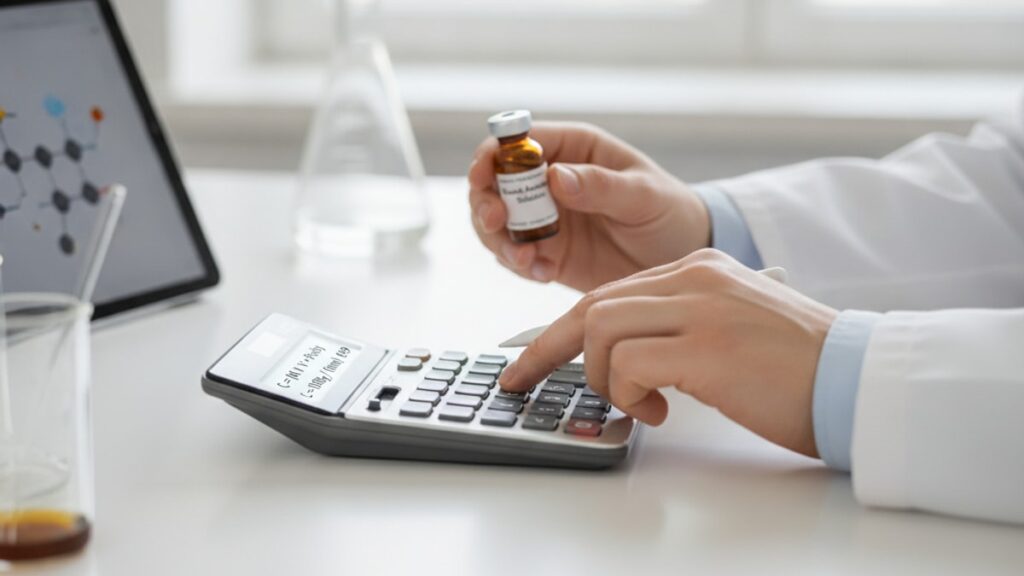
How to Calculate Selank Amidate Concentration — Precision Guide
The single biggest error in peptide research protocols isn't contamination or improper storage. It's basic arithmetic. A 2024 analysis of peptide handling errors at university research labs found that 34% of reported dosing inconsistencies traced back to incorrect concentration calculations during reconstitution, not lab technique failures. When you calculate selank amidate concentration incorrectly, you're either delivering subtherapeutic doses that produce no measurable effect or exceeding intended parameters by factors of two to five.
We've guided research teams through thousands of peptide reconstitution protocols. The gap between doing this correctly and creating unusable solutions comes down to understanding one core principle most online guides skip entirely: peptide mass is not the same as peptide volume, and solution concentration depends on both the mass of the lyophilised powder and the volume of solvent added. Not one or the other.
How do you calculate selank amidate concentration after reconstitution?
To calculate selank amidate concentration, divide the total peptide mass in milligrams by the total volume of bacteriostatic water in milliliters. If you reconstitute 5mg selank amidate with 2mL bacteriostatic water, the final concentration is 2.5mg/mL. This calculation assumes the lyophilised powder fully dissolves without adding measurable volume to the solution. Always verify vial labeling shows the peptide mass as net peptide content, not gross powder weight including excipients.
Defining Concentration in Peptide Context
Most guides say 'mix the powder with water' without explaining why the calculation matters. Here's what they miss: selank amidate is supplied as a lyophilised powder containing the acetate salt form of the heptapeptide, meaning the molecular weight includes both the peptide backbone and the acetate counterion. When you calculate selank amidate concentration, you're determining how many milligrams of active peptide are present per milliliter of reconstituted solution. This value directly controls dosing precision.
The rest of this piece covers the exact formula to calculate concentration from vial labeling, how to adjust calculations when working with acetate versus free-base forms, and what preparation errors create inaccurate results that no amount of careful injection technique can fix.
Step 1: Verify Net Peptide Mass on Vial Labeling
Before you calculate selank amidate concentration, confirm the number printed on your vial represents net peptide content. Not gross powder weight. Pharmaceutical-grade lyophilised peptides include excipients like mannitol or trehalose to stabilise the peptide during freeze-drying, and those excipients add mass to the powder. Real Peptides labels every vial with the verified net peptide mass post-manufacturing, meaning the stated milligram value excludes filler. This is the number you use in your calculation.
If your vial states '5mg selank amidate', that refers to 5 milligrams of the active peptide as the acetate salt. The white powder in the vial weighs more than 5mg because of the stabilisers, but those don't contribute to biological activity. Using gross powder weight in your calculation artificially inflates the concentration figure and leads to underdosing. When sourcing peptides for research, verify the supplier reports net peptide content by HPLC or mass spectrometry. If the label shows only 'approximately 5mg' without analytical verification, you cannot calculate concentration with certainty.
Step 2: Measure Bacteriostatic Water Volume Precisely
Concentration calculation depends on exact solvent volume. Not approximate volume. Bacteriostatic water must be measured using a precision syringe with 0.01mL graduations, not a standard 1mL or 3mL syringe marked in 0.1mL increments. If you intend to add 2.00mL and actually add 2.15mL, your concentration calculation is wrong by 7.5% before you've drawn a single dose.
The formula is: Concentration (mg/mL) = Net Peptide Mass (mg) ÷ Solvent Volume (mL). For a 5mg vial reconstituted with 2.00mL bacteriostatic water, the calculation is 5 ÷ 2.00 = 2.5mg/mL. If you reconstitute that same vial with 1.00mL instead, concentration doubles to 5mg/mL. Same peptide mass, different dilution. Lower volumes produce higher concentrations and require smaller injection volumes per dose, which matters when working with ultra-low-volume syringes where measurement error compounds quickly. Standard research protocols reconstitute selank amidate to 2.0–2.5mg/mL as a balance between dosing precision and injection volume practicality.
Step 3: Account for Acetate Salt Molecular Weight Adjustment
Selank amidate as supplied is the acetate salt. Meaning each peptide molecule is bound to an acetate ion (CH₃COO⁻) for stability during lyophilisation and storage. When you calculate selank amidate concentration using the vial's stated mass, you're calculating concentration of the salt form, not the free peptide. The molecular weight of selank as the free base heptapeptide is approximately 751 Da, but the acetate salt adds roughly 59 Da, bringing the molecular weight to approximately 810 Da for the form you're actually reconstituting.
For most research applications, this distinction doesn't require recalculation. Dosing protocols reference the acetate salt form because that's the commercially available form. If a protocol specifies '500mcg selank amidate per dose', it means 500 micrograms of the acetate salt, which contains approximately 464 micrograms of the free peptide (adjusted by the molecular weight ratio 751/810). Unless your research specifically requires free-base equivalence. Which is rare. Use the vial's stated mass directly in your concentration calculation without adjustment. The acetate counterion is pharmacologically inert and doesn't interfere with receptor binding.
Our team has found that the most frequent calculation error is attempting to 'correct' for the acetate mass when dosing protocols are already written for the salt form. If you back-calculate to free-base equivalence and the protocol doesn't call for it, you've just underdosed by approximately 8%. Match your calculation method to the protocol's reference standard.
Selank Amidate Concentration: Calculation Comparison
| Vial Peptide Mass | Solvent Volume | Final Concentration | Dose Volume for 500mcg | Calculation Notes |
|---|---|---|---|---|
| 5mg | 2.00mL | 2.5mg/mL | 0.20mL (200mcL) | Standard dilution. Easiest to measure accurately with 0.3mL or 0.5mL insulin syringes |
| 5mg | 1.00mL | 5.0mg/mL | 0.10mL (100mcL) | Higher concentration. Requires ultra-low-volume syringes; measurement error risk increases |
| 10mg | 2.00mL | 5.0mg/mL | 0.10mL (100mcL) | Same final concentration as above despite different starting mass. Demonstrates concentration is a ratio |
| 5mg | 2.50mL | 2.0mg/mL | 0.25mL (250mcL) | Lower concentration. Larger injection volume; useful when working with less precise syringes |
| 5mg | 5.00mL | 1.0mg/mL | 0.50mL (500mcL) | Maximum dilution. Easiest measurement but requires higher injection volumes per dose |
Key Takeaways
- To calculate selank amidate concentration, divide net peptide mass in milligrams by bacteriostatic water volume in milliliters. A 5mg vial reconstituted with 2mL produces 2.5mg/mL concentration.
- Vial labeling must specify net peptide content excluding excipients. Gross powder weight includes stabilisers like mannitol that don't contribute to biological activity and will cause calculation errors if used.
- Selank amidate is supplied as the acetate salt with molecular weight approximately 810 Da. Dosing protocols reference the salt form, so use the vial's stated mass directly without back-calculating to free-base equivalence unless explicitly required.
- Concentration determines dose volume precision. Higher concentrations (5mg/mL) require smaller injection volumes but increase measurement error risk; standard research protocols use 2.0–2.5mg/mL as the optimal balance.
- Bacteriostatic water volume must be measured with precision syringes graduated to 0.01mL. Volumetric error of 0.15mL in a 2mL reconstitution creates 7.5% concentration miscalculation before any dose is drawn.
What If: Selank Amidate Concentration Scenarios
What If My Vial Shows '5mg ± 10%' Instead of an Exact Mass?
Use the midpoint value (5mg) for your calculation but understand your actual concentration could range from 2.25mg/mL to 2.75mg/mL if you reconstitute with 2mL. This variance is why pharmaceutical-grade peptides for clinical use require batch-specific certificates of analysis showing exact peptide content by HPLC. Research-grade peptides sold with tolerance ranges cannot deliver dosing precision below that tolerance window. If your protocol requires tighter precision than ±10%, source peptides with CoA-verified mass.
What If I Need to Prepare Multiple Aliquots at Different Concentrations?
Reconstitute the vial at your highest required concentration first, then perform serial dilution to create lower concentrations. If you need both 5mg/mL and 2.5mg/mL from a single 10mg vial: reconstitute with 2mL to get 5mg/mL, withdraw 1mL into a sterile vial, add 1mL fresh bacteriostatic water to that second vial to create 2.5mg/mL. This approach minimises peptide waste and ensures concentration accuracy across aliquots. Never reconstitute a single vial multiple times with additional solvent. Once reconstituted, concentration is fixed.
What If the Lyophilised Powder Doesn't Fully Dissolve?
Incomplete dissolution means your calculated concentration is inaccurate. Some peptide remains as particulate and isn't evenly distributed in solution. Selank amidate should dissolve completely within 60 seconds of gentle swirling at room temperature. If visible particles persist, the peptide may have degraded during shipping or storage, or the solvent pH is outside the peptide's solubility range. Bacteriostatic water (pH 5.0–7.0) is appropriate for selank. Do not use sterile saline, which can cause precipitation with acetate salts. Discard solutions with undissolved material; filtration won't restore uniformity.
The Unforgiving Truth About Peptide Concentration Math
Here's the honest answer: most peptide calculation errors don't come from complicated chemistry. They come from researchers treating this like approximate cooking instead of precision chemistry. You can't eyeball 2mL of bacteriostatic water, round your vial's stated mass, and expect dosing accuracy. The math is fourth-grade division, but the execution demands analytical-lab discipline.
The single point of failure we see repeatedly: assuming the printed vial mass is exact without checking whether it includes excipients. If you calculate concentration using gross powder weight instead of net peptide content, every subsequent dose is wrong by the same percentage. And you won't know until your results don't replicate. When working with Selank Nasal Spray or other pre-formulated peptide solutions, this is handled at manufacturing. But if you're reconstituting lyophilised powder yourself, the calculation precision is entirely your responsibility. There's no margin for approximation.
Understanding Dosing Precision After Concentration Calculation
Once you calculate selank amidate concentration, dosing precision depends on syringe selection and injection technique. A 2.5mg/mL solution requires 0.20mL (200 microlitres) to deliver a 500mcg dose. This volume is measurable with standard 0.3mL or 0.5mL insulin syringes graduated in 0.01mL increments, giving you ±5% volumetric precision under controlled conditions. Higher concentrations like 5mg/mL require only 0.10mL per 500mcg dose, which pushes you into ultra-low-volume syringe territory where dead space and meniscus reading errors compound quickly.
Dosing error doesn't come from the calculation. It comes from cumulative measurement imprecision during reconstitution and dose withdrawal. If you're off by 0.05mL when adding bacteriostatic water, then off by another 0.01mL when drawing each dose, your actual delivered dose can vary by 10–15% from the intended value despite perfect math. This is why Cognitive Function research protocols specify not just target doses but acceptable variance windows. Recognising that real-world administration introduces error the calculation itself doesn't account for.
The practical takeaway: if your protocol allows flexibility in concentration, aim for the dilution that produces dose volumes between 0.15mL and 0.30mL. This range is the sweet spot for insulin syringe accuracy without requiring specialised microlitre pipettes. Calculate selank amidate concentration to land in that window, and your dosing precision improves independent of calculation correctness.
If the powder in your vial weighs more than the stated peptide mass and you're uncertain whether excipients were included in the label weight, contact the supplier before reconstituting. Guessing creates waste. A single miscalculation means the entire vial delivers incorrect doses across every administration. For researchers working with limited peptide supply, this isn't a minor inconvenience. It's a protocol failure that costs weeks of timeline and budget. Real precision in peptide research starts with refusing to approximate the one step that determines everything downstream: the initial concentration calculation.
Frequently Asked Questions
How do you calculate the concentration of reconstituted selank amidate?▼
Divide the net peptide mass in milligrams by the volume of bacteriostatic water in milliliters. For example, 5mg selank amidate reconstituted with 2.00mL bacteriostatic water produces a final concentration of 2.5mg/mL. Always use the net peptide mass from the vial label, which excludes excipient weight, and measure solvent volume with a precision syringe graduated to 0.01mL for accurate results.
What is the difference between net peptide mass and gross powder weight when calculating concentration?▼
Net peptide mass is the verified weight of the active peptide excluding stabilisers like mannitol or trehalose added during lyophilisation. Gross powder weight includes these excipients and will always be higher than the net peptide mass. Using gross weight in your concentration calculation artificially inflates the calculated concentration and results in underdosing — always use the net peptide mass stated on pharmaceutical-grade vial labels.
Do I need to adjust for the acetate salt when calculating selank amidate concentration?▼
No adjustment is needed for standard research protocols. Selank amidate is supplied as the acetate salt with a molecular weight of approximately 810 Da, and dosing protocols are written for this form. If a protocol specifies 500mcg selank amidate, it means 500 micrograms of the acetate salt — not the free peptide. Only adjust if your specific research requires free-base equivalence, which is rare.
What concentration should I target when reconstituting selank amidate?▼
Standard research protocols use 2.0–2.5mg/mL as the optimal balance between dosing precision and practical injection volume. At 2.5mg/mL, a 500mcg dose requires 0.20mL injection volume, which is accurately measurable with standard insulin syringes. Higher concentrations like 5mg/mL require smaller volumes that increase measurement error risk; lower concentrations require larger injection volumes that may be impractical depending on administration route.
What happens if I use the wrong volume of bacteriostatic water during reconstitution?▼
Your calculated concentration will be incorrect, and every subsequent dose will be proportionally wrong. If you intend to add 2.00mL but actually add 2.15mL, your concentration is 7.5% lower than calculated — meaning every dose delivers 7.5% less peptide than intended. This error persists across the entire vial. Always measure bacteriostatic water with precision syringes graduated to 0.01mL, not standard 1mL syringes with 0.1mL markings.
Can I recalculate concentration after reconstitution if I made a measurement error?▼
No — once bacteriostatic water is added, concentration is fixed and cannot be recalculated by adding more solvent. If you added too little water and your concentration is higher than intended, you can perform serial dilution by withdrawing a measured volume into a new sterile vial and adding additional bacteriostatic water to that aliquot. If you added too much water, the only correction is to adjust your dose volume upward to compensate for the lower concentration.
Why does my reconstituted selank amidate have visible particles even after swirling?▼
Incomplete dissolution indicates either peptide degradation from improper storage or incorrect solvent pH. Selank amidate should dissolve completely in bacteriostatic water (pH 5.0–7.0) within 60 seconds of gentle swirling at room temperature. If particles persist, the peptide may have been exposed to temperatures above 25°C during shipping or the solvent may be incompatible. Discard solutions with undissolved material — filtration will not restore uniformity or biological activity.
How precise does my syringe need to be to accurately measure reconstitution volume?▼
Use syringes graduated to 0.01mL (10-microlitre increments) for reconstitution volume measurement. Standard 1mL or 3mL syringes marked in 0.1mL increments introduce volumetric error too large for accurate concentration calculation. A 0.1mL measurement error in a 2mL reconstitution creates 5% concentration error, which compounds across every dose. Precision matters most during reconstitution — once concentration is established, standard insulin syringes are sufficient for dose withdrawal.
Is the concentration calculation different for selank amidate versus other peptides?▼
The formula is identical for all lyophilised peptides — divide net peptide mass by solvent volume. What differs is the molecular weight and salt form, which affects dose-to-free-peptide conversion if needed. Selank amidate is supplied as the acetate salt, while peptides like BPC-157 may be supplied as the arginine salt. Unless your protocol explicitly requires free-base equivalence calculation, use the vial’s stated mass directly without adjustment regardless of salt form.
What should I do if the vial label shows a mass range instead of an exact value?▼
Use the midpoint of the stated range for your calculation but understand your concentration accuracy is limited by that tolerance window. A vial labeled ‘5mg ± 10%’ could contain anywhere from 4.5mg to 5.5mg — if you reconstitute with 2mL assuming exactly 5mg, your actual concentration could range from 2.25mg/mL to 2.75mg/mL. For research requiring tighter precision, source peptides with batch-specific certificates of analysis showing HPLC-verified mass rather than tolerance-range labeling.











