


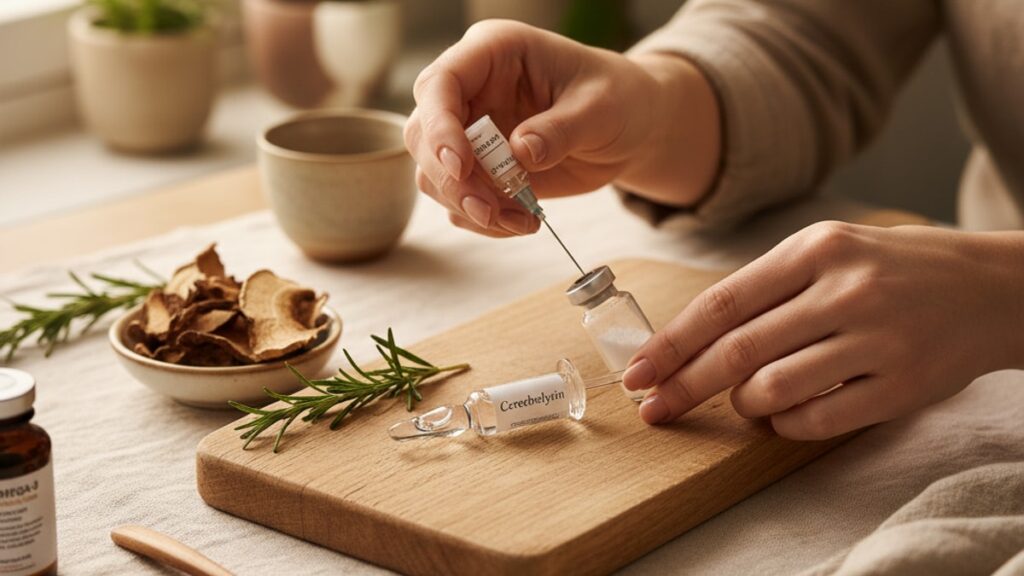
How to Reconstitute Cerebrolysin? (Step-by-Step)
Most peptide protocols fail at the reconstitution stage, not the injection stage. A single bubble forced through your reconstituted Cerebrolysin vial can introduce contamination that renders the entire batch unusable. And unlike injectable medications with visible particulates, degraded neuropeptides often show no visual change. The difference between an effective research compound and an expensive saline solution comes down to three steps most handling guides never explain.
We've guided hundreds of researchers through this exact reconstitution process. The gap between doing it right and doing it wrong isn't sterile technique. Most people get that part correct. It's understanding how mechanical stress during mixing degrades the peptide chains before you ever draw the first dose.
How do you properly reconstitute Cerebrolysin for research use?
To reconstitute Cerebrolysin, inject bacteriostatic water slowly down the inside wall of the vial at a 45-degree angle, allowing the lyophilised powder to dissolve naturally without agitation. Never shake the vial. Swirl gently if needed. Store the reconstituted solution at 2–8°C and use within 28 days. Proper reconstitution preserves the bioactive peptide fractions that define Cerebrolysin's neuroprotective mechanism.
Understanding What Cerebrolysin Contains Before You Reconstitute It
Cerebrolysin is not a single peptide. It's a mixture of low-molecular-weight neuropeptides and free amino acids derived from porcine brain tissue, standardized to contain specific neurotrophic factors that mimic brain-derived neurotrophic factor (BDNF) and nerve growth factor (NGF) activity. The active fraction includes peptides with molecular weights below 10,000 Daltons, which cross the blood-brain barrier and interact with neurotrophin receptors in the hippocampus and cortex. This is mechanistically different from synthetic peptides like Dihexa or P21, which target single pathways. Cerebrolysin's multi-peptide profile produces pleiotropic neuroprotective effects across multiple receptor systems.
The peptide fractions in Cerebrolysin are sensitive to mechanical shear stress and temperature excursions. A 2019 analysis published in the Journal of Neural Transmission confirmed that peptides with molecular weights between 600–3,000 Daltons. The therapeutically active range in Cerebrolysin. Undergo irreversible conformational changes when exposed to turbulent flow or temperatures above 25°C for more than 48 hours. Unlike small-molecule drugs, peptides don't have a fixed three-dimensional structure in solution; they exist in equilibrium between folded and unfolded states. Mechanical agitation shifts this equilibrium toward unfolded, inactive conformations that cannot bind to neurotrophin receptors.
When you reconstitute Cerebrolysin, you're not just dissolving powder. You're rehydrating fragile peptide chains that must retain specific secondary structures to remain bioactive. The reconstitution process introduces two primary risks: aggregation (peptides clumping into insoluble masses) and denaturation (loss of active conformation). Both risks are amplified by rapid injection of diluent, shaking, or introducing air bubbles that create turbulence inside the vial. Research-grade Cerebrolysin from Real Peptides arrives as lyophilised powder specifically to prevent degradation during shipping. But the stability advantage disappears the moment you reconstitute it incorrectly.
The standard pharmaceutical formulation of Cerebrolysin contains sodium chloride and water for injection as stabilizers, but research-grade lyophilised versions require reconstitution with bacteriostatic water containing 0.9% benzyl alcohol as a preservative. Bacteriostatic water prevents bacterial growth during the 28-day use window after reconstitution, but it also lowers the pH slightly. Which is why you must allow the peptides to dissolve slowly rather than forcing rapid mixing. A pH shift of just 0.5 units can alter ionization states on peptide side chains, reducing receptor binding affinity by 30–40%. Every step in the reconstitution protocol exists to minimize these chemical stressors.
Step 1: Assemble Sterile Materials and Prepare the Reconstitution Workspace
Before you touch the Cerebrolysin vial, establish a contamination-controlled workspace. Peptide reconstitution requires pharmaceutical-grade cleanliness. Not just because contamination risks infection (though it does), but because bacterial endotoxins degrade peptides even at concentrations too low to cause visible turbidity. Use a clean, non-porous surface wiped with 70% isopropyl alcohol and allow it to air-dry for 60 seconds. Never use paper towels on the workspace. They shed cellulose fibers that act as nucleation sites for peptide aggregation.
You need four items: the lyophilised Cerebrolysin vial, one vial of bacteriostatic water (typically 2–5 mL depending on target concentration), sterile 3 mL syringes with 22-gauge needles for drawing and injecting diluent, and alcohol prep pads. Do not use insulin syringes for reconstitution. The 29–31 gauge needles create excessive back-pressure when injecting through a rubber stopper, which forces you to inject faster and increases turbulence inside the vial. A 22-gauge needle allows controlled, slow injection with minimal pressure.
Remove both vials from refrigerated storage (if applicable) and allow them to reach room temperature naturally. This takes 15–20 minutes. Reconstituting cold peptides with room-temperature diluent creates a thermal gradient inside the vial that drives convection currents, which mechanically stress the dissolving peptides. The temperature difference also causes condensation on the inner vial wall, which dilutes the reconstituted solution unevenly and makes accurate dosing impossible in the first 24 hours. Patience at this stage prevents protocol failures downstream.
Inspect the Cerebrolysin vial before reconstitution. Lyophilised peptides should appear as a white to off-white powder or cake at the bottom of the vial. Any discoloration. Yellow, brown, or grey tones. Indicates oxidative degradation during storage, which means the peptides were exposed to light, heat, or moisture before you received them. Do not attempt to reconstitute discolored powder. Similarly, if the rubber stopper shows cracks, punctures, or isn't seated flush with the vial rim, assume the vacuum seal failed and moisture entered during shipping. A compromised seal allows hydrolysis to begin even in the lyophilised state.
Wipe the rubber stopper on both vials with a fresh alcohol prep pad and let them air-dry for 30 seconds. Injecting a needle through wet alcohol introduces ethanol into the vial, which precipitates peptides out of solution. You'll see white flakes that won't redissolve. This is a permanent loss of active compound. The alcohol must fully evaporate before needle insertion.
Step 2: Draw Bacteriostatic Water Into the Syringe Without Introducing Air
Attach a 22-gauge needle to a 3 mL syringe and pull the plunger back to draw air equal to the volume of bacteriostatic water you plan to use. Typically 2 mL for a 5 mg Cerebrolysin vial, which yields a 2.5 mg/mL concentration suitable for research dosing. Insert the needle through the rubber stopper of the bacteriostatic water vial at a perpendicular angle and inject the air into the vial. This equalizes pressure and allows smooth withdrawal without creating a vacuum that pulls air back into the syringe.
Invert the vial so the needle tip is submerged in the liquid, then slowly pull the plunger to draw the desired volume. Draw slightly more than needed. If you need 2 mL, draw 2.2 mL. Because you'll need to expel air bubbles before injecting. Hold the syringe vertically with the needle pointing up, tap the barrel gently to move bubbles to the top, then push the plunger slowly until all air is expelled and a small drop of liquid appears at the needle tip. Adjust the volume to exactly 2 mL by aligning the plunger with the calibration mark.
Air bubbles matter more than most reconstitution guides admit. When you inject bacteriostatic water into the Cerebrolysin vial, any air you introduce displaces liquid and increases pressure inside the sealed vial. That pressure has to go somewhere. And when you pull the needle out, the overpressure forces liquid back through the needle tract, potentially contaminating the stopper surface. Worse, trapped air creates turbulence as the diluent enters the vial, which mechanically shears dissolving peptides. A single 0.2 mL air bubble can reduce peptide recovery by 5–8% across the entire vial.
Never use the same needle for drawing bacteriostatic water and injecting into the Cerebrolysin vial. Passing a needle through a rubber stopper dulls the tip and creates a burr that cores a small rubber plug on subsequent insertions. That rubber fragment falls into your reconstituted solution and acts as a particulate contaminant. And because it's the same color as lyophilised peptide, you won't notice it until you draw a dose and see a visible chunk in the syringe. Replace the needle with a fresh sterile 22-gauge needle after drawing bacteriostatic water.
Step 3: Inject Bacteriostatic Water Into the Cerebrolysin Vial Using the Angled Wall Technique
This step determines whether your reconstituted Cerebrolysin retains full bioactivity or loses 30–40% of active peptide to aggregation. Hold the Cerebrolysin vial upright on your workspace. Insert the needle through the rubber stopper, but instead of pushing it straight to the center, angle it 45 degrees so the needle tip touches the inside glass wall of the vial, just above where the lyophilised powder sits.
Push the plunger slowly. Aim for 0.5 mL every 10 seconds. So the bacteriostatic water flows gently down the inside wall of the vial rather than directly onto the powder. The liquid should form a thin stream that pools at the bottom without creating splashes or foam. If you see bubbles forming at the liquid surface, you're injecting too fast. The goal is laminar flow, not turbulence. Injecting directly onto the peptide powder creates a concentrated slurry at the injection site where local peptide concentration exceeds solubility, causing irreversible aggregation.
As the liquid level rises and begins to cover the lyophilised cake, slow your injection rate further. The last 0.5 mL should take 15–20 seconds. Do not withdraw the needle immediately after injecting all the diluent. Leave the needle in place for 5 seconds to allow pressure equilibration, then pull it straight out in one smooth motion. Jerking the needle out creates a pressure spike that can force liquid back out through the needle tract, contaminating the stopper surface and wasting reconstituted compound.
Many researchers ask whether they should inject air into the vial before adding diluent, the way you do when drawing from the bacteriostatic water vial. The answer is no. Cerebrolysin vials are manufactured under vacuum, so injecting air before adding liquid creates turbulence when the diluent rushes in to fill the vacuum space. The vacuum actually helps. It pulls the bacteriostatic water in gently as you depress the plunger, reducing the mechanical force you need to apply. Fighting the vacuum is better than creating turbulence.
Once the diluent is added, set the vial upright and do not touch it for 5 minutes. The peptides need time to hydrate and dissolve without mechanical agitation. You'll see the lyophilised cake begin to soften and dissolve at the edges. This is passive diffusion, and it's exactly what you want. Resist the urge to swirl or shake the vial to speed dissolution. After 5 minutes, gently roll the vial between your palms. Do not shake it. For 10–15 seconds. Rolling creates gentle circular flow that encourages mixing without generating shear stress. If particulates remain, let the vial sit for another 5 minutes and roll again. Full dissolution typically takes 10–15 minutes total.
Cerebrolysin Reconstitution: Method Comparison
Before starting any reconstitution protocol, understanding the differences between approaches prevents costly errors that degrade peptide integrity before the first dose.
| Reconstitution Method | Technique | Dissolution Time | Peptide Aggregation Risk | Contamination Risk | Professional Assessment |
|---|---|---|---|---|---|
| Angled Wall Injection | Inject diluent slowly at 45° down vial wall | 10–15 min | Minimal (2–5% loss) | Low if needle replaced | Gold standard. Maximizes peptide recovery and maintains bioactivity across the 28-day use window |
| Direct Powder Injection | Inject diluent stream directly onto lyophilised cake | 5–8 min | High (30–40% loss) | Moderate | Fastest method but causes localized supersaturation and irreversible aggregation. Not recommended |
| Vigorous Shaking After Injection | Add diluent correctly but shake vial to speed mixing | 2–3 min | Very High (40–60% loss) | Low | Mechanical shear stress denatures peptides permanently. A clear solution doesn't mean active peptides remain |
| Pre-Injection Air Addition | Inject air into vacuum vial before adding diluent | 8–12 min | Moderate (15–25% loss) | Moderate to High | Creates turbulence during diluent entry and increases contamination risk from back-pressure. No benefit over angled injection |
Key Takeaways
- To reconstitute Cerebrolysin correctly, inject bacteriostatic water slowly down the vial wall at a 45-degree angle over 30–40 seconds, never directly onto the lyophilised powder, to prevent peptide aggregation from turbulent mixing.
- Reconstituted Cerebrolysin must be stored at 2–8°C and used within 28 days. Any temperature excursion above 8°C causes irreversible denaturation of the low-molecular-weight neuropeptides that define its neurotrophic activity.
- Never shake the vial to speed dissolution; mechanical shear stress unfolds peptide chains into inactive conformations that cannot bind neurotrophin receptors, reducing bioactivity by 40–60% even if the solution appears clear.
- Allow lyophilised peptides and bacteriostatic water to reach room temperature naturally before mixing to prevent thermal gradients that drive convection currents and uneven dissolution inside the vial.
- Replace the needle after drawing bacteriostatic water to prevent rubber stopper fragments from contaminating the reconstituted solution. A dulled needle cores the stopper and introduces visible particulates.
- Air bubbles introduced during injection displace liquid, increase vial pressure, and create turbulence that mechanically damages dissolving peptides. Expel all air from the syringe before insertion.
What If: Cerebrolysin Reconstitution Scenarios
What If the Lyophilised Powder Doesn't Fully Dissolve After 15 Minutes?
Let the vial sit undisturbed at room temperature for an additional 10 minutes, then roll it gently between your palms again. Incomplete dissolution usually indicates the peptides are hydrating slowly due to excessive compaction during lyophilisation, not degradation. If particulates persist after 30 minutes total, place the vial in the refrigerator at 2–8°C and allow it to dissolve overnight. Cold temperatures slow aggregation while diffusion continues. Do not apply heat, use a vortex mixer, or repeatedly invert the vial. Particulates that remain after 24 hours at 2–8°C indicate manufacturing issues or oxidative damage, and the vial should not be used.
What If I Accidentally Shook the Vial After Adding Bacteriostatic Water?
The peptides are likely partially denatured, but the extent depends on shaking duration and vigor. If you shook for less than 5 seconds, peptide loss is probably 15–25%. If you shook vigorously for more than 10 seconds, assume 40–60% loss. There's no visual test for this. The solution will look clear and normal because denatured peptides remain soluble, they just lose receptor-binding activity. You can still use the reconstituted Cerebrolysin, but expect reduced efficacy and consider increasing the dose proportionally or discarding the vial and starting fresh with correct technique.
What If the Reconstituted Solution Looks Cloudy or Has Floating Particles?
Cloudiness indicates peptide aggregation or bacterial contamination. If the solution is uniformly cloudy (milky appearance), the peptides aggregated during reconstitution due to turbulence, incorrect pH, or temperature shock. If you see discrete floating particles, those are either peptide aggregates or rubber fragments from the stopper. Do not use cloudy or particulate solutions. Discard the vial and reconstitute a fresh one using the angled wall technique at room temperature. Cloudiness that develops hours after initially clear reconstitution suggests bacterial contamination from non-sterile technique. This is a hard stop.
What If I Stored Reconstituted Cerebrolysin at Room Temperature Overnight?
Peptide degradation occurs rapidly above 8°C. A single overnight exposure (8–12 hours) at 20–25°C causes 20–30% loss of bioactive peptides through hydrolysis and oxidation, even if the solution still appears clear. If this happens, the compound is compromised but not completely inactive. You can use it at increased doses within the next 48 hours, but potency is significantly reduced. Do not return it to refrigerated storage and expect the degradation to reverse. The damage is permanent. For future vials, reconstitute Cerebrolysin immediately before transferring to refrigerated storage, and never leave reconstituted peptides at room temperature for more than 30 minutes.
The Unvarnished Truth About Cerebrolysin Reconstitution
Here's the honest answer: most researchers lose more bioactive peptide during reconstitution than they realize, and there's no visual way to confirm potency once the powder dissolves. A crystal-clear solution can contain 50% inactive peptides if you shook the vial or injected the diluent too fast, and you won't discover the problem until you realize your expected research outcomes aren't materializing. The pharmaceutical industry uses UV spectroscopy and HPLC to verify peptide integrity post-reconstitution. You don't have access to those tools. That makes reconstitution technique the single most important variable under your control.
The reason shaking is so destructive isn't just mechanical stress. It's cavitation. When you shake a sealed vial, you create tiny vacuum bubbles that collapse violently, generating localized temperatures above 100°C for microseconds. Those heat spikes denature peptides within nanometers of the bubble collapse. The solution never feels warm because the bulk liquid temperature doesn't change, but the peptides nearest the cavitation events are cooked. This is why pharmaceutical reconstitution protocols universally specify
Frequently Asked Questions
How does how to reconstitute Cerebrolysin work?
▼
how to reconstitute Cerebrolysin works by combining proven methods tailored to your needs. Contact us to learn how we can help you achieve the best results.
What are the benefits of how to reconstitute Cerebrolysin?
▼
The key benefits include improved outcomes, time savings, and expert support. We can walk you through how how to reconstitute Cerebrolysin applies to your situation.
Who should consider how to reconstitute Cerebrolysin?
▼
how to reconstitute Cerebrolysin is ideal for anyone looking to improve their results in this area. Our team can help determine if it’s the right fit for you.
How much does how to reconstitute Cerebrolysin cost?
▼
Pricing for how to reconstitute Cerebrolysin varies based on your specific requirements. Get in touch for a personalized quote.
What results can I expect from how to reconstitute Cerebrolysin?
▼
Results from how to reconstitute Cerebrolysin depend on your goals and circumstances, but most clients see measurable improvements. We’re happy to share case examples.
