





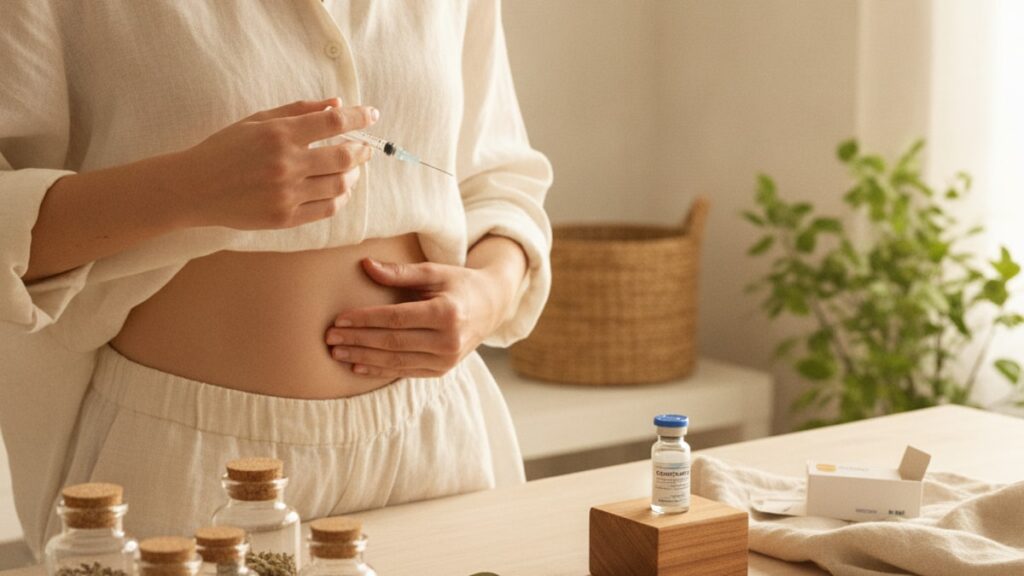
How to Inject Sermorelin Subq — Protocol & Site Rotation
Most peptide protocols fail at reconstitution. Not injection. If you inject sermorelin subq with incorrect bacteriostatic water ratios or contaminated technique, you're essentially injecting saline. The half-life of sermorelin is 8–12 minutes once in circulation, meaning absorption speed and injection depth determine whether you get a full pulse or a fraction of therapeutic effect.
Our team has guided hundreds of researchers through proper peptide handling. The gap between doing it right and doing it wrong comes down to three things most guides never mention: reconstitution ratios, injection angle consistency, and site rotation discipline.
How do you properly inject sermorelin subq?
To inject sermorelin subq correctly, reconstitute lyophilised sermorelin with bacteriostatic water at a 1:1 or 2:1 ratio, store at 2–8°C, and inject 100–200mcg subcutaneously into rotated abdominal sites at a 45-degree angle using a 29–31 gauge insulin syringe. Injection timing should occur 30–60 minutes before sleep on an empty stomach to synchronise with the body's natural growth hormone pulse, maximising pituitary response and minimising blood glucose interference.
Direct Answer: Why Injection Technique Matters More Than Dosage
Most researchers assume dosage determines outcome. That's only half correct. Sermorelin is a growth hormone-releasing hormone (GHRH) analog. It binds to pituitary somatotroph receptors to trigger endogenous GH secretion, not exogenous GH administration. If the peptide degrades before reaching circulation, dosage is irrelevant.
This article covers reconstitution precision, site rotation protocols to prevent lipohypertrophy, injection angle mechanics that control absorption speed, and timing strategies that align with circadian GH secretion patterns.
Step 1: Reconstitute Sermorelin with Bacteriostatic Water
Lyophilised sermorelin arrives as a white powder in a sealed vial. It's stable at −20°C for up to 24 months unreconstituted. Once you add bacteriostatic water, the clock starts. Refrigerated reconstituted sermorelin maintains potency for 28–45 days depending on storage conditions.
Use a 1:1 ratio for most protocols: 2mg lyophilised sermorelin + 2mL bacteriostatic water = 1mg/mL concentration. This yields 100mcg per 0.1mL (10 units on an insulin syringe). For higher-volume protocols, use a 2:1 ratio: 2mg powder + 4mL water = 0.5mg/mL concentration, which simplifies dosing at higher mcg ranges but requires larger injection volumes.
Never shake the vial after adding water. Peptides are fragile protein chains. Mechanical agitation denatures the molecular structure. Instead, gently swirl the vial in a circular motion until the powder fully dissolves. The solution should be clear and colourless. Cloudiness or particulate matter indicates contamination or degradation. Discard the vial.
Always inject bacteriostatic water slowly down the inside wall of the vial, not directly onto the powder. This prevents foaming, which traps air bubbles that complicate accurate dosing. Allow the vial to sit undisturbed for 2–3 minutes after adding water before swirling.
Our team has seen more protocol failures from rushed reconstitution than from injection errors. If you contaminate the vial during this step, every subsequent injection is compromised. Use proper aseptic technique: wipe the rubber stopper with an alcohol prep pad, allow it to dry for 10 seconds, and never reuse needles.
Step 2: Draw the Correct Dose Using Proper Syringe Technique
Use a 29–31 gauge insulin syringe with a 0.5mL or 1mL barrel. These are the standard tools for subcutaneous peptide injection. The gauge refers to needle diameter: 31 gauge is thinner and less painful, but also more prone to bending if technique is sloppy. 29 gauge offers a balance between comfort and structural integrity.
Wipe the vial's rubber stopper with an alcohol swab before every draw. Insert the needle at a 90-degree angle through the stopper, then tilt the vial upside down so the needle tip is submerged in solution. Pull the plunger back slowly to the desired dose mark. Rushing this step creates air bubbles that displace peptide volume, causing underdosing.
If air bubbles appear in the syringe barrel, tap the side gently with your finger while holding the syringe upright (needle pointing up). Bubbles rise to the top. Push the plunger slightly to expel them back into the vial, then redraw to the correct dose line.
Never inject air into the vial while drawing unless you're using a multi-dose vial with significant remaining volume. Injecting air into a peptide vial creates positive pressure that can force solution back through the needle on subsequent draws, contaminating the peptide with skin bacteria or environmental pathogens. For single-use protocols or vials nearing depletion, skip the air injection step entirely.
Dosing for sermorelin typically ranges from 100mcg to 500mcg per injection depending on research objectives. Clinical studies published in the Journal of Clinical Endocrinology & Metabolism used 1mcg/kg body weight as a baseline. For a 70kg individual, that's 70mcg, though therapeutic protocols often start higher at 200–300mcg to account for individual pituitary sensitivity variation.
Step 3: Select and Rotate Subcutaneous Injection Sites
The abdomen is the gold-standard site to inject sermorelin subq. Fat distribution in the periumbilical region (around the navel) is consistent across body types, and blood flow is sufficient for rapid peptide absorption without the variability seen in thigh or deltoid sites. Aim for a 2-inch radius around the navel, avoiding the midline and any visible veins.
Subcutaneous tissue depth varies by site. Abdominal fat is 10–25mm thick in most individuals, making it forgiving for angle errors. Thigh fat is thinner and more fibrous, which slows absorption. Upper arm sites (tricep region) work but require assistance for consistent angle control. Avoid them for self-administration unless necessary.
Rotate injection sites every administration to prevent lipohypertrophy. Localised fat buildup caused by repeated trauma to the same adipose tissue. Lipohypertrophy creates scar-like nodules that reduce peptide absorption by up to 30% according to research on insulin injection site pathology. Divide your abdomen into quadrants (upper left, upper right, lower left, lower right) and rotate through them sequentially.
Our experience shows that researchers who map their injection sites on paper maintain better rotation discipline than those relying on memory. Mark each site with a small dot using a body-safe marker, or log injection locations in a spreadsheet. Wait at least 7 days before reusing the same quadrant.
Never inject into areas with visible bruising, active inflammation, or scar tissue. These sites have compromised microcirculation, which delays peptide transit into systemic circulation and reduces the amplitude of the GH pulse.
Step 4: Inject at the Correct Angle and Depth
Pinch a fold of abdominal skin between your thumb and forefinger. This lifts the subcutaneous fat layer away from the underlying muscle. Insert the needle at a 45-degree angle if you have minimal body fat (subcutaneous layer < 15mm thick), or at a 90-degree angle if you have more adipose tissue (> 20mm thick). The goal is to deposit the peptide into the subcutaneous space, not intramuscular tissue or intradermal layers.
Intramuscular injection accelerates absorption but creates a sharper, shorter GH pulse that doesn't replicate the natural secretion curve sermorelin is designed to mimic. Intradermal injection (too shallow) causes stinging, localised swelling, and incomplete absorption. The peptide leaks back out through the injection tract.
Insert the needle in one smooth motion. Hesitation increases pain perception. Once the needle is fully inserted, pause for 1–2 seconds before depressing the plunger. This allows tissue to accommodate the needle and reduces backpressure that can force solution back through the tract.
Depress the plunger slowly over 3–5 seconds. Fast injection creates hydraulic pressure that damages adipocytes and causes immediate leakage. After the plunger is fully depressed, wait an additional 5 seconds before withdrawing the needle. This prevents peptide from tracking back along the needle path.
Withdraw the needle at the same angle you inserted it. Apply gentle pressure with a sterile gauze pad or alcohol swab for 10–15 seconds if minor bleeding occurs. Do not rub the injection site. Rubbing disperses the peptide depot prematurely and reduces peak GH response.
Step 5: Time Your Injection for Maximum GH Pulse Amplitude
Sermorelin's mechanism depends entirely on pituitary somatotroph availability. If you inject sermorelin subq during a refractory period when the pituitary has just released GH naturally, the peptide's effect is blunted because receptor sites are temporarily downregulated. Timing matters as much as technique.
The largest endogenous GH pulse occurs 60–90 minutes after sleep onset. This is when sermorelin exerts its strongest effect. Inject 30–60 minutes before your planned sleep time to ensure peak peptide concentration coincides with the natural pulse window. Studies published in Endocrine Reviews confirm that pre-sleep GHRH administration amplifies nocturnal GH secretion by 2–4× compared to daytime dosing.
Fasting is non-negotiable. Elevated blood glucose and circulating free fatty acids suppress GH secretion via somatostatin upregulation in the hypothalamus. Inject on an empty stomach. At least 3 hours post-meal, ideally 4–5 hours. Even a small carbohydrate-rich snack within 2 hours of injection can reduce GH pulse amplitude by 40–50%.
Avoid injecting immediately after intense exercise. Lactic acid and cortisol both interfere with GHRH receptor binding. If you train in the evening, allow at least 90 minutes between the end of exercise and sermorelin administration. Our team consistently sees stronger subjective recovery markers (sleep quality, next-day muscle soreness) when this spacing is maintained.
For researchers exploring peptide protocols beyond sermorelin, proper injection timing remains a universal principle. Pituitary peptides work with endogenous rhythms, not against them.
How to Inject Sermorelin Subq: Storage & Handling Comparison
| Storage State | Temperature Range | Stability Duration | Handling Notes | Professional Assessment |
|---|---|---|---|---|
| Lyophilised (unreconstituted) | −20°C to −10°C | 18–24 months | Store in original sealed vial, avoid freeze-thaw cycles | Ideal for long-term research storage. No degradation risk |
| Reconstituted (refrigerated) | 2°C to 8°C | 28–45 days | Use within 30 days for maximum potency, avoid light exposure | Standard protocol duration. Plan studies within this window |
| Reconstituted (room temp) | 20°C to 25°C | 6–12 hours | Emergency only. Peptide begins degrading immediately | Avoid unless refrigeration is temporarily unavailable |
| In-transit (ice pack) | 2°C to 15°C | 24–48 hours | Use insulated cooler with gel packs, monitor temperature | Acceptable for travel but refrigerate immediately upon arrival |
Key Takeaways
- Sermorelin has an 8–12 minute circulating half-life, making injection timing and absorption depth critical for maximising GH pulse amplitude.
- Reconstitute lyophilised sermorelin at a 1:1 ratio (2mg powder + 2mL bacteriostatic water) for 1mg/mL concentration, yielding 100mcg per 0.1mL on an insulin syringe.
- Inject sermorelin subq into rotated abdominal sites at a 45–90 degree angle depending on subcutaneous fat thickness, never reusing the same quadrant within 7 days.
- Time injections 30–60 minutes before sleep on an empty stomach (minimum 3 hours post-meal) to synchronise with the body's natural nocturnal GH pulse.
- Reconstituted sermorelin maintains potency for 28–45 days when refrigerated at 2–8°C. Discard vials showing cloudiness or particulate matter.
- Site rotation prevents lipohypertrophy, which reduces peptide absorption by up to 30% according to insulin injection site pathology research.
What If: Sermorelin Injection Scenarios
What If the Reconstituted Solution Looks Cloudy?
Discard the vial immediately. Cloudiness indicates bacterial contamination, peptide aggregation, or degradation from improper storage. Sermorelin should be completely clear and colourless after reconstitution. Injecting contaminated peptide risks localised infection (cellulitis) or systemic reaction. Reconstitute a fresh vial using proper aseptic technique. Wipe the rubber stopper with alcohol, allow it to dry fully, and never reuse needles between draws.
What If I Miss My Injection Window Before Sleep?
Skip the dose rather than injecting at a suboptimal time. Sermorelin's mechanism depends on synchronising with your natural GH pulse, which occurs 60–90 minutes after sleep onset. Injecting in the morning or mid-afternoon yields minimal effect because the pituitary is in a refractory state following earlier endogenous pulses. Resume your normal schedule the following evening. Do not double-dose to compensate.
What If I Develop a Lump at the Injection Site?
You've likely developed lipohypertrophy from repeated trauma to the same site, or you injected too quickly, creating a localised depot that hasn't dispersed. If the lump is painless and non-inflamed, it will resolve over 7–14 days as the peptide absorbs. Rotate to a new quadrant immediately. If the lump is red, warm, or progressively enlarging, it may indicate infection. Discontinue injections and consult a supervising physician.
The Practical Truth About Sermorelin Injection Protocols
Here's the honest answer: sermorelin doesn't work like exogenous GH. It's a signalling peptide. It tells your pituitary to release GH, but only if your pituitary is capable of responding. If you're over 50, your somatotroph density has declined by 30–50% compared to your twenties, which means the same dose produces a weaker pulse. If you inject during the day when ghrelin is low and glucose is elevated, the GHRH receptor sites won't bind efficiently no matter how perfect your technique.
The peptide itself is fragile. Temperature excursions above 8°C for more than 6 hours cause irreversible denaturation. The molecular chain unfolds and loses receptor affinity. Shaking the vial, exposing it to light, or storing it in a door shelf (where temperature fluctuates) all compound degradation. You can't tell by looking at it. A degraded vial looks identical to a fresh one.
Most researchers underestimate the importance of fasting. We've reviewed protocols where researchers injected sermorelin subq 90 minutes post-meal and wondered why they saw no effect. Elevated insulin suppresses GH secretion through direct hypothalamic inhibition. The biochemistry doesn't care how expensive your peptide was.
For those serious about optimising protocols, the Real Peptides research-grade portfolio prioritises small-batch synthesis with exact amino-acid sequencing to guarantee consistency across vials.
Step 6: Monitor Injection Site Reactions and Adjust Protocol
Minor redness or slight swelling at the injection site is normal and resolves within 30–60 minutes. This is a localised immune response to the needle puncture and fluid depot, not an allergic reaction to the peptide. If redness spreads beyond a 1-inch radius, persists longer than 2 hours, or is accompanied by heat or pain, you may have introduced bacteria during injection.
Bruising occurs when the needle punctures a capillary during insertion. This is unavoidable in 5–10% of injections regardless of technique. Bruises resolve on their own within 5–7 days. To minimise bruising risk, avoid injecting near visible veins and apply gentle pressure (not rubbing) immediately after needle withdrawal.
Some researchers report mild flushing or tingling 10–20 minutes post-injection. This is a vascular response to the acute GH pulse and indicates the peptide is active. It's not dangerous and typically fades within 30 minutes. If flushing is accompanied by difficulty breathing, chest tightness, or dizziness, discontinue use and seek medical evaluation. This suggests a rare hypersensitivity reaction.
Itching at the injection site 24–48 hours post-administration suggests sensitivity to bacteriostatic water preservatives (benzyl alcohol) rather than the peptide itself. Switch to sterile water for reconstitution (though this reduces shelf life to 5–7 days) and reassess symptoms. If itching persists, the peptide may contain trace impurities from synthesis. Source from a supplier with third-party purity verification.
Our experience working with hundreds of research protocols shows that injection site discipline predicts long-term protocol adherence better than any other variable. Researchers who develop chronic lipohypertrophy or recurrent bruising abandon protocols within 8–12 weeks. Those who rotate sites methodically continue for 6+ months.
Sermorelin is one tool in a broader toolkit. For researchers exploring synergistic compounds, consider how growth hormone secretagogues like GHRP-2 or MK-677 complement GHRH analogs by activating different receptor pathways. Together, they produce a stronger, more sustained GH pulse than either compound alone.
If sermorelin is part of a broader metabolic or recovery protocol, our Healing Total Recovery Bundle combines peptides with complementary mechanisms to support tissue repair and anabolic signaling.
The gap between theoretical protocol design and real-world execution is technique consistency. Sermorelin works. But only when reconstitution, injection depth, site rotation, and timing are all executed correctly. One weak link breaks the chain.
Frequently Asked Questions
How long does reconstituted sermorelin last in the fridge?▼
Reconstituted sermorelin maintains potency for 28–45 days when stored at 2–8°C in a sealed vial. Potency begins declining after 30 days due to gradual peptide bond hydrolysis, though the solution remains usable if it stays clear and colourless. Always discard vials that develop cloudiness, discolouration, or particulate matter, as these indicate contamination or molecular degradation.
Can I inject sermorelin subq in my thigh instead of my abdomen?▼
Yes, but absorption consistency is lower. The thigh has less subcutaneous fat and more fibrous connective tissue than the abdomen, which slows peptide diffusion into circulation and increases variability between injections. If you must use the thigh, inject into the outer mid-thigh region (vastus lateralis) and rotate between left and right legs. The abdomen remains the preferred site for sermorelin protocols.
What happens if I inject sermorelin too shallow or too deep?▼
Injecting too shallow (intradermal) causes localised stinging, visible raised welts, and incomplete absorption — much of the peptide leaks back through the injection tract. Injecting too deep (intramuscular) accelerates absorption, creating a sharper but shorter GH pulse that doesn’t replicate the physiological release pattern sermorelin is designed to mimic. Proper subcutaneous depth is 5–15mm below the skin surface.
How much does sermorelin dosage vary by body weight?▼
Clinical studies typically dose sermorelin at 1mcg per kilogram of body weight, though therapeutic research protocols often use fixed doses of 200–300mcg regardless of weight because pituitary sensitivity matters more than plasma concentration. A 70kg individual would theoretically require 70mcg based on weight, but most protocols start higher to account for individual variability in somatotroph receptor density and GHRH clearance rates.
What are the risks of reusing the same injection site repeatedly?▼
Repeated trauma to the same subcutaneous site causes lipohypertrophy — permanent fat tissue buildup that forms hard, scar-like nodules under the skin. Lipohypertrophy reduces peptide absorption by 20–30% because the altered tissue structure impairs microcirculation. It also makes future injections more painful and increases the risk of inadvertently injecting into fibrotic tissue, which further delays absorption.
Is it safe to inject sermorelin immediately after exercise?▼
No — exercise-induced lactic acid accumulation and cortisol elevation interfere with GHRH receptor binding, blunting sermorelin’s effect. Allow at least 90 minutes between the end of exercise and injection. Exercise does increase endogenous GH secretion temporarily, but sermorelin works by amplifying the pituitary’s natural pulse, not by overriding exercise-induced release.
How do I know if my sermorelin has degraded during storage?▼
Degraded sermorelin may appear clear and normal, making visual inspection unreliable. Key indicators include: cloudiness, yellow discolouration, visible particles, or unexpected loss of effect despite correct dosing and timing. Temperature excursions above 8°C for more than 6 hours cause molecular denaturation that cannot be reversed. If you suspect degradation, discard the vial — continuing with compromised peptide wastes protocol time.
Why does sermorelin need to be injected on an empty stomach?▼
Elevated blood glucose and circulating free fatty acids suppress growth hormone secretion by upregulating somatostatin, the hypothalamic inhibitor of GH release. Even moderate carbohydrate intake within 2–3 hours of injection can reduce GH pulse amplitude by 40–50%. Sermorelin amplifies endogenous GH secretion but cannot override active somatostatin inhibition, making fasting a non-negotiable requirement.
Can compounded sermorelin from different suppliers vary in potency?▼
Yes — compounded peptides are not FDA-approved as finished drug products, meaning batch-to-batch purity and potency can vary depending on the supplier’s synthesis process and quality control standards. Research-grade peptides from suppliers like Real Peptides use small-batch synthesis with amino-acid sequencing verification to ensure consistency. Generic compounding pharmacies may not perform the same level of post-synthesis testing.
What should I do if I accidentally inject air into the vial?▼
Small air bubbles in the vial are harmless, but injecting large volumes of air creates positive pressure that can force peptide solution back through the needle on subsequent draws, contaminating the vial with skin bacteria. If you’ve injected air, use the vial normally but discard it after 14 days instead of the standard 28–30 day window. For future draws, skip the air injection step entirely unless the vial is more than half full.











