


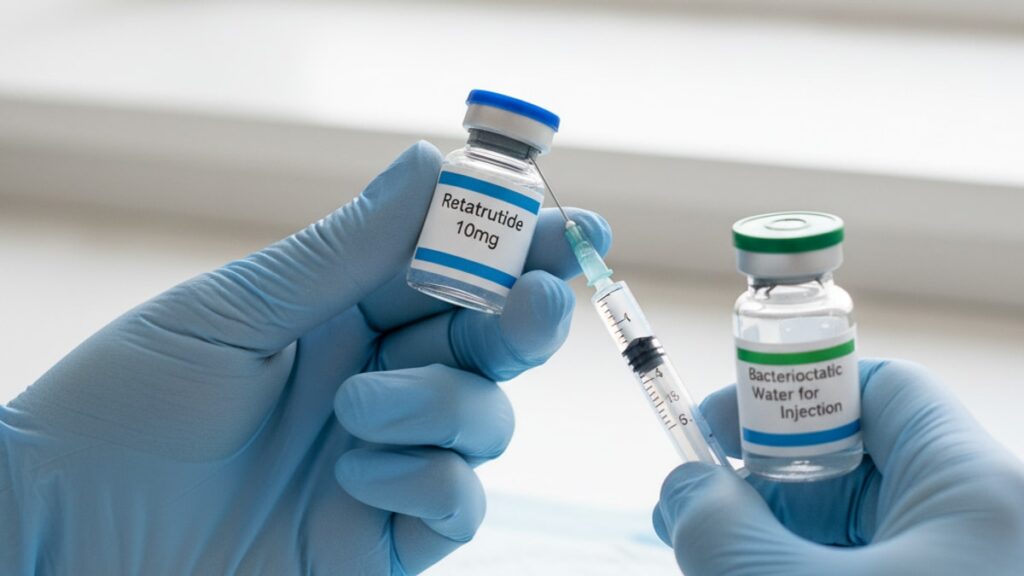
In the world of advanced biological research, precision isn't just a goal; it's the entire foundation. Every variable matters. Every step in a protocol can be the difference between a breakthrough discovery and a set of invalid data. We've seen it happen. That's why when we talk about something as seemingly simple as how to reconstitute 10 mg of Retatrutide, we're not just talking about mixing a powder with a liquid. We're talking about the first, critical, non-negotiable step in safeguarding the integrity of your research materials.
Let's be honest, the excitement in research lies in the application and the results, not necessarily the prep work. It's tempting to rush through reconstitution to get to the main event. But our team can't stress this enough: how you handle that lyophilized peptide is paramount. The complex, delicate structure of a compound like Retatrutide is stabilized in its freeze-dried state. The moment you introduce a solvent, you begin a new chapter in its chemical life—one that requires meticulous care to ensure it remains stable, potent, and pure. This isn't just procedural box-ticking; it's fundamental science.
Why This Process Demands Your Full Attention
So, what's really at stake? When you reconstitute a peptide, you're reintroducing it to an aqueous environment where it can perform its biological function. Do it wrong, and you risk catastrophic failure before your study even begins. The primary risk is degradation. Peptides are essentially short chains of amino acids linked by fragile peptide bonds. Aggressive handling, like shaking the vial vigorously, can introduce mechanical stress (shearing forces) that literally tears these chains apart, rendering the peptide useless. It’s a subtle form of destruction you can't even see.
Then there’s the issue of contamination. Your lab environment is filled with microorganisms. Failing to maintain a sterile field can introduce bacteria into your vial. This not only compromises your experiment but, if the bacteria proliferate, can also degrade the peptide itself. This is precisely why using the correct supplies, like sterile syringes and true Bacteriostatic Water, is non-negotiable. Bacteriostatic water contains 0.9% benzyl alcohol, a preservative that inhibits bacterial growth and dramatically extends the viable life of the reconstituted peptide. Using anything else, like simple sterile water or, even worse, tap water, is an invitation for contamination and rapid degradation.
Finally, there's the matter of accurate dosing. The entire goal of your research hinges on knowing exactly how much of a compound you're working with. Incorrect reconstitution math—adding the wrong volume of diluent or miscalculating the final concentration—throws every subsequent measurement off. This is how studies produce confounding, unrepeatable results. It’s a simple mistake with profound consequences. Our experience shows that ninety percent of reconstitution errors fall into one of these three categories: degradation from handling, contamination from technique, or inaccuracy from math. We’re going to help you avoid all three.
Your Essential Toolkit for Flawless Reconstitution
Before you even think about touching a vial, you need to assemble your toolkit. Having everything ready and within arm's reach is key to a smooth, sterile process. Scrambling for a supply mid-procedure is how mistakes happen. Here’s what our lab professionals at Real Peptides consider the absolute essentials.
-
Your Lyophilized Peptide Vial: This is your starting point. For this protocol, we're focused on a 10 mg vial of Retatrutide. When you receive a peptide from us, you'll notice it's a solid, dry puck of powder at the bottom of the vial. This is the lyophilized, stable form.
-
Bacteriostatic (BAC) Water: This is your reconstitution solvent. We can't overstate its importance. As mentioned, the benzyl alcohol in BAC water is crucial for preventing microbial contamination after the vial's sterile seal is broken. It's the professional standard for multi-use peptide solutions.
-
Sterile Syringes: You will need at least two. One syringe (typically 1 mL to 3 mL) is used to draw the BAC water and inject it into the peptide vial. A second, smaller syringe (typically a 1 mL U-100 insulin syringe) will be used for accurately measuring your doses from the reconstituted solution for your research application.
-
Alcohol Prep Pads: Sterility is everything. You'll need several of these to sterilize the rubber stoppers on both your peptide vial and your BAC water vial before piercing them with a needle.
-
A Clean, Well-Lit Workspace: Prepare your area. Wipe down the surface with a disinfectant. Wash your hands thoroughly. Treat this process with the same respect you'd give to any other sensitive lab procedure.
Sourcing high-quality supplies is just as important as sourcing a high-purity peptide. The quality of your research is a chain, and it's only as strong as its weakest link. A pristine peptide can be ruined by a contaminated solvent.
The Reconstitution Math: Getting Your Concentrations Right
This is where many people feel a bit of anxiety, but the math is actually quite straightforward. Your goal is to create a solution with a known concentration, which will allow you to draw precise doses. For a 10 mg vial of Retatrutide, you control the final concentration by deciding how much BAC water to add.
Let’s break it down.
- Total Peptide: 10 mg
- 1 mg = 1,000 micrograms (mcg)
- Therefore, your vial contains 10,000 mcg of Retatrutide.
Now, let's see what happens when you add different volumes of BAC water.
Scenario 1: Adding 1 mL of BAC Water
- You now have 10,000 mcg of peptide dissolved in 1 mL of solution.
- The concentration is 10,000 mcg/mL, or 10 mg/mL.
- On a standard U-100 insulin syringe, 1 mL is marked as 100 units. So, 100 units = 10,000 mcg.
- To find the dose per unit, you divide: 10,000 mcg / 100 units = 100 mcg per unit.
- A 10-unit mark on the syringe would be 1,000 mcg (or 1 mg).
Scenario 2: Adding 2 mL of BAC Water
- You now have 10,000 mcg of peptide dissolved in 2 mL of solution.
- The concentration is 5,000 mcg/mL, or 5 mg/mL.
- This dilution makes measuring smaller doses easier.
- Now, 100 units on a syringe equals 5,000 mcg (since 1 mL = 100 units).
- The dose per unit is: 5,000 mcg / 100 units = 50 mcg per unit.
- A 10-unit mark on the syringe would be 500 mcg (or 0.5 mg).
Scenario 3: Adding 4 mL of BAC Water
- You now have 10,000 mcg of peptide dissolved in 4 mL of solution.
- The concentration is 2,500 mcg/mL, or 2.5 mg/mL.
- The dose per unit is: 2,500 mcg / 100 units = 25 mcg per unit.
- A 10-unit mark on the syringe would be 250 mcg (or 0.25 mg).
The choice of how much BAC water to add depends entirely on the dosing requirements of your research protocol. Lower concentrations (achieved by adding more water) make it easier to accurately measure very small microgram doses. Higher concentrations are more compact. Our team generally recommends starting with 2 mL for a 10 mg vial, as it provides a good balance of concentration and measurement simplicity for most applications.
To make this even clearer, here's a quick reference table.
| Volume of BAC Water Added to 10mg Vial | Final Concentration (mg/mL) | Final Concentration (mcg/mL) | Dose per 1 Unit (on U-100 Syringe) |
|---|---|---|---|
| 1 mL | 10 mg/mL | 10,000 mcg/mL | 100 mcg/unit |
| 2 mL | 5 mg/mL | 5,000 mcg/mL | 50 mcg/unit |
| 4 mL | 2.5 mg/mL | 2,500 mcg/mL | 25 mcg/unit |
| 5 mL | 2 mg/mL | 2,000 mcg/mL | 20 mcg/unit |
Double-check your math. Then check it again. This simple calculation is the bedrock of your dosing accuracy.
The Step-by-Step Protocol for Reconstituting Retatrutide
With your supplies gathered and your math confirmed, you're ready for the procedure itself. Follow these steps meticulously. Do not rush.
Step 1: Preparation and Sterilization
- Wash your hands thoroughly with soap and water.
- Wipe down your designated workspace with a disinfectant.
- Lay out all your supplies on the clean surface.
- Use an alcohol prep pad to vigorously scrub the rubber stopper on the BAC water vial. Let it air dry.
- Use a fresh alcohol prep pad to do the same for the rubber stopper on your Retatrutide vial.
Step 2: Drawing the Bacteriostatic Water
- Uncap your larger syringe (the one for reconstitution).
- Pull the plunger back to the mark corresponding to the volume of BAC water you plan to use (e.g., the 2 mL mark).
- Insert the needle through the sterilized rubber stopper of the BAC water vial.
- Invert the vial and inject the air from the syringe into the vial. This equalizes the pressure and makes it much easier to draw the liquid out.
- Slowly pull the plunger back, drawing your desired volume of BAC water into the syringe. Check for major air bubbles. If you have them, you can flick the syringe gently to get them to the top and then expel them back into the vial before drawing the last bit of liquid to your exact measurement.
- Once you have the correct volume, withdraw the needle from the BAC water vial.
Step 3: Introducing the Water to the Peptide
This is the most delicate part of the process. Remember: gentle does it.
- Take your Retatrutide vial. It should be upright on your work surface.
- Take the syringe filled with BAC water and insert the needle through the center of the sterilized rubber stopper.
- CRITICAL: Do NOT inject the water directly onto the lyophilized powder. This can damage the peptide. Instead, angle the needle so that it's touching the inside wall of the glass vial.
- Slowly and gently depress the plunger, allowing the BAC water to run down the side of the glass and pool with the powder.
- Once all the water has been transferred, carefully withdraw the needle.
Step 4: Dissolving the Peptide
- Now you need to encourage the powder to dissolve fully. DO NOT SHAKE THE VIAL. Shaking creates those destructive shearing forces we talked about.
- Instead, gently roll the vial between your palms. You can also swirl it very gently.
- Continue this gentle motion until all the powder is dissolved and the solution is completely clear. This can take a few minutes. Be patient.
- A properly reconstituted peptide solution should be perfectly clear, with no floating particles or cloudiness.
That's it. You've successfully reconstituted your peptide. Simple, right? The key is the deliberate, careful, and sterile technique.
Proper Storage: Protecting Your Investment
Reconstitution is only half the battle. Now you need to store the solution correctly to maintain its stability and potency for the duration of your research.
Once reconstituted, the peptide vial must be refrigerated. The ideal temperature range is between 2°C and 8°C (36°F and 46°F). Do not freeze it. Freezing and thawing can degrade the peptide structure just as effectively as shaking it.
Peptides are also sensitive to light. It's best practice to store the vial in its original box or in another light-blocking container within the refrigerator. Light exposure can accelerate degradation over time.
How long does it last? When reconstituted with bacteriostatic water and stored properly, most peptides, including Retatrutide, remain stable for at least 4-6 weeks. This is a significant advantage over using sterile water, where the lack of a preservative means the solution should ideally be used within 24-48 hours to avoid the risk of bacterial growth.
This is a major contrast to other research compound formats, such as our shelf-stable BPC 157 Capsules, which don't require these temperature-controlled protocols. Each compound format has its own specific handling requirements, and understanding them is crucial.
The First Principle: Start with Uncompromising Purity
We've dedicated this entire discussion to the proper procedure for reconstitution, but there's an unspoken truth underpinning it all: the most impeccable technique in the world cannot fix an impure or improperly synthesized peptide. It all starts with the quality of the raw material.
At Real Peptides, our entire philosophy is built on this principle. We utilize small-batch synthesis to ensure maximum quality control. Every batch has its exact amino acid sequence verified, guaranteeing that what's on the label is what's in the vial. This relentless focus on purity means that when you start a protocol with one of our products, you're beginning with a known, reliable, and potent variable. This is the bedrock of reproducible science.
Your research deserves a foundation of certainty. From the synthesis of novel compounds like Survodutide to established research staples, our commitment is to provide that certainty. When you follow a meticulous reconstitution protocol with a peptide you can trust, you are setting your project up for success. We encourage you to explore our full collection of peptides to see the breadth of research possibilities available.
This process, from synthesis to reconstitution, is a partnership between the supplier and the researcher. We provide the highest purity materials possible, and you provide the careful handling required to see them realize their full potential. When you're ready to ensure your research is built on a foundation of quality, we're here to help you Get Started Today.
By internalizing these steps—understanding the why, using the right tools, mastering the math, and executing with care—you elevate your research. You eliminate confounding variables and ensure that the data you collect is a true reflection of the peptide's activity. And that, after all, is the entire point.
Frequently Asked Questions
What does a properly reconstituted 10 mg Retatrutide solution look like?
▼
A correctly reconstituted solution should be perfectly clear and colorless, like water. There should be no cloudiness, discoloration, or visible particles floating in the vial. If you notice any of these, it could indicate a problem with contamination or degradation.
Can I use sterile water instead of bacteriostatic water?
▼
While you can use sterile water for immediate, single-use applications, we strongly recommend against it for multi-use vials. Sterile water lacks a preservative, meaning bacteria can grow once the seal is broken. Bacteriostatic water contains benzyl alcohol, which inhibits this growth and keeps the solution stable for weeks.
Why is it so important not to shake the vial?
▼
Shaking introduces harsh mechanical forces that can break the delicate peptide bonds holding the amino acid chain together. This process, known as shearing, effectively destroys the peptide’s structure and renders it biologically inactive. Always swirl or roll the vial gently.
How long is reconstituted Retatrutide stable in the refrigerator?
▼
When reconstituted with bacteriostatic water and stored properly in a refrigerator (2°C-8°C), Retatrutide is typically stable and potent for at least 4 to 6 weeks. Always protect it from light to maximize its lifespan.
What happens if I accidentally add too much BAC water?
▼
Adding too much water doesn’t ruin the peptide, but it does dilute it more than you intended. You will need to recalculate your dosing based on the new, lower concentration. For example, if you added 4 mL instead of 2 mL, each unit on your syringe will contain half the dose you originally planned for.
Is it normal for the powder to take a while to dissolve?
▼
Yes, it’s completely normal. Lyophilized peptides can sometimes take a few minutes of gentle rolling or swirling to dissolve fully. Be patient and continue the gentle motion until the solution is completely clear.
Should I pre-fill syringes for later use?
▼
Our team advises against pre-filling syringes for long-term storage. The plastic in syringes is not designed for preserving peptide stability over many days, and there is a higher risk of contamination. It is always best practice to draw each dose from the refrigerated vial immediately before use.
What is the ‘puck’ of powder in the vial?
▼
The solid, dry disc or powder at the bottom of the vial is the lyophilized (freeze-dried) peptide. This process removes water under vacuum, creating a stable state that preserves the peptide’s integrity during shipping and storage before reconstitution.
Why do I need to inject air into the BAC water vial before drawing?
▼
The vials are vacuum-sealed. Injecting a volume of air equal to the liquid you intend to withdraw helps to equalize the pressure inside the vial. This makes it significantly easier to pull the plunger back and draw the liquid out smoothly and accurately.
Can I freeze my reconstituted Retatrutide to make it last longer?
▼
No, you should never freeze a reconstituted peptide. The process of freezing and thawing can cause ice crystals to form, which can damage the peptide’s structure, similar to shaking. Refrigeration is the correct method for storage.
What if my reconstituted solution looks cloudy?
▼
Cloudiness is a red flag. It can indicate bacterial contamination or that the peptide has degraded and precipitated out of the solution. We do not recommend using any solution that is not perfectly clear.
Does the temperature of the BAC water matter during reconstitution?
▼
It’s best practice to allow both the peptide vial and the bacteriostatic water to come to room temperature before mixing. This can help the peptide dissolve more easily. However, the most critical factor is the gentle handling, not the precise temperature.
