





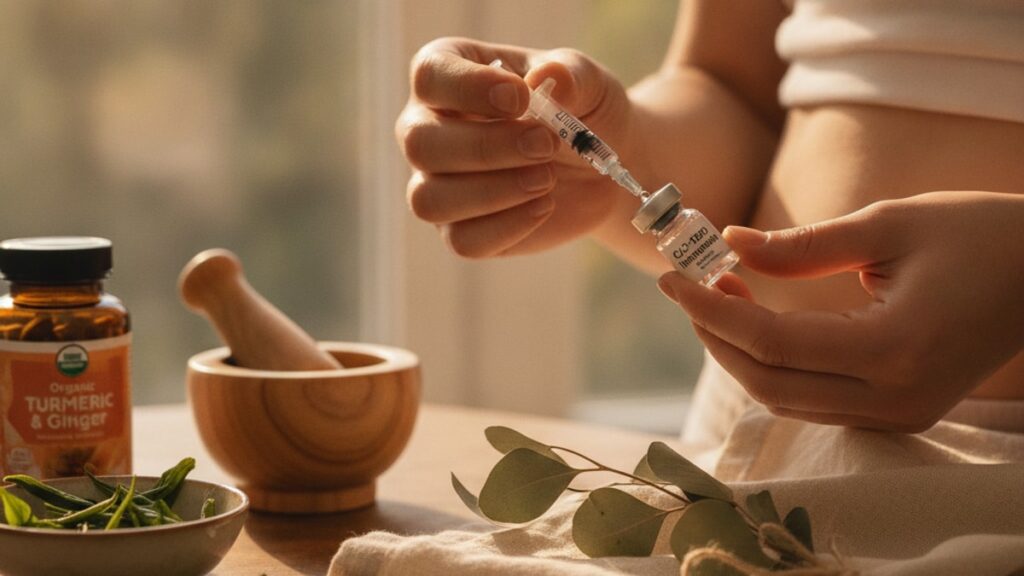
How to Inject CJC-1295 No DAC & Ipamorelin Subq Safely
Most injection errors don't happen at the needle stage. They happen at reconstitution. A peptide that looks perfectly clear in the vial can be completely inactive if mixed incorrectly. The difference between effective subcutaneous administration and wasted product comes down to three variables most protocols never mention: bacteriostatic water temperature, air pressure in the vial, and injection angle relative to subcutaneous tissue depth.
Our team has guided hundreds of researchers through this exact process for Real peptides. The gap between doing it right and doing it wrong isn't just effectiveness. It's the difference between stable peptide structure and irreversible protein denaturation that no visual inspection will detect.
How do you inject CJC-1295 No DAC and Ipamorelin subcutaneously?
To inject CJC-1295 No DAC and Ipamorelin subcutaneously, reconstitute lyophilised peptide powder with bacteriostatic water at room temperature, inject into the vial sidewall at a 45° angle, and administer 0.1–0.3ml doses into abdominal subcutaneous tissue using a 29–31 gauge insulin syringe. Rotate injection sites by at least two inches between administrations to prevent lipohypertrophy. Subcutaneous tissue fibrosis that reduces absorption by 30–40% over repeated use.
You're not just pushing liquid under skin. You're delivering modified growth hormone secretagogues. CJC-1295 No DAC (a GHRH analogue with a modified heptapeptide sequence for extended half-life) and Ipamorelin (a selective ghrelin receptor agonist). Into subcutaneous adipose tissue where capillary density determines systemic bioavailability. The subcutaneous route achieves 70–85% bioavailability compared to intramuscular administration, but only if the peptide remains structurally intact through reconstitution and the injection reaches the correct tissue layer without venous puncture or intramuscular deposition. This article covers exactly how reconstitution mechanics determine peptide stability, why injection angle matters more than needle gauge, and what preparation errors negate therapeutic effect entirely.
Step 1: Reconstitute Lyophilised Peptide with Correct Water Temperature and Air Pressure Management
Lyophilised CJC-1295 No DAC and Ipamorelin arrive as white powder cakes in sealed vials. Reconstitution transforms this powder into an injectable solution. But the process is mechanically precise, not intuitive. Most guides tell you to 'add bacteriostatic water slowly.' That's insufficient. You need to control three variables simultaneously: water temperature, air pressure differential, and injection velocity.
Start with bacteriostatic water at room temperature (20–25°C). Never refrigerated. Cold water increases solution viscosity, which means you inject with greater force to overcome needle resistance, creating turbulence inside the vial that shears peptide bonds. Draw 1–2ml of bacteriostatic water (depending on your target concentration) into a sterile syringe. Before injecting into the peptide vial, pull the plunger back slightly to create a small air cushion in the syringe. This prevents vacuum formation when you inject liquid into a sealed vial.
Inject the water down the inside wall of the vial at a 45° angle. Not directly onto the peptide cake. Direct impact fractures peptide aggregates mechanically before they dissolve, exposing hydrophobic residues that trigger aggregation. The water should run down the glass and dissolve the powder passively. If you see foam or bubbles forming at the powder surface, you injected too fast. Swirl the vial gently in a circular motion. Never shake. Shaking introduces air-liquid interface turbulence that denatures proteins through cavitation. The solution should be clear and colourless within 60–90 seconds. Any cloudiness indicates incomplete dissolution or aggregation. Do not inject cloudy peptide solutions.
Step 2: Prepare Injection Site and Confirm Subcutaneous Tissue Depth Using Pinch Test
Subcutaneous tissue sits between dermis and muscle fascia. Typically 5–15mm deep depending on body composition and site selection. Your goal is to deposit peptide solution into this adipose layer, not into muscle (too deep) or intradermal space (too shallow). The pinch test determines tissue depth and injection angle.
Select an injection site in the abdominal region. Specifically, the area 2–3 inches lateral to the umbilicus and below the ribcage. This zone has consistent subcutaneous tissue depth across body types and minimal nerve density. Clean the site with an alcohol swab and allow it to dry completely. Injecting through wet alcohol drives surface bacteria into the puncture tract. Pinch the skin between thumb and forefinger, lifting a fold of tissue away from the underlying muscle. The thickness of this fold, measured at its base, tells you subcutaneous depth: if the fold is 10mm thick, subcutaneous tissue extends roughly 5mm below the surface.
For most individuals, subcutaneous tissue in the abdominal region is 8–12mm deep. A 29–31 gauge insulin syringe with a 5/16-inch (8mm) needle inserted at 45° reaches mid-subcutaneous depth without penetrating muscle fascia. If you're leaner (visible abdominal muscle definition), use a 90° angle with the same needle length. If you have higher body fat percentage, a 45° angle is safer. The pinch test is the quality control step. It prevents intramuscular injection, which doubles absorption rate and creates unpredictable plasma peaks that aren't therapeutically useful for peptides designed for sustained release.
Step 3: Draw Precise Dose and Inject at Controlled Rate to Prevent Tissue Trauma
Dosing precision matters because CJC-1295 No DAC and Ipamorelin are dosed in micrograms, not milligrams. A standard research protocol uses 100–300mcg of each peptide per injection. If you reconstituted 2mg of CJC-1295 in 2ml of bacteriostatic water, your concentration is 1mg/ml. Meaning 0.1ml delivers 100mcg. Insulin syringes are marked in 0.01ml increments (units), making them ideal for peptide dosing. Confirm your math before drawing: dose in mcg ÷ concentration in mcg/ml = volume to draw in ml.
Insert the needle into the vial at a slight angle, invert the vial so liquid pools at the needle tip, and draw slightly more than your target dose. You'll expel air bubbles next. Tap the syringe barrel gently to move bubbles to the top, then push the plunger until a small bead of liquid appears at the needle tip. This expels air and confirms flow. Recheck your volume marking. You should now have exactly your target dose.
To inject CJC-1295 No DAC & Ipamorelin subq, insert the needle at your determined angle (45° or 90° based on pinch test), release the pinch, and depress the plunger steadily over 3–5 seconds. Fast injection (under 2 seconds) causes tissue distension and localised discomfort. The solution needs time to disperse through adipose tissue. Withdraw the needle at the same angle you inserted it, and apply light pressure with a clean alcohol swab for 5 seconds. Do not massage the injection site. This accelerates systemic absorption and defeats the purpose of subcutaneous depot formation.
CJC-1295 No DAC & Ipamorelin Subq: Administration Variables Comparison
| Variable | Optimal Range | Suboptimal Range | Impact of Deviation |
|---|---|---|---|
| Bacteriostatic water temp | 20–25°C (room temp) | <15°C (refrigerated) | Cold water increases viscosity → injection turbulence → peptide shearing |
| Needle gauge | 29–31G | 25–27G (thicker) | Larger gauge increases tissue trauma and discomfort without improving delivery |
| Injection angle (normal BMI) | 45° | 90° (perpendicular) | 90° risks intramuscular deposition → unpredictable absorption kinetics |
| Injection rate | 3–5 seconds per 0.2ml | <2 seconds (rapid bolus) | Rapid injection causes subcutaneous distension → localised pressure → peptide reflux |
| Site rotation distance | ≥2 inches between sites | <1 inch (repeated use) | Insufficient rotation → lipohypertrophy → 30–40% absorption reduction |
| Professional Assessment | Optimal technique requires reconstitution at room temperature, 45° insertion angle for standard body composition, and minimum 2-inch site rotation to prevent fibrotic tissue formation. Needle gauge matters less than injection rate. Slow steady depression prevents reflux. |
Key Takeaways
- Reconstitute lyophilised CJC-1295 No DAC and Ipamorelin with bacteriostatic water at room temperature, injecting liquid down the vial sidewall at 45° to prevent mechanical peptide shearing.
- Subcutaneous tissue depth in the abdominal region is typically 8–12mm. Use the pinch test to determine correct injection angle (45° for most, 90° for leaner individuals).
- A 29–31 gauge insulin syringe delivers optimal balance between tissue trauma minimisation and flow control for peptide volumes of 0.1–0.3ml.
- Inject at a controlled rate of 3–5 seconds per 0.2ml to allow subcutaneous dispersion and prevent solution reflux from tissue pressure.
- Rotate injection sites by at least 2 inches between administrations to avoid lipohypertrophy, which reduces absorption efficiency by 30–40% over time.
- Standard research dosing for CJC-1295 No DAC ranges from 100–300mcg per injection, with Ipamorelin dosed similarly. Confirm concentration math before drawing to ensure microgram precision.
What If: CJC-1295 & Ipamorelin Injection Scenarios
What If the Reconstituted Solution Looks Cloudy or Has Floating Particles?
Do not inject it. Cloudiness indicates incomplete dissolution, protein aggregation, or contamination. Gently swirl the vial again and inspect under bright light. If clarity doesn't improve within 2 minutes, the peptide is compromised. Aggregated peptides lose receptor binding affinity and may trigger immune responses. Reconstitute a fresh vial, this time injecting bacteriostatic water more slowly and ensuring room temperature conditions.
What If You Inject CJC-1295 No DAC & Ipamorelin Subq and See Immediate Swelling at the Site?
This indicates intradermal injection (too shallow) rather than subcutaneous deposition. The peptide solution pools in dermal tissue, causing visible raised skin. Apply light pressure for 10 seconds but do not massage. Massaging spreads the solution laterally and increases absorption variability. The swelling typically resolves within 15–20 minutes as the solution disperses into subcutaneous space. For the next injection, increase needle insertion depth slightly or adjust angle to 60°.
What If You Miss Your Scheduled Injection Time by Several Hours?
CJC-1295 No DAC has a half-life of approximately 6–8 days, and Ipamorelin's half-life is roughly 2 hours with effects lasting 3–4 hours post-injection. Missing a dose by 4–6 hours won't meaningfully affect plasma levels for CJC-1295, but Ipamorelin's shorter duration means a delayed dose shifts your peak GH release window. Administer the dose as soon as you remember if it's within 12 hours of scheduled time. If more than 12 hours late, skip and resume normal schedule. Do not double-dose to compensate.
The Unflinching Truth About Peptide Injection Technique
Here's the honest answer: most people who report 'peptides didn't work' made an error at reconstitution or injection. Not a failure of the compound itself. The marketing around peptides often skips the mechanical precision required, leaving users to figure out technique through trial and error. That's not how pharmacologically active compounds should be handled.
When you inject CJC-1295 No DAC & Ipamorelin subq incorrectly. Whether through improper reconstitution that denatures peptide structure, injection into muscle tissue that alters absorption kinetics, or repeated use of the same site causing fibrotic scar tissue. You're not getting the compound you paid for. You're getting degraded fragments with unpredictable receptor activity. This isn't a small issue. Subcutaneous injection isn't a formality; it's the delivery mechanism that determines whether the peptide reaches circulation intact.
The research is clear: peptide stability degrades rapidly under mechanical stress (shaking, turbulent mixing, temperature fluctuation above 25°C), and injection technique directly affects bioavailability through tissue depth and site condition. A study published in the Journal of Pharmaceutical Sciences found that even minor protocol deviations. Such as reconstituting with cold water or injecting at excessive speed. Reduced peptide bioactivity by 15–30% compared to controlled technique. If you're using research-grade compounds like those available through our Real peptides catalogue, technique precision isn't optional.
The difference between effective peptide use and wasted product is entirely within your control. Follow the reconstitution steps exactly. Use the pinch test to confirm tissue depth. Rotate sites consistently. These aren't suggestions. They're the mechanical requirements for peptide delivery.
If you're overwhelmed by the process or uncertain about any step, our team at Real Peptides provides detailed handling guidance with every order. Peptide research demands precision from synthesis through administration. We ensure you have both the compound purity and the procedural clarity to use it correctly.
Frequently Asked Questions
How do you properly reconstitute CJC-1295 No DAC and Ipamorelin for injection?▼
Reconstitute by adding 1–2ml of bacteriostatic water at room temperature to the lyophilised peptide vial, injecting the water down the inside glass wall at a 45° angle rather than directly onto the powder. Swirl gently in a circular motion until the solution is completely clear — this typically takes 60–90 seconds. Never shake the vial, as mechanical agitation denatures peptide structure through air-liquid interface turbulence. The reconstituted solution should be stored at 2–8°C and used within 28 days.
What is the correct needle size and injection angle to inject CJC-1295 No DAC & Ipamorelin subq?▼
Use a 29–31 gauge insulin syringe with a 5/16-inch (8mm) needle for subcutaneous peptide injection. For individuals with normal body composition, insert the needle at a 45° angle into abdominal subcutaneous tissue 2–3 inches lateral to the umbilicus. Leaner individuals with visible abdominal definition should use a 90° perpendicular angle to ensure the needle reaches subcutaneous depth without going too shallow. The pinch test — lifting a fold of skin and measuring its thickness — confirms correct angle selection.
How much does CJC-1295 No DAC and Ipamorelin cost, and where can you source research-grade peptides?▼
Research-grade CJC-1295 No DAC typically costs between 45–85 USD per 2mg vial, while Ipamorelin ranges from 35–70 USD per 5mg vial depending on supplier and synthesis batch size. Pricing varies based on purity verification (HPLC testing), synthesis method (solid-phase vs liquid-phase), and supplier regulatory compliance. Real Peptides provides third-party verified, research-grade peptides synthesised under USP standards with exact amino-acid sequencing — ensuring consistency across batches for reproducible research outcomes.
What are the most common side effects of subcutaneous CJC-1295 and Ipamorelin injections?▼
The most frequently reported side effects include injection site reactions (redness, mild swelling, or tenderness lasting 1–3 hours), transient flushing or warmth due to growth hormone pulse, and temporary water retention in the first 1–2 weeks of use. These effects are dose-dependent and typically resolve as the body adapts to the peptide protocol. Serious adverse events are rare but include hypoglycaemia if combined with insulin or oral hypoglycaemics, and elevated cortisol in sensitive individuals. Site rotation every injection minimises localised reactions.
How does subcutaneous injection of CJC-1295 compare to intramuscular administration?▼
Subcutaneous injection achieves 70–85% bioavailability with a slower, more sustained absorption profile compared to intramuscular injection, which has faster peak plasma concentration but shorter duration of effect. For peptides like CJC-1295 No DAC designed for pulsatile GH release, subcutaneous administration better mimics physiological secretion patterns. Intramuscular injection doubles absorption rate and creates sharper plasma spikes, which aren’t therapeutically advantageous for peptides targeting sustained receptor activation. Subcutaneous is the standard route for growth hormone secretagogues in research protocols.
Can you inject CJC-1295 and Ipamorelin in the same syringe, or do they need separate injections?▼
Yes, CJC-1295 No DAC and Ipamorelin can be mixed in the same syringe and administered as a single subcutaneous injection — this is common practice in research protocols combining a GHRH analogue with a ghrelin receptor agonist for synergistic GH release. Mix by drawing each peptide sequentially into the syringe at their respective doses, ensuring total volume doesn’t exceed 0.5ml for comfortable subcutaneous deposition. Do not pre-mix the peptides in a single vial for storage — combine them only at the time of injection to avoid prolonged interaction in solution.
What happens if you accidentally inject CJC-1295 or Ipamorelin into muscle instead of subcutaneous tissue?▼
Intramuscular injection of CJC-1295 or Ipamorelin accelerates absorption and creates higher peak plasma concentrations within 15–30 minutes compared to the 45–90 minute peak from subcutaneous injection. This isn’t dangerous, but it alters the intended pharmacokinetic profile — you’ll experience a sharper but shorter-duration GH pulse rather than the sustained elevation subcutaneous delivery provides. If you suspect intramuscular deposition (no resistance during injection, deeper needle penetration), monitor for more pronounced flushing or transient lightheadedness as plasma levels spike.
How should reconstituted CJC-1295 and Ipamorelin be stored to maintain peptide stability?▼
Store reconstituted peptides at 2–8°C (refrigerated) in the original vial, protected from light. Bacteriostatic water preserves peptide stability for up to 28 days under refrigeration — beyond this window, bacterial growth risk increases and peptide degradation accelerates. Never freeze reconstituted peptides; ice crystal formation disrupts tertiary protein structure irreversibly. Lyophilised (unreconstituted) peptides should be stored at −20°C and can remain stable for 12–24 months depending on manufacturer specifications. Any temperature excursion above 25°C for more than 2 hours degrades potency.
Why is site rotation important when injecting peptides subcutaneously?▼
Repeated subcutaneous injections at the same site cause lipohypertrophy — localised fibrotic tissue formation from chronic low-grade inflammation that reduces peptide absorption by 30–40% and creates visible lumps under the skin. Rotating injection sites by at least 2 inches between administrations distributes tissue stress and prevents scar tissue accumulation. The abdominal region offers approximately 8–12 viable sites when rotating in a circular pattern around the umbilicus. Lipohypertrophy is cumulative and doesn’t resolve quickly — prevention through rotation is essential.
What is the most precise way to dose CJC-1295 No DAC and Ipamorelin in micrograms using an insulin syringe?▼
Calculate concentration first: if you reconstituted 2mg of peptide in 2ml of bacteriostatic water, your concentration is 1mg/ml or 1000mcg/ml. To dose 200mcg, divide 200 by 1000 to get 0.2ml — which equals 20 units on a standard U-100 insulin syringe (where 1ml = 100 units). Always double-check your math before drawing: target dose in mcg ÷ concentration in mcg/ml = volume in ml. Insulin syringes marked in 0.01ml increments allow dosing precision within ±5mcg for typical research protocols.











