



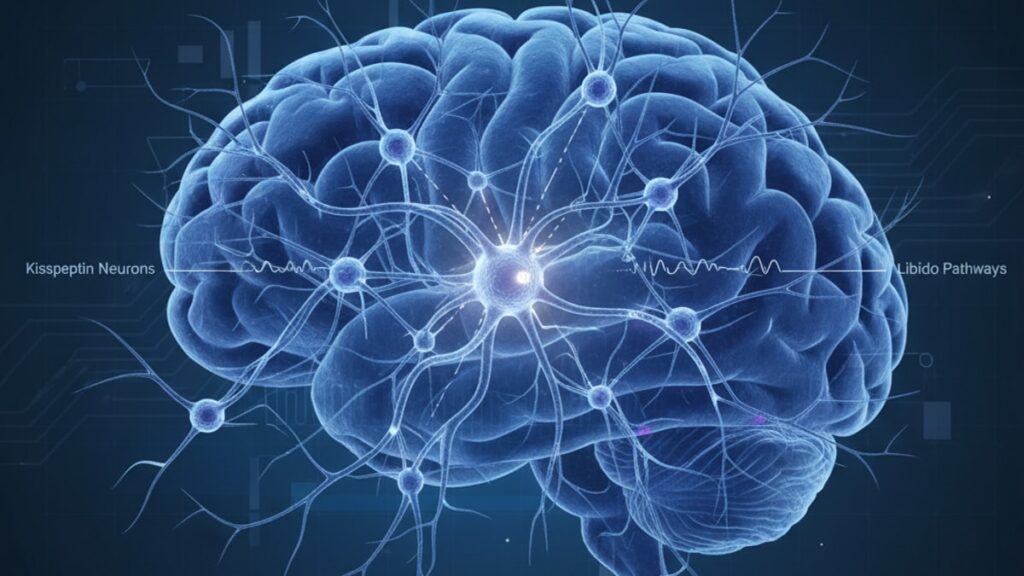
Kisspeptin Low Libido Mechanism — The Hormonal Pathway
Research published in the Journal of Clinical Investigation found that kisspeptin administration in men with hypoactive sexual desire disorder increased neural activity in brain regions associated with sexual arousal by 27% compared to placebo. A measurable, reproducible response that confirms kisspeptin's direct role in sexual motivation pathways. The effect isn't psychological. It's neuroendocrine.
Our team has worked with researchers investigating peptide-based interventions for reproductive dysfunction. The gap between how kisspeptin is marketed and how it actually works is substantial. And that gap matters when evaluating whether it's a viable intervention for low libido or just another overhyped compound.
How does kisspeptin address low libido?
Kisspeptin binds to the KISS1R receptor on GnRH (gonadotropin-releasing hormone) neurons in the hypothalamus, triggering the release of GnRH. GnRH then signals the pituitary gland to secrete LH (luteinizing hormone) and FSH (follicle-stimulating hormone), which in turn stimulate the gonads to produce testosterone in men and estrogen in women. The hormones that directly regulate sexual desire. When kisspeptin signalling is impaired, this entire cascade stalls at the first step.
The kisspeptin low libido mechanism is not a peripheral effect. It's central. The KISS1R receptors are concentrated in the arcuate nucleus and anteroventral periventricular nucleus of the hypothalamus, the exact regions that govern reproductive hormone secretion. This is why kisspeptin administration bypasses downstream issues like gonadal insufficiency and targets the upstream regulatory bottleneck.
Most discussions of kisspeptin for libido frame it as a testosterone booster. That's not accurate. Kisspeptin doesn't raise testosterone unless the problem originates in hypothalamic GnRH signalling. If your low libido is caused by testicular Leydig cell dysfunction or aromatase excess, kisspeptin won't meaningfully change anything. The kisspeptin low libido mechanism works only when the failure point is upstream. Specifically, when GnRH neurons aren't firing at sufficient frequency or amplitude.
This article covers how kisspeptin activates the hypothalamic-pituitary-gonadal (HPG) axis, why that matters for libido, what clinical evidence exists for its use in sexual dysfunction, and where the mechanism breaks down in real-world application.
How Kisspeptin Activates the Hypothalamic-Pituitary-Gonadal Axis
Kisspeptin is encoded by the KISS1 gene and binds specifically to the G-protein-coupled receptor KISS1R (formerly known as GPR54). When kisspeptin binds to KISS1R on GnRH neurons, it initiates a signalling cascade that depolarises the neuron and triggers calcium influx. The biological trigger for neurotransmitter release. The GnRH released by these neurons travels through the hypothalamic-hypophyseal portal system to the anterior pituitary, where it binds to GnRH receptors on gonadotroph cells.
The pituitary response is dose-dependent and pulsatile. A single kisspeptin pulse can trigger LH secretion within 15 minutes in healthy adults. The amplitude and frequency of LH pulses determine downstream testosterone or estrogen production. Too infrequent and the gonads don't receive sufficient stimulation; too frequent and the receptors desensitise.
The kisspeptin low libido mechanism is most effective when the block is at the hypothalamic level. Functional hypothalamic amenorrhea in women, for example, is characterised by suppressed GnRH pulsatility due to stress, caloric deficit, or excessive exercise. Kisspeptin administration in this context restores LH pulsatility and can reactivate ovarian function. In men, stress-induced hypogonadotropic hypogonadism follows a similar pattern. Cortisol elevation suppresses kisspeptin neurons, which reduces GnRH secretion and downstream testosterone production.
The arcuate nucleus population of kisspeptin neurons is particularly sensitive to metabolic signals like leptin and insulin. Low leptin. Common in caloric restriction or low body fat states. Suppresses kisspeptin expression, which explains why chronic dieters often experience libido loss despite otherwise normal health markers. This isn't a psychological effect; it's a direct neuroendocrine shutdown.
Clinical Evidence for Kisspeptin in Sexual Desire Disorders
A 2017 randomised controlled trial published in the Journal of Clinical Investigation administered kisspeptin-54 (the 54-amino-acid isoform) intravenously to men with hypoactive sexual desire disorder. Functional MRI scans revealed increased activation in the posterior cingulate cortex and thalamus when participants viewed sexually explicit images. Brain regions directly implicated in sexual arousal and motivation. The activation pattern was significantly greater than placebo and correlated with subjective reports of increased sexual interest.
Importantly, the effect was specific. Kisspeptin administration did not increase general mood or non-sexual positive affect. The neural response was isolated to sexual stimuli, suggesting that kisspeptin's role in libido is direct rather than a downstream consequence of improved mood or reduced anxiety.
A separate study in women undergoing IVF treatment found that kisspeptin administration triggered LH surges comparable to hCG (human chorionic gonadotropin) injections, the standard pharmacological trigger for ovulation. The LH surge was dose-dependent, peaking at 12 hours post-administration and returning to baseline within 24 hours. This confirms that exogenous kisspeptin can replicate endogenous GnRH pulsatility when hypothalamic function is intact.
However, clinical use outside of controlled trials remains limited. Kisspeptin peptides are not FDA-approved for libido enhancement or sexual dysfunction. Most research-grade kisspeptin formulations available through peptide suppliers like Real Peptides are intended strictly for laboratory investigation. Not clinical use. The half-life of kisspeptin-10 (the 10-amino-acid isoform) is approximately 30 minutes when administered subcutaneously, which limits sustained therapeutic application without frequent dosing or modified delivery systems.
Why the Kisspeptin Low Libido Mechanism Fails in Some Cases
The kisspeptin low libido mechanism depends on intact downstream responsiveness. If the pituitary doesn't respond to GnRH, or if the gonads don't respond to LH and FSH, kisspeptin administration achieves nothing. This is why kisspeptin supplementation doesn't universally restore libido. The bottleneck must be hypothalamic for the intervention to work.
Primary hypogonadism. Where the testes or ovaries themselves are dysfunctional. Will not respond to kisspeptin. Elevated LH and FSH levels in the presence of low testosterone or estrogen indicate a primary gonadal problem, not a hypothalamic signalling issue. Kisspeptin in this context is like turning the ignition key in a car with a dead battery. The upstream signal works fine, but the downstream machinery can't execute the command.
Prolactin excess is another common failure point. Elevated prolactin suppresses GnRH secretion and directly inhibits gonadal steroidogenesis. Kisspeptin may partially overcome prolactin-induced GnRH suppression, but it won't address the gonadal-level inhibition. This is why hyperprolactinemia cases often require cabergoline (a dopamine agonist that lowers prolactin) rather than kisspeptin.
Another overlooked factor: kisspeptin receptor desensitisation. Chronic, high-dose, or continuous kisspeptin exposure can downregulate KISS1R expression on GnRH neurons. Animal studies show that sustained kisspeptin infusion leads to paradoxical suppression of LH secretion after 48–72 hours. The endogenous system evolved for pulsatile signalling. Continuous activation breaks the feedback loop.
Kisspeptin Low Libido Mechanism: Dosing and Delivery Comparison
| Kisspeptin Isoform | Half-Life (Subcutaneous) | Typical Research Dose | LH Response Onset | Primary Use Case | Bottom Line |
|---|---|---|---|---|---|
| Kisspeptin-54 | ~2.5 hours | 0.3–1.0 nmol/kg | 30–60 minutes | Hypothalamic GnRH deficiency research | Longest half-life, most stable response. Preferred for single-dose trials |
| Kisspeptin-10 | ~30 minutes | 1.0–10.0 nmol/kg | 15–30 minutes | Acute GnRH stimulation tests | Rapid onset, very short duration. Requires frequent dosing or infusion |
| Modified analogs (e.g., TAK-448) | ~4–6 hours | Varies by formulation | 30–45 minutes | Prolonged HPG axis activation | Synthetic modifications extend half-life but lack long-term human safety data |
The table above clarifies why kisspeptin hasn't transitioned smoothly from bench research to clinical application. The naturally occurring peptides have pharmacokinetic profiles that don't align with once-daily or even twice-daily administration. Modified analogs with extended half-lives exist but remain investigational.
Key Takeaways
- Kisspeptin binds to KISS1R receptors on GnRH neurons in the hypothalamus, triggering the release of GnRH and initiating the hormonal cascade that produces testosterone and estrogen.
- The kisspeptin low libido mechanism works only when the dysfunction originates at the hypothalamic level. Primary gonadal failure or pituitary unresponsiveness will not improve with kisspeptin administration.
- Clinical trials show that intravenous kisspeptin-54 increases neural activation in sexual arousal centers by 27% in men with hypoactive sexual desire disorder compared to placebo.
- The half-life of kisspeptin-10 is approximately 30 minutes subcutaneously, requiring frequent dosing or continuous infusion for sustained effect.
- Chronic or high-dose kisspeptin exposure can cause KISS1R receptor downregulation, leading to paradoxical suppression of LH secretion after 48–72 hours.
What If: Kisspeptin Low Libido Mechanism Scenarios
What If I Have Low Testosterone but Normal LH and FSH — Will Kisspeptin Help?
No. Normal or elevated LH and FSH levels with low testosterone indicate primary hypogonadism. The testes aren't responding to the pituitary signal. The kisspeptin low libido mechanism addresses hypothalamic or pituitary insufficiency, not gonadal failure. Kisspeptin in this scenario increases GnRH and LH output, but the testes still won't produce testosterone. Testosterone replacement therapy, not kisspeptin, is the appropriate intervention when LH is already elevated.
What If I'm Using Kisspeptin and My Libido Improves Initially but Then Drops Off?
This pattern suggests receptor desensitisation. Continuous or high-frequency kisspeptin dosing downregulates KISS1R expression on GnRH neurons, blunting the LH response over time. The endogenous system relies on pulsatile kisspeptin release. Not constant stimulation. Switching to intermittent dosing (e.g., every 48–72 hours instead of daily) or cycling off entirely for 2–4 weeks may restore receptor sensitivity.
What If My Libido Loss Is Stress-Related — Does Kisspeptin Address That?
Partially. Chronic stress elevates cortisol, which suppresses kisspeptin neuron activity in the arcuate nucleus. Exogenous kisspeptin can bypass that suppression and reactivate GnRH release. However, if cortisol remains chronically elevated, the effect will be limited. The kisspeptin low libido mechanism is downstream of cortisol's suppressive action. Addressing the stressor itself (sleep deprivation, caloric deficit, overtraining) is more effective than pharmacologically overriding the stress signal.
The Direct Truth About Kisspeptin Low Libido Mechanism
Here's the honest answer: kisspeptin works, but only under very specific conditions. And those conditions aren't common. The clinical trials showing efficacy used intravenous kisspeptin-54 at controlled doses in men with documented hypoactive sexual desire disorder. The subcutaneous, research-grade peptides available online are shorter isoforms with half-lives measured in minutes, not hours. The dosing required to replicate trial results would demand multiple daily injections or continuous infusion.
The marketing around kisspeptin for libido vastly overstates its accessibility and practicality. Most people experiencing low libido don't have isolated hypothalamic GnRH deficiency. They have stress-induced suppression, primary hypogonadism, metabolic dysfunction, or psychological factors that kisspeptin doesn't address. The peptide is highly effective at what it does (activating GnRH neurons), but what it does is extraordinarily narrow.
If you're considering kisspeptin, the first step is confirming the failure point. Get baseline bloodwork: total testosterone, free testosterone, LH, FSH, prolactin, and cortisol. Low testosterone with low or normal LH suggests a hypothalamic or pituitary issue. Kisspeptin might help. Low testosterone with high LH means your testes aren't responding. Kisspeptin won't change that. The mechanism is elegant, but it's not a universal libido fix.
Kisspeptin isn't the upstream reset most low-libido cases need. When the block is genuinely hypothalamic. Functional hypothalamic amenorrhea in women, stress-induced hypogonadotropic hypogonadism in men, or idiopathic GnRH deficiency. The kisspeptin low libido mechanism is one of the most targeted interventions available. For everyone else, it's a mismatch between the tool and the problem.
Frequently Asked Questions
How does kisspeptin improve libido in men and women?▼
Kisspeptin binds to KISS1R receptors on GnRH neurons in the hypothalamus, triggering the release of GnRH which signals the pituitary to secrete LH and FSH — these hormones then stimulate the gonads to produce testosterone in men and estrogen in women, the hormones that directly regulate sexual desire. The effect is measurable: clinical trials show a 27% increase in neural activation in sexual arousal centers compared to placebo. However, this mechanism works only when the dysfunction originates at the hypothalamic level — if the problem is primary gonadal failure or elevated prolactin, kisspeptin won’t address it.
Can kisspeptin replace testosterone therapy for low libido?▼
No, kisspeptin and testosterone therapy serve different failure points. Kisspeptin stimulates the body’s own testosterone production by activating the HPG axis — it works when the testes are functional but the upstream signal (GnRH) is insufficient. Testosterone replacement bypasses the entire hormonal cascade and directly supplements the missing hormone. If you have primary hypogonadism (high LH with low testosterone), kisspeptin won’t help because your testes aren’t responding to the signal. Testosterone therapy is the correct intervention in that case.
What is the difference between kisspeptin-10 and kisspeptin-54?▼
Kisspeptin-54 is the full-length 54-amino-acid peptide with a half-life of approximately 2.5 hours subcutaneously, making it more suitable for single-dose clinical trials. Kisspeptin-10 is the truncated 10-amino-acid isoform with a half-life of only 30 minutes, requiring frequent dosing or continuous infusion to maintain effect. Both bind to the same KISS1R receptor and trigger GnRH release, but kisspeptin-54 provides a more sustained response. Most research-grade peptides available online are kisspeptin-10 due to lower synthesis cost.
How long does it take for kisspeptin to increase libido?▼
Kisspeptin triggers LH secretion within 15–30 minutes of administration, but the downstream effect on libido depends on how quickly testosterone or estrogen levels rise in response to that LH surge. In clinical trials, men reported subjective increases in sexual interest within hours of intravenous kisspeptin-54 administration. However, sustained libido improvement requires consistent HPG axis activation over days to weeks — single-dose effects are transient unless the underlying hypothalamic suppression is resolved.
What blood tests should I get before using kisspeptin for low libido?▼
You need baseline measurements of total testosterone, free testosterone, LH, FSH, prolactin, and cortisol to identify where the dysfunction originates. Low testosterone with low or normal LH suggests hypothalamic or pituitary insufficiency — kisspeptin may help. Low testosterone with high LH indicates primary gonadal failure — kisspeptin won’t improve that. Elevated prolactin suppresses GnRH release and requires cabergoline, not kisspeptin. Without this diagnostic step, you’re guessing whether the kisspeptin low libido mechanism even applies to your case.
Does kisspeptin work for libido loss caused by chronic stress or dieting?▼
Partially. Chronic stress elevates cortisol, which suppresses kisspeptin neuron activity in the hypothalamus. Exogenous kisspeptin can bypass that suppression and reactivate GnRH release. Similarly, caloric restriction lowers leptin, which also suppresses kisspeptin expression — administering kisspeptin can restore GnRH pulsatility. However, if cortisol remains elevated or leptin stays low, the effect will be limited. The kisspeptin low libido mechanism works best when the stressor is removed or mitigated — using peptides to override a chronic metabolic signal is less effective than addressing the root cause.
Why does kisspeptin stop working after a few weeks of use?▼
Chronic or high-dose kisspeptin exposure causes KISS1R receptor downregulation on GnRH neurons. Animal studies show that continuous kisspeptin infusion leads to paradoxical suppression of LH secretion after 48–72 hours because the receptors desensitise. The endogenous system evolved for pulsatile kisspeptin signalling — not constant activation. Switching to intermittent dosing (every 48–72 hours instead of daily) or cycling off entirely for 2–4 weeks may restore receptor sensitivity.
Is kisspeptin safe for long-term use in libido enhancement?▼
There is no long-term safety data for continuous kisspeptin use in humans beyond short-term clinical trials lasting weeks to months. The peptide is not FDA-approved for sexual dysfunction or libido enhancement — available formulations are research-grade only. Potential risks include receptor desensitisation (leading to reduced effectiveness), unpredictable effects on fertility and menstrual cycles, and unknown interactions with chronic HPG axis suppression from other causes. Anyone considering prolonged kisspeptin use should do so under medical supervision with regular monitoring of reproductive hormone levels.
Can women use kisspeptin for low libido during menopause?▼
The kisspeptin low libido mechanism in postmenopausal women is complicated. Menopause is characterised by ovarian failure — the ovaries no longer respond to LH and FSH regardless of how much GnRH is released. Kisspeptin will increase GnRH, LH, and FSH secretion, but the ovaries won’t produce estrogen in response. The libido effect observed in premenopausal women depends on restoring estrogen production, which kisspeptin cannot do when the ovaries are no longer functional. Hormone replacement therapy (estrogen and possibly testosterone) is the appropriate intervention for menopause-related libido loss.
Where can I find legitimate kisspeptin peptides for research?▼
Research-grade kisspeptin is available from suppliers that specialise in peptide synthesis for laboratory use, including [Real Peptides](https://www.realpeptides.co/?utm_source=other&utm_medium=seo&utm_campaign=mark_real_peptides). These formulations are intended strictly for in vitro or animal research — not human consumption. Peptides sold for research purposes are not subject to the same purity, sterility, or dosing standards as pharmaceutical-grade compounds. If you’re considering kisspeptin for personal use, work with a prescribing physician who can source pharmaceutical-grade material and monitor your response with appropriate lab work.











