





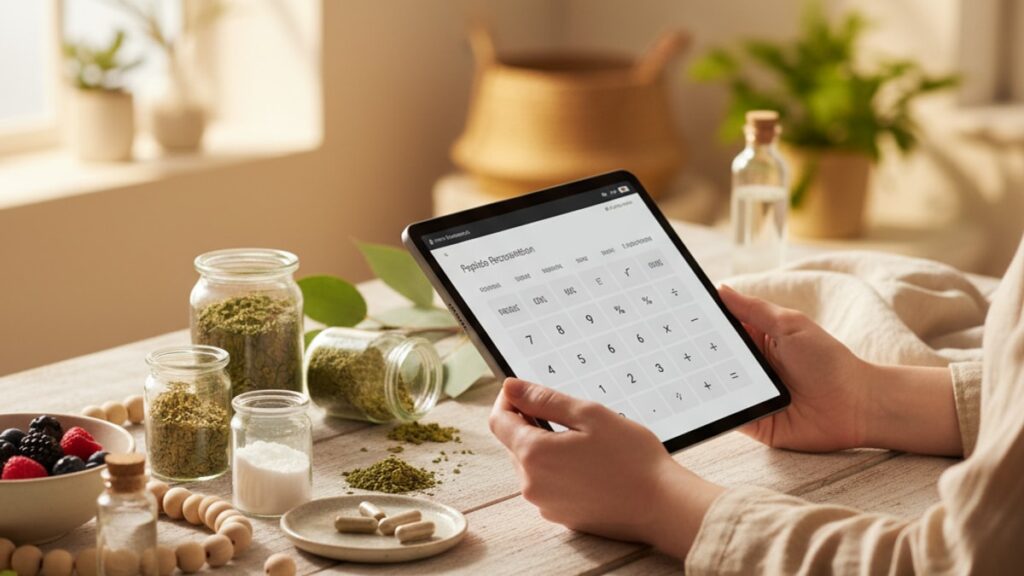
Peptide Reconstitution Calculator — Precision Dosing
Research peptides arrive as lyophilised powder for one reason: stability. Once reconstituted with bacteriostatic water, the peptide's shelf life drops from years to weeks, and its potency depends entirely on one calculation you probably learned to avoid in school. The dosage conversion formula. A peptide reconstitution calculator removes the guesswork, turning vial mass and diluent volume into the exact dose per injection unit. Get it wrong, and your research compound is either underdosed into irrelevance or overdosed beyond protocol safety margins.
We've worked with hundreds of research teams setting up peptide protocols. The single most common failure point isn't sterile technique or storage temperature. It's the math. Specifically, the conversion between milligrams of peptide, millilitres of bacteriostatic water, and units drawn into an insulin syringe.
What is a peptide reconstitution calculator and why does it matter for research dosing?
A peptide reconstitution calculator is a tool that converts the mass of lyophilised peptide (in milligrams) and the volume of bacteriostatic water added (in millilitres) into the concentration of the final solution. Allowing researchers to determine how many units on an insulin syringe deliver the intended dose. Without this calculation, there is no way to translate a protocol specifying "250 micrograms per injection" into the physical volume you draw from the vial. The calculator prevents dosing errors that compromise experimental consistency and data validity.
Why Manual Reconstitution Math Fails in Practice
The formula itself is straightforward: concentration equals mass divided by volume. A 5mg vial reconstituted with 2mL of bacteriostatic water yields 2.5mg/mL, or 2,500 micrograms per millilitre. Standard insulin syringes measure in units (100 units per mL), so 10 units on the syringe equals 0.1mL, which contains 250 micrograms of peptide. Simple enough on paper. Catastrophic in practice when researchers miscalculate unit-to-millilitre conversions or forget that peptide mass on the vial label represents approximate fill, not exact content.
The most common error pattern involves unit confusion. Insulin syringes display graduations in "units". A term that means 1/100th of a millilitre in syringe nomenclature but has no inherent peptide dosage meaning. A researcher targeting 500 micrograms who draws "50 units" assumes they're measuring peptide dose when they're actually measuring volume. If the vial concentration is 2mg/mL, those 50 units (0.5mL) deliver 1,000 micrograms. Double the intended dose. Multiply this across a 12-week protocol and the error compounds into unusable data.
Bacteriostatic water volume choice creates another variable. Adding 1mL to a 5mg vial produces a more concentrated solution (5mg/mL) than adding 3mL (1.67mg/mL). Higher concentration means smaller injection volumes, which sounds convenient until you're trying to draw 4 units accurately from a 100-unit syringe. Measurement precision becomes the limiting factor. Lower concentration improves measurement accuracy but increases injection frequency or requires larger volume injections that some protocols cannot accommodate. A peptide reconstitution calculator models these trade-offs before you commit bacteriostatic water to the vial.
Peptide purity further complicates manual calculations. A vial labelled "10mg" rarely contains exactly 10.00mg of active peptide. Lyophilisation adds stabiliser mass (mannitol, trehalose) that contributes to total powder weight but not to peptide content. Reputable suppliers provide Certificates of Analysis stating actual purity (typically 95–99%), meaning a "10mg" vial at 97% purity contains 9.7mg of active peptide. Ignoring this 3% difference accumulates across dosing schedules, particularly in dose-response studies where precision determines whether results are replicable. Our full peptide collection at Real Peptides includes Certificates of Analysis with every order, specifying exact purity percentages so reconstitution calculations reflect actual peptide content rather than label approximations.
How a Peptide Reconstitution Calculator Converts Mass to Dosage
A peptide reconstitution calculator automates the conversion sequence that manual calculation requires you to track across multiple steps. You input three variables: peptide mass (from the vial label), bacteriostatic water volume (the amount you intend to add), and desired dose per injection (from your research protocol). The calculator outputs the exact syringe volume in both millilitres and insulin syringe units needed to deliver that dose.
The calculation pathway begins with concentration determination. Dividing peptide mass by bacteriostatic water volume yields concentration in milligrams per millilitre. For a 10mg vial reconstituted with 2mL of bacteriostatic water: 10mg ÷ 2mL = 5mg/mL. Converting to micrograms (multiply by 1,000) gives 5,000 micrograms per millilitre. The concentration most calculators display because research protocols typically specify doses in micrograms rather than milligrams.
Next comes dose-to-volume conversion. If the protocol specifies 300 micrograms per injection and the solution concentration is 5,000 micrograms per millilitre, the required injection volume is 300 ÷ 5,000 = 0.06mL. Insulin syringes measure in units (100 units = 1mL), so 0.06mL converts to 6 units on the syringe. This is the number you set when drawing the solution. The physical graduation mark you align with the syringe plunger.
Peptide reconstitution calculators also reverse the calculation. If you know your preferred injection volume (say, 20 units because it's easier to measure accurately than 6 units), the calculator determines what bacteriostatic water volume produces a concentration where 20 units delivers your target dose. This workflow prevents the common mistake of reconstituting first and discovering afterward that your dose requires drawing 3 units. A volume too small for reliable measurement on standard insulin syringes.
For multi-dose vials, the calculator estimates doses per vial by dividing total peptide mass by dose per injection. A 10mg vial with 250-microgram injections yields 40 doses (10,000 micrograms ÷ 250 micrograms). This projection informs ordering frequency and helps identify when remaining solution volume approaches the point where accurate measurement becomes difficult. Peptides like Ipamorelin and Sermorelin are commonly dosed in the 200–300 microgram range, making dose-per-vial calculation essential for multi-week research timelines.
Peptide Reconstitution Calculator Comparison
Choosing a peptide reconstitution calculator depends on calculation complexity, interface usability, and whether the tool accounts for peptide purity adjustments. The table below compares three common calculator types used in research settings.
| Calculator Type | Input Variables | Purity Adjustment | Reverse Calculation (Volume to Dose) | Output Format | Professional Assessment |
|---|---|---|---|---|---|
| Basic Online Calculator | Peptide mass, water volume, desired dose | No. Assumes 100% purity | No. Dose-to-volume only | Syringe units and millilitres | Suitable for single-dose planning but ignores Certificate of Analysis purity data, leading to 2–5% dosing errors over multi-week protocols |
| Spreadsheet Template | Peptide mass, water volume, purity percentage, dose | Yes. User inputs purity from CoA | Yes. Includes both directions | Millilitres, units, doses per vial | Best for recurring protocols where you can save vial-specific data, but requires Excel proficiency and formula validation before first use |
| Research Lab Software Module | All inputs plus peptide molecular weight, injection schedule | Yes. Database-integrated CoA | Yes. Optimises water volume for target injection volume | Full protocol summary including storage timeline | Most accurate for complex protocols and regulatory documentation, but requires institutional software access and training |
Key Takeaways
- A peptide reconstitution calculator eliminates the unit-to-volume conversion errors that occur when researchers confuse insulin syringe "units" (measurement of volume) with peptide dose (measurement of mass).
- Standard insulin syringes measure in 100 units per mL, meaning each unit equals 0.01mL. The calculator converts your protocol dose in micrograms into the syringe units you physically draw.
- Peptide purity percentages from Certificates of Analysis must be factored into reconstitution math or dosing accuracy drifts 2–5% below target, compounding across multi-week research timelines.
- Bacteriostatic water volume determines solution concentration. Higher concentration allows smaller injection volumes but reduces measurement precision for doses requiring fewer than 10 syringe units.
- A 5mg vial reconstituted with 2mL bacteriostatic water yields 2,500 micrograms per millilitre; drawing 10 units (0.1mL) delivers 250 micrograms.
- Reverse calculation (determining water volume needed to produce a specific syringe measurement for your dose) prevents the mistake of reconstituting first and discovering your dose requires an unmeasurable 3-unit draw.
What If: Peptide Reconstitution Scenarios
What If I Need to Adjust Dose Mid-Protocol Without Reconstituting a New Vial?
Change the syringe volume you draw rather than the water volume already in the vial. If your current concentration is 2mg/mL (2,000 micrograms per mL) and you're drawing 15 units (0.15mL) for 300 micrograms, increasing to 400 micrograms requires drawing 20 units instead. The peptide reconstitution calculator recalculates syringe units for the new dose using your existing concentration. This approach preserves the remaining solution and avoids introducing contaminants through additional needle punctures. Track concentration and remaining volume carefully. Once you're below 0.3mL in the vial, measurement accuracy degrades because the needle bevel cannot draw consistently from minimal fluid depth.
What If the Vial Label Says 10mg But the Certificate of Analysis Shows 96% Purity?
Input 9.6mg as your peptide mass when using the peptide reconstitution calculator. The 10mg label reflects total lyophilised powder weight including stabilisers (mannitol, trehalose), but only 96% is active peptide. Using 10mg in your calculation overestimates actual dose by 4%, which seems minor until you consider a 12-week protocol. Cumulative exposure diverges enough to affect dose-response consistency. Every research-grade peptide at Real Peptides includes a Certificate of Analysis specifying purity to two decimal places; using that exact figure ensures your reconstitution math reflects what's actually in solution, not what's printed on the vial.
What If I Want to Store Some Vials Reconstituted and Some as Powder?
Reconstitute only what you'll use within 28 days and store the remainder as lyophilised powder at −20°C. Once bacteriostatic water is added, peptide stability drops. Most peptides remain potent for 28 days at 2–8°C, but degradation accelerates beyond that window even under refrigeration. The peptide reconstitution calculator helps plan partial reconstitution: if your protocol requires 250 micrograms daily and you have three 5mg vials, reconstitute one vial with 2mL (yielding 2,500 micrograms/mL), which provides 20 days of dosing at 10 units per injection. Reconstitute the second vial only when the first is depleted. This approach balances convenience against stability. You're not puncturing multiple vials (contamination risk) but you're also not storing reconstituted solution beyond its viable window.
The Unforgiving Truth About Peptide Dosing Math
Here's the honest answer: if you're estimating peptide doses by eyeballing syringe measurements or rounding "close enough" because the math feels tedious, your research data is already compromised. Peptide research demands sub-microgram precision. The difference between a growth hormone secretagogue producing measurable IGF-1 elevation and producing nothing often falls within a 50-microgram range. A calculator isn't optional convenience for researchers who "aren't good at math". It's the minimum standard for anyone claiming their protocol is controlled and replicable. Institutions that skip this step don't publish reproducible findings; they publish noise and call it data.
The bottom line for reconstitution accuracy: your peptide concentration is only as precise as the calculation that determined it, and your dosing consistency is only as reliable as the syringe measurement you can physically achieve. A peptide reconstitution calculator solves the first variable; choosing appropriate bacteriostatic water volume solves the second. Researchers targeting doses below 100 micrograms should reconstitute to concentrations where the required dose equals at least 10 syringe units. Anything less introduces measurement error that manual technique cannot compensate for. For protocols involving peptides like BPC 157, TB-500, or Thymosin Alpha-1, where dosing precision determines whether tissue repair mechanisms activate or remain dormant, calculator-driven reconstitution isn't best practice. It's the only practice that produces defensible results.
Calculators also expose a truth most researchers don't want to confront: if you cannot perform the reconstitution calculation manually and verify the calculator's output, you don't understand your own protocol well enough to troubleshoot it when results deviate from expectations. The calculator should accelerate your workflow, not replace your comprehension of the concentration formula, unit conversions, and molecular weight relationships that govern peptide solution chemistry. Use the calculator to eliminate arithmetic errors. But understand the math well enough to recognise when the calculator's output is implausible given your inputs.
When Peptide Concentration Determines Research Viability
Reconstitution decisions shape more than dosing accuracy. They determine whether multi-dose vials remain usable across their storage window or degrade into inactive solution before you've drawn half the doses. Peptides undergo hydrolysis and oxidation in aqueous solution at rates determined by concentration, pH, temperature, and time. Higher concentration solutions (achieved by adding less bacteriostatic water) generally degrade slower than dilute solutions because there's less water available to participate in hydrolytic peptide bond cleavage. But higher concentration also means smaller injection volumes, which pushes measurement precision to the limits of insulin syringe accuracy.
The optimal reconstitution volume balances these constraints. For peptides dosed in the 200–500 microgram range per injection, reconstituting to 2–3mg/mL keeps injection volumes between 10–25 syringe units. Accurate enough for reliable measurement, small enough to avoid discomfort at subcutaneous injection sites. For peptides requiring microgram-range doses (growth hormone releasing peptides, neuroprotective compounds like Semax or Selank), reconstituting to 1mg/mL or lower ensures that even 50-microgram doses translate to measurable syringe volumes above 5 units.
Protocols extending beyond four weeks introduce another variable: vial access frequency. Every needle puncture through the rubber stopper introduces contamination risk, even with proper alcohol swabbing and sterile technique. A 5mg vial reconstituted for 250-microgram doses yields 20 injections. If dosed daily, that's 20 punctures over 20 days. Compare this to reconstituting two separate 2.5mg vials, each yielding 10 doses: you're halving per-vial puncture frequency, reducing contamination probability, and ensuring neither vial sits refrigerated for more than 10 days before depletion. The peptide reconstitution calculator models these scenarios before you commit to a reconstitution strategy that seemed convenient at first but becomes problematic by week three.
Every reconstituted peptide vial at Real Peptides includes preparation guidance calibrated to the specific peptide's stability profile and typical research dose ranges. Compounds with shorter half-lives or higher oxidative sensitivity (like Thymalin and Epithalon) come with recommendations for smaller bacteriostatic water volumes to minimise time in solution, while more stable compounds tolerate higher dilution for easier measurement. These aren't arbitrary suggestions. They're derived from accelerated degradation studies showing where potency loss crosses below acceptable thresholds for research use.
Proper reconstitution math doesn't just protect your current protocol. It protects the validity of every downstream analysis built on data generated from that protocol. Research teams comparing peptide efficacy across dose ranges depend on the assumption that a 200-microgram dose in trial one contained the same peptide mass as a 200-microgram dose in trial twelve. Break that assumption with careless reconstitution, and you're not collecting data. You're collecting artifacts of your own measurement error. A peptide reconstitution calculator closes that gap, turning approximation into precision and guesswork into replicable process.
Frequently Asked Questions
How does a peptide reconstitution calculator determine the correct syringe measurement for a specific dose?
▼
The calculator divides your target dose (in micrograms) by the solution concentration (in micrograms per millilitre) to determine injection volume in millilitres, then converts that volume to insulin syringe units by multiplying by 100. For example, a 300-microgram dose from a solution containing 2,500 micrograms per millilitre requires 0.12mL, which equals 12 units on a standard insulin syringe. This eliminates manual conversion errors between mass units and volume measurements.
Can I use tap water or sterile saline instead of bacteriostatic water for peptide reconstitution?
▼
No — tap water introduces microbial contamination and lacks the benzyl alcohol preservative that prevents bacterial growth in multi-dose vials. Sterile saline works for single-use immediately after reconstitution, but it lacks bacteriostatic properties, meaning the solution must be used within 24 hours or discarded. Bacteriostatic water contains 0.9% benzyl alcohol, extending multi-dose vial viability to 28 days under refrigeration at 2–8°C. Using improper diluent compromises both sterility and peptide stability.
What happens if I reconstitute a peptide with more bacteriostatic water than intended?
▼
The solution becomes more dilute, requiring larger syringe volumes to achieve your target dose. If you added 3mL instead of 2mL to a 5mg vial, concentration drops from 2,500 to 1,667 micrograms per millilitre — a 300-microgram dose now requires 18 syringe units instead of 12. Dilution does not damage the peptide chemically, but excessively dilute solutions increase injection volume and may accelerate hydrolytic degradation. Re-calculating with actual water volume added allows continued accurate dosing from the over-diluted vial.
How much does peptide purity percentage affect final dosing accuracy?
▼
Purity variance of 3–5% translates directly to dosing error of the same magnitude. A 10mg vial at 95% purity contains 9.5mg active peptide; using 10mg in your reconstitution calculation overestimates every dose by 5%. Across a 12-week protocol with daily injections, this cumulative error can shift total peptide exposure enough to alter dose-response outcomes. Certificates of Analysis specify exact purity — inputting that value into your peptide reconstitution calculator ensures calculated doses reflect actual peptide content, not label approximations.
Why do some protocols specify injection volume in units rather than millilitres?
▼
Because insulin syringes — the standard tool for peptide injection — display graduations in units (100 units per 1mL) rather than decimal millilitres. Instructing a researcher to ‘draw 0.12mL’ requires mental conversion; instructing them to ‘draw 12 units’ matches the physical markings they see on the syringe barrel. Units eliminate conversion errors at the point of dose administration. This is why peptide reconstitution calculators output both millilitres and syringe units — the former for calculation verification, the latter for practical injection measurement.
What is the minimum syringe volume I can measure accurately on a standard insulin syringe?
▼
Reliable measurement accuracy on 100-unit insulin syringes begins at approximately 5 units (0.05mL), though precision improves significantly above 10 units. Below 5 units, even small variations in needle bevel position, plunger alignment, or air bubbles introduce measurement error exceeding 10%. For protocols requiring doses that translate to fewer than 10 syringe units, reconstitute with less bacteriostatic water to increase solution concentration, thereby increasing the syringe volume needed per dose into the measurable range.
How do peptide reconstitution calculators handle peptides that require daily versus weekly dosing schedules?
▼
The calculator determines doses per vial by dividing total peptide mass by dose per injection, which directly informs dosing frequency planning. A 10mg vial with 500-microgram daily doses provides 20 days of treatment, but the same vial with 2mg weekly doses provides 5 weeks. This projection helps match reconstitution volume to usage timeline — peptides consumed within 10 days tolerate higher dilution for easier measurement, while peptides lasting 4+ weeks benefit from lower dilution to reduce cumulative degradation and contamination risk from repeated vial punctures.
Can the same peptide reconstitution calculator be used for all peptide types regardless of molecular weight?
▼
Yes, because the calculation depends only on peptide mass, bacteriostatic water volume, and target dose — molecular weight does not directly affect the concentration formula. However, molecular weight becomes relevant when protocols specify doses in moles or when comparing potency across structurally similar peptides. Standard research protocols specify doses in mass units (milligrams or micrograms), which the calculator converts to injection volume without requiring molecular weight input. Advanced calculators include molecular weight fields for researchers performing molar concentration conversions.
What should I do if my peptide vial contains visible aggregation or cloudiness after reconstitution?
▼
Do not use the solution — visible aggregation indicates protein denaturation or contamination, neither of which can be reversed. Cloudiness immediately after adding bacteriostatic water sometimes resolves with gentle swirling (never shake, which causes foaming and further denaturation), but persistent cloudiness or particulate matter means the peptide has degraded. Proper reconstitution involves injecting bacteriostatic water slowly down the vial wall, allowing it to dissolve the lyophilised powder without agitation. Aggregated peptides lose bioactivity and should be discarded regardless of remaining volume.











