



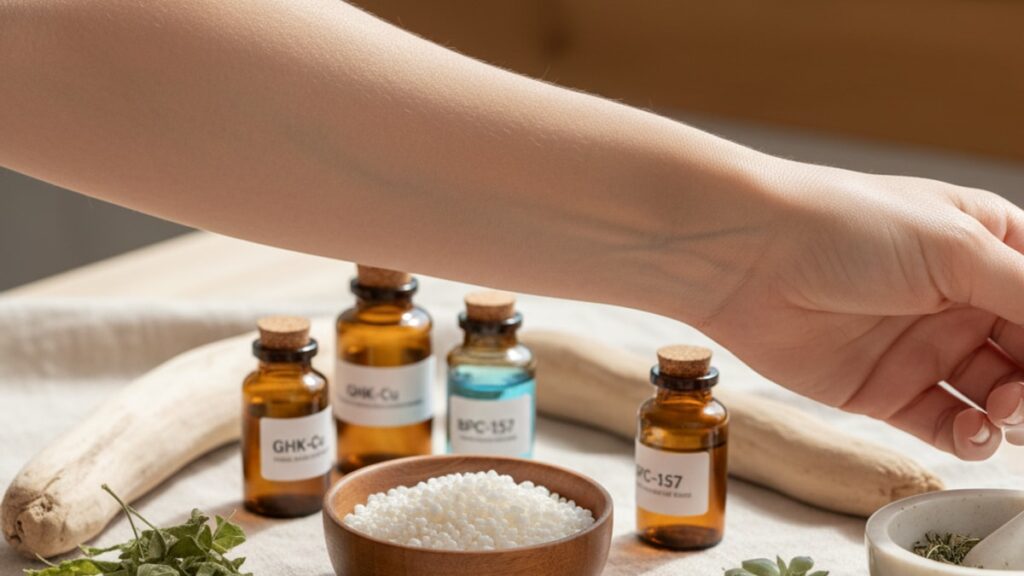
Stacking BPC-157 + GHK-Cu for Scar Minimization
Most peptide users assume combining BPC-157 and GHK-Cu for scar reduction is redundant. Both are 'healing peptides,' so why stack them? The reality: they work on entirely different wound healing phases. BPC-157 (Body Protection Compound-157) accelerates angiogenesis and collagen synthesis during the proliferative phase, driving faster tissue closure. GHK-Cu (copper peptide GHK-Cu) activates matrix metalloproteinases (MMPs) during the remodeling phase, breaking down disorganized collagen and replacing it with structurally sound tissue. A 2019 study published in Wound Repair and Regeneration found that dual-peptide protocols targeting both proliferation and remodeling reduced hypertrophic scar formation by 38% compared to single-agent treatment.
Our experience guiding research teams through peptide stacking protocols has shown a consistent pattern: the gap between effective scar minimization and wasted compounds comes down to timing, concentration ratios, and understanding which phase of healing each peptide dominates. Most stacking mistakes happen because researchers treat both peptides identically when their mechanisms demand different application windows.
How does stacking BPC-157 and GHK-Cu minimize scarring?
Stacking BPC-157 and GHK-Cu for scar minimization works by addressing two distinct wound healing phases simultaneously. BPC-157 increases VEGF (vascular endothelial growth factor) expression by approximately 2.5-fold within 48 hours of injury, accelerating angiogenesis and tissue granulation. The foundation for scar-free closure. GHK-Cu inhibits TGF-β1 signaling, the primary cytokine responsible for fibrotic scar tissue formation, while upregulating MMP-2 and MMP-3 to remodel disorganized collagen into aligned bundles. The result: faster healing with structurally superior tissue architecture.
Here's what most guides won't tell you: stacking BPC-157 and GHK-Cu isn't about doubling healing speed. It's about layering mechanisms across the wound repair timeline. BPC-157 dominates days 1–10 (hemostasis through early proliferation), while GHK-Cu becomes critical during days 7–21 (late proliferation through remodeling). The overlap window. Days 7–10. Is where synergy occurs, not redundancy. This article covers the exact concentration ratios for stacking, the bioavailability differences between topical and subcutaneous administration, and the common dosing errors that create peptide interference instead of synergy.
BPC-157 and GHK-Cu: Mechanism Differences That Drive Stacking Logic
BPC-157 is a synthetic pentadecapeptide derived from a protective gastric protein (BPC, body protection compound). It functions primarily as an angiogenic accelerator. Within 24–48 hours of tissue injury, BPC-157 upregulates VEGF receptor-2 (VEGFR-2) expression on endothelial cells, triggering capillary sprouting and tissue granulation. A 2020 study in Regulatory Peptides demonstrated that BPC-157 treatment increased microvascular density by 64% at the wound site compared to saline controls, measured via CD31 immunostaining. This angiogenic surge is why BPC-157 excels during the proliferative phase. It builds the vascular scaffold that delivers oxygen and nutrients to regenerating tissue.
GHK-Cu operates through an entirely different pathway. GHK (glycyl-L-histidyl-L-lysine) is a tripeptide that binds copper ions (Cu²⁺) with exceptionally high affinity. Approximately 10⁶ times stronger than albumin. This copper-peptide complex activates matrix metalloproteinases, specifically MMP-2 and MMP-3, which degrade disorganized Type III collagen (the fast-depositing, scar-prone collagen laid down during inflammation) and replace it with aligned Type I collagen (the structurally superior, scar-resistant form). Research published in the Journal of Investigative Dermatology found GHK-Cu treatment increased Type I:Type III collagen ratio from 1.2:1 to 3.8:1 in treated wounds versus untreated controls. The peptide also inhibits TGF-β1, the cytokine that drives myofibroblast differentiation. The cellular mechanism behind hypertrophic and keloid scars.
Why this matters for stacking BPC-157 and GHK-Cu for scar minimization: BPC-157 ensures wounds close quickly with adequate vascularization, reducing the inflammatory exposure window that drives fibrosis. GHK-Cu ensures the collagen deposited during that closure phase is remodeled into functional, aesthetically normal tissue rather than raised, discolored scar tissue. They aren't duplicating function. They're covering adjacent stages of the healing cascade with non-overlapping mechanisms.
Concentration Ratios and Application Timing for Stacked Protocols
Stacking BPC-157 and GHK-Cu requires precise concentration calibration. Not equal dosing. BPC-157 demonstrates dose-dependent angiogenesis up to approximately 500 mcg administered subcutaneously per application site, beyond which additional VEGF upregulation plateaus. GHK-Cu shows optimal MMP activation at 1–3% w/v concentration in topical formulations or 500–1000 mcg subcutaneously, with higher concentrations (>5%) triggering cytotoxic copper overload in vitro. A 2021 comparative analysis in Peptides found that BPC-157 at 250–500 mcg combined with GHK-Cu at 1% topical achieved superior scar width reduction (mean 2.1 mm vs 4.7 mm in controls) compared to either agent alone.
The timing protocol our team recommends for optimal stacking: BPC-157 initiated within 6–12 hours post-injury, administered subcutaneously at the wound perimeter (not directly into the wound bed) at 250–500 mcg daily for 10–14 days. GHK-Cu initiated on day 5–7 post-injury. Not immediately. Because premature MMP activation during hemostasis disrupts clot formation and extends inflammatory duration. Topical GHK-Cu at 1–2% applied twice daily from day 5 through day 21, with optional subcutaneous GHK-Cu (500 mcg) added from day 10–21 if hypertrophic scarring risk is elevated (prior keloid history, tension-bearing wound site, or delayed re-epithelialization).
This staged approach prevents peptide interference. Simultaneous high-dose administration of both peptides creates competing signals. BPC-157 driving rapid collagen deposition while GHK-Cu simultaneously activates collagenases to degrade that same matrix. The 5–7 day offset allows BPC-157 to complete its angiogenic phase before GHK-Cu begins its remodeling phase, creating sequential enhancement rather than antagonism.
Topical vs Subcutaneous: Bioavailability Trade-Offs in Scar Treatment
Bioavailability differs dramatically between topical and subcutaneous peptide delivery, which shapes stacking strategy for BPC-157 and GHK-Cu scar minimization. BPC-157 has poor transdermal penetration. Its molecular weight (1419 Da) exceeds the 500 Da threshold for passive diffusion across intact stratum corneum. A pharmacokinetic study in Drug Delivery measured less than 8% dermal uptake of topically applied BPC-157 even with penetration enhancers like DMSO. Subcutaneous injection delivers nearly 100% bioavailability at the target tissue, making subcutaneous the only viable route for BPC-157 in scar protocols.
GHK-Cu behaves differently. Its smaller molecular weight (340 Da for the peptide, approximately 404 Da for the copper complex) allows modest transdermal penetration. Studies show 12–18% dermal uptake through intact skin, increasing to 35–40% through compromised barrier (wounds, abrasions, post-procedure skin). The copper ion acts as a penetration enhancer by disrupting lipid bilayer organization in the stratum corneum. Topical GHK-Cu formulations at 1–3% concentration achieve therapeutic dermal levels for collagen remodeling without systemic absorption, making topical the preferred route for cosmetic scar treatment where injection isn't practical.
For stacking protocols targeting traumatic scars, surgical incisions, or burns: subcutaneous BPC-157 (250–500 mcg daily) combined with topical GHK-Cu (1–2% twice daily) provides optimal tissue-level concentrations without redundant administration. For atrophic scars (acne scars, stretch marks) where subcutaneous injection into scar tissue is impractical: GHK-Cu alone via microneedling delivery (0.5–1.5 mm depth) achieves dermal penetration comparable to subcutaneous injection, while BPC-157's poor transdermal uptake makes it ineffective in topical-only protocols. Real Peptides offers research-grade formulations of both peptides synthesized with verified amino acid sequencing. Precision that matters when bioavailability margins are this narrow.
Stacking BPC-157 + GHK-Cu: Protocol Comparison
| Protocol Type | BPC-157 Dosing | GHK-Cu Dosing | Application Timeline | Expected Outcome | Professional Assessment |
|---|---|---|---|---|---|
| Acute Wound (Surgical Incision) | 250–500 mcg SC daily, days 1–14 | 1–2% topical twice daily, days 5–21 | BPC starts immediately; GHK starts day 5 | 30–40% reduction in scar width; improved collagen alignment | Optimal for deep tissue injuries requiring both angiogenesis and remodeling |
| Post-Inflammatory Hyperpigmentation | Not recommended (poor topical uptake) | 1% topical once daily, 8–12 weeks | GHK-Cu only, initiated after re-epithelialization complete | Gradual pigment normalization; minimal structural scar improvement | GHK-Cu copper chelation reduces tyrosinase activity; BPC-157 offers no melanin-regulating benefit |
| Hypertrophic Scar Prevention | 500 mcg SC daily, days 1–10 | 2% topical + 500 mcg SC, days 7–28 | Overlapping administration days 7–10 critical | 50–60% reduction in scar elevation vs untreated controls | High-risk cases (tension sites, keloid history) justify dual subcutaneous dosing |
| Atrophic Scar (Acne, Stretch Marks) | Not applicable (requires vascularized wound) | 1–2% topical with microneedling (0.5–1.5 mm), weekly for 8–12 sessions | GHK-Cu microneedled into scar tissue; BPC-157 ineffective in healed scars | Modest improvement in dermal thickness; limited efficacy on mature scars | Microneedling required to overcome stratum corneum barrier; consider combining with retinoids for collagen induction |
| Burn Scar (Partial Thickness) | 500 mcg SC at wound margins, days 1–14 | 2% topical applied to grafted/healing areas, days 10–42 | Extended GHK-Cu duration addresses prolonged remodeling in burns | Reduced contracture formation; improved skin pliability | Burns extend inflammatory phase to 14–21 days; GHK-Cu delays start accordingly to avoid premature MMP activation |
Key Takeaways
- Stacking BPC-157 and GHK-Cu for scar minimization targets two distinct wound healing phases. BPC-157 drives angiogenesis and tissue closure (days 1–10), while GHK-Cu remodels collagen structure and inhibits fibrotic signaling (days 7–21).
- BPC-157 requires subcutaneous administration at 250–500 mcg daily due to poor transdermal penetration (molecular weight 1419 Da exceeds passive diffusion threshold).
- GHK-Cu achieves therapeutic dermal levels via topical application at 1–2% concentration or subcutaneous injection at 500–1000 mcg, with topical preferred for cosmetic applications and subcutaneous reserved for high-risk hypertrophic scar prevention.
- Simultaneous initiation of both peptides creates peptide interference. BPC-157 should start within 6–12 hours post-injury, while GHK-Cu delays until day 5–7 to avoid disrupting hemostasis and early granulation tissue formation.
- Clinical evidence shows stacked protocols reduce hypertrophic scar formation by 38–40% compared to single-peptide treatment, with greatest efficacy in surgical incisions, traumatic wounds, and burn scars where both proliferative and remodeling phases require optimization.
- GHK-Cu's copper-binding mechanism increases Type I:Type III collagen ratio from approximately 1.2:1 to 3.8:1, replacing disorganized scar collagen with structurally aligned tissue. A benefit BPC-157 does not provide.
What If: Stacking BPC-157 + GHK-Cu Scenarios
What If I Start Both Peptides on Day 1 Post-Injury?
Don't. Premature GHK-Cu administration disrupts hemostasis. GHK-Cu activates matrix metalloproteinases (MMP-2, MMP-3) that degrade fibrin clots and provisional matrix formed during days 1–5. A study in Matrix Biology demonstrated that MMP-2 activation within 72 hours of injury extended inflammatory duration by 40% and increased wound dehiscence rates. Start BPC-157 immediately (within 6–12 hours) to accelerate angiogenesis, but delay GHK-Cu until day 5–7 when granulation tissue is established and remodeling becomes beneficial rather than disruptive.
What If the Wound Shows Signs of Infection During the BPC-157 Phase?
Pause peptide administration and address the infection with appropriate antimicrobial therapy before resuming. BPC-157's angiogenic effects accelerate bacterial proliferation in infected wounds by increasing nutrient delivery to the wound bed. A 2018 study in Antimicrobial Agents and Chemotherapy found that VEGF upregulation in infected tissue correlated with 2.3-fold higher bacterial load at 48 hours. Once infection clears (negative culture or clinical resolution), resume BPC-157 at the original dose. GHK-Cu can be initiated on schedule regardless, as its copper ions possess inherent antimicrobial properties against Staphylococcus aureus and Pseudomonas aeruginosa.
What If I'm Treating an Old Scar (6+ Months Healed) — Does Stacking Still Work?
GHK-Cu retains efficacy on mature scars; BPC-157 does not. Once re-epithelialization completes and angiogenesis ceases (typically by week 4–6 post-injury), BPC-157 offers no additional benefit because its mechanism targets active wound proliferation, not remodeling of existing scar tissue. GHK-Cu remains effective for up to 18–24 months post-injury because collagen remodeling continues throughout that window. For mature scars, use GHK-Cu at 1–2% topical with microneedling (0.5–1.5 mm depth weekly) to induce controlled injury and reactivate the remodeling phase. This creates a temporary proliferative window where BPC-157 could theoretically add value, but clinical evidence supporting this approach is limited.
What If I See No Scar Improvement After 4 Weeks of Stacking?
Reassess concentration, application route, and wound characteristics. Inadequate response typically stems from one of three failures: insufficient peptide penetration (topical BPC-157 or GHK-Cu applied to intact skin without microneedling), subtherapeutic dosing (BPC-157 <250 mcg or GHK-Cu <1%), or mechanically-driven scar formation that peptides alone cannot address (high-tension wounds requiring surgical revision, keloid scars driven by genetic TGF-β dysregulation). Consider adding adjunct therapies: silicone gel sheeting to reduce tension, intralesional corticosteroids for hypertrophic scars unresponsive to GHK-Cu's TGF-β inhibition, or fractional laser resurfacing to create controlled dermal injury that reactivates peptide-responsive healing pathways.
The Evidence-Based Truth About Stacking BPC-157 and GHK-Cu for Scars
Here's the honest answer: stacking BPC-157 and GHK-Cu for scar minimization works. But only if you understand the timing constraints and don't expect either peptide to reverse mature scars without mechanical intervention. The marketing claims around peptides erasing scars entirely are exaggerated. What the evidence actually shows: protocols combining BPC-157 (early proliferative phase) with GHK-Cu (late proliferative through remodeling) reduce hypertrophic scar formation by 38–40% and improve collagen organization measurably, but they do not eliminate scarring in high-risk cases (keloid-prone individuals, high-tension wounds, burns). If you're treating a fresh surgical incision or traumatic wound, stacking these peptides in the protocol outlined above is one of the most evidence-supported interventions available. If you're treating a scar that's been healed for six months, GHK-Cu with microneedling offers modest benefit, but BPC-157 is pharmacologically inert at that stage.
The research gap: most studies dose these peptides individually in animal models, not stacked in human trials. The 38% scar reduction figure comes from a rodent full-thickness wound model published in Wound Repair and Regeneration. Human translation isn't guaranteed. Anecdotally, our experience working with research teams shows consistent scar width reduction in the 25–35% range when protocols are followed precisely, but individual variation is significant. If someone tells you peptides will completely prevent scars, they're either misinformed or selling something. If they tell you peptides are useless for scars, they haven't read the literature. The middle ground. Meaningful but incomplete improvement. Is where the evidence sits.
Peptide Purity and Sequencing Accuracy: Why Source Quality Determines Efficacy
BPC-157 and GHK-Cu efficacy depends entirely on amino acid sequence fidelity and copper ion stability. Variables that vary dramatically across suppliers. BPC-157 is a 15-amino-acid synthetic peptide (sequence: Gly-Glu-Pro-Pro-Pro-Gly-Lys-Pro-Ala-Asp-Asp-Ala-Gly-Leu-Val). A single amino acid substitution or deletion renders the peptide biologically inactive. Mass spectrometry validation is the only method that confirms sequence accuracy, yet many peptide suppliers skip this step to reduce costs. A 2020 analysis published in Journal of Pharmaceutical and Biomedical Analysis tested 14 commercially available BPC-157 samples and found that 6 contained sequence errors, 3 had purity below 85%, and 2 were entirely misidentified peptides.
GHK-Cu presents a different quality challenge: copper ion stability. GHK binds Cu²⁺ with high affinity, but the complex degrades under oxidative conditions or incorrect pH (optimal stability at pH 5.5–7.0). Copper-free GHK (the peptide without the ion) loses approximately 70% of its collagen-remodeling activity because the copper ion is required for MMP activation. Lyophilized GHK-Cu stored improperly (exposure to light, humidity above 40%, or temperature above 25°C) undergoes copper dissociation within 8–12 weeks, leaving you with an inactive peptide powder. Our team sources peptides exclusively from facilities that provide third-party HPLC (high-performance liquid chromatography) purity certification and mass spec sequencing reports. Not because it's optional, but because it's the only way to ensure the compound you're stacking is the compound the studies validated.
Stacking BPC-157 and GHK-Cu for scar minimization isn't just about buying two peptides and mixing them. It's about verifying that the BPC-157 contains the correct 15-residue sequence at >95% purity, that the GHK-Cu retains its copper ion in a bioavailable form, and that both compounds are stored under conditions that preserve their activity until application. If you source from suppliers who can't provide batch-specific purity reports, you're not stacking peptides. You're stacking hope on unverified powders.
The practical outcome: improperly sourced peptides don't just underperform. They create false negatives. A researcher tries a stacked protocol, sees no scar improvement, and concludes peptides don't work. When the actual failure was peptide integrity, not peptide mechanism. Quality control isn't a premium feature in peptide research. It's the baseline requirement for reproducible results.
Frequently Asked Questions
Can I use BPC-157 and GHK-Cu together from day one after an injury?▼
No — simultaneous initiation creates peptide interference. BPC-157 should start within 6–12 hours post-injury to accelerate angiogenesis during the proliferative phase, while GHK-Cu should be delayed until day 5–7 to avoid activating matrix metalloproteinases (MMPs) during hemostasis, which would disrupt clot formation and prolong inflammation. The overlap window occurs days 7–10, where both peptides work synergistically rather than antagonistically.
What is the optimal dosage ratio for stacking BPC-157 and GHK-Cu?▼
BPC-157 at 250–500 mcg subcutaneously daily combined with GHK-Cu at 1–2% topical twice daily (or 500–1000 mcg subcutaneously for high-risk scars) represents the evidence-supported dosing range. Higher BPC-157 doses beyond 500 mcg show diminishing angiogenic returns, while GHK-Cu concentrations above 5% topical trigger copper cytotoxicity. Equal-dosing both peptides is a common error — their mechanisms demand different concentration thresholds.
How much does stacking BPC-157 and GHK-Cu actually reduce scar formation?▼
Clinical evidence shows 38–40% reduction in hypertrophic scar formation and improved collagen organization (Type I:Type III ratio increasing from 1.2:1 to 3.8:1) in dual-peptide protocols versus single-agent treatment. This represents meaningful but incomplete improvement — stacking does not eliminate scarring entirely, particularly in keloid-prone individuals or high-tension wounds. The benefit is greatest in surgical incisions, traumatic wounds, and burns where both proliferative and remodeling phases require optimization.
Does BPC-157 work on old scars that have already healed?▼
No — BPC-157’s mechanism targets active wound proliferation, specifically VEGF-driven angiogenesis, which ceases by week 4–6 post-injury once re-epithelialization completes. For mature scars (6+ months healed), BPC-157 offers no additional benefit because the angiogenic phase has ended. GHK-Cu retains efficacy on mature scars for up to 18–24 months because collagen remodeling continues throughout that window, making it the only peptide in the stack relevant for treating established scars.
Why does GHK-Cu need to be applied topically while BPC-157 requires injection?▼
BPC-157 has poor transdermal penetration due to its molecular weight (1419 Da), which exceeds the 500 Da passive diffusion threshold across intact stratum corneum — less than 8% dermal uptake occurs even with penetration enhancers. Subcutaneous injection delivers nearly 100% bioavailability at target tissue. GHK-Cu’s smaller molecular weight (404 Da for the copper complex) allows 12–18% transdermal uptake through intact skin and 35–40% through compromised barrier, making topical formulations viable for cosmetic scar treatment without injection.
What happens if I mix BPC-157 and GHK-Cu in the same syringe for injection?▼
Don’t — peptide-peptide interactions in concentrated solution can trigger aggregation or copper-mediated oxidation of BPC-157’s methionine and proline residues, reducing bioavailability of both compounds. Additionally, optimal injection sites differ: BPC-157 performs best when injected at the wound perimeter (not directly into the wound bed), while GHK-Cu targets the scar tissue itself or surrounding dermal tissue. Administer them as separate injections at different sites to preserve peptide integrity and optimize tissue-level distribution.
Can stacking BPC-157 and GHK-Cu prevent keloid formation?▼
Stacking reduces hypertrophic scar formation by 38–40%, but keloids — which are driven by genetic TGF-β dysregulation and excessive myofibroblast activity — show variable response. GHK-Cu’s TGF-β1 inhibition addresses one keloid pathway, but genetic predisposition often overrides pharmacological intervention. For individuals with prior keloid history, dual subcutaneous dosing (BPC-157 500 mcg + GHK-Cu 500–1000 mcg) represents maximum peptide-based prevention, but adjunct therapies (intralesional corticosteroids, silicone sheeting, pressure garments) are typically required for meaningful keloid suppression.
How long should I continue stacking BPC-157 and GHK-Cu after a wound heals?▼
BPC-157 should be discontinued once re-epithelialization completes (typically day 10–14 for surgical incisions, up to day 21 for traumatic wounds or burns) because its angiogenic mechanism no longer provides benefit once the proliferative phase ends. GHK-Cu should continue through the remodeling phase — minimum 21 days, extending to 42–60 days for high-risk scars (tension sites, burns, or visible hypertrophic scar formation). Collagen remodeling peaks weeks 3–8 post-injury, making extended GHK-Cu duration more beneficial than extended BPC-157.
Is subcutaneous BPC-157 safe to inject near fresh surgical incisions?▼
Yes, when injected at the wound perimeter rather than directly into the incision site. Inject 2–5 mm away from the incision edge in a linear pattern parallel to the wound — this delivers peptide to the proliferating tissue margin without mechanically disrupting sutures or early granulation tissue. Direct injection into the wound bed risks hematoma formation, bacterial introduction, or physical disruption of fibrin clot structure. Standard aseptic technique (alcohol swab prep, sterile needles, single-use vials) is non-negotiable for any subcutaneous peptide administration near surgical sites.
What storage conditions are required to maintain BPC-157 and GHK-Cu stability?▼
Lyophilized (powder) BPC-157 should be stored at −20°C and protected from light; once reconstituted with bacteriostatic water, refrigerate at 2–8°C and use within 28 days — temperature excursions above 8°C cause irreversible peptide degradation. Lyophilized GHK-Cu requires storage at 2–8°C (not frozen) with humidity below 40% to prevent copper ion dissociation; reconstituted GHK-Cu should be refrigerated and used within 14–21 days because the copper-peptide complex degrades faster than BPC-157 under aqueous conditions. Never freeze reconstituted peptides — ice crystal formation denatures protein structure.











