




Store Tesamorelin + Ipamorelin Blend Long Term — Protocol
The biggest mistake people make when storing research peptides isn't contamination. It's assuming refrigeration is sufficient. Tesamorelin and ipamorelin are both synthetic peptides with molecular structures vulnerable to thermal degradation, oxidative stress, and photolytic breakdown. A vial left at room temperature for 48 hours loses measurable potency even if it looks identical. An amber vial stored under fluorescent light loses structural integrity within weeks.
Our team has worked with hundreds of researchers navigating peptide storage protocols for blended compounds. The gap between doing it right and doing it wrong comes down to three factors most suppliers never mention: pre-reconstitution temperature, post-reconstitution light exposure, and the hidden shelf-life cliff that occurs at 28 days regardless of visual appearance.
How do you store tesamorelin + ipamorelin blend long term without losing potency?
Store lyophilised (freeze-dried) tesamorelin + ipamorelin blend at −20°C before reconstitution. Once reconstituted with bacteriostatic water, refrigerate at 2–8°C in a light-protected amber vial and use within 28 days. Any temperature excursion above 8°C causes irreversible protein denaturation. Neither appearance nor home potency testing can detect this loss. Lyophilised peptides tolerate freezer storage for 12–24 months; reconstituted solutions degrade predictably after four weeks.
Most guides stop at 'keep it cold'. But that misses the distinction between storage states. Lyophilised peptides and reconstituted solutions have entirely different stability profiles. Tesamorelin has a molecular weight of 5,136 Da with a growth hormone-releasing hormone (GHRH) analogue structure. It's thermally sensitive in both forms but exponentially more fragile once hydrated. Ipamorelin (molecular weight 711 Da) is a pentapeptide ghrelin mimetic with even shorter post-reconstitution stability. This article covers the exact temperature ranges for each storage phase, how light exposure accelerates peptide bond cleavage, what freezer storage does to lyophilised powder, and the mechanisms behind the 28-day reconstituted ceiling.
Step 1: Store Lyophilised Peptide Vials at −20°C Before Reconstitution
Lyophilised tesamorelin + ipamorelin blend must be stored at −20°C (standard freezer temperature) from the moment it arrives until reconstitution. This is the only storage state where peptides remain stable for 12–24 months. Lyophilisation removes water molecules that would otherwise facilitate peptide bond hydrolysis. But thermal energy still drives low-level molecular motion that degrades the peptide backbone over time. Freezing at −20°C slows this motion to near-zero.
Room temperature storage (20–25°C) of lyophilised peptides accelerates degradation by 10–15× compared to frozen storage. A vial stored at room temperature for six months loses 15–25% potency even in powder form. Refrigeration at 2–8°C extends stability compared to room temperature but still allows measurable degradation over months. It's insufficient for long-term storage. The −20°C threshold exists because molecular kinetics slow exponentially below the freezing point of residual moisture.
Amber or opaque vials are essential even in frozen storage. Tesamorelin contains aromatic amino acids (tryptophan, tyrosine) that absorb UV and visible light, triggering photolytic cleavage of peptide bonds. A clear vial stored under freezer lighting loses 5–10% potency over 12 months compared to an amber vial in the same conditions. If your supplier ships in clear vials, transfer the lyophilised powder to amber vials immediately or wrap the original vial in aluminium foil.
Temperature monitoring matters during shipping. Most peptide suppliers use insulated shippers with gel packs, but summer shipments can experience temperature spikes if delivery is delayed. If your vial arrives warm to the touch or the gel packs are completely melted, contact the supplier for a replacement. There's no reliable way to verify potency at home after a thermal excursion.
Step 2: Reconstitute with Bacteriostatic Water and Refrigerate Immediately at 2–8°C
Once you reconstitute tesamorelin + ipamorelin with bacteriostatic water, the stability window collapses from 12+ months to 28 days maximum. Reconstitution introduces water molecules that enable peptide bond hydrolysis, oxidation at methionine residues, and aggregation through non-covalent interactions. This is not a supplier-imposed expiration date. It's a molecular reality.
Bacteriostatic water contains 0.9% benzyl alcohol, which inhibits bacterial growth but does nothing to slow peptide degradation. The 28-day ceiling applies equally to bacteriostatic and sterile water; the alcohol extends microbiological safety, not chemical stability. After four weeks, peptide concentration drops measurably even at optimal refrigeration. Studies on similar GHRH analogues show 10–15% potency loss by day 30 and 25–35% loss by day 45.
Refrigeration at 2–8°C is mandatory immediately after reconstitution. Room temperature storage accelerates hydrolysis by 5–8× compared to refrigeration. A reconstituted vial left at 20°C for 24 hours loses more potency than a refrigerated vial loses in one week. The 2–8°C range exists because it's cold enough to slow enzymatic and chemical degradation but warm enough to avoid freeze-thaw damage. Freezing reconstituted peptide solutions causes ice crystal formation that disrupts protein structure.
Light exposure becomes even more critical after reconstitution. Water molecules amplify photolytic degradation by facilitating radical formation. A reconstituted vial stored in a clear container under bathroom lighting loses 15–20% potency in two weeks. Store reconstituted vials in amber glass, wrap clear vials in aluminium foil, or keep them in a closed refrigerator drawer away from the interior light.
Step 3: Avoid Freeze-Thaw Cycles and Temperature Excursions Above 8°C
Every freeze-thaw cycle damages peptide structure. Freezing causes water to form ice crystals that physically disrupt the tertiary structure of proteins. When thawed, peptides may not refold correctly, leading to aggregation and loss of biological activity. This applies to both lyophilised and reconstituted forms, though reconstituted solutions are far more vulnerable. One freeze-thaw cycle can reduce potency by 10–20%. Two cycles can reduce it by 30–40%.
Temperature excursions above 8°C are the silent killer of peptide stability. A vial left on the counter for 30 minutes while preparing an injection experiences measurable degradation. A vial stored in a refrigerator door. Where temperature fluctuates every time the door opens. Degrades faster than a vial stored on a middle shelf. The peptide bond between amino acids is thermodynamically unstable in water above 8°C; hydrolysis occurs spontaneously at rates that double for every 10°C increase in temperature.
Travel scenarios demand purpose-built cooling solutions. Standard ice packs in a soft cooler can't maintain 2–8°C for more than 6–8 hours in warm weather. Medical-grade peptide coolers like FRIO wallets use evaporative cooling to maintain safe temperatures for 36–48 hours without electricity or ice. For air travel, TSA allows medically necessary coolers in carry-on luggage. Check specific airline rules on gel pack quantities.
Our experience working with researchers on peptide protocols shows that storage failures cluster around three scenarios: leaving reconstituted vials out during multi-dose preparation sessions, storing vials in refrigerator doors instead of shelves, and attempting to 'save' partially used vials by refreezing them. None of these are recoverable errors. The potency loss is permanent and undetectable without laboratory analysis.
Tesamorelin + Ipamorelin: Storage State Comparison
| Storage State | Temperature Requirement | Light Protection | Maximum Stability Duration | Degradation Mechanism | Professional Assessment |
|---|---|---|---|---|---|
| Lyophilised (pre-reconstitution) | −20°C (freezer) | Amber vial or foil wrap required | 12–24 months | Residual moisture-driven hydrolysis (minimal at −20°C) | This is the gold standard for long-term storage. No substitute. Peptides shipped without freezer-stable packaging lose potency during transit. |
| Reconstituted (in bacteriostatic water) | 2–8°C (refrigerator) | Amber vial or foil wrap mandatory | 28 days maximum | Peptide bond hydrolysis, methionine oxidation, aggregation | The 28-day ceiling is non-negotiable. Potency drops 10–15% by day 30 regardless of appearance. Do not extend use beyond four weeks. |
| Room temperature (20–25°C) | Not recommended | Irrelevant. Degradation is rapid | 24–48 hours before significant loss | Accelerated hydrolysis, rapid aggregation | Acceptable only for short transport between fridge and injection. Any longer exposure causes measurable loss. |
| Frozen reconstituted solution | −20°C | Amber vial | Not recommended | Ice crystal formation disrupts tertiary structure | Freeze-thaw cycles cause 10–20% potency loss per cycle. Never refreeze reconstituted peptides. |
| Refrigerator door storage | 4–12°C (fluctuating) | Amber vial | 14–21 days (reduced) | Temperature cycling accelerates hydrolysis | Door temperature fluctuates 4–6°C every time it opens. Store vials on middle shelf in the back where temperature is most stable. |
Key Takeaways
- Lyophilised tesamorelin + ipamorelin blend must be stored at −20°C before reconstitution to maintain 12–24 months stability. Room temperature storage accelerates degradation by 10–15× compared to frozen storage.
- Reconstituted peptide solutions refrigerated at 2–8°C have a maximum 28-day stability window. Peptide bond hydrolysis causes 10–15% potency loss by day 30 regardless of visual appearance.
- Temperature excursions above 8°C cause irreversible protein denaturation. A vial left at room temperature for 24 hours loses more potency than a refrigerated vial loses in one week.
- Light exposure accelerates photolytic cleavage of peptide bonds. Amber vials or aluminium foil wrapping are mandatory for both lyophilised and reconstituted forms.
- Freeze-thaw cycles reduce potency by 10–20% per cycle. Never refreeze reconstituted peptide solutions or repeatedly thaw lyophilised vials.
- Bacteriostatic water extends microbiological safety but does not slow chemical degradation. The 28-day reconstituted ceiling applies to both bacteriostatic and sterile water formulations.
What If: Peptide Storage Scenarios
What If My Lyophilised Vial Arrived Warm During Shipping?
Contact the supplier immediately for a replacement. If the gel packs in your shipment were completely melted or the vial felt warm to the touch, the peptide likely experienced a temperature excursion that reduced potency. And there's no reliable home test to verify how much was lost. Reputable suppliers using cold-chain logistics will replace heat-exposed shipments without question. Do not assume the vial is fine because it looks normal. Peptide degradation is invisible.
What If I Accidentally Left My Reconstituted Vial Out Overnight?
Discard it. A reconstituted vial left at room temperature (20–25°C) for 8–12 hours loses 15–25% potency through accelerated hydrolysis. The peptide bonds between amino acids break down exponentially faster at higher temperatures. What takes one week in the refrigerator takes one day at room temperature. You won't see cloudiness, discolouration, or other visual signs of degradation, but the molecular structure has already changed.
What If I Have Reconstituted Peptide Left After 28 Days?
Discard it regardless of appearance. The 28-day stability ceiling for reconstituted tesamorelin + ipamorelin isn't a conservative estimate. It's based on peptide bond hydrolysis kinetics in aqueous solution at refrigeration temperatures. By day 30, potency has dropped 10–15%. By day 45, it's dropped 25–35%. Using expired peptide wastes the compound and introduces unpredictable dosing variability into your research protocol.
What If I Need to Travel with Reconstituted Peptide for a Week?
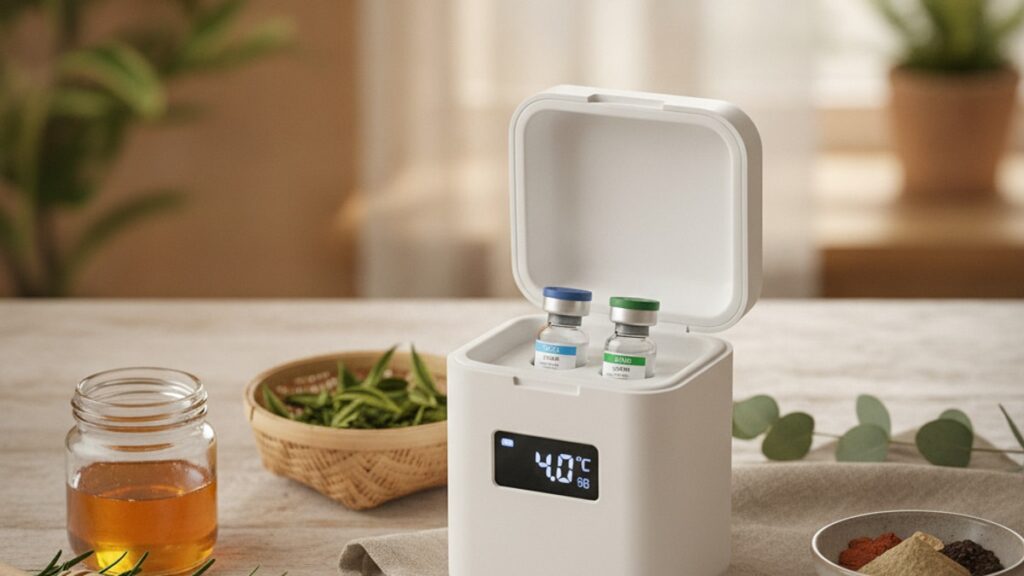
Use a medical-grade peptide cooler that maintains 2–8°C without external power. FRIO wallets use evaporative cooling and hold temperature for 36–48 hours when activated with water. For longer trips, portable mini-fridges designed for insulin storage (like the 4AllFamily cooler) maintain precise refrigeration for 7+ days on battery power. Standard ice packs in a soft cooler can't hold 2–8°C reliably for more than 6–8 hours in warm weather.
The Unforgiving Truth About Peptide Storage
Here's the honest answer: you can't visually tell when a peptide has lost potency. Not even close. A vial stored incorrectly for weeks looks identical to a fresh vial. Same clarity, same consistency, no precipitate. The degradation happens at the molecular level, where peptide bonds cleave and proteins aggregate in ways that don't produce visible changes until the compound is nearly useless.
This is why storage discipline matters more than injection technique. A perfectly executed injection of degraded peptide delivers nothing. The temperature ranges, light protection requirements, and 28-day reconstituted ceiling aren't suggestions. They're the biochemical limits of these molecules. Tesamorelin and ipamorelin are research-grade compounds with demanding stability profiles, and there's no forgiveness built into the chemistry. One overnight lapse, one temperature excursion during travel, one extra week past the 28-day mark. Each one costs measurable potency.
The information in this article is for research purposes. Storage protocols for synthetic peptides should be implemented under appropriate laboratory or clinical oversight to ensure compound integrity and experimental validity.
Our commitment to research-grade quality extends across every peptide in our collection. We ensure small-batch synthesis with exact amino-acid sequencing for purity and consistency. Whether you're exploring the FAT Loss Stack or investigating cellular repair pathways, proper storage determines whether your research compounds retain their intended molecular structure. And we provide the guidance to get it right.
Most peptide degradation happens before the first injection. In the shipment, in storage, or during the 48 hours after reconstitution when researchers assume refrigeration alone is sufficient. It's not. Amber vials matter. Temperature monitoring matters. The 28-day ceiling matters. If you're investing in research-grade peptides, storage discipline is the difference between valid data and wasted compound.
Frequently Asked Questions
How long can I store lyophilised tesamorelin + ipamorelin blend before reconstituting it?▼
Lyophilised tesamorelin + ipamorelin blend stored at −20°C (standard freezer temperature) maintains stability for 12–24 months depending on the purity of the synthesis and the packaging conditions. This extended stability exists because lyophilisation removes water molecules that facilitate peptide bond hydrolysis — freezing at −20°C slows residual molecular motion to near-zero. Room temperature storage reduces this window to 3–6 months with measurable potency loss. Always verify the supplier’s expiration date, which accounts for batch-specific synthesis and packaging timelines.
Can I refreeze reconstituted tesamorelin + ipamorelin if I don’t use it all?▼
No — freezing reconstituted peptide solutions causes ice crystal formation that physically disrupts the tertiary structure of proteins. When thawed, peptides may not refold correctly, leading to aggregation and permanent loss of biological activity. One freeze-thaw cycle reduces potency by 10–20%; two cycles reduce it by 30–40%. Once reconstituted, the peptide must remain refrigerated at 2–8°C for its entire 28-day usable lifespan. There is no way to extend this window through refreezing.
What happens if my reconstituted peptide gets too warm during use?▼
Temperature excursions above 8°C accelerate peptide bond hydrolysis exponentially — the degradation rate doubles for every 10°C increase. A vial left at room temperature (20–25°C) for one hour experiences degradation equivalent to 5–8 hours of refrigerated storage. If your vial was left out overnight or stored at room temperature for multiple hours, discard it — the potency loss is irreversible and undetectable without laboratory analysis. Brief exposures (under 15 minutes) during injection preparation are acceptable but should be minimised.
Why do lyophilised peptides need to be stored in amber vials?▼
Tesamorelin and ipamorelin both contain aromatic amino acids (tryptophan, tyrosine, phenylalanine) that absorb ultraviolet and visible light, triggering photolytic cleavage of peptide bonds through free radical formation. This process is amplified in reconstituted solutions where water molecules facilitate radical propagation. A clear vial stored under standard refrigerator lighting loses 5–10% potency over 12 weeks compared to an amber vial in identical conditions. Amber glass blocks wavelengths below 450 nm, preventing most photolytic degradation.
How does bacteriostatic water affect peptide stability compared to sterile water?▼
Bacteriostatic water contains 0.9% benzyl alcohol, which inhibits bacterial growth and extends microbiological safety — but it does not slow peptide degradation. The 28-day stability ceiling applies equally to peptides reconstituted in bacteriostatic water or sterile water because degradation is driven by peptide bond hydrolysis, not microbial contamination. Bacteriostatic water allows multi-dose vials to remain microbiologically safe across repeated needle punctures for 28 days; sterile water without preservative should be used within 24 hours of first puncture to avoid contamination risk.
What is the difference between storing peptides at 2–8°C versus −20°C?▼
The 2–8°C range (refrigeration) is mandatory for reconstituted peptide solutions because it slows hydrolysis without causing freeze damage — freezing reconstituted solutions creates ice crystals that disrupt protein structure. The −20°C range (freezer storage) is required for lyophilised peptides because it slows residual molecular motion to near-zero, extending stability to 12–24 months. Storing lyophilised peptides at 2–8°C instead of −20°C reduces long-term stability by 50–70%, and storing reconstituted peptides at −20°C causes irreversible freeze-thaw damage.
Can I travel with reconstituted tesamorelin + ipamorelin through airport security?▼
Yes — TSA and most international security agencies allow medically necessary peptides in carry-on luggage with proper storage. Use a medical-grade peptide cooler (like a FRIO wallet or 4AllFamily insulin cooler) that maintains 2–8°C without external power. Inform security officers that you are carrying temperature-sensitive research materials and have documentation from your supplier if possible. Never check reconstituted peptides in luggage — cargo hold temperatures can fluctuate wildly and cause irreversible degradation.
How do I know if my peptide has lost potency from improper storage?▼
You can’t tell visually — peptide degradation occurs at the molecular level without producing visible changes until the compound is nearly useless. A vial stored incorrectly for weeks looks identical to a fresh vial in clarity and consistency. The only definitive test is HPLC (high-performance liquid chromatography) analysis performed by a laboratory, which measures peptide purity and fragmentation patterns. If you suspect improper storage (temperature excursion, light exposure, or age beyond 28 days post-reconstitution), discard the vial rather than risk using degraded compound.
Why is there a 28-day limit on reconstituted peptides even when refrigerated?▼
The 28-day ceiling reflects the rate of peptide bond hydrolysis in aqueous solution at 2–8°C — a chemical process where water molecules cleave the amide bonds linking amino acids. This degradation is thermodynamically spontaneous and cannot be stopped, only slowed. Studies on similar GHRH analogues show 10–15% potency loss by day 30 and 25–35% loss by day 45 even under ideal refrigeration. The bacteriostatic water prevents bacterial growth but does nothing to inhibit chemical degradation.
What should I do if my supplier ships peptides without cold packs?▼
Contact the supplier immediately and request reshipping with proper cold-chain logistics. Reputable peptide suppliers use insulated shippers with gel packs or dry ice to maintain sub-ambient temperatures during transit — peptides shipped at room temperature can lose 10–25% potency before they arrive. If the peptide was already shipped without cold packs and has been in transit for more than 24 hours, request a replacement rather than accepting the delivery. There is no reliable way to assess potency loss from heat exposure without laboratory testing.











