







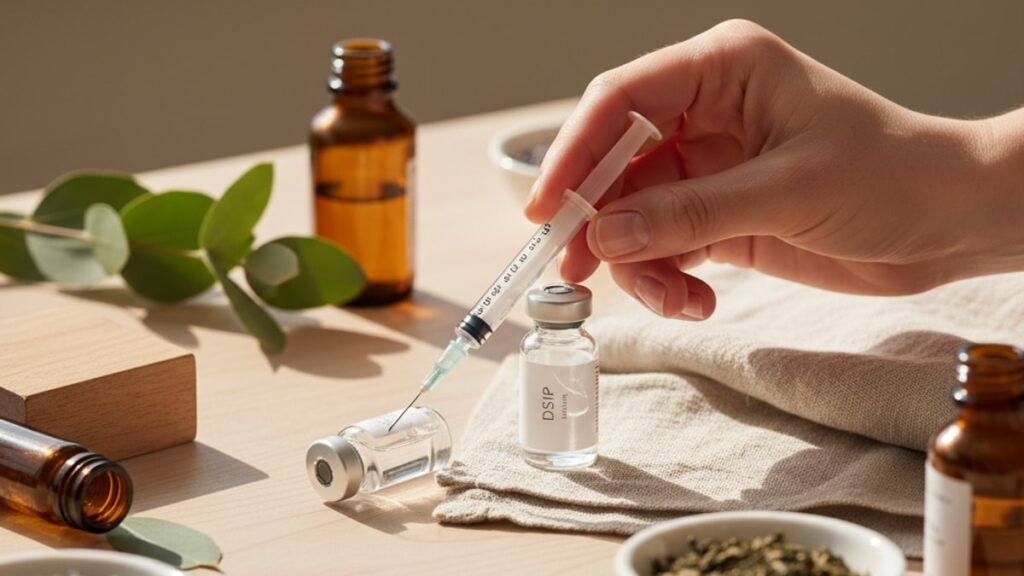
DSIP Needles Syringes — Complete Research Guide
Reconstituting lyophilised peptides like DSIP isn't complicated—but it's precise. The single most common protocol error researchers make isn't storage temperature or bacteriostatic water volume. It's needle gauge selection during reconstitution and administration. A 25-gauge needle creates different stopper trauma and internal pressure dynamics than an 18-gauge draw needle, and that difference determines whether your final ten draws from a vial are sterile or compromised.
We've guided hundreds of research teams through peptide handling protocols. The gap between doing it right and wasting expensive compounds comes down to three equipment choices most protocol documents never mention: draw needle gauge, administration needle length, and syringe dead space volume. Miss any of those and you're either contaminating the vial, injecting air instead of solution, or losing 15% of your dose to retention.
What needles and syringes are needed for DSIP peptide reconstitution and administration?
DSIP needles syringes require an 18–20 gauge draw needle for reconstitution, a 27–30 gauge insulin syringe for subcutaneous administration, and bacteriostatic water as the diluent. The draw needle minimizes stopper coring while the finer administration needle reduces tissue trauma and ensures accurate low-volume dosing in research models.
Yes, you can use standard insulin syringes for DSIP administration—but only after you've reconstituted the lyophilised powder with a separate draw system. DSIP (Delta Sleep-Inducing Peptide) is a nonapeptide supplied as a freeze-dried powder requiring reconstitution with bacteriostatic water before use. The reconstitution step demands a larger-bore needle to penetrate the rubber stopper without coring, while administration benefits from the precision and minimal dead space of insulin syringes designed for subcutaneous injection. This article covers the exact needle gauges and syringe types required for each step, the mechanical reasons those specifications matter, and the protocol mistakes that contaminate vials or waste solution.
Understanding DSIP Reconstitution Requirements
DSIP arrives as a lyophilised powder in sealed glass vials—typically 2mg or 5mg per vial depending on supplier and research protocol design. Lyophilisation removes water content to preserve peptide stability during storage at −20°C, but the powder must be reconstituted with bacteriostatic water before it can be measured, transferred, or administered. Bacteriostatic water contains 0.9% benzyl alcohol as a preservative, allowing multi-dose vials to remain sterile for up to 28 days when refrigerated at 2–8°C after reconstitution. This is the standard diluent for research-grade peptides including BPC-157, Thymosin Alpha-1, and Ipamorelin.
The reconstitution process requires a draw needle—18 to 20 gauge is the standard specification. Gauge refers to needle bore diameter: higher numbers mean smaller diameters. An 18-gauge needle has an outer diameter of 1.27mm, while a 27-gauge insulin needle measures 0.41mm. The larger draw needle serves two mechanical purposes. First, it penetrates the rubber stopper with minimal resistance, reducing the risk of coring—when small rubber fragments shear off the stopper and contaminate the solution. Cored particles are visible under magnification and represent a sterility failure. Second, the wider bore allows air displacement when injecting bacteriostatic water into the vial. Peptide vials are vacuum-sealed; injecting liquid creates positive pressure unless air can escape back through the needle. Using a narrow-gauge needle for this step creates a pressure lock that either prevents full injection or forces the plunger back out when you release pressure.
The protocol sequence is this: attach the 18–20 gauge draw needle to a 3mL or 5mL syringe, draw the calculated volume of bacteriostatic water (typically 1–2mL depending on desired concentration), insert the needle through the vial stopper at a 90-degree angle, inject the water slowly down the inside wall of the vial rather than directly onto the powder, and allow the powder to dissolve passively without shaking. Shaking denatures peptide bonds. After reconstitution, the solution is drawn back using the same large-bore needle, then the draw needle is removed and replaced with the administration needle before injection. Never administer with an 18-gauge needle—the tissue trauma and pain response are excessive and the needle length is inappropriate for subcutaneous depth.
Selecting Administration Needles and Syringes for DSIP
Once DSIP is reconstituted, administration requires insulin syringes—27 to 30 gauge with a 5/16-inch (8mm) or 1/2-inch (12.7mm) needle length. These are the same syringes used for insulin delivery in diabetic patients and are purpose-built for subcutaneous injection. Subcutaneous injection targets the adipose tissue layer between skin and muscle, typically in the abdomen, thigh, or upper arm. DSIP is administered subcutaneously in research models because the peptide's mechanism involves systemic circulation rather than localized tissue effect, and subcutaneous absorption provides steady release into the bloodstream over 4–6 hours.
Insulin syringes come in three standard volumes: 0.3mL (30 units), 0.5mL (50 units), and 1mL (100 units). For DSIP protocols, the 0.5mL or 1mL sizes are most common because reconstituted peptide concentrations typically require 0.2–0.5mL per dose depending on the researcher's target dosing and the reconstitution ratio. A 2mg vial reconstituted with 2mL bacteriostatic water yields a 1mg/mL concentration—meaning a 100mcg dose requires 0.1mL (10 units on an insulin syringe). The unit markings on insulin syringes are calibrated in 0.01mL increments, allowing precise low-volume measurement that would be impossible with standard 3mL Luer-lock syringes.
Needle gauge affects both injection pain and dosing accuracy. A 27-gauge needle (0.41mm diameter) causes measurably less tissue trauma than a 25-gauge needle (0.51mm diameter), and pain scores in human subcutaneous injection studies show statistically significant differences at this resolution. More importantly, finer needles reduce dead space—the volume of solution that remains in the needle hub and shaft after injection. A 1mL insulin syringe with an integrated 30-gauge needle has a dead space of approximately 0.01mL; a 3mL Luer-lock syringe with a detachable 25-gauge needle can have 0.07mL dead space. For a 0.2mL DSIP dose, losing 0.07mL to dead space means 35% of the intended dose never reaches the subject.
Our experience working with research teams running peptide protocols: dead space losses account for more dosing inconsistency than reconstitution errors. The solution is to use integrated insulin syringes where the needle is permanently attached to the barrel, eliminating the Luer-lock junction where most dead space accumulates. After drawing the dose from the reconstituted vial, hold the syringe vertically with the needle pointing up, tap the barrel to move air bubbles to the top, and expel the air by gently pressing the plunger until a small droplet appears at the needle tip. This technique removes air and fills the dead space with solution, ensuring the full measured dose is delivered.
Avoiding Common Protocol Errors with DSIP Needles Syringes
The most frequently observed error in peptide handling isn't contamination from environmental exposure—it's introducing air into the vial during solution withdrawal. Every time you insert a needle to draw peptide solution, you should inject an equivalent volume of air into the vial first. This creates neutral pressure and prevents vacuum formation. Without this step, the vacuum pulls the plunger backward as you try to draw, making precise volume measurement difficult, and on subsequent draws from the same vial, the negative pressure can pull contaminants backward through the needle tract in the stopper.
Here's the correct draw protocol: attach a fresh administration needle (27–30 gauge) to the insulin syringe. Pull the plunger back to the volume you intend to withdraw—say, 0.3mL. Insert the needle through the vial stopper. Push the plunger to inject that 0.3mL of air into the vial. Invert the vial so the needle tip is submerged in the solution. Pull the plunger back slowly to draw 0.3mL of solution. Remove the needle from the vial, expel air bubbles, and proceed with administration. This sequence maintains sterile pressure dynamics across the vial's lifespan. A vial handled this way remains uncontaminated for 28 days under refrigeration; a vial drawn without air replacement begins showing bacterial growth after 10–14 days even with bacteriostatic water.
Another protocol failure: reusing needles between reconstitution and administration. The 18-gauge draw needle used to add bacteriostatic water should never be used to inject a subject. Beyond the pain and tissue damage from a large-bore needle, the needle has already passed through a rubber stopper—meaning the tip is no longer sterile and may carry rubber particulate. After reconstitution, switch to a fresh insulin syringe for every administration. Some researchers attempt to save costs by drawing multiple doses into a single syringe and refrigerating it for later use. This violates sterile technique: once a needle has been exposed to air or passed through skin, it is contaminated, and storing a drawn syringe introduces risk of peptide degradation from temperature fluctuation and light exposure outside the amber glass vial.
Finally: never inject air back into the vial after drawing your dose. The air in the syringe barrel has been exposed to the environment and your hands. Injecting it into a multi-dose vial introduces contamination. The correct technique is to draw your dose with air-exchange as described, remove the syringe from the vial, then expel air bubbles by tapping and pressing the plunger with the needle pointed upward—allowing the air to escape into the room, not back into the vial. This keeps the remaining peptide solution in the vial sterile for the next draw.
DSIP Needles Syringes: Equipment Comparison
Choosing the right needle and syringe combination depends on whether you're reconstituting or administering. The two tasks require different tools.
| Task | Needle Gauge | Needle Length | Syringe Volume | Purpose | Bottom Line |
|---|---|---|---|---|---|
| Reconstitution | 18–20 gauge | 1.5 inches | 3–5mL | Penetrate stopper without coring; allow air displacement during injection | Use once per vial to add bacteriostatic water—then discard |
| Administration | 27–30 gauge | 5/16–1/2 inch | 0.5–1mL insulin syringe | Minimize tissue trauma; precise low-volume dosing for subcutaneous injection | Integrated needle design reduces dead space and improves dose accuracy |
| Multi-dose draw | 27–30 gauge | 5/16–1/2 inch | 0.5–1mL insulin syringe | Withdraw solution from reconstituted vial for single administration | Replace needle after each vial puncture if performing multiple draws in one session |
The 18-gauge reconstitution needle is a single-use tool—one needle per vial at the time of reconstitution. The 27–30 gauge insulin syringe is a single-use tool per injection—one syringe per dose, discarded after administration. Attempting to reuse either introduces contamination risk that bacteriostatic water cannot neutralize.
Key Takeaways
- DSIP needles syringes require an 18–20 gauge draw needle for reconstitution and a 27–30 gauge insulin syringe for subcutaneous administration—using the wrong gauge for either step causes stopper coring, pressure lock, or excessive dead space loss.
- Bacteriostatic water is the required diluent for DSIP reconstitution, and multi-dose vials remain sterile for 28 days only if proper air-exchange technique is used during every draw.
- Dead space in Luer-lock syringes can waste up to 35% of a low-volume peptide dose—integrated insulin syringes eliminate this loss and improve dosing consistency.
- Always inject an equivalent volume of air into the vial before drawing solution—this maintains neutral pressure and prevents contamination from vacuum-induced backflow through the needle tract.
- Never reuse needles between reconstitution and administration, and never inject air back into a multi-dose vial after drawing your dose—both practices introduce environmental contamination.
- DSIP and other research peptides from Real Peptides are supplied as lyophilised powders with exact amino-acid sequencing, requiring reconstitution with bacteriostatic water and proper handling technique to maintain purity and sterility throughout the vial's 28-day refrigerated lifespan.
What If: DSIP Needles Syringes Scenarios
What If I Use an Insulin Syringe for Both Reconstitution and Administration?
Don't. Insulin syringes use 27–30 gauge needles with a maximum length of 1/2 inch—too narrow and too short to reliably penetrate a vial stopper without bending or coring. The narrow bore also prevents air from escaping during bacteriostatic water injection, creating a pressure lock that stops the plunger mid-injection. You'll either fail to add the full volume of diluent, or the pressure will push the plunger back out when you release thumb force. Use an 18–20 gauge draw needle on a 3mL syringe for reconstitution, then switch to the insulin syringe only for administration after the peptide is fully dissolved.
What If I Don't Inject Air Before Drawing from the Vial?
The vial develops negative pressure. On the first draw, you'll notice the plunger resisting as you pull back—the vacuum fights your pull and makes precise volume measurement difficult. On subsequent draws from the same vial, the compounding vacuum creates a pressure differential across the stopper. When you insert the needle, the vacuum can pull air or contaminants backward through the needle tract in the rubber, introducing bacteria into a multi-dose vial that should otherwise remain sterile for 28 days. This is how vials become contaminated despite using bacteriostatic water. Always inject air equal to the volume you're withdrawing—this maintains atmospheric pressure inside the vial and prevents backflow contamination.
What If the Reconstituted DSIP Solution Looks Cloudy?
Discard it. Reconstituted DSIP should be clear and colorless—cloudiness indicates either incomplete dissolution, peptide aggregation, or particulate contamination from stopper coring. Incomplete dissolution usually resolves by gently swirling the vial (never shaking) and allowing it to sit at room temperature for 5–10 minutes. If cloudiness persists, the peptide has likely denatured—either from temperature excursion during shipping, improper storage before reconstitution, or agitation during mixing. Injecting aggregated or denatured peptide delivers no biological activity and introduces foreign protein particles that can trigger immune response. The correct action is to document the appearance, photograph the vial if possible, and contact the supplier for replacement. Real Peptides guarantees peptide purity and will replace any vial showing visible contamination or reconstitution failure.
The Technical Truth About DSIP Needles Syringes
Here's the honest answer: most DSIP protocols fail at the equipment stage, not the dosing stage. Researchers assume any syringe will work because 'it's just injecting liquid,' but peptide administration isn't analogous to drawing blood or administering intramuscular medication. The volumes are smaller, the solutions are more fragile, and the multi-dose vial format creates sterility requirements that single-dose ampules don't face. A 3mL Luer-lock syringe with a 25-gauge needle—the default choice in many lab supply catalogs—loses 0.05–0.07mL to dead space on every injection. For a 0.2mL DSIP dose, that's 25–35% waste per administration. Over a 28-day vial lifespan, you're losing nearly two full doses to retention in the needle hub and syringe junction.
The bottom line: DSIP needles syringes are not interchangeable equipment. Reconstitution requires a large-bore draw needle to prevent stopper damage and allow pressure equalization. Administration requires an integrated insulin syringe to minimize dead space and allow precise low-volume measurement. Skipping either specification doesn't cause immediate visible failure—your solution will still look clear, your vial will still seal—but you'll lose dose accuracy, introduce contamination risk, and waste expensive peptide across every administration. The protocol exists because the margins are tight. DSIP works at microgram-level doses where 0.05mL variance is the difference between therapeutic and subtherapeutic concentration. Use the right tools.
Peptide research requires precision at every step—from amino-acid sequencing during synthesis to needle gauge during administration. Real Peptides supplies research-grade DSIP and other compounds like Sermorelin, Tesamorelin, and CJC-1295 with exact molecular composition and third-party purity verification. But even the highest-purity peptide degrades if handled with improper technique. The needle gauge you choose, the air-exchange protocol you follow, and the dead space in your syringe all determine whether your research data reflects the peptide's true biological activity or just diluted, contaminated approximations.
If you're running peptide protocols and notice inconsistent results across subjects despite identical dosing—check your syringes first. The problem isn't the peptide. It's the 0.07mL you're losing to dead space on every injection, or the vacuum contamination you're introducing by skipping air exchange, or the 30% dose variance from using reconstitution needles for administration. Those errors compound across multi-dose vials and multi-week study timelines, turning precise molecular tools into guesswork. Get the equipment right, follow sterile technique, and the peptide performs as synthesized.
Frequently Asked Questions
What gauge needle should I use to reconstitute DSIP peptide?
▼
Use an 18 to 20 gauge draw needle for DSIP reconstitution. The larger bore penetrates the rubber stopper without coring and allows air displacement when injecting bacteriostatic water into the vacuum-sealed vial. Using a smaller gauge like 25 or 27 creates pressure lock and risks stopper fragmentation that contaminates the solution.
Can I use the same needle for DSIP reconstitution and administration?
▼
No. The 18–20 gauge draw needle used for reconstitution causes excessive tissue trauma and pain if used for subcutaneous injection. After reconstituting DSIP, switch to a 27–30 gauge insulin syringe for administration. The draw needle should be discarded after adding bacteriostatic water—it is contaminated from stopper contact and inappropriate for injection.
How much bacteriostatic water should I use to reconstitute a 2mg DSIP vial?
▼
Most protocols use 1–2mL bacteriostatic water per 2mg DSIP vial, yielding concentrations of 1–2mg/mL. The exact volume depends on your target dose per injection—using 2mL creates a 1mg/mL solution where 0.1mL delivers 100mcg. Always inject the water slowly down the vial wall, not directly onto the powder, and allow passive dissolution without shaking to prevent peptide denaturation.
Why does my syringe plunger pull back when I try to draw from the DSIP vial?
▼
You are not injecting air before drawing solution. Peptide vials are vacuum-sealed, and withdrawing liquid without replacing the volume creates negative pressure that fights the plunger pull. Before every draw, inject an air volume equal to the solution volume you plan to withdraw—this equalizes pressure and prevents vacuum-induced contamination from backflow through the stopper.
How long does reconstituted DSIP remain sterile in a multi-dose vial?
▼
Reconstituted DSIP remains sterile for up to 28 days when stored at 2–8°C in a refrigerator, provided you use bacteriostatic water as the diluent and follow sterile draw technique with air exchange on every withdrawal. Vials handled without air replacement or drawn with contaminated needles show bacterial growth after 10–14 days despite the benzyl alcohol preservative in bacteriostatic water.
What is the difference between insulin syringes and Luer-lock syringes for DSIP?
▼
Insulin syringes have integrated needles permanently attached to the barrel, creating minimal dead space (0.01mL), while Luer-lock syringes use detachable needles with junction dead space up to 0.07mL. For low-volume peptide doses like DSIP, the dead space in Luer-lock systems can waste 25–35% of the intended dose. Insulin syringes also provide unit markings in 0.01mL increments for precise measurement.
Should I use a new needle every time I draw from the same DSIP vial?
▼
Yes. Each needle passage through the rubber stopper dulls the tip and increases the risk of coring on subsequent punctures. For multi-dose vials, use a fresh insulin syringe for each administration—one syringe per injection, discarded after use. The cost of needles is negligible compared to the contamination risk and dose inaccuracy from reusing blunted or contaminated needles across multiple draws.
What does it mean if my reconstituted DSIP looks cloudy instead of clear?
▼
Cloudiness indicates peptide aggregation, incomplete dissolution, or particulate contamination from stopper coring. Properly reconstituted DSIP should be clear and colorless. If cloudiness persists after gentle swirling and 10 minutes at room temperature, the peptide has likely denatured from temperature excursion or agitation. Do not inject cloudy solutions—contact the supplier for replacement as the biological activity is compromised.
Can I store a drawn DSIP dose in the syringe overnight in the refrigerator?
▼
No. Once a needle has been exposed to air or passed through a stopper, it is no longer sterile, and storing drawn peptide outside the amber glass vial increases degradation risk from light and temperature fluctuation. Draw each DSIP dose immediately before administration using a fresh insulin syringe—multi-dose vials are designed for this workflow and remain stable for 28 days when solution stays sealed in the vial.
How do I prevent air bubbles in my DSIP syringe after drawing from the vial?
▼
After drawing your dose, hold the syringe vertically with the needle pointing upward and tap the barrel gently to move air bubbles to the top. Slowly press the plunger until a small droplet of solution appears at the needle tip—this expels the air and fills the dead space with peptide solution. Perform this step before every injection to ensure the full measured dose is delivered rather than retained in the needle hub.
What needle length should I use for subcutaneous DSIP administration?
▼
Use a 5/16-inch (8mm) or 1/2-inch (12.7mm) needle length for subcutaneous DSIP injection. These lengths target the adipose tissue layer between skin and muscle without penetrating into muscle tissue. Longer needles risk intramuscular injection, which alters absorption kinetics, while shorter needles may not reach the subcutaneous space in subjects with higher body fat percentages.
Is there a difference in DSIP absorption between 27-gauge and 30-gauge needles?
▼
No difference in absorption, but significant difference in injection pain and dead space. A 30-gauge needle (0.31mm diameter) causes less tissue trauma and lower pain scores than a 27-gauge needle (0.41mm diameter) in subcutaneous injection studies. Both gauges deliver peptide into the same tissue layer with equivalent bioavailability—the finer gauge simply reduces discomfort and often has slightly lower dead space in integrated insulin syringe designs.











