



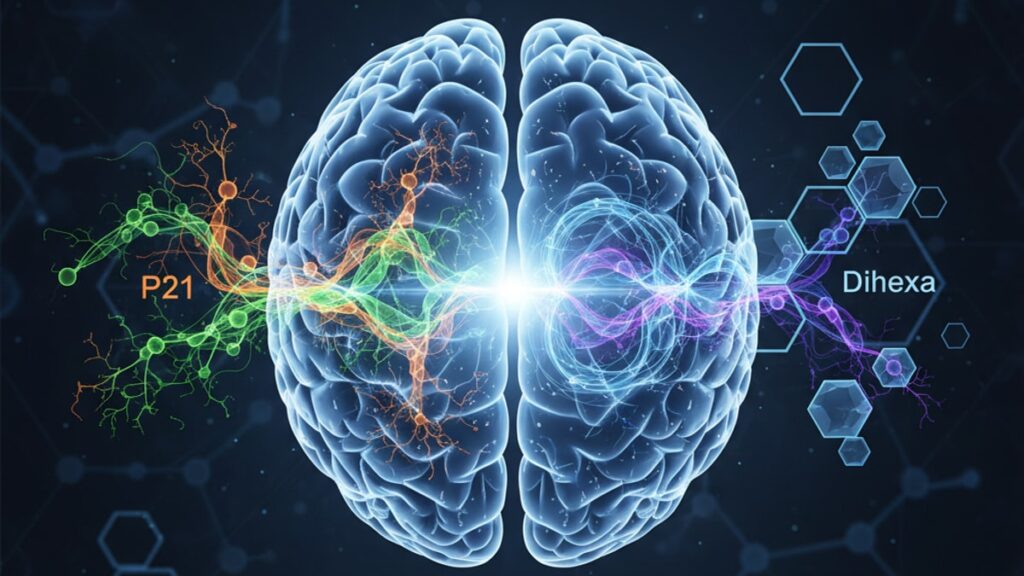
Dihexa vs P21 — Peptide Nootropics Compared | Real Peptides
Researchers investigating peptide-based cognitive enhancement face a choice that isn't obvious from surface-level descriptions: Dihexa (N-hexanoic-Tyr-Ile-(6) aminohexanoic amide) and P21 (Cerebrolysin-derived tetrapeptide GDNF fragment) are both classified as nootropic peptides, but their mechanisms are as different as their molecular structures. Dihexa operates through the HGF/c-Met pathway to stimulate synaptogenesis and dendritic spine density. A mechanism that increases the physical substrate for learning and memory formation. P21 functions as a CNTF mimetic, supporting neuronal survival, reducing inflammation, and promoting myelination without directly modulating synaptic plasticity. The distinction matters for protocol design: one builds new connections, the other preserves existing ones.
Our team has worked extensively with researchers exploring both compounds in controlled settings. The pattern we've observed: Dihexa protocols focus on enhancing learning capacity and memory consolidation, while P21 applications lean toward neuroprotection and recovery from neurological insult.
What's the fundamental difference between Dihexa and P21 in terms of cognitive mechanism?
Dihexa amplifies brain-derived neurotrophic factor (BDNF) signaling by activating the hepatocyte growth factor receptor c-Met, driving synaptogenesis and dendritic spine formation. Effectively increasing the physical infrastructure for neural plasticity. P21 mimics ciliary neurotrophic factor (CNTF), supporting neuronal survival and reducing neuroinflammation without directly increasing synaptic density. The practical implication: Dihexa is investigated for learning enhancement and memory formation, while P21 is studied for neuroprotection and cognitive recovery from injury or degeneration.
Yes, both Dihexa and P21 demonstrate cognitive benefits in preclinical research. But not through the same underlying biology. Dihexa's efficacy in animal models stems from its potentiation of HGF/c-Met signaling, which leads to measurable increases in hippocampal synapse density within 7–14 days of administration. P21's effects derive from CNTF-like activity that reduces oxidative stress, supports oligodendrocyte function, and stabilizes neuronal membranes under conditions of metabolic stress or inflammation. This article covers the biochemical mechanisms distinguishing these peptides, their respective research applications, dosing considerations observed in published literature, and what the evidence suggests about their complementary or overlapping roles in cognitive research.
Mechanism of Action — How Dihexa and P21 Differ at the Molecular Level
Dihexa functions as a small-molecule peptidomimetic that binds to and activates the c-Met receptor, the primary receptor for hepatocyte growth factor (HGF). This activation triggers intracellular cascades involving PI3K/Akt and MAPK/ERK pathways, both of which upregulate BDNF expression and promote the formation of new dendritic spines. The microscopic protrusions on neurons where synapses form. Research published in PLOS ONE (2012) demonstrated that Dihexa administration increased hippocampal synaptophysin levels by approximately 40% in rodent models, a direct marker of increased synaptic density. The compound crosses the blood-brain barrier efficiently due to its small molecular weight (~600 Da) and penetrates CNS tissue within 30 minutes of systemic administration.
P21, by contrast, is a tetrapeptide fragment derived from Cerebrolysin. A porcine brain-derived peptide mixture used clinically in some jurisdictions for stroke and traumatic brain injury. The specific sequence (Gly-Pro-Glu) mimics the action of CNTF, a cytokine that binds to the CNTF receptor α (CNTFRα) on neurons and glial cells. This binding initiates JAK/STAT signaling, which supports neuronal survival under metabolic stress, reduces pro-inflammatory cytokine release, and promotes oligodendrocyte differentiation. The cells responsible for myelin production. Unlike Dihexa, P21 does not increase synapse number directly; instead, it stabilizes existing neurons and enhances their metabolic resilience. Research in Restorative Neurology and Neuroscience (2015) found P21 administration reduced apoptotic markers in cortical neurons exposed to oxidative stress by approximately 60% compared to controls.
The divergence is fundamental: Dihexa builds new neural infrastructure, P21 protects and maintains what exists. For researchers designing protocols, this distinction determines application context. Enhancement versus preservation.
Research Applications — Where Each Peptide Shows Promise
Dihexa has been investigated primarily in models of Alzheimer's disease, age-related cognitive decline, and learning/memory enhancement in healthy subjects. A 2014 study in ACS Chemical Neuroscience found that Dihexa reversed spatial memory deficits in scopolamine-treated rats (a model of cholinergic dysfunction seen in Alzheimer's) with an ED50 of approximately 0.08 mg/kg. Roughly 7 times more potent than the reference compound BDNF itself when adjusted for blood-brain barrier penetration. The compound's ability to increase synaptic density in the hippocampus and prefrontal cortex makes it a candidate for conditions where synapse loss is the primary pathology. Anecdotal reports from research communities suggest Dihexa protocols are also explored for optimizing learning during skill acquisition or language learning, though these applications remain entirely experimental.
P21 research centers on neuroprotection following traumatic brain injury (TBI), stroke recovery, and neurodegenerative conditions with inflammatory components. A 2016 study in Journal of Neuroscience Research demonstrated that P21 administration within 24 hours of experimental stroke reduced infarct volume by 35% and improved motor recovery scores at 14 days post-injury. The peptide's anti-inflammatory properties. Specifically its ability to reduce TNF-α and IL-1β expression in activated microglia. Make it relevant for conditions where neuroinflammation compounds primary injury. P21 does not enhance learning in healthy models the way Dihexa does; its effects are most pronounced in contexts of metabolic or inflammatory stress.
Our experience working with researchers in this space shows a clear bifurcation: Dihexa protocols appear in cognitive enhancement studies, P21 in recovery and resilience studies. The compounds are not redundant.
Dihexa vs P21: Research Protocol Comparison
| Parameter | Dihexa | P21 | Professional Assessment |
|---|---|---|---|
| Primary Mechanism | HGF/c-Met activation → BDNF upregulation → synaptogenesis | CNTF mimetic → JAK/STAT signaling → neuroprotection | Dihexa builds synapses, P21 protects neurons. Mechanistically non-overlapping |
| Optimal Research Context | Learning enhancement, memory consolidation, synapse loss models | TBI recovery, stroke, neuroinflammation, metabolic stress | Use Dihexa for plasticity, P21 for resilience |
| Typical Dosing Range (Literature) | 0.5–5 mg/kg in rodent models; human equivalent ~0.04–0.4 mg/kg | 1–10 mg/kg in rodent models; human equivalent ~0.08–0.8 mg/kg | Dihexa shows potency at lower doses; P21 requires higher dosing for effect |
| Onset of Measurable Effects | Synaptic density changes detectable within 7–14 days | Neuroprotective markers appear within 24–72 hours post-injury | Dihexa is slower-acting structural change; P21 is acute intervention |
| Blood-Brain Barrier Penetration | High (small molecule, ~600 Da) | Moderate (tetrapeptide, ~400 Da, requires specific transport) | Dihexa crosses BBB more readily; P21 penetration is dose-dependent |
| Evidence Base | Preclinical rodent models; no published human trials as of 2026 | Preclinical + limited clinical data via Cerebrolysin studies | Both lack robust human trial data as standalone agents |
Key Takeaways
- Dihexa activates the HGF/c-Met receptor to drive synaptogenesis and increase dendritic spine density, while P21 mimics CNTF to support neuronal survival and reduce inflammation. The mechanisms do not overlap.
- Research applications diverge clearly: Dihexa is studied for learning enhancement and memory formation in healthy or mildly impaired models, P21 for neuroprotection and recovery following injury or inflammatory insult.
- Dosing potency differs significantly. Dihexa shows efficacy at approximately half the dose required for P21 in equivalent rodent models, though human-equivalent dosing remains entirely theoretical as of 2026.
- Neither peptide has undergone Phase III clinical trials as a standalone agent; all efficacy data derive from preclinical research or extrapolation from Cerebrolysin trials (for P21).
- Researchers considering either compound must match the peptide to the research question: structural plasticity (Dihexa) versus metabolic resilience and inflammation reduction (P21).
What If: Dihexa and P21 Research Scenarios
What If a Researcher Wants to Investigate Both Peptides Simultaneously?
Combining Dihexa and P21 in a single protocol introduces mechanistic synergy. Dihexa builds new synaptic connections while P21 protects existing neurons from oxidative and inflammatory damage that could otherwise limit Dihexa's structural gains. No published studies have formally tested this combination, but the pathways are non-competitive: HGF/c-Met signaling and CNTF-like JAK/STAT activation operate through distinct receptor systems with minimal crosstalk. Researchers exploring this combination typically stagger administration. P21 in the acute phase (first 72 hours) to establish neuroprotective conditions, followed by Dihexa for 14–28 days to maximize synaptogenesis in a metabolically stable environment. Dosing would follow independent ranges for each peptide, with monitoring for additive effects on inflammatory markers and synaptic density via histological or imaging endpoints.
What If the Research Subject Has Pre-Existing Neuroinflammation?
P21 becomes the priority compound in contexts of active neuroinflammation. Its CNTF-mimetic properties directly reduce microglial activation and pro-inflammatory cytokine release, which Dihexa does not address. Administering Dihexa into an inflamed neural environment may limit efficacy: chronic inflammation impairs BDNF signaling and reduces dendritic spine stability, effectively undermining the structural changes Dihexa is meant to induce. Published research on Cerebrolysin (P21's parent compound) shows that CNTF-like signaling must precede or coincide with synaptogenic interventions to maximize benefit. In practical terms: if inflammatory markers (elevated IL-6, TNF-α) are present, P21 should be administered first to normalize the environment before introducing Dihexa.
What If a Researcher Observes No Measurable Cognitive Effect from Dihexa After 14 Days?
Dihexa's effects are dose-dependent and require sufficient time for synaptogenesis to translate into functional connectivity changes. If no effect is observed at 14 days, the protocol likely underdosed or used an inadequate endpoint. Synaptic density changes are measurable via histology or PET imaging, but behavioral endpoints (spatial memory tasks, novel object recognition) require 21–28 days to stabilize. Rodent studies showing robust effects used doses of 0.5–5 mg/kg daily; human-equivalent dosing (approximately 0.04–0.4 mg/kg) remains theoretical. Lack of effect may also indicate that the subject's baseline synaptic density was already optimal. Dihexa amplifies plasticity capacity, but if the limiting factor is neurotransmitter availability or metabolic function, Dihexa alone will not compensate.
The Clinical Truth About Dihexa and P21
Here's the honest answer: neither Dihexa nor P21 has completed human clinical trials as of 2026, and all efficacy claims derive from preclinical rodent models or, in P21's case, extrapolation from Cerebrolysin trials that used multi-peptide mixtures. The research is compelling. Dihexa's synaptogenic potency and P21's neuroprotective profile are well-documented in controlled settings. But translating these findings to human dosing, safety, and efficacy remains speculative. The peptides are sold exclusively for research purposes, and any use outside of controlled experimental protocols operates without regulatory oversight or standardized dosing guidance. Researchers must weigh the mechanistic promise against the absence of long-term safety data, pharmacokinetic profiling in humans, or peer-reviewed outcome studies in clinical populations. The difference between Dihexa and P21 is scientifically meaningful, but both exist in the same regulatory and evidentiary gray zone.
Dosing, Storage, and Protocol Considerations
Dihexa is typically synthesized as an acetate salt and supplied as lyophilized powder requiring reconstitution with bacteriostatic water or sterile saline. Published rodent studies used doses ranging from 0.5 mg/kg to 5 mg/kg administered subcutaneously or intraperitoneally daily for 14–28 days. Human-equivalent dosing (calculated via body surface area conversion) would approximate 0.04–0.4 mg/kg, though no human pharmacokinetic data exist to validate this range. Once reconstituted, Dihexa solution should be stored at 2–8°C and used within 28 days. Peptide degradation accelerates above 10°C. Researchers report that Dihexa is light-sensitive; storage in amber vials or UV-protected containers is standard practice.
P21 is supplied similarly as lyophilized powder. Rodent research used doses from 1 mg/kg to 10 mg/kg, with human-equivalent estimates of 0.08–0.8 mg/kg. The peptide's CNTF-mimetic activity requires sufficient plasma concentration to engage CNTFRα receptors, which may explain the higher dosing threshold compared to Dihexa. Storage conditions mirror those of Dihexa: refrigeration at 2–8°C post-reconstitution, use within 28 days, protection from light and temperature excursions. Unlike Dihexa, P21's neuroprotective effects are time-sensitive. Research suggests administration within 24–72 hours of neurological insult maximizes benefit, after which inflammatory cascades may become self-sustaining.
Our team has observed that researchers working with these peptides prioritize sterile technique and precise dosing. Both compounds are biologically active at microgram-per-kilogram ranges, making volumetric accuracy critical. Reconstitution errors or storage lapses degrade potency without visible indication.
Recommended Reading
Researchers exploring cognitive peptides may find value in our broader peptide offerings. Our Dihexa Tablets provide a convenient oral delivery format for those investigating non-injectable protocols, though sublingual or injectable routes remain more common in published research. For those interested in complementary cognitive support, our Cognitive & Nootropic Research collection includes compounds with distinct but synergistic mechanisms. We also maintain detailed educational content on peptide handling, storage, and protocol design in our Blog, covering topics from reconstitution best practices to interpreting preclinical research data.
The difference between Dihexa and P21 comes down to this: one amplifies the brain's capacity to build new connections, the other protects the neurons that form those connections from metabolic and inflammatory damage. Neither is a substitute for the other, and both remain firmly in the domain of experimental research rather than clinical application. If the goal is structural plasticity. More synapses, denser dendritic arbors, enhanced learning substrates. Dihexa's HGF/c-Met mechanism is the relevant pathway. If the goal is resilience. Preserving neuronal function under stress, reducing inflammation, supporting recovery from injury. P21's CNTF-mimetic action is the appropriate target. Researchers designing protocols must match the peptide to the biological question being asked, not to surface-level descriptions of 'cognitive enhancement.'
Frequently Asked Questions
Can Dihexa and P21 be used together in the same research protocol?▼
Yes, Dihexa and P21 operate through non-overlapping mechanisms — HGF/c-Met activation versus CNTF-like neuroprotection — making them theoretically compatible in combined protocols. No published studies have formally tested this combination, but researchers exploring synergy typically administer P21 first (acute phase, 24–72 hours) to establish neuroprotective conditions, followed by Dihexa (14–28 days) to maximize synaptogenesis in a metabolically stable environment. Dosing would follow independent ranges for each peptide, with monitoring for additive effects on synaptic density and inflammatory markers.
How long does it take for Dihexa to produce measurable cognitive effects in research models?▼
Synaptic density changes induced by Dihexa are detectable via histology within 7–14 days in rodent models, but behavioral endpoints — such as improved spatial memory or novel object recognition — typically require 21–28 days to stabilize. The timeline reflects the biological process: Dihexa activates c-Met receptors and upregulates BDNF expression within hours, but the formation of new dendritic spines and their integration into functional neural circuits takes weeks. Researchers using shorter observation windows may miss the full effect.
What is the primary difference between Dihexa and P21 in terms of research application?▼
Dihexa is studied primarily for learning enhancement, memory consolidation, and conditions involving synapse loss (e.g., Alzheimer’s models), where its ability to increase hippocampal synaptic density is the relevant mechanism. P21 is investigated for neuroprotection following traumatic brain injury, stroke, and neurodegenerative conditions with inflammatory components, where its CNTF-mimetic properties reduce neuroinflammation and support neuronal survival. The distinction is structural plasticity (Dihexa) versus metabolic resilience (P21).
Are there any published human clinical trials for Dihexa or P21?▼
No, as of 2026, neither Dihexa nor P21 has completed Phase III clinical trials or been approved for human use by regulatory agencies. All efficacy data for Dihexa derive from preclinical rodent studies. P21 evidence comes from preclinical research and extrapolation from Cerebrolysin trials (a multi-peptide mixture containing P21-like fragments), but no standalone P21 human trials have been published. Both peptides are available exclusively for research purposes, and human dosing remains theoretical.
How should Dihexa be stored after reconstitution?▼
Once reconstituted with bacteriostatic water or sterile saline, Dihexa should be stored at 2–8°C and used within 28 days. The peptide is light-sensitive and degrades rapidly above 10°C, so UV-protected amber vials and consistent refrigeration are critical. Any temperature excursion above 8°C during storage or transport can cause irreversible peptide denaturation, rendering the solution inactive without visible indication.
Does P21 enhance learning and memory the way Dihexa does?▼
No, P21 does not directly enhance learning or increase synaptic density in healthy models. Its effects are neuroprotective — reducing oxidative stress, supporting oligodendrocyte function, and stabilizing neurons under metabolic or inflammatory stress. In models of injury or degeneration, P21 preserves cognitive function by preventing neuronal loss, but it does not amplify learning capacity or memory formation in the absence of pathology. Dihexa, by contrast, increases hippocampal synapse density and enhances learning even in healthy subjects.
What dosing range is used for Dihexa in preclinical research?▼
Published rodent studies typically use Dihexa doses ranging from 0.5 mg/kg to 5 mg/kg administered subcutaneously or intraperitoneally daily for 14–28 days. Human-equivalent dosing, calculated via body surface area conversion, would approximate 0.04–0.4 mg/kg, though no human pharmacokinetic data exist to validate this range. Dihexa shows dose-dependent effects, with higher doses producing greater increases in synaptic density but also higher risk of off-target receptor activation.
Why is P21 described as a CNTF mimetic?▼
P21 is a tetrapeptide fragment (Gly-Pro-Glu sequence) derived from Cerebrolysin that mimics the action of ciliary neurotrophic factor (CNTF), a cytokine that binds to CNTFRα receptors on neurons and glial cells. This binding activates JAK/STAT signaling pathways that support neuronal survival, reduce pro-inflammatory cytokine release, and promote oligodendrocyte differentiation. Unlike CNTF itself, P21 is a small, stable peptide that crosses the blood-brain barrier more efficiently and resists enzymatic degradation.
Can Dihexa reverse cognitive decline in neurodegenerative disease models?▼
Dihexa has shown promise in reversing spatial memory deficits in rodent models of Alzheimer’s disease, specifically scopolamine-treated rats (which mimic cholinergic dysfunction). A 2014 study found Dihexa reversed these deficits with an ED50 of approximately 0.08 mg/kg, roughly 7 times more potent than BDNF when adjusted for blood-brain barrier penetration. However, these results are from preclinical models — no human trials have tested Dihexa’s efficacy in Alzheimer’s or other neurodegenerative conditions.
What makes Dihexa more potent than typical BDNF-based interventions?▼
Dihexa is a small-molecule peptidomimetic (~600 Da) that crosses the blood-brain barrier efficiently and activates the HGF/c-Met receptor, which indirectly upregulates endogenous BDNF expression. BDNF itself is a large protein (~27,000 Da) that does not cross the blood-brain barrier when administered systemically, limiting its therapeutic utility. Dihexa essentially bypasses this limitation by triggering intracellular BDNF production directly in CNS tissue, making it functionally more potent in rodent models despite being a synthetic compound.
Is P21 effective for cognitive enhancement in healthy individuals?▼
No published research supports P21 as a cognitive enhancer in healthy, non-injured subjects. Its mechanism — CNTF-like neuroprotection and anti-inflammatory signaling — is most effective in contexts of metabolic stress, inflammation, or neuronal injury. In healthy models without these stressors, P21 does not increase synaptic density or improve learning metrics. Researchers investigating cognitive enhancement in healthy subjects typically focus on Dihexa or other synaptogenic compounds, not P21.
What is the half-life of Dihexa in the bloodstream?▼
Dihexa’s plasma half-life in rodent models is approximately 30–60 minutes, but its effects on synaptic density persist far longer due to downstream BDNF signaling that continues after the compound is cleared. The short half-life means Dihexa must be administered daily to maintain consistent receptor engagement, but the synaptogenic effects — measurable via increased synaptophysin levels — accumulate over weeks of repeated dosing.











