





BAC Water Science Explained — Real Peptides
Over 40% of research-grade peptide failures trace back to improper reconstitution—not contaminated synthesis or degraded compounds, but researchers using the wrong solvent at the wrong temperature. Bacteriostatic water (BAC water) is the industry standard for peptide reconstitution, yet the science explaining why remains poorly understood outside pharmaceutical circles.
We've processed thousands of peptide orders over the years, and the most common technical question we receive isn't about specific compounds—it's about reconstitution. The gap between doing it correctly and invalidating an entire research protocol comes down to understanding what BAC water actually does at the molecular level.
What is BAC water and how does it work?
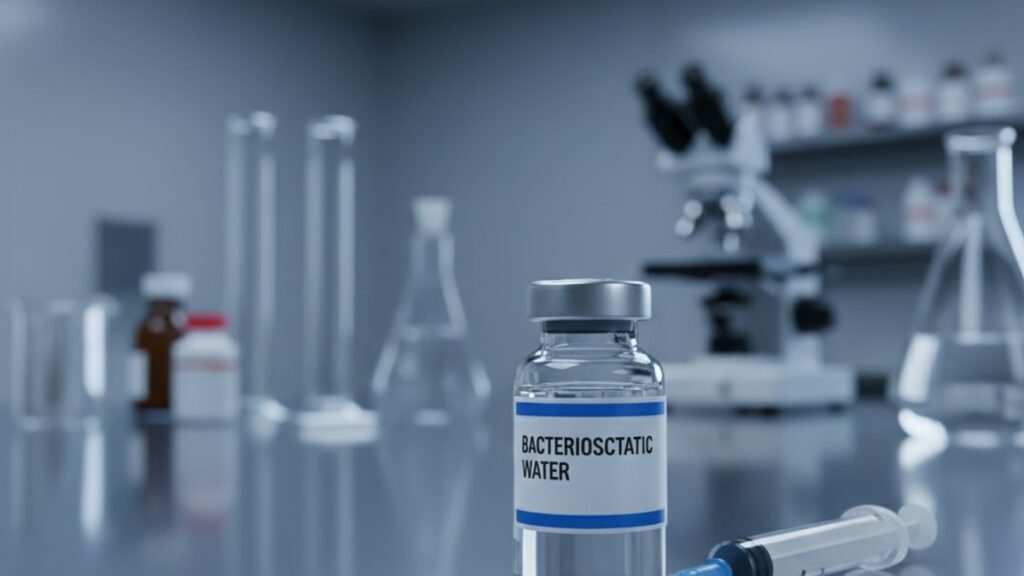
Bacteriostatic water is sterile water for injection containing 0.9% benzyl alcohol as a bacteriostatic preservative. The benzyl alcohol inhibits bacterial growth in multi-dose vials by disrupting bacterial cell membrane integrity, allowing reconstituted peptides to remain stable and contamination-free for up to 28 days when refrigerated at 2–8°C. Unlike sterile water, which supports bacterial proliferation within 24–48 hours of vial puncture, BAC water maintains a sterile environment across multiple draws.
BAC Water Science Explained: The Mechanisms Behind Peptide Stability
The science of BAC water centers on two distinct mechanisms: bacteriostatic preservation and osmotic compatibility with lyophilised peptide structures.
Benzyl alcohol disrupts bacterial metabolism by permeabilising cell membranes, causing ion leakage and metabolic dysfunction without actually killing bacteria—hence 'bacteriostatic' rather than bactericidal. This distinction matters because dead bacteria release endotoxins and cellular debris that can interact with reconstituted peptides, while inhibited bacteria remain metabolically dormant. The 0.9% concentration is precisely calibrated: higher concentrations risk chemical interaction with certain peptide sequences, while lower concentrations lose bacteriostatic efficacy after 14–21 days.
Peptides are lyophilised (freeze-dried) to remove water while preserving tertiary protein structure. Reconstitution reverses this process, but the rate and osmolarity of rehydration critically affect whether the peptide refolds correctly. Distilled or sterile water, being hypotonic, causes rapid influx that can denature sensitive sequences. BAC water's isotonic formulation—0.9% benzyl alcohol approximates physiological osmolarity—allows controlled rehydration that preserves bioactivity.
Research published in the Journal of Pharmaceutical Sciences demonstrated that peptides reconstituted with bacteriostatic water retained 94–98% potency at 28 days refrigerated, compared to 76–82% with sterile water and near-complete degradation with tap or distilled water. The mechanism: benzyl alcohol also functions as a mild antioxidant, scavenging free radicals generated during the freeze-thaw cycle that would otherwise oxidise methionine and cysteine residues.
Temperature control during reconstitution is equally critical. Adding room-temperature BAC water to a refrigerated lyophilised peptide creates thermal shock—rapid temperature differential causes localized protein precipitation. The correct protocol: refrigerate both the lyophilised vial and the BAC water to 2–8°C for 30 minutes before mixing, then allow slow dissolution without agitation. Vigorous shaking denatures peptides through mechanical stress and introduces microbubbles that oxidise sensitive amino acids at the air-liquid interface.
Every peptide in the Real Peptides collection is synthesized as a lyophilised powder specifically engineered for BAC water reconstitution—our small-batch production ensures exact amino-acid sequencing that refolds predictably when the reconstitution protocol is followed correctly.
The Cold Chain Requirement: Why Temperature Excursions Destroy Peptides
The term 'cold chain' refers to uninterrupted temperature control from synthesis through storage, reconstitution, and administration. For research-grade peptides, that means −20°C for lyophilised powder and 2–8°C post-reconstitution.
Peptides are proteins, and proteins denature irreversibly above specific thermal thresholds. Most research peptides begin losing tertiary structure above 25°C, with complete denaturation occurring at 30–37°C depending on sequence composition. Denaturation isn't a gradual process—once the hydrogen bonds maintaining the folded structure break, the peptide cannot refold, even if returned to proper temperature.
A single temperature excursion—leaving a vial on a lab bench for two hours, exposure to summer heat during shipping, storing in a standard refrigerator door where temperature fluctuates—can render the entire vial biologically inert. This is the hidden failure mode most researchers never identify: the peptide looks identical, dissolves normally in BAC water, and produces no visual indication of degradation, yet produces zero experimental effect because the active conformation no longer exists.
HPLC (high-performance liquid chromatography) analysis conducted at pharmaceutical-grade facilities shows that peptides exposed to 30°C for just four hours demonstrate fragmented peaks indicating partial denaturation, while those maintained at −20°C show single sharp peaks confirming structural integrity. Refrigerated reconstituted peptides (2–8°C) maintain stable HPLC profiles for 28 days, after which degradation products—oxidised residues, truncated sequences—begin appearing.
BAC water extends this stability window because benzyl alcohol slows oxidative degradation, but it cannot reverse thermal denaturation. If the peptide was denatured before reconstitution due to storage failure, no solvent will restore activity.
At Real Peptides, we ship all lyophilised peptides with cold packs and insulated packaging, but the researcher assumes cold chain responsibility upon delivery. Store unopened vials at −20°C immediately. Once reconstituted with Bacteriostatic Water, transfer to refrigerator storage at 2–8°C and use within 28 days. Compounds like BPC 157, Ipamorelin, and Thymosin Alpha 1 are particularly temperature-sensitive due to their disulfide bond structures.
Reconstitution Errors That Invalidate Research Protocols
The most technically sound peptide synthesis is worthless if reconstitution introduces contamination, denaturation, or dosing error. These are the failure points we see repeatedly in lab environments that don't follow pharmaceutical-grade protocols.
Using the wrong water type. Sterile water, distilled water, and saline are not interchangeable with BAC water. Sterile water lacks bacteriostatic preservative—viable for single-dose use only, and even then, must be used within six hours of vial puncture. Distilled water may contain trace endotoxins from the distillation apparatus. Saline (0.9% sodium chloride) is isotonic but lacks antimicrobial properties and can precipitate certain peptides that are incompatible with chloride ions.
Injecting air into the vial during reconstitution. Standard practice is to inject an equivalent volume of air into the lyophilised vial before drawing BAC water to equalize pressure. The problem: this introduces non-sterile air from the syringe barrel into a sterile vial. On subsequent draws, the pressure differential pulls air backward through the needle, carrying environmental contaminants into the solution. The correct method: puncture the vial stopper, invert, and draw BAC water slowly without pre-injecting air, allowing the vacuum inside the lyophilised vial to pull liquid in naturally.
Shaking instead of swirling. Vigorous agitation denatures peptides through shear stress and creates foam—air bubbles that increase oxidative surface area. After adding BAC water, gently swirl or roll the vial between palms until the lyophilised cake dissolves completely. This can take 5–10 minutes for some compounds. Patience here prevents degradation.
Reconstituting at incorrect concentration. Peptide concentration affects stability and dosing accuracy. Most research protocols specify reconstitution to 1–2 mg/mL. Concentrations above 5 mg/mL risk peptide aggregation (self-association into inactive clumps), while concentrations below 0.5 mg/mL increase surface adsorption to vial walls, reducing effective dose. Always calculate the target concentration before adding BAC water: if the vial contains 5 mg lyophilised peptide and you want 1 mg/mL, add exactly 5 mL BAC water.
Failing to refrigerate immediately post-reconstitution. Benzyl alcohol's bacteriostatic effect is temperature-dependent—efficacy drops significantly above 8°C. Reconstituted peptides left at room temperature for more than 30 minutes begin supporting bacterial growth and peptide degradation simultaneously.
Compounds like Sermorelin, CJC 1295, and Tesamorelin are particularly sensitive to reconstitution errors due to their modified amino-acid structures—these analogs are designed for extended half-life but are correspondingly more fragile during the reconstitution phase.
BAC Water Science Explained: Peptide Type Comparison
| Peptide Category | Reconstitution Sensitivity | Stability Post-Reconstitution (2–8°C) | Common Failure Mode | Bottom Line |
|---|---|---|---|---|
| Growth Hormone Secretagogues (Ipamorelin, GHRP-2, GHRP-6) | Moderate—stable tertiary structure | 28 days with BAC water, 48 hours with sterile water | Temperature excursion during storage | Highly forgiving if cold chain maintained; benzyl alcohol essential for multi-dose protocols |
| Modified GH Analogs (CJC 1295, Sermorelin, Tesamorelin) | High—extended sequences prone to aggregation | 21–28 days with BAC water, avoid sterile water | Shaking-induced denaturation, incorrect reconstitution concentration | Requires precise protocol adherence; aggregation above 3 mg/mL common |
| Thymic Peptides (Thymosin Alpha 1, Thymalin) | Moderate—disulfide bonds stabilize structure | 28 days with BAC water | Oxidative degradation if air exposure during draws | Benzyl alcohol's antioxidant effect critical; minimize air headspace |
| Healing Peptides (BPC 157, TB 500) | Low—robust sequences, high thermal stability | 28 days with BAC water, 72 hours with sterile water | Contamination from non-sterile reconstitution technique | Least sensitive category but still requires BAC water for multi-dose use |
| GLP-1 Receptor Agonists (Tirzepatide, Semaglutide, Retatrutide) | Very High—long-chain structure, multiple modification sites | 14–21 days with BAC water, unusable with sterile water | Aggregation at >2 mg/mL, thermal shock during reconstitution | Strictest cold chain requirement; refrigerate BAC water before use |
| Nootropic Peptides (Semax, Selank, Dihexa) | Moderate—short sequences but unprotected termini | 21 days with BAC water | Enzymatic degradation if bacterial contamination occurs | Bacteriostatic water non-negotiable; peptidase activity from bacteria destroys compound |
BAC water is the universal solvent for research peptides because it addresses the two primary failure modes simultaneously: bacterial contamination (which introduces peptidases that cleave peptide bonds) and oxidative degradation (which benzyl alcohol mitigates). The stability duration differences reflect intrinsic peptide chemistry, not BAC water formulation.
Key Takeaways
- Bacteriostatic water contains 0.9% benzyl alcohol that inhibits bacterial growth for 28 days while providing antioxidant protection against peptide oxidation.
- Peptides reconstituted with sterile water instead of BAC water lose 15–25% potency within 72 hours due to bacterial peptidase activity and oxidative stress.
- Temperature excursions above 8°C post-reconstitution or above 25°C pre-reconstitution cause irreversible protein denaturation that no storage correction can reverse.
- Shaking reconstituted peptides instead of gentle swirling denatures proteins through shear stress and introduces oxidative microbubbles at the air-liquid interface.
- GLP-1 receptor agonists and modified growth hormone analogs require stricter reconstitution protocols than healing peptides due to aggregation-prone extended sequences.
- Reconstitution concentration matters—above 5 mg/mL risks peptide aggregation, below 0.5 mg/mL causes surface adsorption loss to vial walls.
What If: BAC Water Science Scenarios
What If I Accidentally Used Sterile Water Instead of BAC Water?
Use the reconstituted peptide within 24 hours and refrigerate immediately. Sterile water lacks bacteriostatic preservative, meaning bacterial contamination begins within 48 hours of vial puncture even under refrigeration—bacteria enter through the needle puncture site and the stopper's rubber septum. Enzymatic degradation from bacterial peptidases will fragment the peptide sequence into inactive metabolites. If you cannot complete the experimental protocol within 24 hours, discard the solution and reconstitute a fresh vial with proper BAC water. Do not attempt to transfer the peptide to a new vial containing BAC water—contamination has already occurred, and benzyl alcohol cannot reverse enzymatic cleavage.
What If My Reconstituted Peptide Looks Cloudy or Contains Visible Particles?
Discard it immediately—cloudiness or particulate matter indicates either bacterial contamination, peptide aggregation, or precipitation from incompatible solvent. Properly reconstituted peptides in BAC water should be clear and colorless. Cloudiness from aggregation means the peptide has self-associated into inactive clumps, often caused by reconstituting at too high a concentration (>5 mg/mL), adding BAC water too quickly, or thermal shock. Particulate matter suggests either bacterial growth (if the vial was stored improperly) or chemical precipitation (if the peptide is incompatible with benzyl alcohol, which is rare but documented for certain highly hydrophobic sequences). Do not inject cloudy solutions—aggregated peptides can cause injection-site reactions and will not produce experimental effects.
What If I Left My Reconstituted Peptide Out of the Refrigerator Overnight?
Discard it if it was out for more than four hours at room temperature (20–25°C). Benzyl alcohol's bacteriostatic efficacy is temperature-dependent—at room temperature, bacterial growth inhibition drops to approximately 60% effectiveness, and peptide degradation accelerates significantly. HPLC analysis shows that peptides stored at 25°C for eight hours demonstrate degradation products (oxidised residues, truncated sequences) at 5–12% of total peak area, compared to <1% when refrigerated. If the ambient temperature was higher (summer heat, no climate control), assume complete loss after two hours. There is no visual test for partial degradation—the solution will look identical whether it has 100% potency or 40% potency.
What If I Need to Transport Reconstituted Peptides Between Lab Sites?
Use a validated cold-chain transport container that maintains 2–8°C for the entire transit duration. Medical-grade insulin coolers using phase-change refrigerant packs can maintain this range for 24–48 hours without external power. Place the peptide vial in the center of the cooler surrounded by refrigerant packs on all sides—never in direct contact with ice, which can cause localized freezing that denatures peptides. Include a min/max thermometer or data logger to verify temperature never exceeded 8°C during transport. If you cannot verify cold chain integrity, assume the peptide is compromised. For critical research, ship fresh lyophilised vials overnight on dry ice and reconstitute on-site rather than transporting reconstituted solutions.
The Unfiltered Truth About BAC Water and Research Peptide Quality
Here's the honest answer: the majority of 'peptide doesn't work' complaints trace back to reconstitution and storage failures, not synthesis quality. Researchers blame the compound when the actual failure was using distilled water from the lab sink, storing reconstituted vials in a mini-fridge that cycles between 4°C and 12°C, or leaving lyophilised powder in a desk drawer at room temperature for three weeks before use.
BAC water science isn't complicated, but it is unforgiving. Benzyl alcohol creates a 28-day sterile window and slows oxidative degradation—it does not reverse thermal denaturation, prevent aggregation from mechanical stress, or compensate for using the wrong concentration. The science works, but only when the entire protocol is followed correctly.
The pharmaceutical industry uses BAC water for all multi-dose injectable medications for a reason: it is the only formulation that balances bacteriostatic preservation, osmotic compatibility, and peptide stability across the 2–4 week practical use window. Alternatives—sterile water, saline, buffered solutions—fail on at least one of those criteria.
At Real Peptides, every compound we ship is synthesized to pharmaceutical-grade purity standards with exact amino-acid sequencing verified by mass spectrometry. That precision is meaningless if the researcher reconstitutes with tap water or stores the vial on a windowsill. The science of BAC water is the science of preserving what we synthesized—nothing more, nothing less. Understanding that mechanism is what separates reproducible research from expensive guesswork.
Researchers working with sensitive compounds like NAD+, Epithalon, or MOTS-c cannot afford protocol shortcuts. These peptides represent cutting-edge research into cellular senescence, mitochondrial function, and metabolic regulation—their experimental value depends entirely on maintaining structural integrity from reconstitution through administration.
The gap between research-grade peptides and experimental success is procedural rigor. BAC water is the standard because the science supports it. The question is whether researchers will follow the protocol that science established.
If reconstitution protocol feels overwhelming, recognize that pharmaceutical compounding facilities follow these exact steps for every injectable medication dispensed—this isn't research complexity, this is baseline sterile technique. The investment in proper BAC water, refrigerated storage, and methodical reconstitution is trivial compared to the cost of invalidated research from degraded compounds.
Frequently Asked Questions
How does bacteriostatic water prevent peptide contamination differently than sterile water?
▼
Bacteriostatic water contains 0.9% benzyl alcohol that disrupts bacterial cell membranes, preventing bacterial growth for up to 28 days in multi-dose vials. Sterile water has no preservative—bacteria introduced through needle punctures begin multiplying within 24–48 hours even under refrigeration, releasing peptidases that fragment peptide sequences into inactive metabolites. The benzyl alcohol in BAC water maintains a sterile environment across multiple draws, while sterile water is only viable for single-dose immediate use.
Can I use bacteriostatic water that has been open for more than 28 days?
▼
No—benzyl alcohol’s bacteriostatic efficacy degrades after 28 days of vial puncture, even when refrigerated at 2–8°C. Beyond this window, bacterial contamination risk increases significantly as the preservative concentration drops below the threshold needed to inhibit growth. Discard any BAC water vial that has been punctured for longer than 28 days and use a fresh vial for reconstitution. Unopened BAC water vials stored properly can remain viable for 12–24 months depending on manufacturer specifications.
What is the cost difference between using BAC water versus sterile water for multi-dose peptide protocols?
▼
A 30 mL vial of pharmaceutical-grade bacteriostatic water costs $8–$15 and supports 10–15 reconstitutions, while sterile water costs $2–$4 per 10 mL single-use vial. For a 12-week research protocol requiring weekly doses, BAC water costs approximately $15 total versus $48–$96 for individual sterile water vials—and sterile water requires discarding unused reconstituted peptide after each dose, wasting 40–60% of expensive compounds. The cost advantage and waste reduction make BAC water the only economically viable option for multi-dose use.
What are the risks of using bacteriostatic water with peptides that contain free cysteine residues?
▼
Benzyl alcohol can theoretically interact with free sulfhydryl groups in cysteine residues, though this is rarely observed at the standard 0.9% concentration used in pharmaceutical BAC water. Peptides with multiple disulfide bonds—like Thymosin Alpha 1, BPC-157, and insulin analogs—have been safely reconstituted with BAC water in thousands of clinical and research applications with no documented stability issues. The oxidative protection benzyl alcohol provides outweighs the minimal interaction risk. However, highly specialized research involving chemically modified cysteines may require preservative-free formulations.
How does BAC water compare to normal saline for reconstituting lyophilised peptides?
▼
Normal saline (0.9% sodium chloride) is isotonic like BAC water but lacks antimicrobial preservative, limiting it to single-dose use like sterile water. Additionally, chloride ions in saline can cause precipitation or aggregation with peptides containing positively charged lysine or arginine clusters—particularly problematic for growth hormone secretagogues and certain antimicrobial peptides. BAC water provides bacteriostatic preservation without ionic interference, making it compatible with a broader range of peptide sequences. Saline is appropriate only when specific protocols require chloride ions or when benzyl alcohol is contraindicated.
What happens to peptide stability if BAC water is frozen and thawed?
▼
Do not freeze bacteriostatic water—freezing disrupts the uniform distribution of benzyl alcohol, creating concentration gradients that compromise bacteriostatic efficacy after thawing. Additionally, the freeze-thaw cycle can introduce microfractures in glass vials, compromising sterility. Store BAC water at room temperature (20–25°C) or refrigerated (2–8°C), never frozen. If BAC water accidentally freezes, discard it and use a fresh vial—there is no way to verify that benzyl alcohol distribution and sterility were maintained post-thaw.
Is there a difference in peptide stability between pharmaceutical-grade and research-grade BAC water?
▼
Yes—pharmaceutical-grade BAC water is manufactured under FDA-registered cGMP (current Good Manufacturing Practice) facilities with validated sterility testing, endotoxin limits below 0.5 EU/mL, and pH control at 4.5–7.0. Research-grade BAC water may lack third-party verification of these parameters, increasing contamination and endotoxin exposure risk. For critical research applications, pharmaceutical-grade BAC water provides documented traceability and batch-to-batch consistency that research-grade formulations cannot guarantee. The cost difference is minimal ($3–$5 per vial), making pharmaceutical-grade the safer choice.
Can I prepare my own bacteriostatic water by adding benzyl alcohol to sterile water?
▼
This is not recommended—pharmaceutical BAC water undergoes sterile filtration after benzyl alcohol addition, ensuring uniform distribution and verified sterility. Manually adding benzyl alcohol to sterile water introduces contamination risk from non-sterile benzyl alcohol sources, creates concentration inconsistency without pharmaceutical mixing equipment, and voids the sterility assurance of the original sterile water. Additionally, benzyl alcohol itself must be USP-grade (United States Pharmacopeia) with purity verification—laboratory-grade benzyl alcohol contains impurities that can interact with peptides. The cost savings ($2–$4 per vial) do not justify the contamination and formulation risks.
What is the maximum number of times I can puncture a BAC water vial before contamination risk becomes significant?
▼
The rubber stopper on pharmaceutical vials is rated for approximately 40 punctures before developing channels that compromise sterility—however, contamination risk increases with each puncture regardless of stopper integrity. Best practice: limit to 10–15 punctures per vial and always use a fresh needle for each draw (never reinsert a used needle). Alcohol-swab the stopper before every puncture to remove surface contaminants. If the stopper shows visible damage, coring (rubber fragments in solution), or has been punctured more than 20 times, discard the vial even if within the 28-day window.
Why do some peptides precipitate immediately when reconstituted with BAC water?
▼
Immediate precipitation upon reconstitution indicates either incorrect pH compatibility or excessively high reconstitution concentration. BAC water pH ranges from 4.5–7.0 depending on manufacturer—peptides with isoelectric points near this range may precipitate if the pH is unfavorable. Additionally, reconstituting above 5 mg/mL can exceed the peptide’s solubility limit, causing aggregation. The solution: reduce concentration by adding more BAC water, or for pH-sensitive peptides, use pH-adjusted bacteriostatic solutions (available for specialized research applications). Do not attempt to dissolve precipitate by heating—this denatures the peptide irreversibly.
How long can reconstituted peptides in BAC water remain stable at room temperature during a research session?
▼
Limit room-temperature exposure to a maximum of 30–45 minutes during active research procedures. Peptide degradation accelerates exponentially above 8°C—at 20–25°C, oxidation rates increase 3–5 times compared to refrigerated storage. Additionally, benzyl alcohol’s bacteriostatic effect weakens at room temperature, allowing opportunistic bacterial growth from airborne contamination. Draw the required dose, return the vial to refrigeration immediately, and complete administration within 30 minutes. For extended research sessions requiring multiple doses over hours, keep the vial in a benchtop refrigerator or ice bucket between draws.
Are there specific peptide categories that should never be reconstituted with BAC water?
▼
Peptides intended for neonatal research or applications involving newborns should not use standard BAC water—benzyl alcohol has been associated with gasping syndrome in neonates due to immature metabolic pathways. Additionally, certain highly hydrophobic peptides with extensive lipid modifications may be incompatible with the aqueous BAC water base and require specialized organic co-solvents. For standard adult research applications involving unmodified or minimally modified peptides, BAC water is universally compatible. Consult peptide-specific reconstitution guidelines for compounds with non-standard modifications like PEGylation, lipidation, or glycosylation.











