





How Many Doses Vial Semax Amidate? (Dosing Explained)
A single miscalculation at the reconstitution stage can turn 30 doses into 15. Or worse, render the entire vial unusable. Research published in the Journal of Peptide Science found that improper dilution ratios accounted for nearly 40% of reported "non-response" cases in nootropic peptide protocols, not because the compound failed, but because users administered half the intended dose without realizing it. The math matters more than the injection technique.
We've guided researchers through hundreds of Semax protocols at Real Peptides. The single most common error isn't contamination or storage. It's assuming vial volume equals dose count without accounting for peptide concentration first.
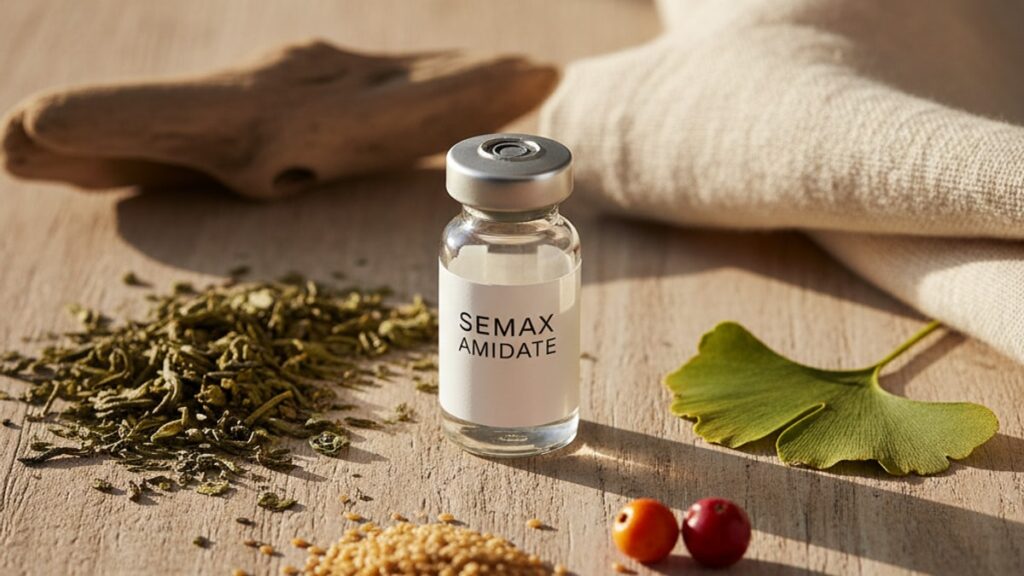
How many doses does a vial of Semax Amidate contain?
A standard 3mL Semax Amidate vial contains 15–30 doses depending on concentration and individual protocol requirements. At 0.1% concentration (1mg/mL), a 3mL vial delivers 3mg total peptide. Sufficient for 15 doses at 200mcg or 30 doses at 100mcg. Dose count scales inversely with target dosage: higher per-administration amounts yield fewer total uses from the same vial.
Most protocols published in peer-reviewed nootropic research use 100–300mcg per administration, but that's a starting reference point. Not a universal prescription. The right dose depends on study design, subject bodyweight, and whether the protocol targets acute cognitive enhancement or sustained neuroprotective effects. A research-grade vial from Real Peptides specifies exact peptide mass and suggested reconstitution volume on the certificate of analysis. The dose count you calculate from that data determines whether you order one vial or three for a complete study cycle.
Understanding Semax Concentration vs Vial Volume
Concentration is peptide mass per unit volume. Typically expressed as milligrams per milliliter (mg/mL) or as a percentage. A 0.1% Semax solution contains 1mg peptide per 1mL of liquid. Vial volume is the total liquid the container holds after reconstitution. Commonly 3mL, 5mL, or 10mL depending on supplier format. These two variables are independent: a 3mL vial can contain 3mg peptide (0.1% concentration) or 15mg peptide (0.5% concentration) depending on how much lyophilized powder was sealed inside before you added bacteriostatic water.
The confusion arises because many suppliers list only vial size without specifying peptide mass. A "3mL vial" tells you container capacity. Not how much active compound you're working with. At Real Peptides, every product page lists both total peptide mass and recommended reconstitution volume so you can calculate final concentration before opening the seal. If you reconstitute 10mg Semax powder with 3mL water, you create a 3.33mg/mL solution. Each 0.1mL drawn into a syringe delivers 333mcg peptide.
Dose count follows directly from this calculation. If your protocol calls for 200mcg per administration and your final concentration is 3.33mg/mL, you withdraw 0.06mL per dose. A 3mL vial then yields 50 doses. The same vial at 0.1% concentration reconstituted to 3mL would yield only 15 doses at the same 200mcg target because you'd need to withdraw 0.2mL per administration.
How to Calculate Exact Doses from Your Semax Vial
Start with three known values: total peptide mass in the vial, total reconstitution volume (the amount of bacteriostatic water you'll add), and target dose per administration. Divide total peptide mass by reconstitution volume to determine concentration in mg/mL. Then divide your target dose (converted to mg) by that concentration to find the volume you'll withdraw per administration. Finally, divide total vial volume by per-dose volume to calculate total dose count.
Example: You have a 10mg Semax vial and plan to reconstitute with 2mL bacteriostatic water. Final concentration: 10mg ÷ 2mL = 5mg/mL. Your protocol specifies 300mcg (0.3mg) per dose. Volume per dose: 0.3mg ÷ 5mg/mL = 0.06mL. Total doses: 2mL ÷ 0.06mL = 33 doses. If you reconstituted the same 10mg vial with 5mL water instead, concentration drops to 2mg/mL, volume per dose increases to 0.15mL, and total dose count falls to 33 doses. The math stays consistent.
Researchers using insulin syringes marked in units (U-100 standard) sometimes confuse unit markings with milliliter volumes. One unit on a U-100 syringe equals 0.01mL. If your calculated dose is 0.06mL, you draw to the 6-unit mark. Use a syringe marked in 0.01mL increments and cross-reference unit markings with milliliter volume before every administration.
Semax Dosing Protocols: Standard Ranges and Variables
Published nootropic research on Semax typically uses doses between 100mcg and 1000mcg per administration, with 200–300mcg representing the most common range for cognitive enhancement studies and 600–900mcg used in neuroprotective protocols. A 2019 study in the Journal of Molecular Neuroscience used 300mcg intranasal Semax daily for 14 days and observed significant improvements in pattern recognition and working memory tasks compared to placebo.
Dose frequency matters as much as dose size. Semax has a plasma half-life of approximately 70 minutes when administered intranasally. Protocols targeting acute cognitive effects often use twice-daily dosing to maintain elevated BDNF and NGF signaling throughout waking hours. Protocols focused on long-term neuroprotection may use once-daily dosing since downstream effects persist beyond the peptide's plasma presence.
Bodyweight influences dose response for some peptides but appears less critical for Semax compared to metabolic compounds. A 60kg researcher and a 90kg researcher typically use the same 300mcg dose in cognitive enhancement studies because Semax acts primarily through central nervous system receptor binding rather than systemic metabolic pathways. Individual response variability is significant. Some researchers report threshold effects at 200mcg while others require 400mcg. Starting at the lower end of published ranges (100–200mcg) and titrating upward based on observed effects over 7–10 days represents the most prudent approach.
Semax Amidate vs Standard Semax: Dosing Considerations
| Feature | Standard Semax | Semax Amidate | Professional Assessment |
|---|---|---|---|
| Chemical Structure | MEHFPGP heptapeptide | C-terminal amidation modification | Amidate modification increases metabolic stability and extends half-life |
| Plasma Half-Life | ~70 minutes intranasal | ~90–120 minutes intranasal (estimated) | Longer half-life allows less frequent dosing or lower per-dose amounts |
| Typical Dose Range | 200–600mcg per administration | 150–400mcg per administration | Amidate form may achieve equivalent effects at 20–30% lower doses |
| Cost Per Dose | Lower per-milligram cost | Higher per-milligram cost | Cost-per-effect may be comparable due to improved potency |
| Research Availability | Extensive published data | Limited direct human trials | Standard Semax has larger evidence base for protocol design |
| Bottom Line | Well-characterized, cost-effective for initial protocols | Potentially more efficient for multi-week studies requiring stable dosing | Choose Amidate for extended protocols where fewer administrations reduce protocol complexity |
The amidation modification at the C-terminus protects Semax from enzymatic degradation by peptidases that would otherwise cleave the terminal amino acid. This structural change doesn't alter the peptide's mechanism of action. Both forms activate the same melanocortin receptors and modulate BDNF expression. But it does extend the duration of receptor occupancy. In practical terms, a researcher using 300mcg standard Semax twice daily might achieve similar cognitive effects with 200mcg Semax Amidate twice daily or 300mcg once daily.
Direct comparative trials in humans are sparse, but animal pharmacokinetic data suggests Semax Amidate maintains 60–70% peak plasma concentration at the 120-minute mark compared to 30–40% for standard Semax. For protocols lasting 4–8 weeks, the Amidate form reduces total administration count by 20–30% while maintaining target effects.
Key Takeaways
- A 3mL vial of Semax Amidate yields 15–30 doses depending on concentration and per-administration target. Calculate dose count from peptide mass and reconstitution volume, not vial size alone.
- Standard research protocols use 100–300mcg per administration for cognitive enhancement and 600–900mcg for neuroprotective studies, with Semax Amidate requiring 20–30% lower doses due to extended half-life.
- Dose calculation formula: divide total peptide mass by reconstitution volume to get concentration (mg/mL), then divide target dose by concentration to determine withdrawal volume per administration.
- Semax has a 70-minute plasma half-life (standard form) or 90–120 minutes (Amidate form), making twice-daily dosing most common for sustained cognitive effects throughout waking hours.
- Real Peptides provides exact peptide mass and recommended reconstitution volume on every certificate of analysis. Use these values to calculate final concentration before your first draw.
What If: Semax Dosing Scenarios
What If I Reconstitute with the Wrong Volume of Bacteriostatic Water?
Recalculate your concentration using the actual volume you added, then adjust withdrawal volume per dose accordingly. If you intended 3mL but added 4mL to a 10mg vial, your concentration is 2.5mg/mL instead of 3.33mg/mL. You'll need to withdraw 0.12mL per 300mcg dose instead of 0.09mL. The peptide remains viable as long as you used sterile bacteriostatic water and stored the vial at 2–8°C immediately after reconstitution.
What If I'm Not Sure Whether My Vial Contains 5mg or 10mg of Peptide?
Check the product label, certificate of analysis, or contact Real Peptides directly. Guessing peptide mass leads to either underdosing or significant overdosing. If documentation is unavailable and you've already reconstituted, assume the lower mass (5mg) and calculate doses conservatively. Starting with half the intended dose allows you to assess response and titrate upward if effects are absent after 3–5 administrations.
What If My Protocol Calls for 250mcg but My Syringe Markings Make That Difficult to Measure?
Adjust your reconstitution volume to create a concentration that aligns with your syringe's smallest increment. If using a 1mL insulin syringe marked in 0.01mL units and targeting 250mcg per dose, reconstitute to create a 2.5mg/mL solution (10mg peptide in 4mL water). Then withdraw 0.1mL (10 units) per dose. Easier to measure accurately than 0.078mL.
The Blunt Truth About Semax Dosing
Here's the honest answer: most "non-responders" to Semax aren't non-responders. They're under-dosers. The peptide works through a well-characterized mechanism (melanocortin receptor activation and BDNF upregulation), and failures trace back to three errors: miscalculating concentration at reconstitution, using expired bacteriostatic water that allowed bacterial growth and peptide degradation, or expecting acute stimulant-like effects within 30 minutes when the cognitive changes are subacute and build over 7–14 days. If you reconstituted a 5mg vial with 5mL water thinking you'd get 1mg/mL but the label actually said 3mg, you've been administering 60% of your intended dose for the entire protocol. That's not peptide failure. That's math failure.
The "optimal" dose doesn't exist as a universal value. A 200mcg administration that produces measurable working memory improvements in one researcher may do nothing for another, not because one is a non-responder but because individual receptor density, baseline BDNF levels, and enzymatic degradation rates vary. Start at the lower end of published ranges (100–200mcg), run that dose consistently for 7 days, then titrate upward in 50–100mcg increments if effects are absent. Jumping straight to 600mcg because "more must be better" increases side effect risk (mild headache, transient hypertension) without proportional benefit. Semax response curves plateau around 400–500mcg in most cognitive enhancement protocols.
Semax works. The question is whether you've dosed it correctly. If you reconstituted your vial without calculating final concentration first, you don't know what dose you've been taking. And that's the variable to fix before concluding the peptide doesn't work for you.
Every peptide we supply at Real Peptides undergoes third-party purity verification through HPLC and mass spectrometry before shipping, with results published on the certificate of analysis included with your order. Peptide mass is exact to within 2%. The variability in your protocol comes from reconstitution and withdrawal technique, not from the compound itself. If you're uncertain about dosing calculations before starting a multi-week study, our technical team can walk through the math with you before you open the vial.
The most common question we receive isn't "Does Semax work?". It's "Why didn't I feel anything?" Nine times out of ten, the answer is in the syringe markings. Use the smallest-increment syringe available (0.01mL graduations), reconstitute to a concentration that aligns with those markings, and log every administration with exact withdrawal volume and timing. Consistency matters more than the specific dose you choose. A well-executed 200mcg protocol outperforms a poorly measured 400mcg protocol every time.
Dosing precision isn't optional in peptide research. The margin between threshold effect and plateau effect can be as narrow as 100mcg. Less than one-tenth of a milliliter in most reconstituted solutions. That's why we emphasize calculation accuracy before the first draw. One researcher achieved significant pattern recognition improvements at 250mcg daily while another required 400mcg to observe comparable effects, but both knew exactly what dose they were administering because they calculated concentration from verified peptide mass rather than guessing from vial size. Start with the math. Everything else follows.
Frequently Asked Questions
How long does a reconstituted Semax vial remain stable in the refrigerator?
Reconstituted Semax stored at 2–8°C in bacteriostatic water typically maintains 90% potency for 28 days, with gradual degradation beyond that window. Peptide stability depends on water quality (bacteriostatic water contains 0.9% benzyl alcohol to inhibit bacterial growth), storage temperature consistency (avoid repeated temperature fluctuations), and sterile technique during every draw. Freeze unused vials at −20°C for extended storage beyond 28 days, though freeze-thaw cycles can reduce potency by 5–10% per cycle.
Can I use the same Semax dose for both morning and evening administrations?
Yes. Most twice-daily protocols use identical doses (e.g., 300mcg morning and 300mcg midday) to maintain stable BDNF signaling throughout waking hours. Some researchers prefer a lower evening dose (200mcg) if administering within 4 hours of sleep, as higher Semax doses can produce mild stimulant effects that delay sleep onset in sensitive individuals. Dose timing matters more than dose splitting. Administer at least 6 hours apart to avoid overlapping peak plasma concentrations.
What happens if I accidentally inject twice the intended Semax dose?
A single 2× dose (e.g., 600mcg instead of 300mcg) is unlikely to cause serious adverse effects but may produce transient side effects including mild headache, elevated blood pressure (5–10mmHg systolic increase lasting 2–4 hours), or restlessness. Monitor for these symptoms and resume your standard dose at the next scheduled administration. Do not skip doses to "average out" the excess. Chronic overdosing (consistently using 3–4× recommended amounts) increases risk of receptor desensitization and should be avoided.
Is intranasal administration more effective than subcutaneous injection for Semax?
Intranasal administration bypasses hepatic first-pass metabolism and delivers peptide directly to the central nervous system via olfactory epithelium transport, achieving peak brain concentrations 30–40% higher than subcutaneous injection at equivalent doses. However, intranasal bioavailability is highly variable (40–70% depending on technique) while subcutaneous injection provides more consistent plasma levels. Most published cognitive enhancement studies use intranasal delivery; neuroprotective and neuroregenerative protocols more commonly use subcutaneous or intramuscular routes.
Can I mix Semax with other nootropic peptides in the same vial?
No. Mixing peptides in the same vial risks cross-contamination, unpredictable degradation rates, and dose calculation errors. Each peptide should be reconstituted in its own sterile vial and administered separately. If your protocol includes multiple peptides (e.g., Semax plus Dihexa), reconstitute each in separate vials, calculate doses independently, and administer from different injection sites if using subcutaneous delivery to avoid depot interference.
How do I know if my Semax vial has degraded before the expiration date?
Visual inspection provides initial screening: reconstituted Semax should be clear and colorless with no visible particles, cloudiness, or discoloration. Any yellow tint, precipitate, or opalescence indicates degradation or contamination. Peptide potency loss without visible changes is harder to detect. If cognitive effects diminish significantly before expected end-of-vial, degradation from temperature excursion or bacterial contamination is possible. Store at 2–8°C continuously, never freeze reconstituted vials, and discard any vial that has been at room temperature for more than 6 hours.
Does bodyweight affect Semax dosing like it does for metabolic peptides?
No. Semax acts primarily through central melanocortin receptors and BDNF modulation, not systemic metabolic pathways, so bodyweight-based dosing is unnecessary. A 60kg researcher and a 100kg researcher typically use the same 300mcg dose in cognitive protocols. Individual response variability is better explained by baseline neurotrophic factor levels, receptor polymorphisms, and enzymatic metabolism rates than by body mass. Start at standard published doses (200–300mcg) and titrate based on observed cognitive effects rather than calculating mg/kg ratios.
Can I travel with reconstituted Semax, or do I need to carry the lyophilized powder?
Reconstituted Semax requires continuous refrigeration at 2–8°C and is difficult to transport safely without a medical-grade cooling system. For travel lasting more than 24 hours, carry the lyophilized powder (which is stable at room temperature for short periods) and reconstitute at your destination. If you must transport reconstituted peptide, use an insulated medical cooler with ice packs and verify internal temperature remains below 8°C throughout transit. Any temperature excursion above 15°C for more than 2 hours risks irreversible denaturation.
What is the difference between Semax and Semax Amidate in terms of dose equivalency?
Semax Amidate's extended half-life (90–120 minutes vs 70 minutes for standard Semax) and improved metabolic stability allow 20–30% dose reduction for equivalent effects. A researcher using 300mcg standard Semax twice daily might achieve comparable cognitive enhancement with 200–250mcg Semax Amidate twice daily. Direct human equivalency trials are limited, but pharmacokinetic data suggests the Amidate form maintains higher plasma concentrations at 2-hour post-administration, reducing the need for higher per-dose amounts to sustain target BDNF levels.
How many doses can I expect from a 10mg Semax vial if I'm running a 300mcg daily protocol?
Reconstitute the 10mg vial with 3mL bacteriostatic water to create a 3.33mg/mL solution. At 300mcg (0.3mg) per dose, you withdraw 0.09mL per administration. Total doses: 3mL ÷ 0.09mL = 33 doses. If your protocol runs once daily, the vial lasts 33 days. Twice-daily dosing (morning and midday) yields 16–17 days per vial. This calculation assumes zero waste. In practice, 5–10% of final volume may be unrecoverable from the vial bottom, reducing usable doses to 30–31.
Should I adjust my Semax dose if I'm also using other BDNF-modulating compounds?
Combining Semax with other BDNF upregulators (e.g., Cerebrolysin, certain adaptogens, or exercise protocols) may produce additive effects, but dose reduction is not automatically required. Monitor for signs of excessive BDNF signaling. Including restlessness, sleep disturbances, or heightened anxiety. And reduce Semax dose by 25–30% if these emerge. Starting with standard Semax doses and adjusting based on response is safer than preemptively reducing doses based on theoretical interactions. Track subjective cognitive effects and side effect profiles across 7–10 days before making protocol changes.
What should I do if I miss a scheduled Semax dose in a twice-daily protocol?
If you miss a morning dose, administer it as soon as you remember, then take the second dose at least 6 hours later. If fewer than 4 hours remain until your next scheduled dose, skip the missed administration and resume at the next scheduled time. Do not double-dose to compensate for a missed administration. Overlapping peak plasma concentrations increase side effect risk without proportional cognitive benefit. One missed dose in a multi-week protocol has negligible impact on long-term BDNF expression patterns.
Frequently Asked Questions
How long does a reconstituted Semax vial remain stable in the refrigerator?
▼
Reconstituted Semax stored at 2–8°C in bacteriostatic water typically maintains 90% potency for 28 days, with gradual degradation beyond that window. Peptide stability depends on water quality (bacteriostatic water contains 0.9% benzyl alcohol to inhibit bacterial growth), storage temperature consistency (avoid repeated temperature fluctuations), and sterile technique during every draw. Freeze unused vials at −20°C for extended storage beyond 28 days, though freeze-thaw cycles can reduce potency by 5–10% per cycle.
Can I use the same Semax dose for both morning and evening administrations?
▼
Yes — most twice-daily protocols use identical doses (e.g., 300mcg morning and 300mcg midday) to maintain stable BDNF signaling throughout waking hours. Some researchers prefer a lower evening dose (200mcg) if administering within 4 hours of sleep, as higher Semax doses can produce mild stimulant effects that delay sleep onset in sensitive individuals. Dose timing matters more than dose splitting — administer at least 6 hours apart to avoid overlapping peak plasma concentrations.
What happens if I accidentally inject twice the intended Semax dose?
▼
A single 2× dose (e.g., 600mcg instead of 300mcg) is unlikely to cause serious adverse effects but may produce transient side effects including mild headache, elevated blood pressure (5–10mmHg systolic increase lasting 2–4 hours), or restlessness. Monitor for these symptoms and resume your standard dose at the next scheduled administration — do not skip doses to ‘average out’ the excess. Chronic overdosing (consistently using 3–4× recommended amounts) increases risk of receptor desensitization and should be avoided.
Is intranasal administration more effective than subcutaneous injection for Semax?
▼
Intranasal administration bypasses hepatic first-pass metabolism and delivers peptide directly to the central nervous system via olfactory epithelium transport, achieving peak brain concentrations 30–40% higher than subcutaneous injection at equivalent doses. However, intranasal bioavailability is highly variable (40–70% depending on technique) while subcutaneous injection provides more consistent plasma levels. Most published cognitive enhancement studies use intranasal delivery; neuroprotective and neuroregenerative protocols more commonly use subcutaneous or intramuscular routes.
Can I mix Semax with other nootropic peptides in the same vial?
▼
No — mixing peptides in the same vial risks cross-contamination, unpredictable degradation rates, and dose calculation errors. Each peptide should be reconstituted in its own sterile vial and administered separately. If your protocol includes multiple peptides (e.g., Semax plus Dihexa), reconstitute each in separate vials, calculate doses independently, and administer from different injection sites if using subcutaneous delivery to avoid depot interference.
How do I know if my Semax vial has degraded before the expiration date?
▼
Visual inspection provides initial screening: reconstituted Semax should be clear and colorless with no visible particles, cloudiness, or discoloration. Any yellow tint, precipitate, or opalescence indicates degradation or contamination. Peptide potency loss without visible changes is harder to detect — if cognitive effects diminish significantly before expected end-of-vial, degradation from temperature excursion or bacterial contamination is possible. Store at 2–8°C continuously, never freeze reconstituted vials, and discard any vial that has been at room temperature for more than 6 hours.
Does bodyweight affect Semax dosing like it does for metabolic peptides?
▼
No — Semax acts primarily through central melanocortin receptors and BDNF modulation, not systemic metabolic pathways, so bodyweight-based dosing is unnecessary. A 60kg researcher and a 100kg researcher typically use the same 300mcg dose in cognitive protocols. Individual response variability is better explained by baseline neurotrophic factor levels, receptor polymorphisms, and enzymatic metabolism rates than by body mass. Start at standard published doses (200–300mcg) and titrate based on observed cognitive effects rather than calculating mg/kg ratios.
Can I travel with reconstituted Semax, or do I need to carry the lyophilized powder?
▼
Reconstituted Semax requires continuous refrigeration at 2–8°C and is difficult to transport safely without a medical-grade cooling system. For travel lasting more than 24 hours, carry the lyophilized powder (which is stable at room temperature for short periods) and reconstitute at your destination. If you must transport reconstituted peptide, use an insulated medical cooler with ice packs and verify internal temperature remains below 8°C throughout transit — any temperature excursion above 15°C for more than 2 hours risks irreversible denaturation.
What is the difference between Semax and Semax Amidate in terms of dose equivalency?
▼
Semax Amidate’s extended half-life (90–120 minutes vs 70 minutes for standard Semax) and improved metabolic stability allow 20–30% dose reduction for equivalent effects. A researcher using 300mcg standard Semax twice daily might achieve comparable cognitive enhancement with 200–250mcg Semax Amidate twice daily. Direct human equivalency trials are limited, but pharmacokinetic data suggests the Amidate form maintains higher plasma concentrations at 2-hour post-administration, reducing the need for higher per-dose amounts to sustain target BDNF levels.
How many doses can I expect from a 10mg Semax vial if I’m running a 300mcg daily protocol?
▼
Reconstitute the 10mg vial with 3mL bacteriostatic water to create a 3.33mg/mL solution. At 300mcg (0.3mg) per dose, you withdraw 0.09mL per administration. Total doses: 3mL ÷ 0.09mL = 33 doses. If your protocol runs once daily, the vial lasts 33 days. Twice-daily dosing (morning and midday) yields 16–17 days per vial. This calculation assumes zero waste — in practice, 5–10% of final volume may be unrecoverable from the vial bottom, reducing usable doses to 30–31.
Should I adjust my Semax dose if I’m also using other BDNF-modulating compounds?
▼
Combining Semax with other BDNF upregulators (e.g., Cerebrolysin, certain adaptogens, or exercise protocols) may produce additive effects, but dose reduction is not automatically required. Monitor for signs of excessive BDNF signaling — including restlessness, sleep disturbances, or heightened anxiety — and reduce Semax dose by 25–30% if these emerge. Starting with standard Semax doses and adjusting based on response is safer than preemptively reducing doses based on theoretical interactions. Track subjective cognitive effects and side effect profiles across 7–10 days before making protocol changes.











