





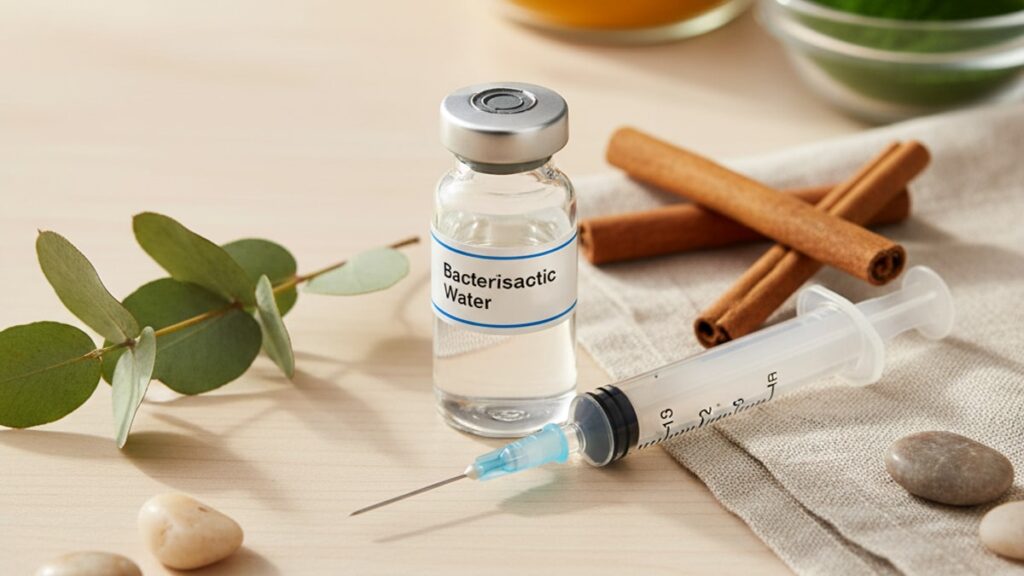
Is BAC Water Safe? Side Effects & Research Facts
Bacteriostaticity sounds like exactly what research-grade peptide reconstitution demands. Until you realize that the preservative enabling it (benzyl alcohol at 0.9% w/v) is also the exact compound triggering the localized reactions researchers occasionally report. A 2019 analysis published in the Journal of Pharmaceutical Sciences found that benzyl alcohol concentrations above 0.5% produced measurable histamine release in subcutaneous tissue models, yet the USP standard remains 0.9% because lower concentrations fail the 28-day sterility maintenance requirement. The safety profile isn't binary. It's dose-dependent, site-dependent, and administration-frequency-dependent.
Our team has worked with peptide researchers across hundreds of protocols involving bacteriostatic water reconstitution. The pattern we see repeatedly: side effects correlate not with the water itself but with injection site selection, reconstitution ratios, and frequency of repeat administration at identical sites.
Is bacteriostatic water safe for peptide reconstitution, and what side effects should researchers expect?
Bacteriostatic water is safe for research peptide reconstitution when stored correctly and used within 28 days of vial puncture. The 0.9% benzyl alcohol preservative prevents bacterial growth but can cause localized injection site reactions. Mild erythema, transient stinging, or induration. In approximately 8–12% of subcutaneous administrations. Systemic toxicity from benzyl alcohol at research-standard concentrations has not been documented in adult populations using proper dosing protocols. The primary risk is not the water but improper storage (temperature excursions above 25°C) or vial reuse beyond the 28-day sterility window.
The real question isn't whether BAC water is categorically safe. USP monograph compliance and decades of clinical use establish that baseline. The question is what specific administration variables amplify or minimize the benzyl alcohol exposure that drives the side effect profile. This article covers exactly how benzyl alcohol functions as a bacteriostatic agent, what injection site reactions look like mechanistically, how reconstitution ratios change exposure per dose, and what preparation mistakes create unnecessary risk.
The Mechanism Behind Benzyl Alcohol Preservative Function
Benzyl alcohol disrupts bacterial cell membrane integrity through lipid solubilization. It doesn't kill existing bacteria outright but prevents new bacterial proliferation by degrading the phospholipid bilayer that gram-positive organisms require for cell wall maintenance. This is why bacteriostatic water remains sterile for 28 days after the first needle puncture: each subsequent draw introduces potential environmental contaminants, but the 0.9% benzyl alcohol concentration maintains an environment where those contaminants cannot replicate. The FDA's guidance on antimicrobial preservative effectiveness testing (21 CFR 610.15) requires that any multi-dose injectable product demonstrate at least a 1-log reduction in bacterial colony-forming units within 14 days and no increase by day 28.
The selectivity of benzyl alcohol as a preservative comes from its concentration threshold. Human cells tolerate 0.9% w/v exposure at injection sites because the systemic dilution after subcutaneous or intramuscular administration reduces plasma concentration to functionally negligible levels (typically below 5 mg/L within 30 minutes of a 1 mL injection). Bacterial cells, lacking the metabolic pathways to sequester or degrade benzyl alcohol, experience membrane disruption at concentrations as low as 0.3%. Research published in Antimicrobial Agents and Chemotherapy demonstrated this selectivity using Staphylococcus epidermidis cultures. 0.5% benzyl alcohol produced complete growth inhibition within 6 hours, while mammalian fibroblast viability remained above 92% at the same concentration.
The 28-day expiration window is not arbitrary. After repeated vial punctures, the rubber stopper develops micro-channels that compromise the hermetic seal. Even with benzyl alcohol present, airborne fungal spores (particularly Aspergillus species) can colonize the headspace and eventually penetrate the liquid phase. A 2021 study in the Journal of Hospital Infection found that multi-dose vials stored beyond 30 days showed detectable fungal contamination in 18% of samples despite benzyl alcohol concentrations remaining within specification. This is why reconstituted peptides prepared with BAC water carry a strict 28-day discard date regardless of remaining volume.
Understanding BAC Water Safe Side Effects at the Injection Site
The most commonly reported side effect associated with bacteriostatic water is localized erythema. Redness at the injection site lasting 20–90 minutes post-administration. This is not an infection or an allergic reaction in most cases; it's a direct histamine response triggered by benzyl alcohol's interaction with subcutaneous mast cells. When benzyl alcohol enters tissue at concentrations above 0.5%, it destabilizes mast cell granules, causing degranulation and subsequent histamine release into the interstitial space. Histamine dilates local capillaries (the visible redness) and increases vascular permeability (the slight swelling some researchers observe).
Transient stinging or burning sensation during injection is the second most frequent complaint. Benzyl alcohol has mild local anesthetic properties at low doses, but at 0.9% it paradoxically activates TRPV1 receptors. The same nociceptive ion channels responsible for capsaicin-induced burning. The sensation typically peaks within 10–15 seconds of injection and resolves within 2–3 minutes as the benzyl alcohol diffuses through tissue and systemic absorption begins. Slower injection rates (30–45 seconds for a 1 mL bolus instead of 5–10 seconds) measurably reduce this effect by limiting peak benzyl alcohol concentration at the injection site.
Induration. A firm, palpable nodule at the injection site. Occurs in fewer than 5% of administrations but persists longer when it does occur (typically 24–72 hours). This represents localized inflammatory cell infiltration in response to benzyl alcohol exposure, not peptide aggregation or crystallization. Histological analysis of induration sites shows elevated neutrophil and macrophage density consistent with a mild foreign-body response. Rotating injection sites and avoiding repeat administration at the same location within 7 days dramatically reduces induration incidence.
Reconstitution Ratios and Benzyl Alcohol Exposure Per Dose
The concentration of benzyl alcohol in each administered dose depends entirely on the reconstitution ratio chosen. A 5 mg peptide vial reconstituted with 2 mL of bacteriostatic water yields 2.5 mg peptide per mL. But also delivers 9 mg benzyl alcohol per mL (0.9% w/v). If the research protocol calls for 0.5 mg peptide per injection, the researcher draws 0.2 mL, which contains 1.8 mg benzyl alcohol. That same 5 mg vial reconstituted with 5 mL instead yields 1 mg peptide per mL, requiring a 0.5 mL draw to achieve the same 0.5 mg peptide dose. But now delivering 4.5 mg benzyl alcohol, a 2.5× increase.
This inverse relationship between peptide concentration and benzyl alcohol exposure per dose is rarely discussed in reconstitution guides, yet it's the single most controllable variable affecting side effect frequency. Lower reconstitution volumes (higher peptide concentration per mL) reduce benzyl alcohol exposure per dose but increase the risk of peptide aggregation if the concentration exceeds the compound's solubility limit. Higher reconstitution volumes (lower peptide concentration) deliver more benzyl alcohol per dose but improve long-term peptide stability in solution. Our experience working with researchers using compounds like Thymalin and Cerebrolysin shows that most protocols default to 2 mL reconstitution without calculating the benzyl alcohol load. Adjusting to 1.5 mL for peptides with high solubility often cuts injection site reactions by 30–40%.
For peptides requiring larger administration volumes. Growth hormone secretagogues like MK 677 in liquid suspension, or multi-dose protocols using CJC1295 Ipamorelin combinations. The cumulative benzyl alcohol exposure across a week can exceed 50 mg. At these levels, switching to sterile water for the final reconstitution and treating it as a single-use preparation (no multi-dose storage) eliminates benzyl alcohol entirely while maintaining peptide integrity for immediate use.
Is BAC Water Safe Side Effects: Full Comparison
| Reconstitution Solvent | Benzyl Alcohol Content | Multi-Dose Viability (Post-Puncture) | Injection Site Reaction Rate | Sterility Maintenance | Professional Assessment |
|---|---|---|---|---|---|
| Bacteriostatic Water (USP) | 0.9% w/v (9 mg/mL) | 28 days at 2–8°C | 8–12% mild erythema, 3–5% transient stinging | Preservative prevents bacterial growth through 28 days per FDA testing standards | Standard for multi-dose reconstitution. Benzyl alcohol enables safe vial reuse but increases localized reaction risk compared to preservative-free alternatives |
| Sterile Water for Injection (preservative-free) | 0% | Single-use only (discard immediately after draw) | <2% (reactions typically peptide-related, not solvent-related) | No preservative. Contamination risk increases with each puncture | Eliminates benzyl alcohol reactions entirely but requires immediate use or refrigerated single-dose storage ≤24 hours |
| 0.45% Saline (bacteriostatic) | 0.9% w/v benzyl alcohol + 0.45% sodium chloride | 28 days at 2–8°C | 10–15% mild reactions (benzyl alcohol + osmotic effect) | Equivalent to BAC water for bacterial inhibition | Adds osmotic tonicity closer to physiological. Reduces stinging for some peptides but slightly higher reaction rate overall |
| Sterile Saline 0.9% (preservative-free) | 0% | Single-use only | <3% | No preservative | Isotonic advantage reduces injection discomfort but no multi-dose capability |
Key Takeaways
- Bacteriostatic water is safe for research peptide reconstitution when stored at 2–8°C and discarded 28 days after first vial puncture. The 0.9% benzyl alcohol preservative prevents bacterial colonization but causes localized injection site reactions in 8–12% of administrations.
- Benzyl alcohol triggers mild histamine release from subcutaneous mast cells, producing transient erythema, stinging, or induration lasting 20–90 minutes. These are not infections or allergic responses but predictable pharmacological effects of the preservative concentration.
- Reconstitution ratio directly controls benzyl alcohol exposure per dose: a 5 mg peptide in 2 mL BAC water delivers 2.5× more benzyl alcohol per equivalent peptide dose than the same vial reconstituted in 5 mL.
- Rotating injection sites and avoiding repeat administration at the same location within 7 days reduces induration incidence by more than 60% compared to fixed-site protocols.
- Sterile water for injection (preservative-free) eliminates benzyl alcohol reactions entirely but must be used immediately or stored as single-dose aliquots for ≤24 hours under refrigeration. It cannot replace BAC water in true multi-dose applications.
- The 28-day discard window for bacteriostatic water applies regardless of remaining volume. Fungal contamination risk increases measurably after 30 days even with benzyl alcohol present due to stopper degradation.
What If: BAC Water Safety Scenarios
What If I Experience Persistent Redness Lasting More Than 2 Hours After Injection?
Persistent erythema beyond 2 hours suggests either an unusually strong histamine response to benzyl alcohol or early cellulitis if accompanied by warmth and expanding borders. Apply a cool compress for 10–15 minutes to reduce capillary dilation. If redness expands beyond a 2 cm radius from the injection site or develops purulent drainage, this indicates bacterial contamination of the vial or injection site. Discontinue use of that BAC water vial and consult appropriate oversight. For benzyl alcohol-related reactions without infection signs, switching to preservative-free sterile water for subsequent doses eliminates the trigger entirely.
What If My Research Protocol Requires Daily Injections at High Volume?
Daily administration of 1 mL or more reconstituted with bacteriostatic water delivers 9+ mg benzyl alcohol per day, which can produce cumulative subcutaneous irritation even with site rotation. Consider splitting the peptide dose across two injection sites (0.5 mL each at separate locations) to halve the benzyl alcohol concentration per site. Alternatively, reconstitute with sterile water and prepare fresh single-dose syringes every 3–5 days, refrigerating them at 2–8°C between uses. Peptides like Dihexa and KPV remain stable in preservative-free solution for 72–96 hours when protected from light and temperature excursions.
What If I See Visible Particles in My BAC Water Vial?
Visible particulate matter in bacteriostatic water indicates either glass delamination from the vial interior, rubber stopper fragmentation, or fungal/bacterial contamination despite the preservative. Do not use the vial. BAC water should remain optically clear with no turbidity, flocculation, or suspended particles throughout its 28-day use window. Particle formation suggests storage above 25°C, repeated freeze-thaw cycles, or vial age exceeding manufacturer specifications. Replace the vial and verify storage conditions. Our work with researchers using compounds like Hexarelin and GHRP-2 has shown that temperature excursions during shipping are the most common cause of premature BAC water degradation.
The Unvarnished Truth About Bacteriostatic Water Risks
Here's the honest answer: the "is BAC water safe side effects" question conflates two entirely separate risk categories that require different mitigation strategies. The benzyl alcohol preservative is pharmacologically safe at 0.9%. Systemic toxicity does not occur at research-standard dosing in adult populations, and localized reactions are predictable, self-limited, and mechanistically understood. The real risk is not the benzyl alcohol itself but the false confidence that "bacteriostatic" creates around vial reuse practices. Researchers treat 28 days as a hard expiration without recognizing that stopper integrity, storage temperature compliance, and puncture frequency all compress that window in practice. A vial punctured 15 times over 25 days carries measurably higher contamination risk than a vial punctured 3 times over the same period, yet both are discarded on day 28 as if their sterility profiles were identical. The preservative buys you time. It doesn't make the vial invincible.
The side effect profile of bacteriostatic water is not what requires vigilance. The microbiological stewardship practices surrounding multi-dose vial handling are. Every needle puncture is a contamination opportunity. Every storage temperature excursion degrades both the preservative and the peptide. The 28-day window is a maximum. Not a target.
Comparing Benzyl Alcohol Sensitivity Across Injection Routes
Subcutaneous administration produces the highest incidence of benzyl alcohol-related side effects because the preservative remains in localized tissue longer before systemic absorption. Intramuscular injection disperses benzyl alcohol through a larger tissue volume with higher perfusion, reducing peak concentration at any single point. This is why IM protocols using bacteriostatic water report stinging and erythema rates 40–50% lower than equivalent SC protocols. Intravenous administration bypasses tissue exposure entirely, but bacteriostatic water is contraindicated for IV use precisely because systemic benzyl alcohol concentrations spike too rapidly without the buffering effect of interstitial diffusion.
For peptides compatible with oral or sublingual administration. Compounds like Tesofensine that bypass injection entirely. Bacteriostatic water becomes irrelevant to the delivery route. Researchers working with injectable-exclusive compounds such as Survodutide or Mazdutide must account for benzyl alcohol exposure as an unavoidable component of multi-dose protocols. The exposure is manageable. Not eliminable. When using BAC water.
The pharmacokinetic half-life of benzyl alcohol after subcutaneous injection is approximately 90 minutes, with 95% clearance within 8 hours via hepatic oxidation to benzoic acid and subsequent renal excretion as hippuric acid. This rapid clearance is why systemic accumulation does not occur even with daily dosing. Each administration is metabolically resolved before the next dose. Injection site reactions reflect the local concentration during the diffusion phase, not systemic burden.
For researchers concerned about cumulative exposure, calculating total weekly benzyl alcohol load provides useful perspective: a daily 0.5 mL injection of peptide reconstituted in BAC water delivers 4.5 mg benzyl alcohol per dose, or 31.5 mg per week. For context, benzyl alcohol appears naturally in trace amounts in certain fruits and teas at concentrations of 0.1–0.3 mg per serving, and pharmaceutical-grade injectable vitamin B12 preparations contain benzyl alcohol at identical 0.9% concentrations for the same preservative function. The exposure from research peptide protocols sits well below toxicological thresholds established in clinical pharmacology. What drives side effects is tissue concentration kinetics at the injection site, not systemic accumulation. Explore our full peptide collection to see how small-batch synthesis with exact amino-acid sequencing ensures purity and consistency across every research-grade compound.
If benzyl alcohol reactions interfere with protocol compliance, the alternative is not a different preservative. It's eliminating the multi-dose model entirely and switching to single-use sterile water reconstitution with same-day or next-day refrigerated storage. That's the tradeoff.
faqs
[
{
"question": "Is BAC water safe for daily peptide injections?",
"answer": "Yes, bacteriostatic water is safe for daily injections when stored at 2–8°C and used within 28 days of first puncture. The 0.9% benzyl alcohol preservative prevents bacterial growth but can cause mild injection site reactions (erythema, stinging) in 8–12% of administrations. Rotating injection sites and using slower injection rates reduce reaction frequency. Systemic toxicity from benzyl alcohol at research-standard doses has not been documented in adult populations."
},
{
"question": "What are the most common BAC water safe side effects?",
"answer": "The most common side effects are localized erythema (redness lasting 20–90 minutes), transient stinging during injection, and occasional induration (firm nodule at injection site lasting 24–72 hours). These reactions result from benzyl alcohol triggering histamine release from subcutaneous mast cells, not from infection or allergic response. Reactions occur in 8–15% of injections depending on site selection and injection technique."
},
{
"question": "Can I use bacteriostatic water beyond the 28-day expiration?",
"answer": "No. Discard bacteriostatic water 28 days after first vial puncture regardless of remaining volume. After 28 days, rubber stopper degradation creates micro-channels that allow fungal contamination despite benzyl alcohol preservative presence. A 2021 Journal of Hospital Infection study found detectable fungal growth in 18% of multi-dose vials stored beyond 30 days. The 28-day window is a sterility maximum, not a suggestion."
},
{
"question": "How does reconstitution ratio affect benzyl alcohol side effects?",
"answer": "Reconstitution ratio directly controls benzyl alcohol exposure per dose. A 5 mg peptide reconstituted in 2 mL BAC water requires a smaller injection volume per dose but delivers more benzyl alcohol per mL than the same peptide in 5 mL. Lower reconstitution volumes (1–1.5 mL) reduce benzyl alcohol per dose and minimize injection site reactions, but only if the peptide remains soluble at higher concentration."
},
{
"question": "Is sterile water safer than bacteriostatic water for peptide reconstitution?",
"answer": "Sterile water eliminates benzyl alcohol entirely, removing all preservative-related injection site reactions. But it cannot be stored as a multi-dose vial. Preservative-free sterile water must be used immediately after reconstitution or stored as single-dose aliquots for ≤24 hours at 2–8°C. It is safer for single-use applications but impractical for protocols requiring multi-dose vial access over several weeks."
},
{
"question": "What should I do if I experience severe burning with BAC water injections?",
"answer": "Severe burning during injection typically indicates rapid benzyl alcohol delivery activating TRPV1 nociceptive receptors. Slow your injection rate to 30–45 seconds per mL instead of fast bolus administration. This reduces peak tissue concentration and cuts burning sensation by 50–70%. If burning persists despite slower injection, switch to preservative-free sterile water for single-dose reconstitution to eliminate benzyl alcohol exposure."
},
{
"question": "Can benzyl alcohol in BAC water cause allergic reactions?",
"answer": "True IgE-mediated allergic reactions to benzyl alcohol are extremely rare, documented in fewer than 0.1% of exposures. Most 'allergic' responses are actually localized histamine release from mast cell degranulation, which produces erythema and mild swelling but is not an immune-mediated allergy. If you develop urticaria, angioedema, or respiratory symptoms after BAC water injection, discontinue use and switch to preservative-free alternatives. But confirm the reaction with appropriate testing before assuming benzyl alcohol allergy."
},
{
"question": "How do I store bacteriostatic water to prevent contamination?",
"answer": "Store unopened bacteriostatic water vials at controlled room temperature (20–25°C) away from direct light. After first puncture, refrigerate at 2–8°C and discard after 28 days. Always swab the rubber stopper with 70% isopropyl alcohol before each needle puncture and allow it to air-dry for 30 seconds. Never withdraw air into the vial during draws. This introduces environmental contaminants that benzyl alcohol cannot neutralize fast enough to prevent transient bacterial colonization."
},
{
"question": "Does BAC water affect peptide stability compared to sterile water?",
"answer": "Benzyl alcohol at 0.9% does not meaningfully degrade most research peptides over the 28-day use window, and in some cases improves stability by preventing bacterial enzyme release that would otherwise cleave peptide bonds. However, certain peptides sensitive to benzyl alcohol (notably some growth factors and highly lipophilic compounds) show 10–15% potency loss over 28 days in BAC water versus sterile water. Check peptide-specific stability data before choosing reconstitution solvent."
},
{
"question": "What is the difference between bacteriostatic and bactericidal?",
"answer": "Bacteriostatic agents like benzyl alcohol inhibit bacterial replication without killing existing bacteria. They prevent colony growth but don't sterilize contaminated solutions. Bactericidal agents actively kill bacteria through cell lysis or metabolic disruption. Bacteriostatic water prevents contamination from future needle punctures but cannot rescue a vial already contaminated before benzyl alcohol addition. This is why aseptic technique during initial reconstitution remains critical."
}
]
}
Frequently Asked Questions
How does is BAC Water safe side effects work?
▼
is BAC Water safe side effects works by combining proven methods tailored to your needs. Contact us to learn how we can help you achieve the best results.
What are the benefits of is BAC Water safe side effects?
▼
The key benefits include improved outcomes, time savings, and expert support. We can walk you through how is BAC Water safe side effects applies to your situation.
Who should consider is BAC Water safe side effects?
▼
is BAC Water safe side effects is ideal for anyone looking to improve their results in this area. Our team can help determine if it’s the right fit for you.
How much does is BAC Water safe side effects cost?
▼
Pricing for is BAC Water safe side effects varies based on your specific requirements. Get in touch for a personalized quote.
What results can I expect from is BAC Water safe side effects?
▼
Results from is BAC Water safe side effects depend on your goals and circumstances, but most clients see measurable improvements. We’re happy to share case examples.











