





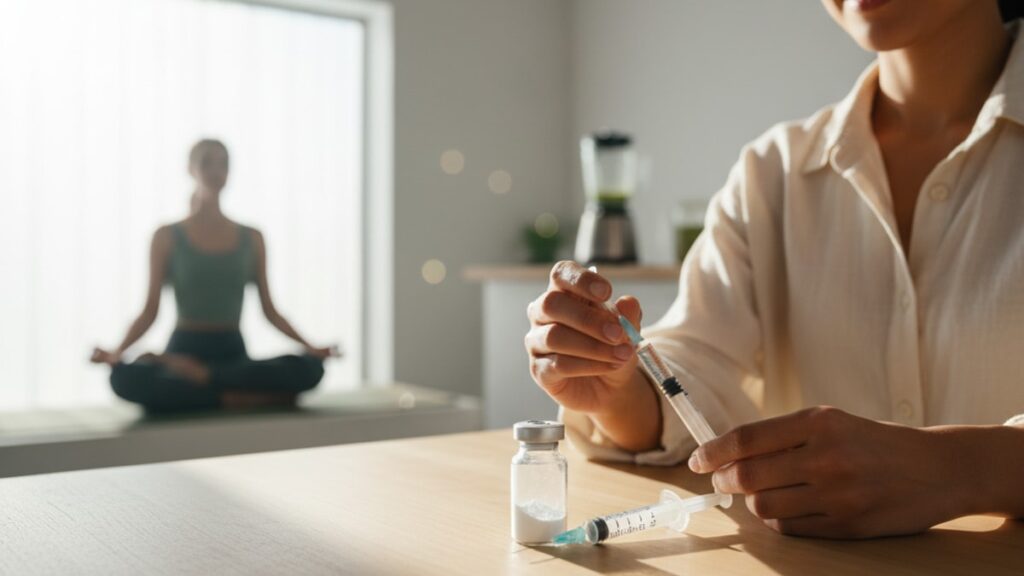
You've made a significant investment in your research. You’ve selected a peptide with enormous potential, a compound that could unlock new understandings in immunology and cellular function. The vial of lyophilized Thymosin Alpha 1 Peptide sitting on your lab bench represents countless hours of planning and hypothesis. But here's a truth our team has seen play out time and again: all of that potential can be compromised in the first five minutes if the reconstitution process isn't handled with absolute precision.
It sounds simple, right? Just add water. But it's so much more nuanced than that. The process of bringing a freeze-dried peptide back into a stable, liquid state is a critical, often underestimated, step in any successful research project. It’s the bridge between a pure, stable compound and a viable solution ready for your experimental model. Get it wrong, and you're not just wasting product; you're invalidating your data before you even begin. At Real Peptides, our focus isn't just on providing impeccably pure, U.S.-made peptides; it's on ensuring you have the knowledge to use them effectively. We believe that an unflinching commitment to quality extends beyond our synthesis lab and all the way to your benchtop.
Why Meticulous Reconstitution Is Non-Negotiable
Let’s be honest, this is crucial. Lyophilization, or freeze-drying, is a fantastic process for preserving the delicate structure of peptides like Thymosin Alpha 1 for transport and storage. It removes water under low pressure and temperature, leaving the peptide as a stable, powdery cake. However, that delicate structure—a specific chain of 28 amino acids folded in a precise way—is also its greatest vulnerability. When you reintroduce a liquid, you're not just dissolving a powder; you're asking that intricate molecular architecture to relax back into its biologically active form without breaking.
Improper technique can be catastrophic. Vigorously shaking the vial, using the wrong diluent, or injecting the liquid with too much force can cause mechanical stress. This stress can shear the peptide chains, leading to aggregation (clumping) or denaturation (unfolding). Think of it like trying to untangle a delicate necklace by yanking on it. You'll just create a useless knot. A denatured peptide is, for all intents and purposes, a different molecule. It won't bind to its target receptors correctly, and the results of your study will be unreliable, if not completely meaningless.
This is why we can't stress this enough: the goal isn't just to get the powder into a solution. The goal is to do so while preserving 100% of the peptide's structural integrity and biological activity. It's a game of finesse, not force. Every step, from the temperature of your diluent to the angle of your needle, matters immensely. Our experience shows that researchers who master this fundamental process see far more consistent and reproducible results in their work. It's the bedrock of good science.
Assembling Your Toolkit: Essential Supplies
Before you even think about opening that vial, you need to have the right tools laid out on a clean, organized surface. Working in a sterile field is paramount to prevent contamination that could interfere with your experiment. Scrambling for a forgotten item mid-process is how mistakes happen.
Here’s what our team recommends you have ready:
- Your Vial of Lyophilized Thymosin Alpha 1: The star of the show. At Real Peptides, we ensure every vial contains the precise amount of high-purity peptide advertised. This accuracy is foundational for correct dosing calculations.
- Diluent: This is the sterile liquid you'll use for reconstitution. The choice of diluent is critical and depends on your research needs. For most applications involving Thymosin Alpha 1, the gold standard is Bacteriostatic Water. It's sterile water that contains 0.9% benzyl alcohol, which acts as a preservative to inhibit bacterial growth after repeated withdrawals from the vial. This is especially important for multi-use vials.
- Sterile Syringe: You'll need at least one sterile syringe for drawing and injecting the diluent. An insulin syringe (typically 1mL, 0.5mL, or 0.3mL) marked in IU or mL is perfect for this, as it allows for precise measurement.
- Alcohol Prep Pads: You'll need several. These are for sterilizing the rubber stoppers on both your peptide vial and your diluent vial to prevent introducing contaminants.
Here's a quick comparison of common diluents. For a sensitive peptide like Thymosin Alpha 1, the choice is clear.
| Diluent Type | Key Component | Primary Use/Benefit | Our Recommendation for TA1 |
|---|---|---|---|
| Bacteriostatic Water | 0.9% Benzyl Alcohol | Ideal for multi-use vials. The preservative inhibits bacterial growth. Extends shelf-life. | Highly Recommended |
| Sterile Water | Pure H2O | For single-use applications only. Contains no preservative, so it's prone to contamination. | Use with extreme caution |
| 0.9% Sodium Chloride | Saline Solution | Sometimes used, but can cause peptide aggregation in certain compounds. Not ideal. | Not Recommended |
| Acetic Acid Solution | Diluted Acetic Acid | Only for specific peptides that require an acidic pH for solubility. TA1 does not. | Do Not Use |
Ultimately, bacteriostatic water provides the best balance of safety, stability, and longevity for your reconstituted solution. It's what we use in our own quality control processes.
The Reconstitution Protocol: A Step-by-Step Breakdown
Alright, you've got your supplies, and you understand the stakes. Now, let's walk through the exact process our team uses. Follow these steps methodically, and you'll set your research up for success. We're aiming for a final solution that is clear, properly concentrated, and biologically active.
Step 1: Preparation and Sanitization
First things first: prepare your workspace. This should be a clean, draft-free area. Wipe down the surface with a disinfectant. Wash your hands thoroughly. Pop the plastic caps off both your Thymosin Alpha 1 vial and your bacteriostatic water vial. Use a fresh alcohol prep pad to vigorously wipe the rubber stopper of each vial. Let them air dry for about 30-60 seconds. Don't blow on them or wave them around—that just introduces contaminants.
Step 2: Calculating the Correct Diluent Volume
This is where precision really starts to count. You need to decide on your desired final concentration. A common and easy-to-work-with concentration is 1mg per 1mL (or 1000mcg/mL). Let's say you have a 10mg vial of Thymosin Alpha 1.
The math is straightforward:
(Total Peptide in Vial (mg)) / (Desired Concentration (mg/mL)) = Total Diluent to Add (mL)
So, for our example:
(10mg) / (1mg/mL) = 10mL of bacteriostatic water
If you wanted a higher concentration, say 2mg/mL:
(10mg) / (2mg/mL) = 5mL of bacteriostatic water
It's absolutely essential to get this calculation right, as it dictates the dosage for your entire experiment. Double-check your math before you draw any liquid.
Step 3: Drawing the Diluent
Uncap your sterile syringe. Pull the plunger back to the mark that corresponds to the volume of bacteriostatic water you just calculated. This pre-fills the syringe with air. Now, insert the needle through the sanitized rubber stopper of the bacteriostatic water vial. Invert the vial and inject the air into it. This pressurizes the vial and makes drawing the liquid much easier. Now, slowly pull the plunger back, drawing your exact calculated volume of water into the syringe. Check for any large air bubbles. If you see some, you can gently flick the syringe barrel to make them rise to the top and then carefully push the plunger to expel them.
Step 4: Injecting the Diluent (The Critical Step)
This is the moment of truth. Take your syringe filled with bacteriostatic water and carefully insert the needle through the center of the rubber stopper on your Thymosin Alpha 1 vial. Here's the most important part of the entire process: do not inject the water directly onto the lyophilized powder. This forceful stream can damage the peptide.
Instead, angle the needle so that the tip is touching the inside glass wall of the vial. Slowly, and I mean slowly, depress the plunger. Let the water run gently down the side of the glass. This allows the powder to dissolve gradually and without mechanical shock. Once all the water is in the vial, carefully withdraw the needle.
Step 5: Gentle Mixing
We cannot say this loudly enough: DO NOT SHAKE THE VIAL. Shaking creates froth and introduces that destructive mechanical shear we talked about. It's the fastest way to ruin your peptide. Instead, you'll want to gently mix the solution. You can do this in two ways:
- Swirling: Hold the vial upright and gently swirl it in a slow, circular motion. Watch as the powder dissolves into the water.
- Rolling: Gently roll the vial back and forth between your palms.
Continue this gentle mixing until the lyophilized cake is completely dissolved and the solution is perfectly clear. This may take a few minutes. Be patient. Patience here pays dividends in data quality later.
Step 6: Visual Inspection
The final step before storage is a quick quality check. Hold the vial up to a light source. The solution should be completely clear, with no cloudiness, floaters, or undissolved particles. If it's anything but crystal clear, it may indicate a problem with either the peptide or the reconstitution process. A high-purity product like ours should dissolve completely, leaving a transparent solution.
Common Pitfalls and How to Sidestep Them
Over the years, we've consulted with countless research teams, and we've seen a few common mistakes trip people up. Knowing what they are is half the battle.
- The Vial Shake: We've mentioned it three times, so let's make it four. It's the most common and most damaging mistake. The impulse to shake a vial to mix it is strong, but you must resist. Always roll or swirl.
- Using Tap Water or Sterile Water for a Multi-Use Vial: Never, ever use tap water. It's full of impurities and isn't sterile. Using sterile water is only acceptable for immediate, single-use applications. If you plan to draw from the vial more than once, you absolutely must use bacteriostatic water to prevent dangerous bacterial growth.
- Incorrect Calculations: Rushing the math is a recipe for disaster. An incorrect concentration throws off all subsequent dosing. We've seen researchers off by a factor of 10, completely invalidating their work. Write it down, use a calculator, and have a colleague check it. It takes an extra minute and can save a month's worth of research.
- Ignoring Temperature: Reconstituting with room-temperature diluent is fine. However, allowing the lyophilized peptide to sit out at room temperature for extended periods before reconstitution is not ideal. Similarly, once reconstituted, immediate and proper refrigeration is non-negotiable.
Avoiding these simple errors is foundational. It ensures that the high-quality peptide you purchased remains high-quality when you use it. When you start with a product from our full peptide collection, you're starting with guaranteed purity; your handling procedure is what preserves it.
Storage and Handling of Your Reconstituted Peptide
So, you've successfully reconstituted your Thymosin Alpha 1. Fantastic. Now you have to store it correctly to maintain its potency for the duration of your study.
Reconstituted peptides are sensitive to two main things: temperature and light. The benzyl alcohol in the bacteriostatic water will prevent bacterial growth, but it won't stop the peptide itself from slowly degrading if stored improperly.
The rule is simple: refrigerate immediately. The ideal temperature range is between 2°C and 8°C (36°F and 46°F). Your standard lab or kitchen refrigerator is perfect for this. Do not store it in the refrigerator door, where the temperature fluctuates the most. Place it in the main body of the fridge.
Never, ever freeze reconstituted Thymosin Alpha 1. The freeze-thaw cycle can be just as damaging as shaking it, causing the peptide chains to fracture and aggregate. Lyophilization is a highly controlled, specific type of freezing; simply sticking it in a standard freezer is not the same and will destroy the product.
Also, keep the vial in its original box or another light-blocking container to protect it from light degradation. When properly reconstituted with bacteriostatic water and stored in the refrigerator, Thymosin Alpha 1 should remain stable and potent for your research for several weeks.
The Real Peptides Difference: Purity from the Start
We've dedicated this entire discussion to proper handling because we believe in the integrity of the research process from beginning to end. It all starts with the quality of the raw material. At Real Peptides, our entire operation is rooted in an uncompromising standard of purity and precision. All our peptides, including our flagship Thymosin Alpha 1 Peptide, are synthesized right here in the United States through a meticulous small-batch process.
This isn't just a talking point; it's a fundamental difference. Small-batch synthesis allows for an unparalleled level of quality control. We can ensure the exact amino-acid sequencing is perfect and that the final lyophilized product is free from contaminants and byproducts that plague mass-produced alternatives. When you receive a vial from us, you know you're getting a product with verified purity, which means your reconstitution will be smoother and your experimental results will be more reliable. It's that simple.
We know that seeing is believing. For visual learners who want to dive deeper into peptide science and other lab techniques, the content on our affiliated YouTube channel can provide additional context and demonstrations that bring these concepts to life. Our goal is to be a resource for the entire research community. When you're ready to build your next study on a foundation of verifiable quality, we invite you to explore our offerings and Get Started Today.
Ultimately, the care you put into reconstituting your peptide is a direct reflection of the care you put into your research. It's a small step that has a massive impact on the validity and integrity of your work. By following this protocol, you're not just mixing a solution; you're honoring the scientific process and giving your project the best possible chance of success.
Frequently Asked Questions
Can I use sterile water instead of bacteriostatic water for Thymosin Alpha 1?
▼
You can, but only if you plan to use the entire vial in a single application immediately after reconstitution. For multi-use vials, we strongly recommend using bacteriostatic water, as its preservative prevents bacterial growth and maintains sterility.
What does ‘lyophilized’ actually mean?
▼
Lyophilization is a sophisticated freeze-drying process used to preserve delicate biological materials like peptides. It involves freezing the substance and then reducing the surrounding pressure to allow the frozen water to sublimate directly from a solid to a gas, keeping the peptide’s structure intact.
How can I tell if my reconstituted peptide has degraded?
▼
Visual signs of degradation include cloudiness, discoloration, or the presence of floating particles in the solution after it should be fully dissolved. A properly reconstituted, high-purity peptide solution should be perfectly clear.
You mentioned it a lot, but why exactly shouldn’t I shake the vial?
▼
Shaking introduces intense mechanical stress and friction into the solution. This force can physically break the fragile peptide bonds or cause the molecules to unfold and clump together (denaturation), rendering the peptide biologically inactive.
What is the ideal storage temperature for reconstituted Thymosin Alpha 1?
▼
The ideal temperature is standard refrigeration, between 2°C and 8°C (36°F and 46°F). Never freeze the reconstituted solution, as the freeze-thaw cycle can damage the peptide.
How long is reconstituted Thymosin Alpha 1 stable in the fridge?
▼
When reconstituted with bacteriostatic water and stored correctly in the refrigerator, Thymosin Alpha 1 is generally considered stable for research purposes for up to 30 days. For maximum potency, using it sooner is always better.
Is it okay to pre-load syringes for later use?
▼
Our team generally advises against pre-loading syringes for long-term storage. There is a higher risk of contamination, and some plastics in syringes can interact with the peptide solution over time. It’s best practice to draw the required dose from the vial right before application.
What if I see particles in the solution even after gentle mixing?
▼
If you’ve followed the protocol correctly and still see particles, it could indicate an issue with solubility or product purity. A high-quality peptide should dissolve completely. We recommend ceasing use and contacting your supplier.
Can I mix two different peptides in the same syringe?
▼
We strongly advise against this unless a specific research protocol calls for it and confirms their chemical compatibility. Mixing different peptides can lead to unpredictable reactions, degradation, or changes in pH that could compromise both compounds.
Does it matter if I let the vial warm to room temperature before reconstituting?
▼
Yes, it’s actually good practice. Allowing the cold lyophilized vial to sit at room temperature for about 10-15 minutes before adding the diluent can reduce condensation and ensure a smoother reconstitution process.
How do I properly dispose of used syringes and vials?
▼
All used syringes, needles, and vials should be disposed of in a designated sharps container according to your local and institutional biohazard waste regulations. Never throw them in the regular trash.











